


Red Bull modifies F1 engine cover to add cooling for Mexican GP
Red Bull has modified its engine cover for Formula 1's 2019 Mexican Grand Prix to cope with the increased cooling demands from the conditions at the Autodromo Hermanos Rodriguez

Due to Mexico City's high altitude - approximately 2.25km (1.4 miles) above sea level - the change in air density creates a number of problems for F1 engineers.
The density of air is reduced by around 0.3kg/m3 compared to that at sea level, which means that the mass of air entering the cooling inlets on F1 cars is also smaller.
As a result, engines run at hotter temperatures, and Red Bull has therefore opted to open up an extra pair of outlets at the rear of the engine cover to compensate.
In the current turbo-hybrid era in Mexico, the compressor also has to work harder to provide the internal combustion engine with a greater percentage of oxygen to improve the overall efficiency.
This means that while engine power is not affected too heavily, the increased heat around the engine components does necessitate larger cooling inlets and outlets.
Red Bull's extra outlets are part of the engine cover cut-outs used for its rear suspension wishbones, but these have been flared out to draw more heat from the car.
The reduced air density in Mexico also influences aerodynamics, and each car will run at its maximum-downforce specification to offset the 'thinner' air.
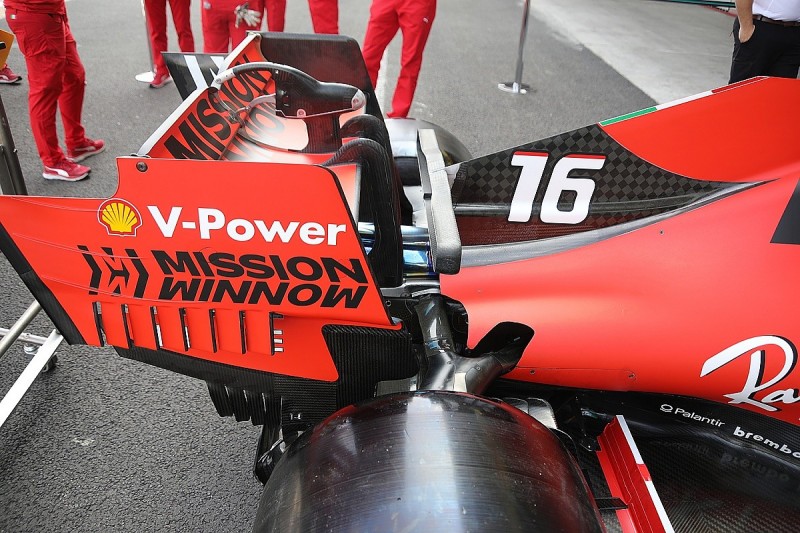
It is believed that despite this the overall downforce output is less than at Monza, where the cars run skinny wings to capture the maximum speed available from the straights.
The Mexican Grand Prix regularly has the highest top speeds of the season as a result, and in 2018 Esteban Ocon clocked in at 364.9km/h in the speed trap - 2.4km/h higher than at Monza.
Giorgio Piola's image above shows Ferrari's rear wing for the Mexican race this weekend, which is noticeably deeper to create as much rear-end downforce as possible.
The mainplane has been straightened at the outboard sections, as the aerodynamicists do not need to compromise on drag for this circuit.
Share Or Save This Story


Leclerc and Hamilton's differing theories behind Ferrari's Austin qualifying disappointment

What we learned from Friday practice at the 2026 United States GP

The reasons behind Ferrari's US GP upgrades


How both Verstappen and Antonelli were “surprised” in United States GP qualifying

Red Bull no longer falls away on difficult days: What Austin qualifying reveals about its progress

Verstappen responds to COTA boss and proposes drastic measures to tackle bumps

F1 United States GP: Antonelli dominates from pole - but forced to wait for title

Pryce pips McRae in final stage showdown to win British Rally Championship

Dakar Rally moves 2027 event out of Saudi Arabia; new location to be announced

F1 United States GP live commentary and updates - Antonelli wins at COTA
Subscribe and access Autosport.com with your ad-blocker.
From Formula 1 to MotoGP we report straight from the paddock because we love our sport, just like you. In order to keep delivering our expert journalism, our website uses advertising. Still, we want to give you the opportunity to enjoy an ad-free and tracker-free website and to continue using your adblocker.


Top Comments