


The humble origin story of a MotoGP powerhouse
With Aprilia fighting for the MotoGP world title, it's worth remembering that a breakthrough premier class crown would be its 20th in grand prix racing. From 1992 to 2011, the Noale marque scored numerous 250cc and 125cc titles, with the likes of Max Biaggi and Valentino Rossi leaving their mark. Here's the story of how that empire was built
Autosport Retro
Telling the forgotten stories and unearthing the hidden gems from years gone by.
In a dull world, the beginning of Aprilia's story in world championship road racing would involve owner Ivano Beggio coming up with the idea to branch out from the company's off-road and endurance efforts, a bog-standard due diligence process and then a green light to unleash the project.
The reality, as was so often the case in the 1980s, is much more fun. The marque's grand prix debut at Kyalami in 1985 can be tracked to a dud Kawasaki and a Tuscan Aprilia dealer armed with a visionary pamphlet.
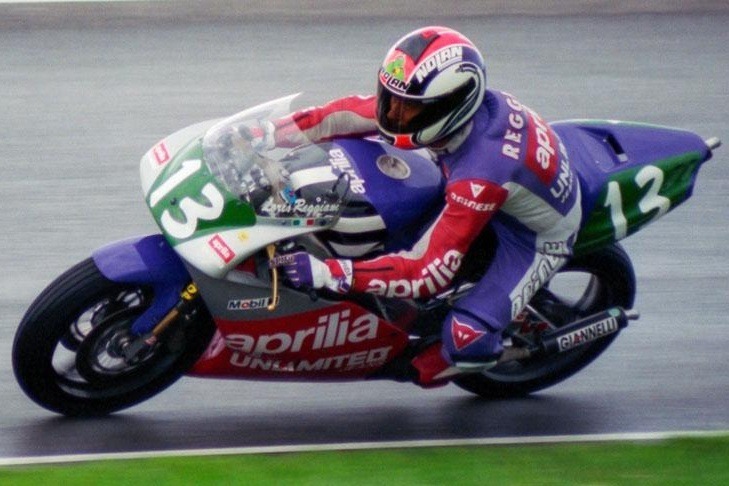
Loris Reggiani, the man who rode the bike in South Africa and turned a few heads as that 250cc season went on, recalls how his career as a motorcycle racer had arrived at a turning point after battling through 1984 as a hands-on Kawasaki privateer.
"I had a very bad season with an old 250cc Kawasaki," he tells Autosport in a video call from his home in Italy. "I had spent all the money I had. No teams were looking for me. So my idea was to stop racing and start going to work."
Enter a second pivotal figure in the genesis story: Florence-based Aprilia dealer Michele Verrini. Having worked with Reggiani when managing the 125cc Minarelli team a few years earlier, Verrini believed in the rider from Forli. He had, after all, won the British GP for the squad back in 1980.
"Verrini was the man who invented the idea of Aprilia in road racing," declares Reggiani, now 67 but then still in his twenties. "When I told him about my idea to stop racing, he said, 'No way, you have to go on, because you have enough talent to go on! I will think of something for you. He was one of the biggest Aprilia dealers in Italy. He knew Beggio, of course, and he thought he could try to convince Beggio to move from off-road to road racing. First, though, he went to a designer friend and made up three or four pages, telling a story about going 250cc racing with Aprilia colours."
The thrust of that yet-fictional leaflet was that Reggiani and his small crew could make a competitive 250 road racing machine - if only Aprilia would back the project.
"The amount of money requested was very low, just the minimum to make a bike," adds Reggiani. "At that time it was almost easy to make a bike in the world championship. There were many small factories doing it. But I thought it was a crazy idea. I said he could go to Aprilia if he wanted, but that nothing was going to come of it."
To Reggiani's surprise, however, Beggio said 'yes' within a couple of weeks. Founded after the second world war and with some success in world championship motocross to its name, Aprilia was neither a fresh-faced company nor a stranger to competition. Its owner understood that a road racing project could lead to selling more motorcycles, and agreed to the minimal budget proposed. That conversation between Verrini and Beggio took place in the autumn of 1984. When the unexpected go-ahead came, Reggiani went straight to work. In grand amateur fashion, the first grand prix Aprilia was to be built in his garage.
Reggiani recounts: "I brought Aprilia an old Kawasaki that was working quite well, asked for a few modifications and they made the frame. They gave us three Rotax engines and we produced the bike in my house, in my workshop."

Reggiani (sat) and Verrini (far right) led Aprilia's foray into circuit racing
At a time when it was still possible for small fish to do great things with not very much money in grand prix racing, getting Aprilia's AF1 challenger onto the grid for the 1985 opener in South Africa in March proved doable. It would race under the CR1 banner, a nod to Verrini's Centro Ricambi 1 dealership. (It's still open for business after all these years, so if you fancy a Florence pilgrimage that doesn't involve sweating in a queue with wannabe art history experts, pay it a visit on the Via Cimabue.)
The hand-made bike, described in that year's Motocourse as a "very ordinary looking machine", proved a deceptively effective piece of kit. Reggiani's lone Aprilia qualified 17th out of 28 on its debut, and came home 12th. It was a solid machine that would continue to improve, but two crashes interrupted the season as the rider missed four rounds due to injury.
Nonetheless, there was already a podium to celebrate come June, at the Yugoslavian GP. By season's end, Aprilia was third in a constructors championship table that featured a whopping 14 makes. The dominant Japanese, Honda and Yamaha, were streets ahead, but Reggiani's garage project - with Verrini as its team manager - had done enough to make Noale pay closer attention. "Because of that year's results, Aprilia understood that the value to the brand was so big compared to off-road racing, considering the amount of money spent," Reggiani explains.
"I was leading, all alone, and just thinking of all those things that had [gone wrong]. So believe me, it was a never-ending race" Loris Reggiani
No wonder, then, that the following year's challenger was put together at the factory. Though Reggiani continued to run race operations from home over the next two years, and Rotax would continue to play an important role on the engine side for some time to come, it was the start of a gradual process that would culminate in pukka, factory-built-and-run 250cc Aprilias winning world titles by the mid-nineties.
First, though, came a thump down to earth in 1986. Reggiani was nearly killed in a road accident, the bike featured what he calls "a couple of big mistakes," and the year turned into a write-off. But things were more than back on track in 1987.
"Aprilia made a wonderful bike," says the man who would come to be known as 'Luckless Loris' for his many misfortunes. "We had a better engine than Yamaha and a better chassis than Honda."

Reggiani on his way to a maiden Aprilia victory at Misano
Reliability acted as a counterweight to performance, however. Mechanical fallibility was an issue that would need fixing for years to come. "The bike broke down in maybe half the races, because of really shitty things. At Hockenheim, something got into the carburettor and closed a main jet, or something like that. At Monza, I was on pole, but some small ignition pickup piece broke after three or four laps. At Brno, oil from the gearbox got onto the rear wheel... There were many times I could have won, but didn't finish the race!"
But everything finally held together for a breakthrough grand prix win in August, which back then was almost the end of the season. As luck would have it, the big day came at Misano, the home track for both team and factory. After a year of gremlins, it was a nervous ride for Reggiani. "I remember Misano very well! Now I was leading, all alone, and just thinking of all those things that had [gone wrong]. So believe me, it was a never-ending race. When they showed the chequered flag, I let out a big scream in my helmet."
Yet the floodgates stubbornly failed to open in 1988. The tandem engine was replaced with a V-twin, and Reggiani says the chassis couldn't match the powerful new unit. But his wasn't the only point of view, and relations soured as he tried to develop the package. "Aprilia thought that the problem was the rider and I thought the problem was the bike," is how Reggiani sums it up today.
Things got bad enough that Aprilia's first grand prix winner, and the man so central to its story, defected to ride a Honda for 1989. Reconciliation and return were on the cards for 1990, but by the time Reggiani got back, there had been significant changes off the track.
During the course of 1989, ex-Cagiva technical man Jan Witteveen was brought into the fold. His start with the team was a traumatic one, overshadowed by the death of factory rider Ivan Palazzese at Hockenheim, in a sickening accident that began with the Venezuelan running into the back of Andreas Preining in the stadium section.
But Witteveen, an Italian-based Dutchman, would prove to be a defining hire at Noale. Overseeing all road racing activities until his departure in 2005, Witteveen was almost synonymous with Aprilia's DNA as its success in the nineties and noughties unfolded. In 1998, Moto Sprint went so far as to describe him as 'the father of all Aprilia race bikes.'

Witteveen is considered 'the father of all Aprilia race bikes'
Photo by: Mirco Lazzari GP / Getty Images
For Witteveen, who became known for strong opinions and received an unusual amount of press for a tech boss over the years, the emphasis upon arrival was on laying proper foundations as much as sorting the unreliable bike. A decent base was essential. Racing operations had moved from Reggiani's garage into the Noale factory by then, but Witteveen says it was a long way from being a proper race shop.
"Having the racing activity within the company is a bit chaotic," the former tech boss tells Autosport in an Austrian Kaffeehaus. "Aprilia didn't have space: things weren't even next to each other, they were on top of each other! It wasn't a good solution. So we built up the racing department. Things were remodelled and, with time, slowly got better."
So seriously was the upgrade back at base taken, in fact, that Aprilia did not run a works team at all in 1990, choosing to let external crews run its four factory bikes. "The racing department was being restructured and we wanted everyone working on development. There was no manpower left for a factory team."
1990 also saw Carlo Pernat arrive to head up the sporting side of things in Noale. Pernat had been recruited from Cagiva, bringing his share of lessons from the fellow Italian manufacturer's plucky 500cc efforts.
"I took two engineers for electronics - one for software and one for hardware. I sent them to companies where they could learn the basics. A few months later, they came back - and then we started to make our own laboratory" Jan Witteveen
Results for Reggiani, Martin Wimmer, Didier de Radigues and Carlos Lavado were modest that season, but that was almost part of the plan. Important groundwork was being laid for the future. Witteveen prioritised setting up efficient processes and investing in young, committed technical staff from the local area - including a certain Gigi Dall'Igna.
"The Japanese were far ahead in things like electronics," says Witteveen. "They were able to make small, light parts - real racing parts. So I said, 'Okay, we have to do it ourselves.' I took two engineers for electronics - one for software and one for hardware. I sent them to companies where they could learn the basics. A few months later, they came back - and then we started to make our own laboratory and so on. We made our own electrical department."
But despite the construction sites and new hires, Witteveen made sure he didn't scare the accounting department with his push. "As technicians, we shouldn't always just think technically. My philosophy was always to keep costs low. No big budget. You have to be careful. Because if things aren't going so well for the company in a year or two, then they start to take a look at what this or that costs."
Under Witteveen's stewardship, Aprilia began building its factory effort but without troubling the finances
Happily for fans of today's MotoGP Aprilia effort, the bean-counters never came for the racing department at Noale. Halting the embarrassing public breakdown habit was probably also helpful in that respect.
"At Aprilia, lots of things broke down," remarks Witteveen. "The reliability was not very good. And the first thing I looked at was that we needed motorcycles that would make it across the finish line. If you have motorcycles that keep running and are stable, then you can develop them. But if they break today but not tomorrow, that's problematic."
From mid-1989 to the end of the following year, a growing team of race specialists was settling into a proper factory at Noale - with reliability and self-sufficiency their guiding principles. And so the foundation was laid for a breakthrough that would have lasting repercussions.
Read part two of Aprilia's remarkable world championship road racing success story here.


Reggiani returned to Aprilia for 1990 and found a very different operation to the one he left

How Aprilia's world championship juggernaut hit its straps

Rivals block KTM request to open MotoGP engines due to breakdowns

MotoGP German Grand Prix as it happened

MotoGP German GP: Marquez leads Ducati sweep to take sprint win

The corner MotoGP riders must watch out for at German GP

Injured Zarco hit with double long lap for Barcelona crash

Aprilia faces its biggest challenge right now – and Marquez is just one part of it

Live: MotoGP Czech Grand Prix as it happens

F1 champion Norris completes first full test in McLaren’s Le Mans Hypercar

How Solberg lit up WRC title fight in Chile

F2 adds extra Baku feature race and insists Qatar, Abu Dhabi still on – what does this mean for F1?

Healeys, MGBs and Lotus Elans top Castle Combe Autumn Classic
Subscribe and access Autosport.com with your ad-blocker.
From Formula 1 to MotoGP we report straight from the paddock because we love our sport, just like you. In order to keep delivering our expert journalism, our website uses advertising. Still, we want to give you the opportunity to enjoy an ad-free and tracker-free website and to continue using your adblocker.


Top Comments