


What we can learn from Mercedes' floor after Russell's Belgian GP retirement
Mercedes' championship-leading Formula 1 car had its secrets exposed when George Russell's car was craned out of the gravel at Spa-Francorchamps


Autosport Explains
Our experts decode the most important stories in motorsport.
The last thing that a Formula 1 aerodynamicist wants is to see their car dangling precariously from a crane - beyond the implication of their driver being rendered unable to take further part in the session.
F1 teams like to keep their floor designs secret, since this is the part of the car that generates the most downforce. Much of the detail tends to remain hidden when the car is on-track or in the garage, but its underbelly is prone to being exposed if a crane is needed to lift a car to safety.
For example, Sergio Perez's qualifying crash at Monaco in 2023 was a godsend for the other teams on the grid; Red Bull was dominant in the early part of the ground-effect rebirth, but the view of his RB19 from underneath presented other teams with the chance to see why the car was so effective. The photographs couldn't tell the aerodynamicists the specifics, but it could give them a lead if they ran some simulations with a similar design.
It's not quite the same in 2026 as the floor is a bit less critical, but the view of the underside of George Russell's Mercedes from Spa-Francorchamps tells us a bit about how the floors at the upper end of the grid this year are built.
Here's a closer look at the back end of this year's Mercedes.
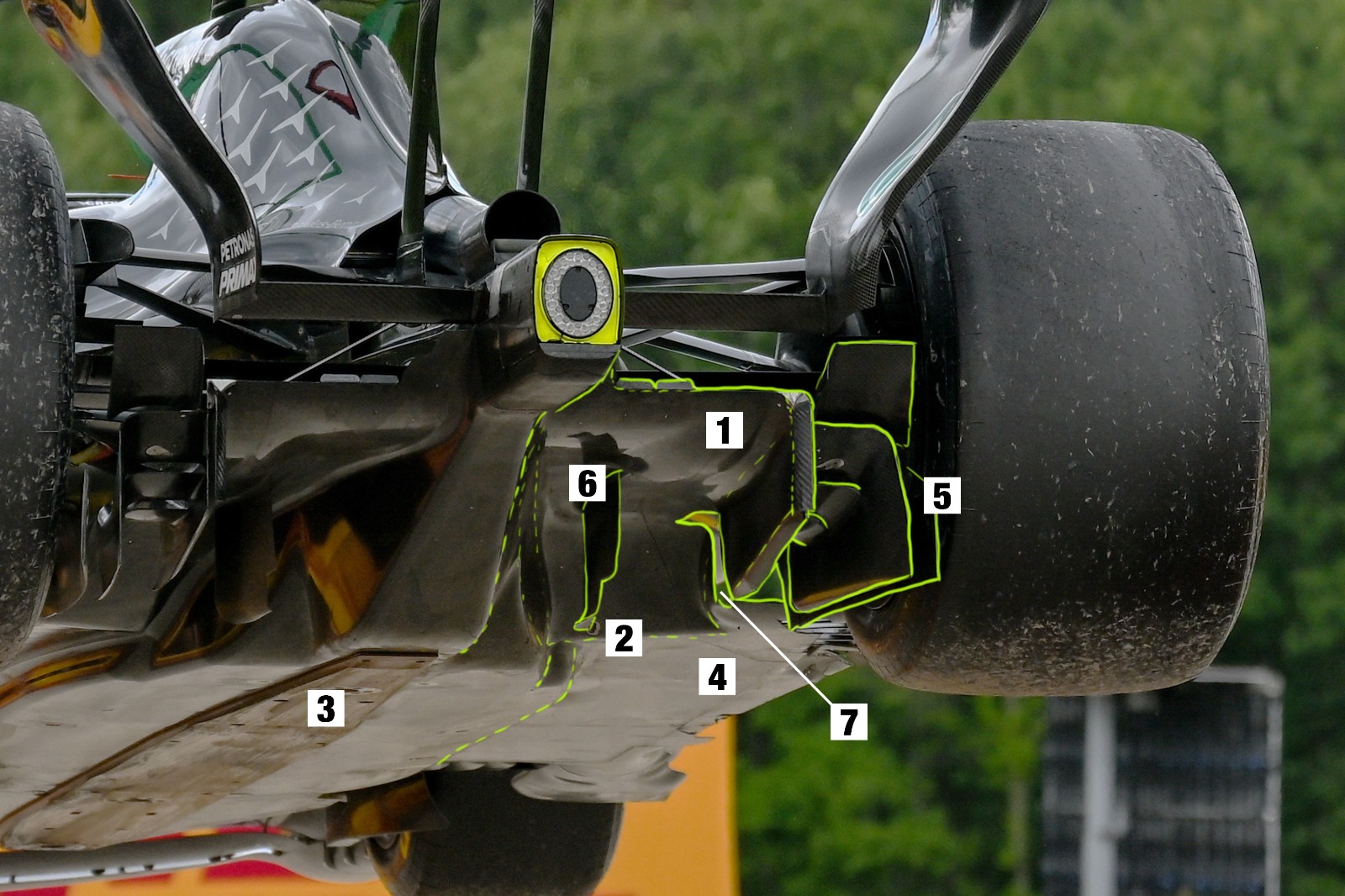
Photo by: circuitpics.de
1. Diffuser, responsible for the expansion of airflow, creating a low-pressure area behind the car. Airflow underneath the car is sucked into this, creating downforce.
2. Diffuser kick line. This is where the floor is no longer required to be flat.
3. Plank, or skid block. Made of resin, and used to ensure cars are not running too low. If this wears down by more than 1mm in a race, then this is considered grounds for disqualification.
4. Outer floor edge. Sits higher than the main floor body, a measure by the FIA to keep a lid on downforce.
5. Outer diffuser components, which link between the wheel hub aero and the diffuser itself.
6. Diffuser strake. Permitted to help condition flow underneath the car.
7. Diffuser 'hole' - an addition explored this year to help feed the entirety of the diffuser.
A few other details can be seen on the image above, such as the small tabs along the top edge of the diffuser. Mercedes had operated with larger variants on this design to expand the working volume of the diffuser, but was required to reduce the size of these by the FIA.
Furthermore, the suspension components and beam wing in front of the diffuser are also angled in a similar fashion to help expand this low-pressure zone produced by the diffuser. All of these components are aerodynamically linked, including the rear wing, to produce a high and consistent level of rear-end downforce.
The outer diffuser components are effectively a carry-over from last year's brake duct-mounted cascade winglets, extending this working area further.
Under last year's rules, the diffuser had to be pretty tightly enclosed to ensure there was minimal interference with the flow structures produced underneath. The reduced sensitivity this year has prompted a few teams to implement a 'hole'.
Using this, the underbody airflow can now expand further and effectively uses the 'inner' diffuser components as an additional strake to manage the flow here.

George Russell, Mercedes, Lewis Hamilton, Ferrari
Photo by: John Thys / AFP via Getty Images
Given the length of the floor body, one of the key problems to overcome is flow separation. Keeping the airflow energised and accelerating underneath can help to overcome the loss of energy due to surface friction, but breaking up the bodywork at the rear also helps here.
The slots on the corner of the floor, ahead of the rear tyre, can also be spotted. Mercedes made a few changes here for the Canadian Grand Prix to keep "tyre squirt" in check - this being the situation where the tyres can squeeze turbulent flow sideways - potentially into the diffuser area - as they rotate and deform.
Even with reduced levels of complexity over the previous ruleset, there's a lot of work that goes into making the diffuser as potent as necessary. Without that, the rear axle is a lot less stable and a driver is unable to put the power down onto the road without sliding about.
When the back end of the car is unpredictable, and unable to provide enough of a platform to balance out the front, the driver simply has no confidence in what they're driving.


Share Or Save This Story


Lights, Camara, action: How Haas picked F1's latest rookie for 2027

Horner's inside story of how Red Bull built its own F1 engine

Why Mercedes' latest 2026 F1 update is no downgrade


Mercedes explains why its upgrade made its F1 car harder to drive

The maths behind when Mercedes could become F1 world champions in 2026

Employing team orders can simply be a matter of common sense

How Toyota destroyed the competition to seal the WEC crowns

McLaren retains Fornaroli as F1 reserve and hands him WEC programme for 2027

How Andrew Jordan realised his teenage rallycross dream

Inside the competition building F1’s future engineering talent
Subscribe and access Autosport.com with your ad-blocker.
From Formula 1 to MotoGP we report straight from the paddock because we love our sport, just like you. In order to keep delivering our expert journalism, our website uses advertising. Still, we want to give you the opportunity to enjoy an ad-free and tracker-free website and to continue using your adblocker.


Top Comments