


Why Verstappen’s unusual run plan highlights F1 teams’ biggest challenge in Malaysia
Max Verstappen did not complete a qualifying simulation due to the threat of rain, but according to Pirelli that approach fits perfectly with F1 teams’ biggest challenge this weekend: keeping thermal degradation under control on Sunday. However, that is much easier said than done


Friday practice for the Formula 1 Bahrain Grand Prix in Malaysia was atypical in several respects. Lap times turned out to be four and a half seconds slower than expected due to the poor track surface, Mercedes did not impress as much as perhaps expected and the run plans were rather unusual.
The latter was perhaps most evident with Max Verstappen. Normally, drivers complete their qualifying simulations halfway through the second practice session before using the second half for long runs. With the FIA estimating the chance of rain ahead of FP2 at 90%, several teams wanted to play it safe, which in practice meant bringing their long runs forward.
“I wanted to do a long run in case there was some rain coming in,” Verstappen clarified when asked about his unusual Friday run plan.
Red Bull technical director Pierre Wache also explained that the team at least wanted to gather data on what is considered the most important factor of the race weekend at Sepang: tyre degradation.
“We didn't want to compromise the long run, which I think is the most important thing this weekend, in terms of degradation and see how the tyres behave, especially the medium. We didn't have data of the medium, so we prioritised that and afterwards it was too late to run the soft,” Wache said.
F1 teams’ biggest challenge at Sepang explained
It underlines two things. Firstly, this quote perfectly illustrates that looking at individual lap times after Friday in Kuala Lumpur is pointless. Only the long runs provide a valuable picture, meaning even less significance should be attached to Friday’s classification than usual.

Max Verstappen, Red Bull Racing
Photo by: Joe Portlock / Getty Images
Secondly, it underlines that F1 teams’ approach in Malaysia differs from a normal race weekend. Usually, it is a balancing act between qualifying performance and keeping the tyres – particularly the rear axle – alive during the race, but this time it is all about the latter.
“We have seen today that the degradation was quite significant, quite high. I remember just one weekend where we had this kind of degradation and that was Barcelona,” said Pirelli’s chief engineer Simone Berra.
“We have recorded around two or three tenths of tyre degradation per lap, on both the medium and the soft. So the level of decay is quite important here. Teams need to manage especially the rear temperatures, but also the front tyres in the high-speed corners.”
Moreover, that can become a vicious circle at Sepang, F1’s tyre supplier explained based on Friday’s data.
“Due to the poor surface, the grip was low on both the medium and the soft. This exacerbated even more thermal degradation because we know that sliding means higher surface temperatures, higher surface temperatures mean lower grip, that means even more sliding, that leads to higher surface temperatures again, and so on.”
Keeping thermal degradation under control is crucial to avoid ending up in this vicious circle, but that is easier said than done. That is because while the rear axle is the primary concern and this track is ‘rear-limited’, the front axle still requires management as well. And those two things are difficult to combine.

Max Verstappen, Red Bull Racing
Photo by: Srinivasa Krishnan
“The point is that for the rear axle especially, there is no rear respite here. It's very difficult to keep the temperatures under control, you have to try to avoid sliding in the high-speed corners and on traction,” Berra explained.
“But meanwhile you have to keep consistency with the pace and you have to avoid overloading the front tyres.
“It's very complicated because you have to protect both axles basically, the front can overheat and degrade as well. It's really not simple. It will be a compromise in the end, which axle you prefer to degrade more. I think all teams will go to protect the rear, because in the end, on the rear axle, you lose much more performance than on the front.”
More qualifying question marks: Is a surprise on the cards?
All of this means that the teams’ work and data analysis on Friday evening is completely different from a week ago during the Azerbaijan Grand Prix.
“Baku was a circuit with very low degradation levels and very high importance of qualifying on the front rows. Here, qualifying is less important,” Berra continued.
“We know that it's possible to overtake, especially when you have this high degradation. If you are able to keep the performance and the tyre temperatures in the correct window, you can extend or you can push more than other competitors. The position on the grid is less important than in other places.”

Fernando Alonso, Aston Martin Racing
Photo by: Michael Potts / LAT images via Getty Images
That said, the extreme focus on race pace does mean that teams head into qualifying with more question marks than usual, even if it takes place in dry conditions.
Berra confirms – understandably without wanting to reveal which teams – that some teams even struggled on Friday to get their tyres up to temperature for the first corner of a flying lap. That may sound remarkable given the extremely high track temperatures, but it is a consequence of the huge focus on protecting the rear axle and therefore on race pace.
An interesting final point is that there are also many question marks for Sunday. As a precaution, all teams have decided to save two sets of hard tyres, meaning nobody – including Pirelli – has data on the C2, the hardest compound available this weekend.
Moreover, given the extreme conditions, the rule of thumb that the harder the compound, the better it is for the race does not necessarily apply.
“I would also expect a high level of degradation on the hard compound, because [a harder tyre] is generating a lower level of grip and therefore a higher level of sliding and higher surface temperature,” Berra explained.
“It's something that we have seen today with the soft and medium as well. We have seen in some back-to-back comparisons for the race that the soft was at a similar level of degradation or even a lower level of degradation than the medium. That’s because the medium was sliding more than the soft and the soft was more controllable, let's call it this way. And so all options are open for Sunday.”
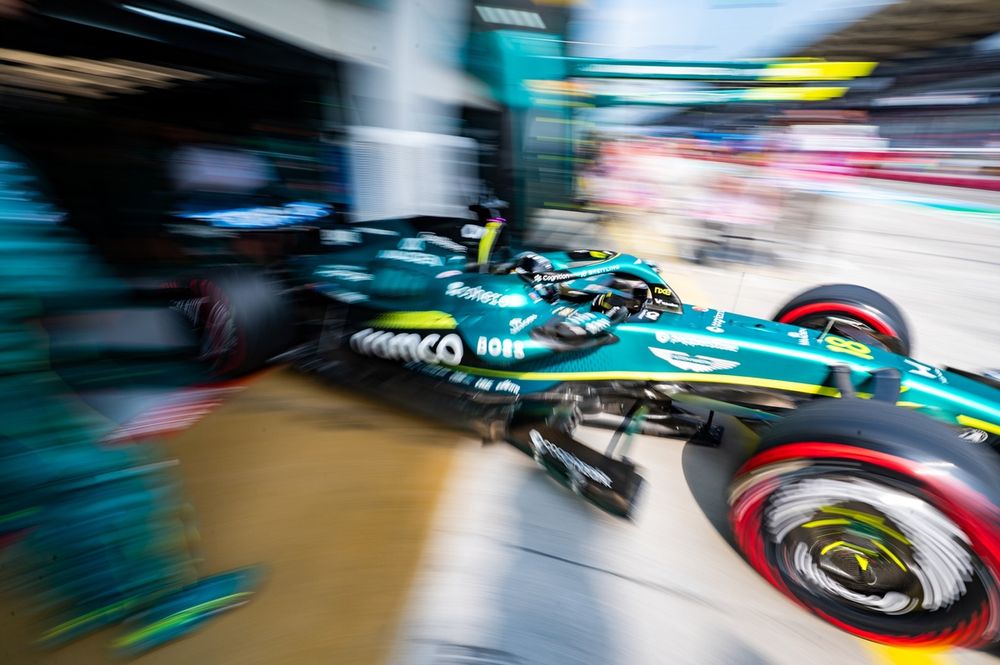
Lance Stroll, Aston Martin
Photo by: Srinivasa Krishnan
The latter is essentially good news, as it could encourage strategic variation, which is exactly what Pirelli always aims for.
“All three compounds are usable because we are most likely going towards a two-stop race, and possibly even three stops. Everything is, let's say, in play at the moment,” Berra concluded.
“This is generating quite a big amount of possibilities in terms of strategies and that's what we want, also from our side, to generate different combinations.”

Share Or Save This Story


Why Verstappen and Hadjar urge Red Bull to "make all the mistakes now" for 2027

Hidden F1 performance differentiator nobody is talking about in 2026

The reasons behind Alonso renewing F1 contract with Aston Martin

F1 Bahrain GP in Malaysia: Verstappen pips Russell to top FP1

Verstappen to make GT3 return at 2026 GT World Challenge Europe finale

How Antonelli is proving unbeatable, even when he's beaten


The unpredictability to expect for F1's one-off return to Sepang in 2026

Was Baku really Red Bull's last opportunity of winning in F1 2026?

Not quite "plain sailing": Baku's late-race chaos almost cost Russell victory over Verstappen

Why Verstappen’s unusual run plan highlights F1 teams’ biggest challenge in Malaysia

What we learned from Friday practice at the 2026 Bahrain GP in Malaysia

Why ‘Mr Formula E’ has called time on his racing career

WRC Sardinia: Fourmaux heads Hyundai 1-2 after puncture-filled morning
Subscribe and access Autosport.com with your ad-blocker.
From Formula 1 to MotoGP we report straight from the paddock because we love our sport, just like you. In order to keep delivering our expert journalism, our website uses advertising. Still, we want to give you the opportunity to enjoy an ad-free and tracker-free website and to continue using your adblocker.


Top Comments