


The hidden F1 performance differentiator nobody is talking about in 2026
In the build-up to the 2026 F1 season, much was said and written about sustainable fuels, although this year everything has been overshadowed by energy management. How important is this factor behind the scenes, and what does it mean for the future?

Autosport Business
Covering industry news and insight into the business of motorsport
With completely new chassis and power unit regulations in Formula 1, one change has quickly been overlooked: the switch to fully sustainable fuels.
There has been little attention paid to it in recent months because everything has been overshadowed by energy management, but the fuel revolution is nevertheless significant in two ways. First, it is one of the performance differentiators that fans normally see very little of – with an intense battle between various fuel suppliers behind the scenes. Second, years of development have gone into it – a process that goes far beyond the simple replacement of traditional gasoline.
F1’s new fuel must be made entirely from sustainable sources, such as non-food biomass and municipal waste, or as synthetic e-fuels using captured carbon and renewable energy. The FIA does not allow ‘mass balancing’ and uses a traceability scheme to verify the origins of the feedstocks. Different energy densities are accounted for by replacing the previous mass-flow limit with an energy-flow limit of 3,000 MJ/h. Within those boundaries, suppliers still have considerable freedom to develop their own formulations – making fuel a key area of competition.
In the build-up to 2026, it was no longer about optimising an existing product, but about building an entirely new one instead, molecule by molecule. It has been an enormous development battle, with ExxonMobil – the fuel and lubricants partner of both Red Bull teams – explaining to Autosport what that actually meant in practice.
“The 2026 regulation is one of the most significant mandates when it comes to fuel development,” said ExxonMobil’s Global Motorsports Technology Director Matti Alemayehu. “We started as soon as the first draft of the regulations was outlined. Our team has taken three years to develop the fuel across 75 people, about a dozen of scientists and engineers, and about hundreds of formulations being optimised and being tested to get to the final product.”
Testing those hundreds of samples involves a continuous balancing act between performance and reliability. With every new formulation, the emphasis can be shifted slightly, making it a matter of finding the right balance – not only for the fuel, but also for the lubricants that, in a sense, have to protect and diagnose the all-new power units.
“You're optimising your performance based on componentry and based on the data response that you're getting. So you're testing with the team on the engine platforms and seeing where you need to optimise, and in that way you're getting to the highest performance and reliability,” Alemayehu said. “That's really the trade-off that you're balancing across for three years, with hundreds of formulations and 75 people. You can kind of see the order of magnitude that goes into getting the highest performance achieved.”

ExxonMobil has been a long-term fuel and lubricants partner of Red Bull
Photo by: ExxonMobil
What applies to developing the 2026 power units – a process Honda has been very open about – also applies to sustainable fuels: when a step is made in terms of finding more performance, reliability can become more difficult. It means that at certain moments in the process a step backwards had to be taken in order to subsequently take two steps forward.
“Absolutely. You're looking at the fuels and the lubricants and that development is always a trade-off. So if you're gaining on one side, you may be having a debit on the other side of the equation,” Alemayehu explained. “So how do you make sure you're working across with the team to optimise where you want to have the optimal performance?”
Part of Red Bull Powertrains’ initial core team
The development process for the new fuels coincided with Red Bull building its own Powertrains facility in Milton Keynes in collaboration with Ford. Just how crucial fuel is to the performance on track is underlined by how integrated ExxonMobil was in that process from the very beginning, at the time still led by Christian Horner.
"We were part of the six-person team that was having the meetings to set up the Red Bull powertrains organisation" Matti Alemayehu
“We were always getting in at the ground floor of the engine being built. In fact, we were part of the six-person team that was having the meetings to set up the Red Bull powertrains organisation,” Alemayehu revealed. “And we've been working together since the first Powertrains team was established. It’s a very close working relationship, it's hand in hand and we're continuously talking. It's an iterative loop, so I would say we're joined at the hip.”
At least on the internal combustion engine side, the outcome so far has been surprisingly positive. Red Bull is lacking on the electrical side of the power unit, but has been ranked at the top by the FIA based on the ICE measurements, making it the only manufacturer not to receive an ADUO token.
That strong start as a newcomer has surprised many in the paddock, but according to Alemayehu, not ExxonMobil: “No, I'm not surprised. The work ethic and how the team drives towards success and really squeezes every performance out of the vehicle is the fundamental behaviour of the team. And it's the same with us and ExxonMobil, so I'm not surprised by any successful outcome from that.”

ExxonMobil was part of the very start of the Red Bull-Ford Powertrains project
Photo by: Red Bull Content Pool
A building block for a V8 return – and what about road relevance?
Aside from the performance aspect, there are two other important subjects when it comes to F1’s new fuel: how complex was the process of ensuring that the 2026 products actually meet all of the FIA’s sustainability targets? And secondly, does this have more potential for the future in terms of road relevance – given that electrification has faced considerable resistance and the internal combustion engine is set to become more prominent again – or are the costs simply too high?
Regarding the first point, the checks proved rather complex for the FIA at the start of this year, which also explains why the sustainable fuel used by Mercedes was only approved late. It led to significant media speculation at the time, but that is all part of introducing new regulations, just as the budget cap also involved an extremely complex auditing process in its first year.

ExxonMobil acknowledges that the switch to fully sustainable fuels and meeting all of the FIA requirements tested not only the governing body, but also the fuel suppliers themselves to the limit.
“So our fuel is certified against the FIA regulations and you can kind of look up what those regulations state. It's really about the FIA saying that you're good, that it meets their specification. It did take us three years to get there, so yes, it is a complicated process,” Alemayehu admitted. “But at the end, we were certified in the fourth quarter of 2025. We were actually ahead of the curve, so we prepared ourselves for that process. Yes, it is complex and it took us three years, but we met all the certification goals.”
Alongside the complex development and approval process, the FIA has also addressed the costs. Development costs in the initial phase were reportedly several hundred euros per litre, although Nikolas Tombazis stresses that costs are high at the beginning of all innovations, as was the case with the first computer. Only gradually do development and production costs come down and the product become more accessible.
“I think sustainable fuels have been a very important step forward. It was extremely challenging for the fuel manufacturers and that's why initially the costs are higher than we would like,” the FIA’s single-seater director admitted. “But I think they've managed to produce fuels from almost no fossil areas. It's a success and it does influence the energy chain. So it definitely is an improvement, a significant step forward. And I think it will gradually seep more and more into the road car.”
That makes it important for the future in two ways. First, it enables F1 to make the internal combustion engine (ideally a V8) more prominent again from 2030 or 2031 onwards without losing sight of its sustainability targets. Secondly, it ties in with the road-car relevance that F1 values so highly. In that respect, however, it is crucial to know exactly when costs will come down and when the fuel used in F1 can become relevant at the pump, but according to ExxonMobil it is still difficult to make predictions about that.

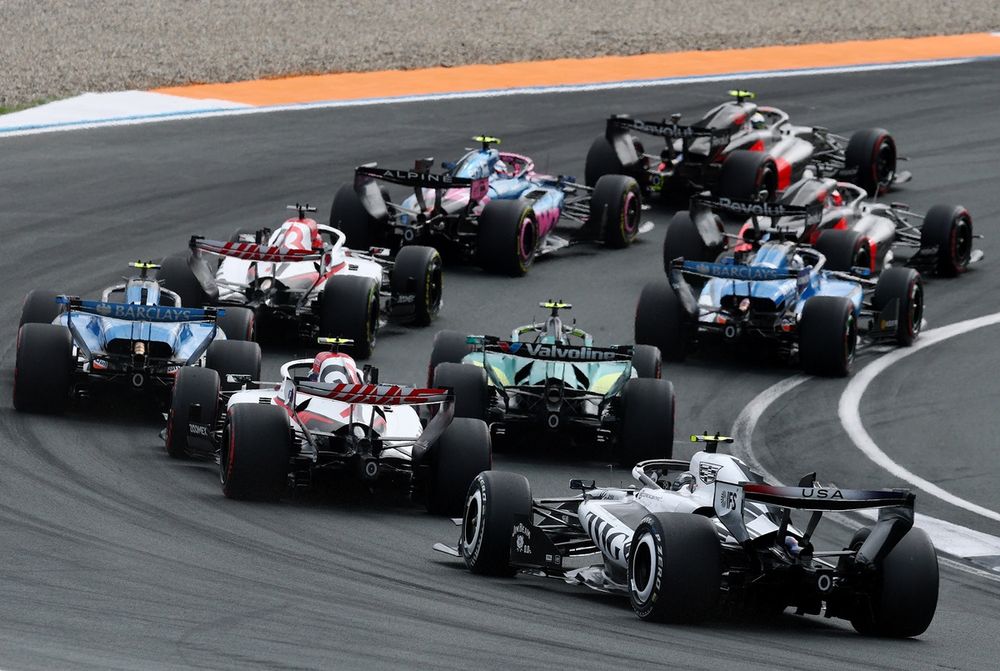
F1's push to sustainable fuels has been an expensive pursuit, but costs are expected to lower as the technology advances
Photo by: Clive Rose / Getty Images
“I think as every motorsports technology, you're developing it to extend to commercial vehicles. But the question of how long does it take, it's still too soon to tell. But that's really why we get involved in racing, for us it’s to understand the next generation technology and that intention is still clear,” Alemayehu said.
Although the next major change in the engine regulations will not come until 2030 or 2031, the development of sustainable fuels is not standing still. The specification is homologated during the season, but as 2026 is only the starting point of the development battle between the different manufacturers, development for next year is already in full swing.
“It's homologated at the moment, but we have a couple of engineers that are embedded with Red Bull. I'm sure you've seen our track lab, where we constantly sample the fuel and the lubricant. It's almost 100 samples per weekend. We take those data points and use them for next season’s development,” Alemayehu explained. “Because when we were developing the fuel for 2026, we didn't have that track loop. So now we can take that in and say, okay, if we tweak our product here and there, does that give us a bit more advantage? It's a cycle and that development cycle never stops.”
These are all aspects that the wider public barely gets to see during an F1 weekend, and aspects that have been massively overshadowed by the enormous focus on energy management
That process is in full swing behind the scenes for 2027, although the track lab Alemayehu refers to also serves another purpose – more specifically when it comes to the lubricants.
“Because the lubricant is so advanced, it acts like a diagnostic tool as well," he said. "So if you take it and you run your wear metals, for example, it tells you what's wearing inside the engine.
"So you can give that feedback to the team and say, hey, you may want to look at this aspect of the engine. So yeah, the team does a really good job of constantly feeding the data loop into the engineers to optimise.”
These are all aspects that the wider public barely gets to see during an F1 weekend, and aspects that have been massively overshadowed by the enormous focus on energy management, clipping and super clipping.
But in 2026, these things are certainly highly significant to the overall picture. It underlines once again that F1 is so much more than what meets the eye for the TV viewer.

The groundwork on sustainable fuels this year is set to aid F1's future regardless of what engine path it takes
Photo by: Guido De Bortoli / LAT Images via Getty Images


The reasons behind Alonso renewing F1 contract with Aston Martin

Was Baku really Red Bull's last opportunity of winning in F1 2026?

The detail that impressed Red Bull the most about Hadjar's F1 return

Why Verstappen says 0.196s Baku finish-line gap to Russell is slightly misleading

Why Verstappen feels Baku was Red Bull's best chance to win in F1 2026

Verstappen reveals why Red Bull's engine problem in Baku was different than it seemed

Imola or Qatar and Abu Dhabi? What’s really going on with the end of the 2026 F1 season

Alonso’s idea to ‘save’ F1 before the V8 return – and how realistic it is

Ocon fighting for his F1 future - but is adamant he deserves to stay

The hidden F1 performance differentiator nobody is talking about in 2026

Ford set for WRC factory return with M-Sport in 2028

Hamilton strongly backs Vasseur amid Horner to Ferrari links
Subscribe and access Autosport.com with your ad-blocker.
From Formula 1 to MotoGP we report straight from the paddock because we love our sport, just like you. In order to keep delivering our expert journalism, our website uses advertising. Still, we want to give you the opportunity to enjoy an ad-free and tracker-free website and to continue using your adblocker.


Top Comments