


Top 10 F1 cars of the 1980s
Another shift in technological advances from the development in turbocharging to an increased use of carbon fibre meant that some of F1’s all-time iconic cars starred in the 1980s

Autosport Retro
Telling the forgotten stories and unearthing the hidden gems from years gone by.
Interest in Formula 1 increased in the 1980s, with stars such as Alain Prost, Ayrton Senna and Nigel Mansell coming to the fore.
There were also big technological advancements, including the increased use of carbon fibre, and major manufacturer involvement as turbocharging rapidly pushed power upwards.
For the latest list in our series on the top 10 F1 cars of each decade, we look at an era dominated by Williams and McLaren as F1 performance reached new heights.
We have considered each car’s level of achievement, how innovative they were, the quality of the opposition, and their impact on F1. As with our previous lists, our stats are for world championship races only.

10. Renault RE30

The RE30 proved fast but fragile
Photo by: Motorsport Images
Wins: 7
Poles: 16
Titles: 0
Both the Renault-powered Lotus 97T and the Honda-engined 99T, which was the first F1 car with active suspension to win a grand prix, nearly took this spot. But the fourth-generation Renault F1 turbocar scored more wins and poles than either – and really should have won a championship.
That it didn’t was largely due to its unreliability, so it can’t climb higher on this list, but Renault was still pushing the boundaries with the engine technology it had introduced to F1 in 1977.
The RE30 incorporated carbon fibre and was arguably the fastest car of 1981. It arrived for round six at Monaco – not the ideal circuit for the early turbos – and took six poles from the 10 races it contested.
Reliability was a problem but Prost scored three wins and two second places on his way to a close fifth in the drivers’ championship. He also led more laps than any other driver. Along with the points scored by Rene Arnoux, it was enough to give Renault third in the constructors’ championship, behind Williams and Brabham.
The revised RE30B, with improved aero and more power, was definitely the fastest car of 1982. Prost and Arnoux took 10 poles between them and led nearly half of all the laps across the 16 rounds. But turbo and fuel injector failures, plus the odd driver error, limited Renault to just four victories.
Renault was again third in the constructors’ table, with Prost fourth and Arnoux sixth in the drivers’ standings. Despite the troubled season Ferrari experienced, with the death of Gilles Villeneuve and serious crash for Didier Pironi, the Italian team still beat Renault to take the first turbo-powered F1 title.
By 1983, when the RE40 came even closer to winning a championship, the major F1 teams either had turbos or were on the verge of getting them. Renault had changed the game, even if it hadn’t taken the ultimate prize.
9. Brabham BT52

When BMW introduced a special fuel for the Brabham BT52, it rocketed Piquet to the title
Photo by: Motorsport Images
Wins: 4
Poles: 2
Titles: 1 (1983 drivers’)
Placing the popular, dart-shaped BT52 in this list is tricky. It is highly regarded and took Nelson Piquet to the world title, but its design concept did not prove successful for long and Renault’s debacle has to be factored into a review of 1983.
The late rule change demanding flat bottoms for 1983 meant designer Gordon Murray had to start again and he targeted moving weight distribution rearward.
Piquet won the season-opening Brazilian GP, a remarkable achievement given how rushed the design and build had been. He added second places in France, Monaco and Britain, but it was Prost’s Renault that looked in control in the middle of the season. The RE40, which had a blown diffuser, was 2.4 seconds clear of the field in France and Prost took four victories.
After winning the Austrian GP, Prost led Piquet by 14 points (when nine were awarded for first place) with only four races to go. But Brabham and BMW had introduced a special fuel that reduced detonation and increased power at the German GP. The BT52B, which also had minor revisions and a reversed Parmalat livery, came on strong and Renault started to crumble.

The French team wasn’t competitive at Monza and Prost retired with engine problems as Piquet won. The Brabham driver then beat Prost into second in the European GP at Brands Hatch, moving to within two points of the championship lead.
Prost was outqualified by both Brabhams and both Ferraris at the South African GP finale and never ran higher than third before more turbo issues put him out. Piquet led comfortably before backing off to be sure of third place, leaving team-mate Riccardo Patrese to win.
Piquet thus pipped Prost to the championship by two points, though the constructors’ crown went to Ferrari. Brabham’s decline would soon begin and there would be just three more F1 wins before its demise, the simple BT52 therefore being the team’s final title winner.
8. McLaren MP4/1

The MP4/1's 1981 British GP win was McLaren's first since 1977, the first of the Dennis era and the first for a carbon fibre car
Photo by: Motorsport Images
Wins: 6
Poles: 0
Titles: 0
The MP4/1’s record is relatively modest but it deserves to be here for several reasons. It established the carbon fibre monocoque in F1, was the first McLaren to take a win in the Ron Dennis era and laid the foundations for the huge success that followed. You could also argue that John Barnard’s design was one of the ultimate Cosworth DFV-engined F1 cars, being one of only three non-turbos to win during 1983.
The MP4/1 was the first new McLaren after the merger with Project Four Racing. McLaren hadn’t won a GP since 1977, but Barnard’s design started showing promise in the middle of 1981. John Watson was third in Spain – the car’s fifth outing – second in France and then scored a famous victory in a dramatic British GP at Silverstone, having narrowly missed an early multi-car crash.
Watson also demonstrated how robust the carbon tub was in a massive crash at Monza, while Andrea de Cesaris tested the car’s strength – and the team’s patience – with repeated incidents. McLaren was only sixth in the constructors’ championship but was heading in the right direction.
Dennis tempted Niki Lauda out of retirement to join Watson in 1982 and the Austrian won as early as round three at Long Beach. Despite the increasing pace of the turbos, Lauda and Watson remained competitive, taking two victories apiece as McLaren finished second in the constructors’ table. Watson finished just five points behind world champion Keke Rosberg.
The MP4/1 continued to evolve into 1983, now with mandated flat floor. The turbo hordes were even stronger, but there was still one more win – Watson leading Lauda in a 1-2 at Long Beach after they had started 22nd and 23rd respectively.
Watson took third on the MP4/1C’s final start at Zandvoort before the chassis made its final contribution to McLaren’s future. At Lauda’s behest, the MP4/1E ran the new Porsche TAG turbo over the final rounds in preparation for the arrival of 1984’s MP4/2…

7. Ferrari 126C2

Ferrari's emotionally-wretched 1982 culminated in the constructors' crown
Photo by: Motorsport Images
Wins: 5
Poles: 7
Titles: 1 (1982 constructors’, plus contributed to 1983 constructors’)
The 1981 126CK had shown Ferrari could produce a powerful turbo engine, but the handling left a lot to be desired. Harvey Postlethwaite’s C2 had an all-new chassis and substantially improved aerodynamics, increasing downforce.
The 1982 campaign nevertheless started slowly and Ferrari had only one point after three races. Even the car’s 1-2 at Imola came against a reduced field thanks to a boycott amid political turmoil.
Ferrari then suffered a major blow when Villeneuve, still furious with team-mate Pironi for what the Canadian felt was being cheated out of San Marino GP victory, was killed in qualifying for the Belgian GP. Ferrari withdrew from the race.
Pironi was classified second at Monaco despite running out of fuel during the crazy closing stages, then was third in Detroit. He took pole at Montreal, only for more tragedy to strike. Pironi stalled at the start and was struck by Riccardo Paletti’s Osella, the Italian succumbing to his injuries.
Despite three pitstops after the restart and an early misfire with his spare car, a distressed Pironi drove with incredible pace to finish a point-less ninth, and then won the Dutch GP. That put him just a point off the championship lead, which he took next time out with second in Britain.
Third at the French GP put Pironi nine points ahead with five rounds to go. But Ferrari’s tumultuous season continued as Pironi’s F1 career ended after he hit Prost’s Renault in spray during practice at Hockenheim and the Ferrari cartwheeled to destruction.
When leader Piquet’s Brabham clashed with Eliseo Salazar’s AGS, Villeneuve replacement Patrick Tambay came through to take an emotional German GP win. That moved Ferrari into a lead of the constructors’ table it would not lose.
There would be no more wins in 1982, but Mario Andretti took a brilliant pole at Monza. As well as Ferrari’s constructors’ success, the absent Pironi finished second in the drivers’ standings.
The C2B – now with a flat bottom – was still competitive in 1983. Tambay took pole at Long Beach, Arnoux scored three poles, and there was a win apiece before the 126C3 arrived mid-season. Arnoux would take two more wins in the new car, helping him to third in the drivers’ championship, and Ferrari retained its constructors’ crown.
6. Brabham BT49

BT49C featured a novel hydro-pneumatic system that dropped the ride height at speed
Photo by: Rainer W. Schlegelmilch / Motorsport Images
Wins: 7
Poles: 6
Titles: 1 (1981 drivers’)
Horrendous reliability with the Alfa Romeo-engined BT48 had ruined Brabham’s 1979 season but it had at least recruited rising star Piquet. Murray’s Cosworth DFV-engined BT49 also arrived towards the end of the season. It had been designed in haste but proved competitive – and was developed to remain competitive into 1982.
After a promising run on the BT49’s debut at the 1979 Canadian GP, which was curtailed by gearbox failure, Piquet was second to the Williams of Alan Jones in the 1980 opener. He then took his first world championship win at Long Beach, with the BT49’s new gearbox aimed at improving its ground effect. Piquet took pole by a second, led every lap, set fastest lap by 0.6s and won by 49s.
Jones took command of the points table in the middle of the campaign, but Piquet kept racking up points and consecutive wins at Zandvoort and Imola edged him ahead. But a clash with Jones next time out in Montreal, followed by engine failure after the restart, and the vagaries of the points system meant the crown went to the Australian.
It was Piquet versus Williams again in 1981, but this time Jones had to share his points with team-mate Carlos Reutemann. Indeed, it was Reutemann who seemed the main threat: after finishing second in the British GP, he was 17 points ahead with six rounds to go.
But a tyre switch from Michelin to Goodyear seemed to throw Reutemann off his stride. Piquet, having already dominated from pole in Argentina and won again at Imola, then scored a fortuitous win in Germany.
As well as the refined 1981 BT49C having more carbon fibre, it also had a novel hydro-pneumatic system that dropped the ride height at speed but allowed the car to return to the new 6cm minimum when stationary. There were also (unproven) suggestions of underweight cars for Piquet to qualify as Brabham came under further suspicion.
Piquet’s scoring over the final rounds was modest, but so was Reutemann’s. Piquet was just one point behind going into the Caesars Palace finale and fifth place was enough after poleman Reutemann’s pace mysteriously vanished.
Over these two seasons, Brabham had essentially been a one-car team, with Ricardo Zuninho and Hector Rebaque barely scoring. Williams beat Brabham in the constructors’ title both times, Patrese joining Piquet for 1982.
Piquet’s focus was on the development of the BMW turbo and he spent most of the season in the BT50. He did win a gruelling Brazilian GP on the road in the even lighter BT49D, only to be disqualified for being underweight during the FISA-FOCA conflict.
Patrese also drove both. In the DFV car, he was third at Long Beach, won a ridiculous Monaco GP and then finished second to Piquet’s BT50 in Canada. That would be the BT49’s final start, leaving its record at 16 podiums.
5. Williams FW07

Regazzoni celebrates the Williams FW07's first win
Photo by: Motorsport Images
Wins: 15 (5 in 1979, 10 in 1980-81)
Poles: 8 (3 in 1979, 5 in 1980-81)
Titles: 3 (1980 drivers’ and constructors’, 1981 constructors’)
Should this be in our 1970s or 1980s list, or both? The Williams FW07 is a rare F1 frontrunner that straddles the decades, but we’ve decided to put it in the later list because that’s when it did most of its winning.
Like many, Williams followed Lotus’s lead and went down the ground effect route for 1979. The pragmatic Patrick Head, Neil Oatley and Frank Dernie designed a better, stiffer version of the Lotus 79 and the DFV-engined FW07 made Williams a frontrunner.
In fact, once the initial bugs had been ironed out and reliability improved, Williams lead driver Jones became the pacesetter. Clay Regazzoni scored the team’s first F1 win at Silverstone but Jones took three poles and four victories to finish third in the 1979 standings.
Jones carried that momentum into 1980 as the FW07’s development continued, scoring five wins (as well as two non-championship successes) to beat Piquet to the crown. New recruit Reutemann won at Monaco and Williams easily took its first constructors’ title.
It did so again in 1981, scoring four more wins, but the drivers’ title went to Piquet. Jones could have taken it, but suffered bad luck and the odd error, while Reutemann probably should have been champion – at one stage holding a 17-point lead when nine was available for victory – but famously capitulated in the Las Vegas finale, won by Jones.
Following Jones’s shock retirement, Reutemann and Keke Rosberg scored a second place apiece in the FW07C before it was replaced by the FW08. That agile car, which scored a brace of poles and wins, gets an honourable mention for Rosberg’s 1982 drivers’ crown, but it’s hard to argue it was the best car of the season.
4. McLaren MP4/5

A warring Senna and Prost overshadows how good the MP4/5 car is remembered
Photo by: Motorsport Images
Wins: 10 (+6 for MP4/5B in 1990)
Poles: 15 (+12 for MP4/5B in 1990)
Titles: 2 (1989 constructors’) (+2 for MP4/5B in 1990)
The MP4/5 had a tough act to follow, given McLaren’s domination of 1988, and Honda had to come up with a new 3.5-litre normally aspirated engine thanks to the banning of turbos. But the V10-engined machine continued the team’s success with another title double.
A combination of an early clash for Senna, clutch trouble for Prost and an inspired Mansell on his debut for Ferrari meant that McLaren lost the Rio 1989 season opener. But the MP4/5, which got a new transverse six-speed gearbox during the campaign, won 10 of the remaining 15 races as Senna and Prost fought an increasingly acrimonious battle for the drivers’ title.
The car took pole for all but one of the rounds and Senna usually led the way. But some unreliability and the odd clash hampered Senna’s challenge and meant the title went to the consistent Prost, following their controversial Suzuka contretemps.
Apart from the Brazilian GP, the MP4/5 was only beaten to victory on the road in Canada (where both cars failed to finish), Hungary (thanks to a Mansell masterclass) and in Australia, where Prost withdrew due to the appalling conditions and Senna crashed out after hitting a backmarker in the spray.

McLaren scored four 1-2s in 1989 and won the constructors’ title by 64 points – not as impressive as the 1988 margin of 134, but dominant nonetheless.
The MP4/5B, which had significant floor/diffuser changes mid-season to cure handling problems, had a more fraught time in 1990, a ferocious Senna and Honda power helping a chassis that was often inferior to the Ferrari 641. It still scored another title double.
3. Williams FW11

The FW11 racked up the trophies but probably should have secured four world titles in total
Photo by: Motorsport Images
Wins: 18
Poles: 16
Titles: 3 (1986 constructors’, 1987 drivers’ and constructors’)
The early F1 Honda turbo engines suffered with poor driveability and reliability, but the Williams-Honda package started to come on strong in 1985. And then the FW11, produced with computer-aided design and manufacture, became F1’s benchmark.
The Honda engine also proved to have a fine balance between power and efficiency as the fuel allowance for each race was cut from 220 litres to 195.
The result was nine wins from 16 races, though Senna’s Lotus-Renault 98T took eight poles. Even the serious road accident that put Frank Williams in a wheelchair did not prevent the team winning the constructors’ crown with ease.
The drivers’ title, however, was a different matter. Piquet expected to be number one, while Williams was understandably not keen to slow Mansell. The Briton proved more competitive than expected and edged Piquet 5-4 on wins but his infamous blowout in the Adelaide finale – not to mention the fight between the two Williams drivers – helped the brilliant Prost sneak through and win the championship with McLaren.

The updated FW11B, complete with revised cooling plus the powerful and efficient Honda RA167E (now limited to 4.0 bar boost by the rules), was even further ahead in 1987. Active suspension was also tried on the car, Piquet using it to win at Monza.
Williams took 12 poles and nine wins – and scored nearly twice as many points as second-placed McLaren. There were four 1-2s, the highlights probably being the two occasions, at the high-speed Silverstone and Osterreichring rounds, they lapped the entire field.
The lows were Mansell losing in Hungary when a wheelnut worked loose (“our fault – tolerances on the wheels had become too slack,” said Head), though Piquet still won, and the fact that Williams failed to score points after Mansell’s qualifying crash in Japan.
Following a serious accident for Piquet at Imola, Mansell usually set the pace and won six times. But a combination of incredible Mansell misfortune and consistency from the Brazilian meant he once again missed out on the crown, though the Williams drivers still finished 1-2 in the standings.

2. McLaren MP4/4

It might come as a surprise to see the MP4/4 not top this list
Photo by: Rainer W. Schlegelmilch / Motorsport Images
Wins: 15
Poles: 15
Titles: 2 (1988 drivers’ and constructors’)
The MP4/4 is probably the best-known car on this list. McLaren famously took 15 wins from 16 races in 1988, only losing out at Monza thanks to engine failure for Prost and Senna’s infamous incident with Jean-Louis Schlesser.
The MP4/4 arrived late in pre-season testing, much of the development work on the new Honda engine having been done with the MP4/3B. Although it was the last year before turbocharging was banned from F1, Honda developed the all-new RA168E to optimise the move to 2.5 bar boost. McLaren also developed a three-shaft gearbox to take advantage of how low the new engine could be placed in the chassis.

Senna took pole by half a second for the Rio opener and Prost won the race, setting the scene for what was to follow. Mansell occasionally challenged but suffered woeful reliability with his Williams-Judd, while Gerhard Berger’s Ferrari lacked the fuel efficiency to be a real threat.
The MP4/4 was only beaten to pole once, led 97% of the season’s laps and racked up 10 1-2s as Senna and Prost fought for the title. At San Marino and Detroit they lapped the field.
Prost scored more points but Senna was 8-7 ahead on wins and took the title on the ‘best 11 scores count’ rule. The Brazilian wrapped up the crown in sensational style at Suzuka, recovering from a poor start to defeat Prost for victory.

Aside from perhaps the lowline chassis, the MP4/4 wasn’t particularly revolutionary and Adrian Newey’s March 881 arguably pointed more to F1’s future. It was therefore not as significant as some of the cars on this list but, as a pure winning machine, few cars come close.
1. McLaren MP4/2

The MP4/2's record speaks for itself
Photo by: Motorsport Images
Wins: 22
Poles: 7
Titles: 5 (1984-85 drivers’ and constructors’, 1986 drivers’)
Is the McLaren MP4/2 the most underrated great F1 car? The only machine that could beat the MP4/4 to top spot is one that scored more wins and titles thanks to remaining competitive for three seasons.
Barnard’s MP4/2 brought together the carbon tub, ‘Coke’ bottle rear end, TAG-Porsche power and the driving abilities of Prost and Lauda in 1984. Although beatable in qualifying, the McLaren was usually untouchable in the races, winning 12 times from 16 starts.
Both cars failed in Belgium, were beaten by Piquet’s Brabham in Canada, struggled in Detroit and the drivers made errors in Dallas, but they were the only defeats.
Lauda took the title by half a point before Prost got the crown he’d waited so long for in 1985. The MP4/2B was compromised by aero regulation changes and a switch from Michelin to Goodyear tyres. It also faced threats from Williams, Lotus and Ferrari, yet Prost took five wins on his way to the crown and McLaren retained its constructors’ championship.

The MP4/2C, which featured minor aero tweaks, really was outgunned in 1986, particularly by Williams-Honda, but McLaren and Prost optimised what they had. Prost’s relentless campaign netted 11 podiums; only three were wins but that was enough to beat Mansell and Piquet, who constantly took points off each other.
The MP4/2 lineage bowed out at the end of 1986 having scored 42 podiums and five titles from 48 races. It had started the McLaren domination that would last for much of the decade and into the start of the 1990s.

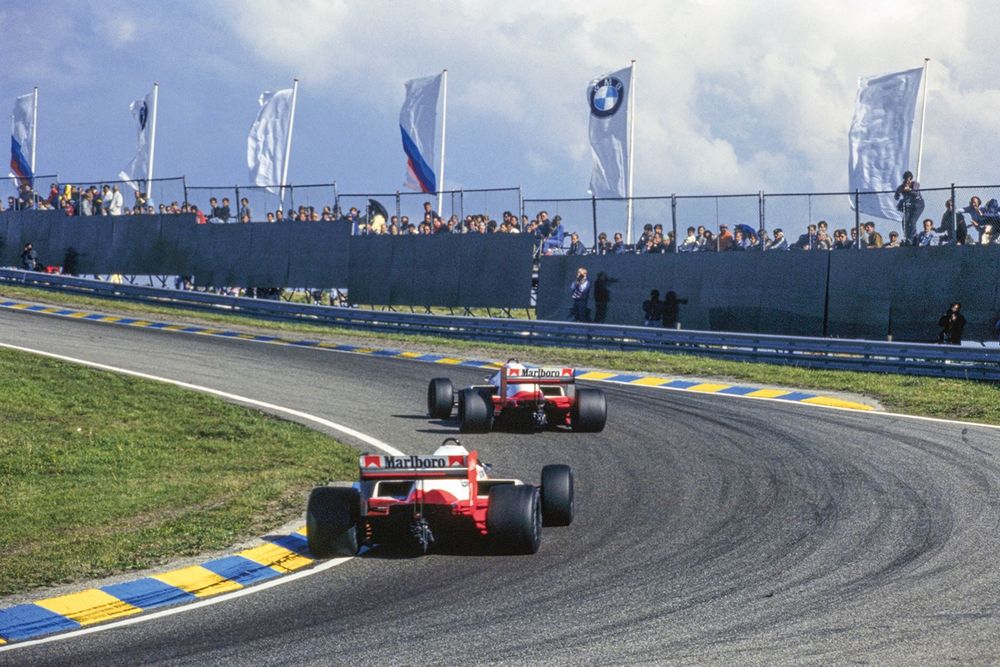
Do you agree with the order of this top 10?
Photo by: Ercole Colombo / Studio Colombo / Getty Images


Top 10 F1 cars of the 1970s

Top 10 F1 cars of the 1960s

Top 10 Italian F1 drivers

Top 10 F1 cars of the 1950s

Autosport magazine: Hamilton at Ferrari – and champions crowned

How the M8B became the most dominant car in McLaren’s history

Employing team orders can simply be a matter of common sense

The greatest F1 campaigns with no wins

Top 10 F1 cars of the 1980s

Formula E’s plan to win over skeptics as Gen4 hits the track

The Antonelli you don't know: Daily life with F1's newest champion

Piastri to receive 10-place grid drop at Las Vegas GP
Subscribe and access Autosport.com with your ad-blocker.
From Formula 1 to MotoGP we report straight from the paddock because we love our sport, just like you. In order to keep delivering our expert journalism, our website uses advertising. Still, we want to give you the opportunity to enjoy an ad-free and tracker-free website and to continue using your adblocker.


Top Comments