


When BMW added F1 'rocket fuel' to ignite Brabham's 1983 title push
There was an ace up the sleeve during the 1983 F1 title-winning season of Nelson Piquet and Brabham. It made a frontrunning car invincible for the last three races to see off Renault's Alain Prost and secure the combination's second world title in three years

Brabham and BMW had a secret weapon in the locker as the battle for the Formula 1 World Championship unfolded through 1983. It waited, waited, waited before deploying a development that ultimately set Nelson Piquet on course for the first title won by a turbocharged F1 car. It was a new blend of fuel that gave the in-line turbo four in the back of the Brabham BT52 a major increase in horsepower, with improved reliability to boot.
Piquet had scored an out-of-the-box victory at the Brazilian Grand Prix in March with the barely tested, Gordon Murray-designed BT52, but the combination of Brabham chassis and BMW engine was absent from the winner’s circle through the summer. Yet by the season’s end, the car, now in B-spec, was without doubt the fastest thing in the F1 field.
Piquet would have had a good shot at winning the Dutch GP at Zandvoort but for his controversial clash with championship rival Alain Prost’s Renault and then, over the final three races of the season at Monza, Brands Hatch and Kyalami, Piquet and team-mate Riccardo Patrese led every racing lap.
The BT52B had been introduced by Brabham on home ground at Silverstone in July. The car had a new livery – the dark blue and white of primary sponsor Parmalat were reversed – but the changes to the chassis were minimal. The big change came next time out on BMW’s home track at Hockenheim for the German GP.
That’s when BMW played the ace it had been holding up its sleeve. It was a development that Brabham and BMW wanted to deploy at a crucial moment of the campaign, remembers Roland Ast, Paul Rosche’s long-time subaltern in the engine department at BMW Motorsport in Munich.
“It was like a tennis match point,” he says. “We said that we had to have the benefit of this fuel in 1983. In F1 you can only have a secret for so many months. That is why we waited.”
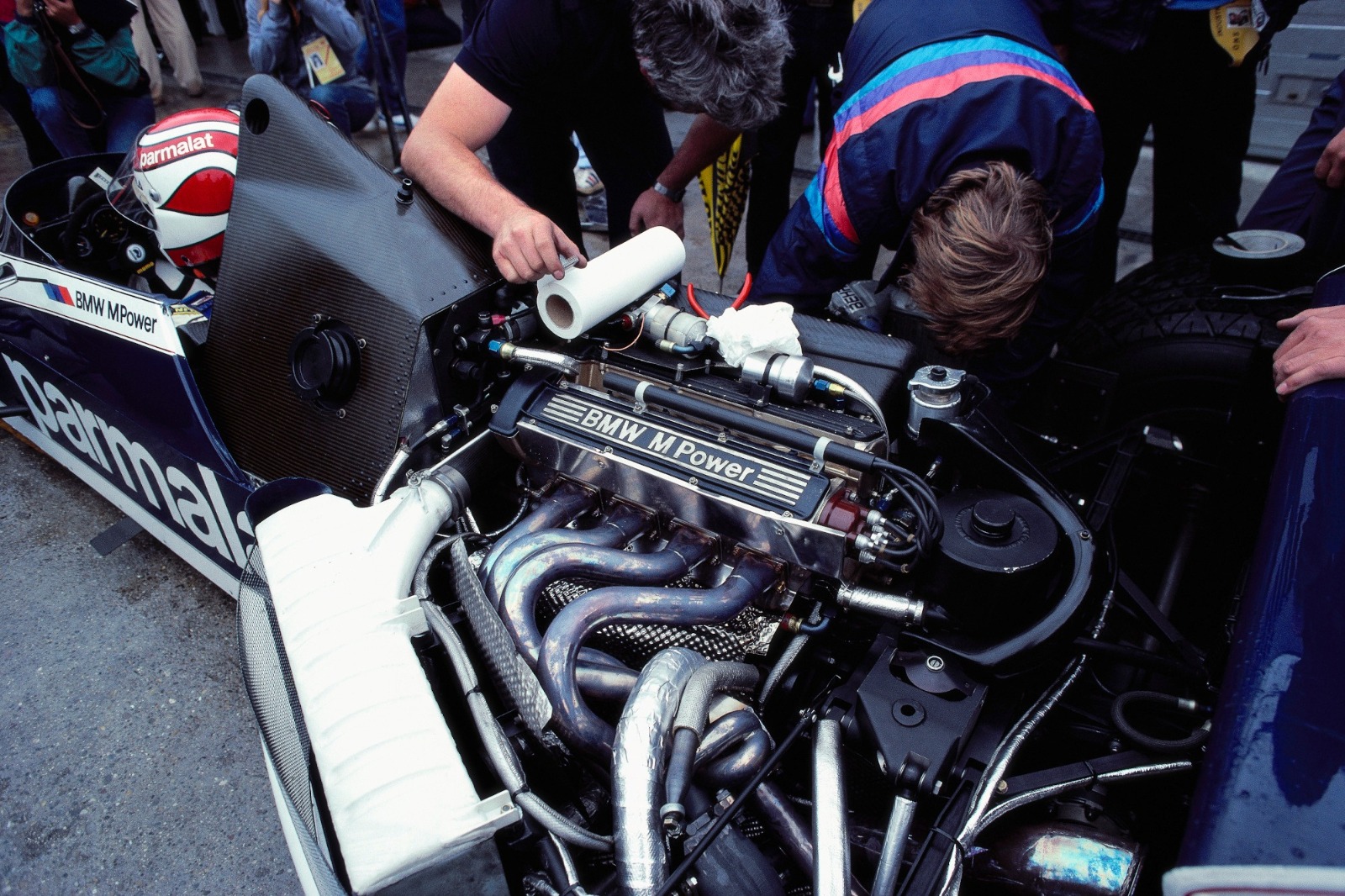
BMW kept its fuel plans secret for the majority of 1983 to avoid its rivals catching up
Photo by: Motorsport Images
BMW’s logic was that if they had introduced the fuel at the start of the season, by its end everyone would have had something similar and the advantages that came with it. They turned out to be correct. Development of designer fuels and turbo technology continued the following year as power outputs edged up towards and perhaps even beyond 1000bhp.
The new blend of petrol was quickly dubbed “Nazi rocket fuel” as it emerged over the final races that something a bit special was being pumped into the BMW engine. The term “first designer racing fuel” was more charitable. The two descriptions offer an insight into its make-up and its origins.
BMW Motorsport engine boss Rosche was forever striving to get more power from his four-cylinder engine, developed around an old cast-iron road-car block with its roots back in the 1960s. But attempts to put much more than 650bhp through the single-turbo motor led to detonation and catastrophic failure.
“Nelson had such an amazing feeling for what the car and the engine were doing. He knew exactly when to reduce the power of the engine to get it over the finish line” Roland Ast
He’d heard that Ferrari, whose V6 twin-turbo was generally reckoned to be the most powerful engine in F1, was experimenting with water injection to overcome the same problem. The only conclusion that he and his team came to when they followed suit at BMW Motorsport headquarters in Munich, he recalls, was that “water doesn’t burn”. It was, however, “the starting point of looking at what we could do with the fuel”.
Rosche recalled hearing stories about an unleaded aviation fuel developed in Germany during the Second World War by one of a group of companies that by the 1980s was under the umbrella of the BASF chemicals group. He was tasked with finding out about it and eventually he tracked down someone he calls “an expert on fuel”.
This expert, who worked at BASF subsidiary Wintershall, came up with the idea of a synthesised fuel that decreased the percentage of easily ignited hydrocarbon compounds in the mix and increased the amount of slower-burn compounds. This made the BMW engine less prone to detonation. It was the breakthrough that Rosche had been looking for. His four cylinders now pushed out some way in excess of 750bhp.
Piquet might have won the German GP. He had been closing on race leader Rene Arnoux’s Ferrari when a cracked filter sent fuel cascading over the turbo. A fire was inevitable, as was retirement, which came with the loss of at least six points. The filter in question, recalls Ast, “was the last production piece on the engine” save for the block.
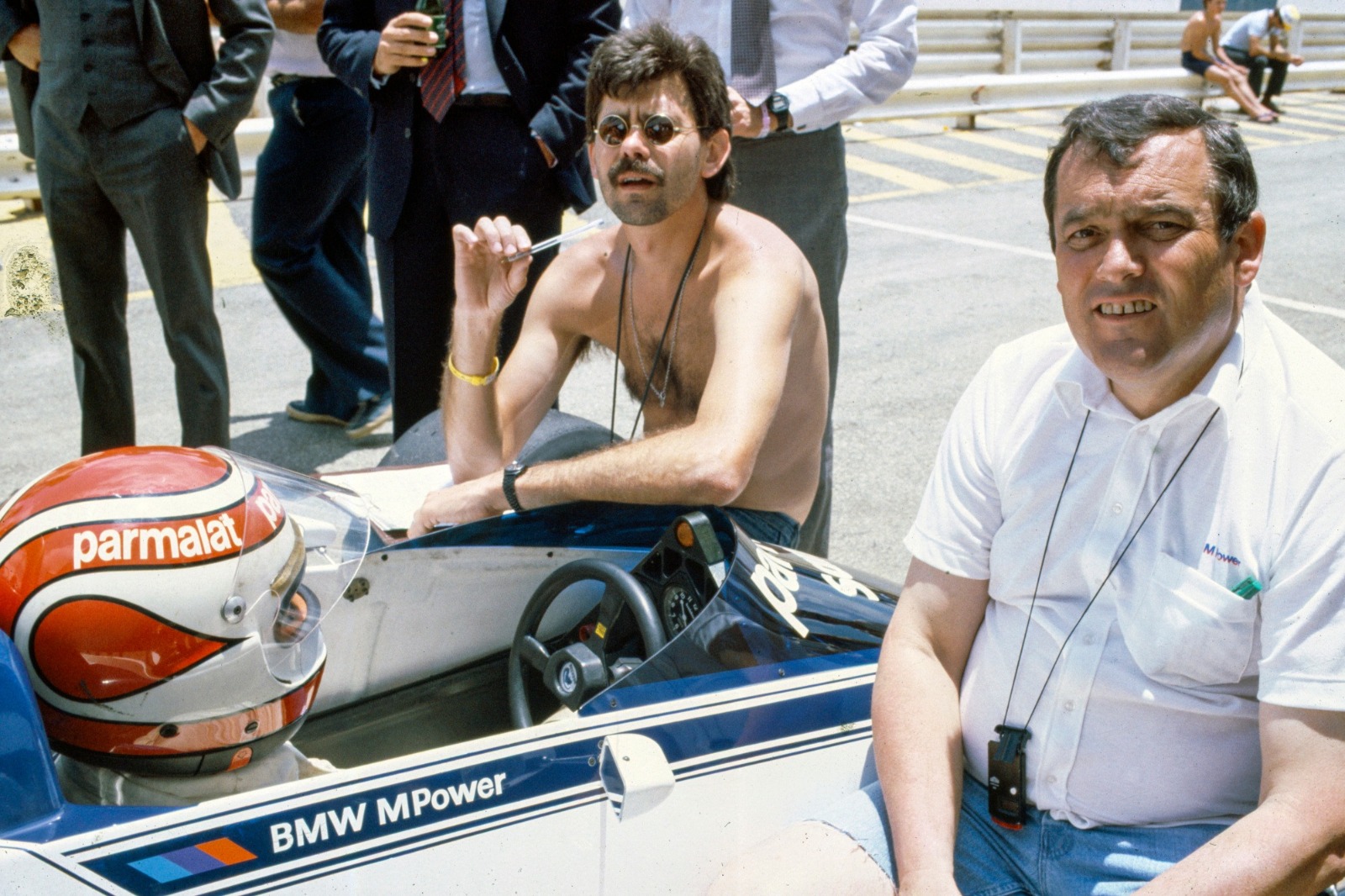
BMW man Rosche (right), with Murray and Piquet (in car), led the push to get more power from the engine with fuel trickery
Photo by: Motorsport Images
Piquet, Brabham and BMW did dominate over the championship run-in, but it wasn’t as simple as it looked from the outside. The victory at Monza that kick-started the Brazilian’s championship push was almost derailed by engine issues. Rosche and Ast knew there was some kind of problem, and couldn’t bear to remain on the pitwall as the laps counted down. Later, Rosche asked Murray over a weiss beer what Piquet had said. “Very high temperatures” came the reply. Yet Piquet had been able to nurse the car home to a 10-second victory.
“Nelson had such an amazing feeling for what the car and the engine were doing,” explains Ast. “He knew exactly when to reduce the power of the engine to get it over the finish line.”
Piquet famously backed off at the championship finale in South Africa, handing the lead to team-mate Patrese and then second place to Alfa Romeo driver Andrea de Cesaris on the way to third, still enough to seal the title by two points. He had dominated the opening laps but, after the retirement of Prost (who led the championship by the same margin going into the race), he was happy turn the boost down and bring the car home.
BMW had endured a difficult weekend prior to race day at Kyalami. The engine struggled in the thin air at the circuit’s 5000ft altitude. A detonation problem resulted in a series of engine failures through a test day the day before the GP meeting started, and then through practice and qualifying.
“The night before the race, out in the grass behind the pits, there was Paul with an engine pulled to pieces,” recalls Murray. “We had been running very lean and kept blowing up, and he had the guys turn the engine upside down while he was scrabbling around on the grass looking up into the bores.”
Rosche’s solution was to modify the injectors to get more fuel into the engine. It was a suck-it-and-see solution. He reckoned somewhere between five and 10% more fuel was required – so he plumped for 7.5%.
“I really do think Paul was a genius: he was one of those guys who could think outside the box,” adds Murray. “Paul wasn’t afraid of getting his hands dirty and he could dream up camshaft profiles in his sleep.”

Piquet dominated the final three races to scoop the 1983 title, but it wasn't as easy as it looked from the outside
Photo by: Motorsport Images
Sleep was something that Murray hadn’t got a lot of over the winter of 1982-83. The BT52 was designed in a hurry, because the successor of the first bespoke BMW-powered Brabham, the BT50, was already designed, built and tested when the team received a bombshell in November 1982.
Jean-Marie Balestre, the autocratic president of governing body FISA, had been pushing to outlaw ground-effect, or rather a ban on underside Venturi sections. Brabham boss Bernie Ecclestone had assured Murray that he wouldn’t get his way in the face of opposition from the British garagistes. But get his way Balestre did. The new rules, made in the name of safety, were finalised as late as November, the only concession to the teams’ schedules being the postponement of the original season opener at Kyalami from January to October.
"I lengthened the wheelbase and moved everything as far back as I could, and that’s the figure we ended up with. If I could have gone to 10%, I would have. My feeling was that we should concentrate on engine power and the pitstops" Gordon Murray
The BT51 was now scrap – and indeed the two cars built were crushed on Ecclestone’s order – and Murray had to go back to the drawing board. And that’s where he pretty much stayed for the next three months. Murray, long-time right-hand man David North and draughtsman Paul Burgess had to work day and night to complete what wasn’t just an all-new design, but also an all-new concept.
“I was living on tablets,” recalls Murray. “I went to the doctor and said, ‘Give me something to keep me awake’. I didn’t have a life outside motor racing.”
The BT52 was, he continues, “a very different motor car” to those that preceded it. Murray says that without ground-effect he opted to “turn the clock back 10 years”.
The Cosworth-engined BT49, which Piquet had taken to his first world title in 1981, and then the BT50 had in the region of two tonnes of downforce, he explains.
“That meant traction wasn’t an issue except at somewhere like Monaco with all its slow corners,” he explains. “But take away that downforce, and with all the power from a turbo engine F1 was suddenly a traction game again.”
That’s why the weight distribution of the BT52 ended up being moved back by 7% over its predecessors.
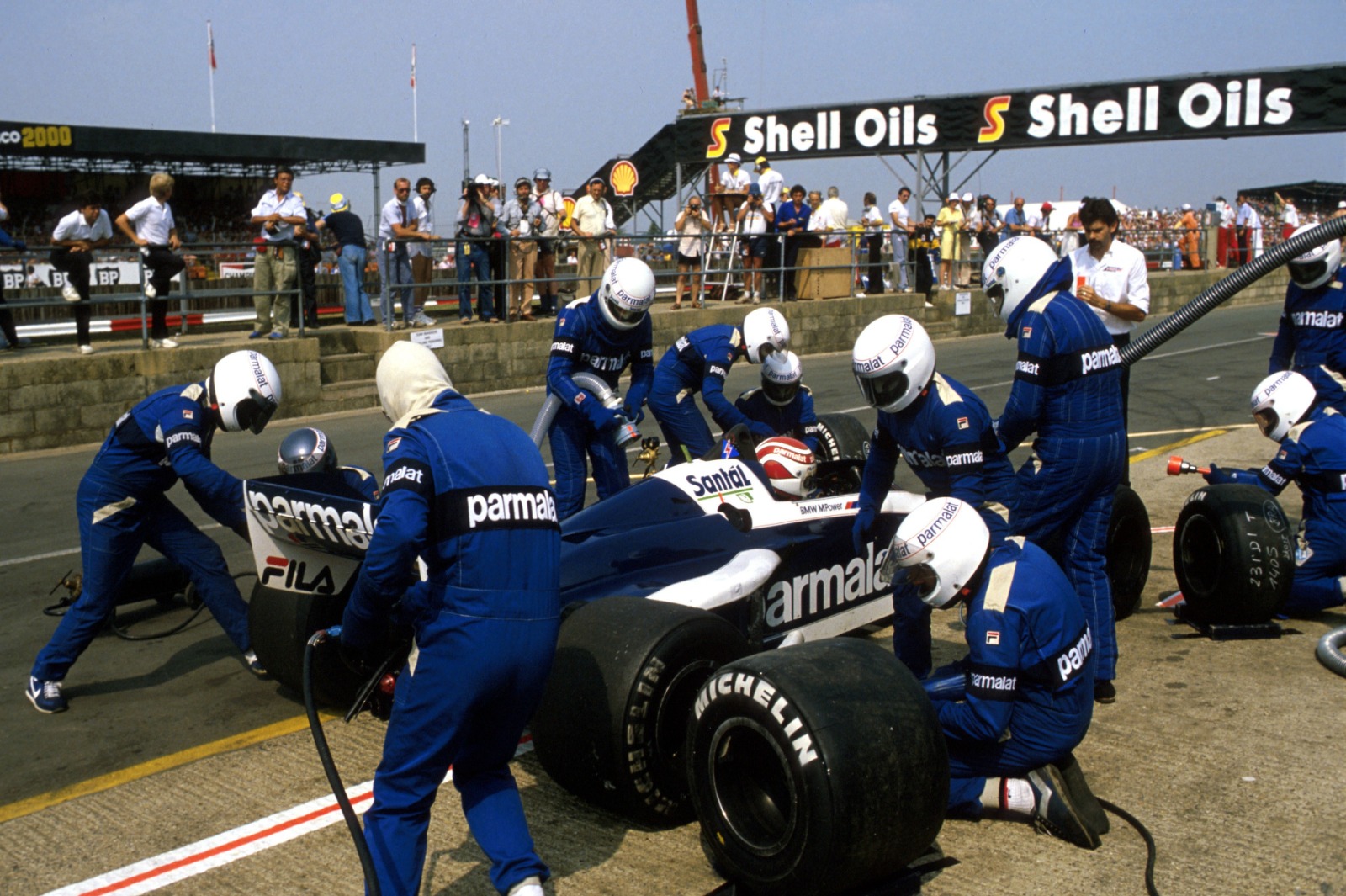
Brabham had brought fuel stops back into fashion in 1982, and this was fundamental in the BT52's rushed design
Photo by: Motorsport Images
“I didn’t say I wanted to move everything back by 7%,” states Murray. “But I lengthened the wheelbase and moved everything as far back as I could, and that’s the figure we ended up with. If I could have gone to 10%, I would have. My feeling was that we should concentrate on engine power and the pitstops.”
That explains not only the limited fuel capacity of the 1983 Brabham – it couldn’t do a full grand prix distance without a mid-race fuel stop, which Brabham had reintroduced to F1 midway through 1982 – but also the simplicity of the car.
“It was pretty non-adjustable,” he explains. “The front wing’s main plane was non-adjustable, so all you could change were the flaps. The rear wing was fixed apart from the Gurney, and it had no rear anti-roll bar. I didn’t want to fiddle with the car.”
Murray insists that the “key advantage of that car was in terms of traction”. And that enabled it to exploit the increase in power that came from that new brew of fuel out of Germany.

Piquet secured his second world championship with Brabham, but the team's relationship with BMW had been fragile
Photo by: Motorsport Images
How Piquet held Brabham and BMW together
The partnership between Brabham and BMW yielded the drivers’ title in 1983, but it was initially an uneasy relationship. It might have fallen over any number of times but for the glue between the two companies provided by Nelson Piquet.
There are tales of the Brazilian pounding around in a recalcitrant BMW-powered car over the winter of 1981-82 while new team-mate Riccardo Patrese set sub-lap-record times in a Cosworth-powered BT49. Piquet knew that the writing was on the wall for the normally aspirated F1 engine, and quickly forged a close working relationship with Paul Rosche.
“Paul and Nelson were like father and son,” says Roland Ast. “He really believed in the technology of turbocharging – and understood it, too. Everyone always says that without Nelson, we wouldn’t have won the world championship in 1983. They are right.”
It was Piquet who stuck with the BT50 after Brabham swapped back and forth between its turbo and normally aspirated cars through the opening races of the 1982 season. He famously non-qualified for the Canadian Grand Prix when he encountered engine problems in the only dry qualifying session, and then followed it up with a first victory for the BMW turbo engine just a week later in Detroit. Patrese raced the BT49 both times.
Brabham reverted to the Cosworth-powered BT49 for Brazil. BMW put out a press release on the announcement of that move titled “BMW Formula 1 engine too fast for Brabham chassis”
Brabham and BMW had forged a relationship during the 1980-81 off-season. A test mule based on the same chassis as the 1981 Brabham-Cosworth BT49C in which Piquet took his first world title was up and running early in the new season. The first iteration of the BT50 then took part in the meeting at Silverstone: Piquet set a time that would have been good enough for third on the grid, just slightly slower than he managed in his regular car to take the same position.
But after a torrid winter of testing in 1981-82, the relationship was straining. Following a disappointing debut for the definitive BT50 in the 1982 season opener at Kyalami, Brabham reverted to the Cosworth-powered BT49 for Brazil. BMW put out a press release on the announcement of that move titled “BMW Formula 1 engine too fast for Brabham chassis”.
Behind the press statement, Brabham boss Bernie Ecclestone and his opposite number at BMW Motorsport, Dieter Stappert, had cut a deal: the BT50 had to be back on the grid on the commencement of the European season at Imola in April. There was another terse press release from BMW when Brabham skipped the San Marino GP as part of the boycott by the teams aligned to the Formula One Constructors’ Association led by Ecclestone in one of the final exchanges of its long-running war with governing body FISA. This time it stated that BMW would “terminate its co-operation” with the team if there weren’t two BT50s on the grid for the Belgian GP at Zolder.
Just a month later, Piquet’s victory on the streets of Detroit proved to be the turning point. Brabham and BMW were on the road to world championship glory.
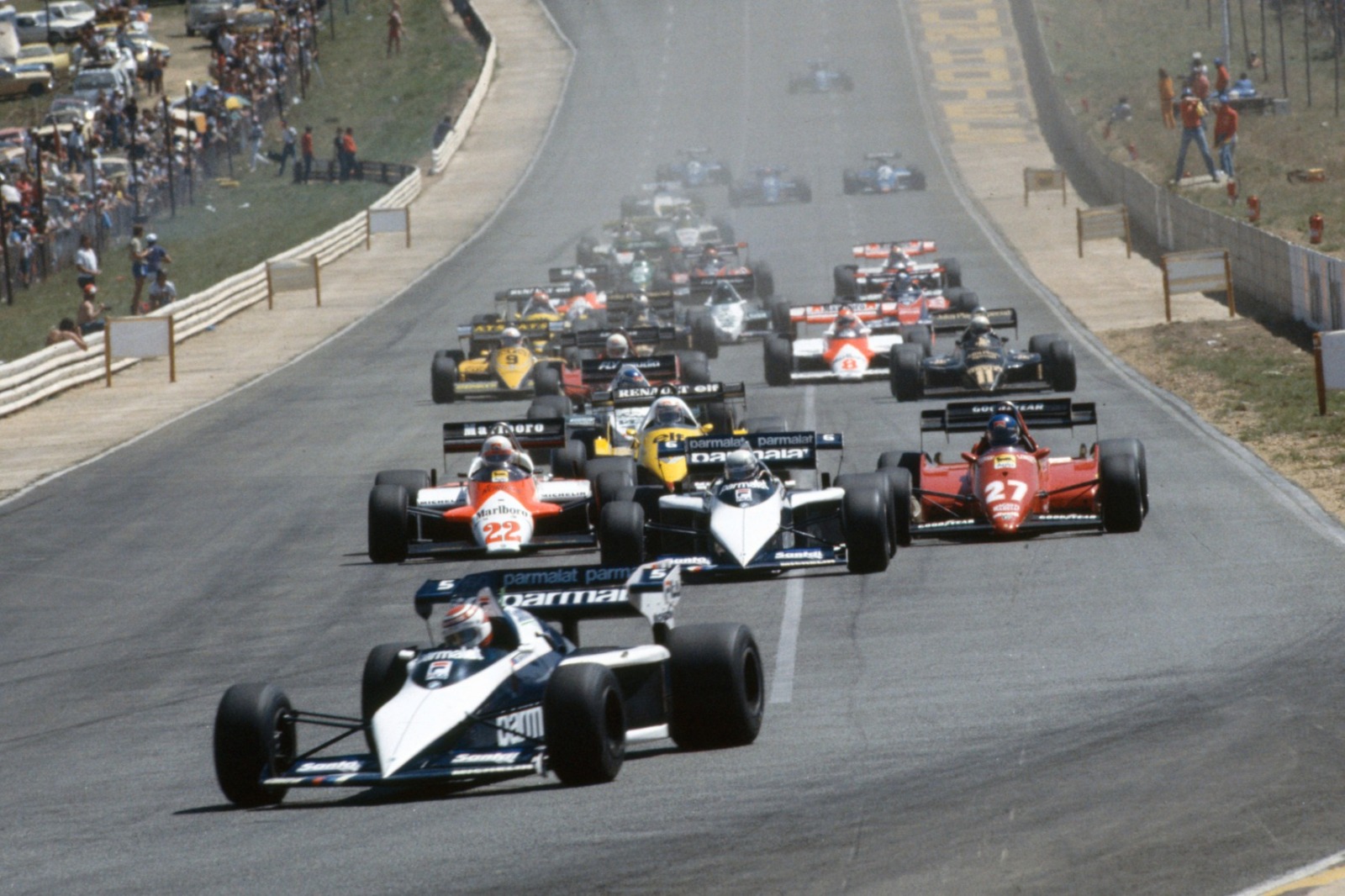
Piquet's faith in BMW and close cooperation with Rosche was rewarded after a difficult spell that included Canada 1982 DNQ
Photo by: Motorsport Images


How Ford is "hitting milestones" in preparation for WEC Hypercar assault

How Porsche Penske finally broke its Petit Le Mans duck

Why there’s no perfect solution to the WEC safety car conundrum

How an “informed gamble” enabled Toyota to beat Alpine in the Fuji 6 Hours

The hope for Lola’s comeback and what it could mean

Why Lola has got big ideas for its future

The debate on whether WEC prioritised 'entertainment' over 'sport' in Austin

Shwartzman to make WEC return with Peugeot

Employing team orders can simply be a matter of common sense

Grant moves back to top of Autosport National Rankings

Why Horner sees history repeating itself for Newey at Aston Martin

Excelr8 takes on 16-year-old to join Ingram for BTCC 2027
Subscribe and access Autosport.com with your ad-blocker.
From Formula 1 to MotoGP we report straight from the paddock because we love our sport, just like you. In order to keep delivering our expert journalism, our website uses advertising. Still, we want to give you the opportunity to enjoy an ad-free and tracker-free website and to continue using your adblocker.


Top Comments