


Top 10 F1 cars of the 1970s
From ground effects to turbochargers, F1 car development exploded across the 1970s which meant no one car stayed dominant for long. So when one did, it was clearly a special design

Autosport Retro
Telling the forgotten stories and unearthing the hidden gems from years gone by.
Aerodynamic, engine and tyre advancements were key features of Formula 1 in the 1970s. While the Cosworth DFV remained competitive, the 1970s ended with the arrival of turbo technology, while downforce increased significantly since the 1960s.
For the latest list in our series on the top 10 F1 cars of each decade, we look at the era fought out by Tyrrell, Lotus, McLaren and Ferrari.
As ever, we have looked at each car’s level of achievement, how innovative they were, the quality of the opposition, and their impact on grand prix racing. Some of the greatest designs of the 1970s remained competitive for several seasons, so longevity has also been considered.

10. Renault RS10

Renault celebrate the first victory for a turbocharged engine in F1
Photo by: Sutton Images
Wins: 1
Poles: 5
Titles: 0
There were cars that scored more success – indeed, the Ligier JS11 that raced against the Renault won three races in 1979 and finished ahead in the championship table – but the RS10 has its place in F1 history as the first turbocharged design to win a grand prix. Turbos would change the face of the sport in the 1980s, so the RS10 makes it into our list almost on significance alone.
Renault’s first turbo F1 car, the RS01, was initially ridiculed but the French manufacturer stuck to its task, with Jean-Pierre Jabouille doing much of the development work. He took Renault’s first F1 pole in the high altitude of Kyalami in 1979 before the RS10 arrived for Jabouille and team-mate Rene Arnoux.
Reliability remained a problem, but the Renault showed its pace and pointed to the future with five poles. And on 1 July 1979, Jabouille overcame early leader Gilles Villeneuve’s Ferrari to take French GP victory at Dijon.
Arnoux finished third that day after a famous late battle with Villeneuve and would add second places at Silverstone and Watkins Glen. Renault ended up only sixth in the constructors’ standings but the turbocharged F1 car had gone from a joke to a serious contender – and it would eventually make the legendary Cosworth DFV obsolete.
9. Brabham BT44

The Brabham BT44 is considered one of the best-looking F1 cars
Photo by: Motorsport Images
Wins: 5
Poles: 2
Titles: 0
Designer Gordon Murray reckons his BT44 could have been a championship contender had Brabham’s focus not drifted elsewhere. It’s regarded as one of the best-looking F1 cars and it scored a decent amount of success.
The car had good downforce for the time and Carlos Reutemann scored three wins in 1974, his Watkins Glen success from pole being backed up by team-mate Carlos Pace in second. Reliability had sometimes been suspect, so Reutemann was only sixth in the points despite taking as many victories as champion Emerson Fittipaldi, while Brabham was fifth in the constructors’ table.
The refined BT44B, now resplendent in Martini livery, was more consistent in 1975 but had fewer peaks. Reutemann racked up six podiums and climbed to third in the championship, but there was only one win – albeit by over a minute and a half at the Nurburgring.
Pace also took a fortuitous victory on home ground in Brazil and Brabham pipped McLaren’s mighty M23 to second in the points, behind dominant champion Ferrari.
The car continued in private hands into 1976 but there was no more success, leaving its final tally at 14 podiums.
8. Tyrrell 006

Tyrrell's 006 gave Stewart his third drivers' crown but never took a constructors' title
Photo by: Motorsport Images
Wins: 5
Poles: 3
Titles: 1 (1973 drivers’)
Placing the stubby 006 in this list is tricky. It did win a world title and scored three 1-2s, but all its wins were taken by Jackie Stewart – undoubtedly the best of the time – and the Lotus 72 and McLaren M23 were both arguably faster, or at least easier to drive.
Nevertheless, the Derek Gardner design went head-to-head with those two great F1 cars and scored five victories. One of those, in South Africa, came from 16th on the grid, while rising star Francois Cevert scored seven podiums in 1973 to go with the one he had taken in the new 006 at the end of the previous season.

That wasn’t quite enough to take the constructors’ crown, which went to Lotus. But whereas Stewart took all of Tyrrell’s wins, Lotus team-mates Fittipaldi (three) and Ronnie Peterson (four) split the 72’s successes between them. That, plus a combination of the Scot’s relentless consistency and some unreliability for Lotus, meant Stewart was able to pull off a brilliant third drivers’ crown.

Sadly, Tyrrell’s season ended in tragedy as Cevert was killed during practice for the Watkins Glen finale, leaving Stewart to retire from F1 a race earlier than planned.
Tyrrell ran the 006 in a handful of races in 1974 but neither Jody Scheckter nor Patrick Depailler could do much with it and the team only returned to the front when the 007 arrived.

7. Ferrari 312T4

Ferrari's 312T4 shone in 1979 as its rivals faltered
Photo by: Motorsport Images
Wins: 6
Poles: 2
Titles: 2 (1979 drivers’ and constructors’)
The two best incarnations of the 312B series – the original 1970 car and the heavily revised 312B3-74 – almost made this list. But neither quite managed to take a title, while the reliable 312T4 did so against strong and varied opposition.

Mauro Forghieri substantially revised the T3 to create the T4, with the main aim being to harness ground effect as pioneered by Lotus. The width of the flat-12 engine was a limitation but, with everyone trying to follow suit and Colin Chapman himself going down a blind alley with the Lotus 80, the 312T4 proved effective.
It appeared for round three in South Africa, where Villeneuve led home team-mate Scheckter for a 1-2. They repeated the feat next time out at Long Beach to take the lead in both championships.

Scheckter then won in Belgium and at Monaco, so the 312T4 had won four of its first five GPs. But after Jabouille’s breakthrough victory for Renault in France, Alan Jones and the Williams FW07 came on strong.
While Villeneuve tended to perform the heroics, it was Schecker who kept racking up the points. Villeneuve battled Jones at Zandvoort before dramatically retiring with a flailing wheel after a puncture, but Scheckter recovered from a bad start to finish second.
Next time out, Villeneuve dutifully followed Scheckter in a 1-2 at Monza as Ferrari sewed up both championships. Villeneuve was then a brilliant second to Jones in Canada and won the wet season finale in the United States, leaving the 312T4’s final tally of 13 podium finishes from 13 races.
The limitations of the T series in the ground-effect era were laid bare in 1980 as the 312T5 proved uncompetitive and Ferrari slumped to 10th in the standings. But the 312T4 had done the job in its brief window of opportunity.

6. Lotus 78

Unreliability let down the Lotus 78's clear potential
Photo by: Rainer W. Schlegelmilch / Motorsport Images
Wins: 7
Poles: 9
Titles: 0 (but contributed to 1978 drivers’ and constructors’)
The Lotus 78 has to be one of F1’s most significant cars that didn’t win a title, though Mario Andretti did start his successful 1978 campaign with it before the 79 came along.
After a dire time trying to replace the super-successful 72 and a winless 1975, Lotus boss Chapman got his team to investigate what the future of F1 design could be and the key development was ground effect, channelling (and sealing) the air under the car in such a way as to create downforce.
The 78 was the fastest car of 1977. Andretti took more poles (seven), more fastest laps (four) and led more laps (25%) than anyone else, but ended up third in the points. Unreliability, often with the development Cosworth DFVs the car probably didn’t need, scuppered his title challenge. Lotus was also beaten to the constructors’ crown by Ferrari.
Nevertheless, the 78 still won five races – four for Andretti and one with Gunnar Nilsson – and pointed the way ahead.

Andretti opened 1978 with a win in Argentina and new team-mate Peterson took a last-gasp victory in South Africa before the Lotus 79 arrived.
Peterson’s second place – to Andretti in the 79 – in Belgium would have been a fine way for the car to sign off in works colours. Unfortunately, there would be one more start, after Peterson’s 79 was damaged in practice at Monza.
The Swede’s 78, essentially the team’s spare car, was involved in a multi-car accident at the start of the Italian GP and Peterson later succumbed when complications set in. It was a sad end for a great driver and ground-breaking car.
5. Tyrrell 003 (includes 002)

Stewart was unstoppable in the Tyrrell 003
Photo by: Rainer W. Schlegelmilch / Motorsport Images
Wins: 9
Poles: 6
Titles: 2 (1971 drivers’ and constructors’)
The Gardner-designed 001, developed in secret, made Tyrrell a constructor rather than ‘just’ a team and burst onto the scene in late 1970. It proved rapid but fragile and was replaced by 003, with aero and monocoque tweaks, at the 1971 Spanish GP.
Stewart immediately reeled off five wins from six rounds, only losing out on a wet day at Zandvoort when Firestone tyres were the things to have rather than his Goodyears. His Montjuic victory was scored despite no other DFV-powered runners being competitive, while he proved unbeatable at Monaco despite no rear brakes…
The Tyrrell was so good at the French GP, where a high air box to feed the DFV and stub nose helped it reach impressive speeds down Paul Ricard’s Mistral Straight, that there were mutterings from Ferrari about legality. Nothing untoward was found and Tyrrell finished 1-2.
With other early Tyrrells, it is difficult to know how much of the success was the car and how much Stewart, but with the 003 design things are more clearcut. Not only was Stewart’s title emphatic, but team-mate Cevert drove the similar 002 to victory at Watkins Glen and finished third in the championship.
With seven wins, six poles and 60% laps led, Tyrrell’s 1971 campaign was easily its best as a constructor.
Stewart also used 003 early in 1972, winning in Argentina and France. For the above stats, we have included Cevert’s results in 002, which was essentially the same but longer to accommodate the taller Frenchman. We haven’t included the poles scored by Stewart in 001.
4. Lotus 79

The Lotus 79 nailed the ground effects concept
Photo by: David Phipps
Wins: 6
Poles: 10
Titles: 2 (1978 drivers’ and constructors’)
If the Lotus 78 was the car that introduced ground effect to F1, it’s the 79 that really nailed it and delivered the championships the concept deserved.
The 79 was a neater, sleeker take on the idea for 1978, revised bodywork increasing the venturi effect and allowing Lotus to downsize the rear wing to produce less drag. The car made its world championship debut in round six at Zolder. Andretti took pole by 0.79 seconds and led every lap on his way to victory – ahead of team-mate Peterson in a 78!
Lotus would only be beaten to pole once over the remaining 10 rounds and the 79 would win six times in total. Its defeats were usually down to unreliability or the odd incident, aside from coming up against the infamous Brabham BT46B ‘fan car’ in Sweden and Andretti’s rather harsh jump-start penalty in Italy.

There were three 1-2s and Andretti took the title with two rounds to spare, while Lotus finished well clear of Ferrari in the constructors’ table (despite the Italian team’s groundbreaking Michelin radial tyres).
The 79, now in Martini livery instead of JPS colours, continued into 1979. Thanks to the Lotus 80 proving a failure, the 79 was used throughout the campaign, but the opposition had caught up. Reutemann scored four podiums but there were no more wins and Lotus went from taking a title double to finishing fourth in the constructors’ table.
3. McLaren M23

Developments and a long lifespan meant the M23 took a title double in 1974 and Hunt's drivers' crown in 1976
Photo by: Motorsport Images
Wins: 16
Poles: 14
Titles: 3 (1974 drivers’ and constructors’, 1976 drivers’)
Gordon Coppuck’s M23, with chisel nose and side radiators following the lead of the Lotus 72 and his own M16 Indycar, arrived with a bang in 1973. Denny Hulme, who had never previously scored a pole position in his world championship career, took top grid spot on the M23’s debut at Kyalami.
Victories followed for Hulme in Sweden and for Peter Revson in the British and Canadian GPs. Up-and-comer Scheckter also gained notoriety in the M23, first by leading in France on his third GP start and then by triggering a multi-car crash at Silverstone.
Hampered by engine and tyre issues, McLaren ended up third in the constructors’ table and got two big boosts for 1974. The first was 1972 world champion Fittipaldi arriving from Lotus and the second was the Marlboro sponsorship the Brazilian brought with him.
With Stewart having retired, there was a battle to replace the reigning world champion at the top of the sport. Ferrari’s Niki Lauda was arguably the fastest, but it was Fittipaldi’s three wins and consistency that took him to the drivers’ crown, boosted by mid-season suspension changes. Hulme also took victory in Argentina, and McLaren secured its first constructors’ title, narrowly beating Ferrari.
Fittipaldi and the M23 remained competitive in 1975, taking two wins, but Lauda and the new Ferrari 312T were too strong. McLaren even lost out to Brabham in the constructors’ contest.
The M23 was extensively developed throughout its life, with multiple wheelbases being tried, and entered a fourth frontline season in 1976. Fittipaldi made a shock departure and was replaced by James Hunt, who grabbed the M23 by the scruff of its neck.
Hunt would probably have been a fine second in the championship had Lauda not suffered his horrific fiery crash in the German GP. Hunt won that race, then took a fourth place and another victory (at Zandvoort) prior to Lauda’s heroic return.

When Lauda withdrew from the wet Fuji finale and Hunt charged to third after a late tyre stop, the M23 took its second drivers’ title. It could not, however, prevent Ferrari retaining its constructors’ crown.
The M23 would finally be replaced by the M26 during 1977 but not before Hunt had taken three remarkable poles. That meant the M23 was competitive into its fifth campaign, being retired after 38 podium finishes.

2. Ferrari 312T/312T2

The Ferrari 312T2 has the most podiums on this list
Photo by: Motorsport Images
Wins: 17
Poles: 15
Titles: 5 (1975 drivers’ and constructors’, 1976 constructors’, 1977 drivers’ and constructors’)
Lauda’s arrival in 1974 gave Ferrari a much-needed boost and he formed a strong relationship with designer Forghieri and boss Luca di Montezemolo. The 312B3-74 proved rapid in 1974 and the flat-12, 500bhp 312T moved things on the following season.
The transverse gearbox was a key feature that improved weight distribution and the whole package worked. Lauda won the non-championship BRDC International Trophy, took pole for the car’s second championship GP outing in Spain, then reeled off four wins and a second place in the next five rounds. Team-mate Clay Regazzoni won at Monza and both titles had already been wrapped up when Lauda took his fifth win of the campaign in the Watkins Glen finale.

Ferrari continued that form into 1976, Lauda winning the first two races and finishing second to Regazzoni in round three at Long Beach. The revised 312T2 then arrived, the most obvious visual difference being the lack of a high air box following a rule change.
Lauda was second to Hunt in Spain (eventually, once the legality of the M23 had been confirmed), won in Monaco and Belgium, and was third in Sweden. Although controversially beaten by Hunt in the British GP – a victory Lauda would inherit months later – Lauda looked on course for the title when F1 headed to the Nurburgring for round 10 of 16.

Lauda’s life-threatening accident allowed Hunt to pip him to the drivers’ crown despite the Austrian’s incredible return, but Ferrari still beat McLaren in the constructors’ championship, each having taken six wins.
Like several cars on this list, the design was developed during its life and the 1977 312T2B had suspension and aerodynamic tweaks. It was no longer the fastest car, particularly once the ground effect Lotus 78 got into its stride, but it was reliable and the canny Lauda took the drivers’ title with three wins and seven other podiums. He then left the team with two rounds to go but Ferrari comfortably took the constructors’ crown for the third year in a row.
Reutemann even managed to win the Brazilian GP early in 1978 before the car was replaced and the 312T/312T2’s final tally of 41 world championship podiums is the highest of any on this list.
The subsequent 312T3, which had a new monocoque and substantial other revisions that mean its statistics aren’t counted above, took four wins in 1978.
1. Lotus 72
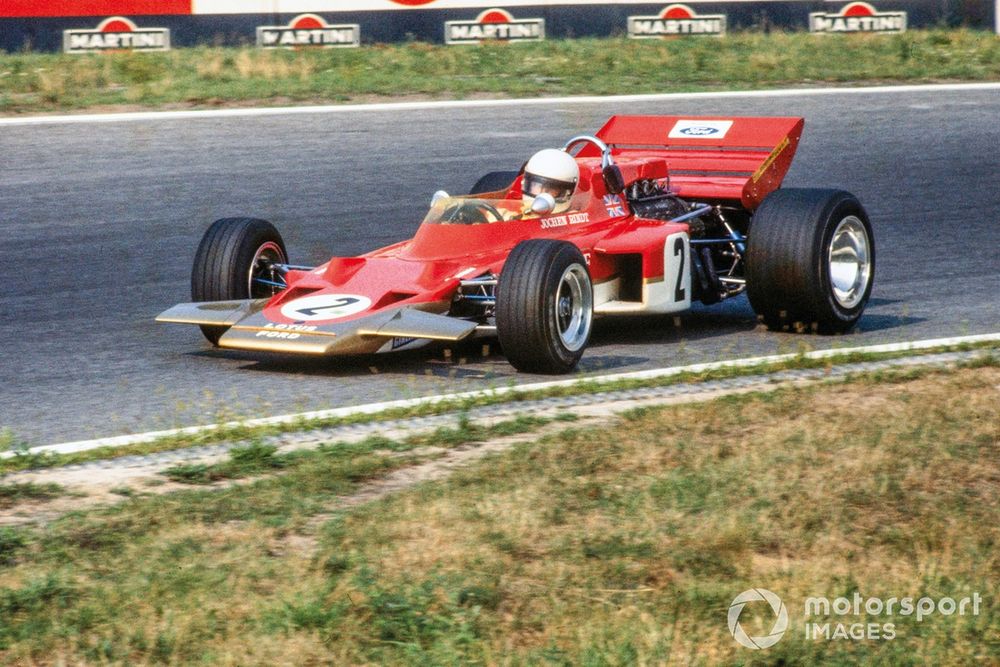
Lotus 72: The car that would change F1 forever
Photo by: David Phipps
Wins: 20
Poles: 17
Titles: 5 (1970 drivers’ and constructors’, 1972 drivers’ and constructors’, 1973 constructors’)
Chapman’s Lotus 72 brought the chisel nose and side radiators – which improved airflow, changed the weight distribution to help traction and boosted straightline speed – to F1 and single-seaters. Some of the other elements, such as the soon-removed anti-dive/anti-squat suspension, were more troublesome but the design had such potential that it remained competitive for five seasons.
Jochen Rindt gave the car its world championship debut at the 1970 Spanish GP but switched back to the ageing 49C for a couple of races while the bugs were ironed out. Once they were, Rindt reeled off four straight wins – a dominant one at Zandvoort, fortuitous ones at Clermont-Ferrand and Brands Hatch, then topping a close duel with Jacky Ickx’s Ferrari at Hockenheim.
That meant the Austrian had a big championship lead and no one was able to catch him even after Rindt was killed in a practice crash at Monza. A young Fittipaldi won the US GP, ending Ickx’s championship hopes, while Lotus pipped Ferrari to the constructors’ crown.
Tyre developments, notably the arrival of Firestone slicks, and perhaps Chapman’s focus on the Lotus 56 turbine hampered the 72 in 1971, but Fittipaldi and the car – now in JPS livery and with revised suspension and air box – were ready the following year. Five wins – plus three in non-championship events – and three other podiums brought the Brazilian the crown.
Though Lotus also won the constructors’ championship, second driver Dave Walker had struggled. Peterson was brought in for 1973 and, once early struggles had been overcome, was arguably the fastest driver of the season in the now Goodyear-shod 72E.
Peterson took four wins and nine poles from the 15 races, but Stewart’s excellent campaign for Tyrrell brought him the crown. Indeed, thanks to his fine start, Fittipaldi ran Stewart closer and was disgruntled that Chapman did not order Peterson to allow him past to win at Monza, which would have kept the title fight alive.
Lotus retained its constructors’ crown but not Fittipaldi, who left for McLaren. Peterson stepped up to take three brilliant wins in 1974, after the unloved 76 had been abandoned, but the design was finally showing its age.
There were no more wins in 1975 and Lotus slumped to seventh in the standings, though Ickx gave the 72 its 39th and final world championship podium finish in Spain. The 72 had been so good that it not only changed F1 design but also proved difficult for even Chapman to replace.


Do you agree with this top 10?
Photo by: David Phipps


Top 10 F1 cars of the 1960s

Top 10 Italian F1 drivers

Top 10 F1 cars of the 1950s

Autosport magazine: Hamilton at Ferrari – and champions crowned

How the M8B became the most dominant car in McLaren’s history

Employing team orders can simply be a matter of common sense

The greatest F1 campaigns with no wins

Top 10 F1 results changed by backmarkers – the passes
Top 10 F1 cars of the 1970s

What the Brazilian GP revealed about F1's ability to cope with rain

Bagnaia undergoes successful surgery on double foot fracture

Double Mini champion gets big BTCC break for 2027
Subscribe and access Autosport.com with your ad-blocker.
From Formula 1 to MotoGP we report straight from the paddock because we love our sport, just like you. In order to keep delivering our expert journalism, our website uses advertising. Still, we want to give you the opportunity to enjoy an ad-free and tracker-free website and to continue using your adblocker.


Top Comments