


Top 10 F1 results changed by backmarkers – the clashes
The times an F1 race leader lost the eventual victory due to a clash with a backmarker

Autosport Retro
Telling the forgotten stories and unearthing the hidden gems from years gone by.
It doesn’t happen very often but every now and again backmarkers play a key role in the outcome of Formula 1 races.
Blue flags and tough penalties for lapped runners who get in the way mean that incidents such as that between Oscar Piastri and Carlos Sainz at this year’s Hungarian Grand Prix happen rarely, but traffic used to be a bigger problem in F1.
Backmarkers can clearly change the course of a race in several ways, including causing safety car periods at crucial times and inadvertently (or otherwise!) creating overtaking opportunities for the leaders. But for this list, we’ve looked at the times that contact between frontrunner and backmarker has changed a race’s outcome.
It’s probably fair to say the ranking itself shouldn’t be taken too seriously – just how do you rate how ‘great’ (or otherwise) a backmarker clash is? We’ve loosely ranked them on drama and significance.
Oh, and a dishonourable mention to Andrea de Cesaris for taking out Scuderia Italia Dallara team-mate Alex Caffi when the latter was on his way to at least fifth in the 1989 United States GP!
10. 2006 Hungarian GP - Kimi Raikkonen and Vitantonio Liuzzi

Raikkonen retiring paved the way for Button's maiden win
Photo by: Getty Images
The rain-hit and dramatic 2006 Hungarian GP is largely remembered as the race in which Jenson Button finally ended his F1 duck, but it was Raikkonen’s McLaren that led the early stages.
PLUS: Jenson Button's greatest F1 races
While Button and Fernando Alonso made their way up from lowly grid positions, Raikkonen took command from pole. Michelin tyres were the things to have and Raikkonen was nearly 7s ahead – albeit with Alonso chipping away at the gap – when the Finn pitted on lap 17 of 70.
Raikkonen rejoined second but struggled with understeer on his second set of tyres and couldn’t match Alonso’s pace. He also had team-mate Pedro de la Rosa closing when he came up to lap Liuzzi’s Toro Rosso on lap 26.
Coming out of Turn 5, Raikkonen misjudged his closing speed as Liuzzi backed off to allow him by, Kimi perhaps looking for de la Rosa in his mirrors, and smashed into the back of the Italian. The impact took both out of the race and brought out the safety car.
Verdict: A bizarre blot on an otherwise impressive season from Raikkonen.
9. 1966 United States GP - John Surtees and Peter Arundell

Surtees continued but lost three laps after the incident
Photo by: Getty Images
The penultimate round of 1966 at Watkins Glen is best-known for Jim Clark’s victory in the usually unreliable BRM H16-powered Lotus 43, but it probably should have been the scene of a success for Surtees in his Cooper-Maserati.

Surtees qualified fourth, two spots behind Clark, and was running a close third to recently crowned champion Jack Brabham and Ferrari’s Lorenzo Bandini when they came up to lap Arundell’s 14th-placed Lotus.
Brabham and Bandini made it through but Arundell stayed ahead of Surtees. As they approached the left-hander near the pits, “somehow or other, Arundell swerved into the centre of the road, and the cars touched,” according to Autosport’s report. Oil was a possible cause.
Both went off onto the grass and made their way to the pits, whereupon a furious Surtees decided to ‘have a word’ with Arundell. That was probably unwise for he lost nearly three laps before returning to the race.
Surtees then became the fastest on-track for the remainder and set a lap record as he put on a recovery charge. Brabham and Bandini both retired with engine problems and Surtees eventually finished third, just a lap behind Clark, while Arundell took seventh.
Autosport reckoned that “it is quite likely that Surtees would have scored a victory had he not been involved early on in an incident with Arundell and lost three laps”.
Verdict: We’ve not found footage, but it’s a shame Surtees didn’t save his rant until after the race!
8. 1982 German GP - Nelson Piquet and Eliseo Salazar

Piquet was left furious
Photo by: Getty Images
Reigning champion Piquet had to put up with a lot of unreliability as BMW developed its turbocharged F1 engine for Brabham. He rarely finished in 1982 and the effort wouldn’t really pay dividends until the following year, but he did lead several races.
One of those was the German GP at Hockenheim. Piquet qualified fourth, which became third following Didier Pironi’s career-ending crash in practice, and took the lead on lap two. The Brabham had started the race light on fuel, the team planning a then unorthodox mid-race fuel stop, and after 18 of the 45 laps Piquet was 26.1s ahead of Patrick Tambay’s Ferrari.
Approaching the new Ostkurve chicane, Piquet swept by the ATS of Eliseo Salazar, which was well over to the left, apparently out of the way. But Salazar didn’t back off enough when Piquet turned into the tight left-right chicane, came in too quickly and clouted the Brabham’s left-rear wheel, taking both out of the race.
Piquet then attacked Salazar, underlining he was a better driver than a kickboxer. It subsequently transpired that the BMW wouldn’t have made the end of the race so Tambay’s poignant victory for Ferrari would still have happened.
Verdict: Salazar surely knew the Brabham was there and Piquet was ahead so it’s a poor error from the backmarker.
7. 1990 Brazilian GP - Ayrton Senna and Satoru Nakajima

Senna's wait for a home win continued
Photo by: Getty Images
Despite having taken three Brazilian GP poles before, Senna arrived for his home race in 1990 still without a win there. The race had moved from Rio to Interlagos, in Sao Paulo, where Senna was born.
McLaren-Honda set the pace, with Senna taking pole by 0.6s from team-mate Gerhard Berger. Senna led from the off and was 12.6s ahead of Alain Prost’s Ferrari after 39 of the 71 laps. Then he came up to lap the Tyrrell of Nakajima.
What happened next could perhaps be best described as a misunderstanding. Senna didn’t need to hurry, though perhaps he thought Nakajima was leaving the door open at the Bico do Pato right-hander. But the Tyrrell turned in and Senna couldn’t prevent his nose getting tagged.
Senna shot into the pits for a new nosecone and rejoined. But Prost was long gone and took his sixth Brazilian GP win, while Senna finished third. Senna would have to wait one more year for an emotional first home victory.

For the record, Nakajima continued to finish eighth, one spot behind team-mate Jean Alesi.
Verdict: Nakajima should have been more aware, but Senna had time to be more circumspect and was never even remotely alongside.
6. 1977 Canadian GP - James Hunt and Jochen Mass

The clash between the McLaren duo came just as Hunt took the lead from Lotus' Andretti
Photo by: Getty Images
This could have been one of Hunt’s greatest drives. On a damp-but-drying Mosport track the reigning world champion’s McLaren M26 relentlessly chased Mario Andretti’s ground effect Lotus 78, which had taken pole in the dry by more than half a second.
Hunt snatched the lead at three-quarters distance, just as the duo came up to lap third-placed Mass’s McLaren. The team-mates contrived to trip over each other, Mass spinning into Hunt, who was going around the outside. A furious Hunt hit the wall and was out of the race – he then punched a marshal before calming down and chatting to the guy! – and Mass fell to sixth.
Leader Andretti would suffer engine failure just three laps from the end, leaving Jody Scheckter to win for Wolf. Mass ended up third, but it could have been a McLaren 1-2.
Verdict: An outstretched arm suggests Mass was trying to help Hunt in the battle with Andretti, but he lost control and left his colleague nowhere to go.
5. 1989 Australian GP - Ayrton Senna and Martin Brundle

The second of three times that Senna appears on this list
Photo by: Getty Images
F1 was in the middle of intense controversy when it arrived in Adelaide for the 1989 finale. McLaren had just lost its appeal against Senna’s exclusion from the preceding Japanese GP following his clash with team-mate Prost, which had secured the Frenchman the world title, and legal wranglings were ongoing.
Senna took pole ahead of Prost, but conditions on race day were appalling, rain putting the race in doubt. Prost made the best start but was easily bullied out of the lead by Senna into the first corner; he had no intention of continuing and pulled in at the end of the opening lap, arguing conditions were too dangerous.
Senna, who would later be one of many to agree with Prost’s assessment, pressed on. Afterall, if he won, the title would be decided in the courts. He was 20.9s clear of second-placed Thierry Boutsen after just 13 laps.
But on lap 14 Senna headed into a ball of spray down the back straight, Piquet having moved his Lotus to the right, and ploughed into the back of Martin Brundle’s Brabham. The impact ripped the front-left wheel off the McLaren, as well as the Brabham’s rear wing, and Senna toured into the pits to retire. It meant the title was now definitely Prost’s.
“I didn’t see a thing until I hit him,” said Senna. “In fact, I felt the impact before I saw the Brabham.”
Boutsen went on to win a race in which only eight of the 26 starters were classified, many of the drivers having spun off or crashed.
Verdict: Accident proved that Prost was right to withdraw from the race.
4. 2018 Brazilian GP - Max Verstappen and Esteban Ocon

Verstappen pushed Ocon in parc ferme for the clash
Photo by: Sutton Images
Verstappen and Ocon weren’t exactly the best of buddies after their battles in the 2014 European F3 championship, which Ocon won, setting the scene for an unusual clash in the modern era.
Verstappen had only qualified fifth at Interlagos but the Red Bull RB14 had good pace on race day and came through to the front. It became a battle for victory between Verstappen and recently crowned world champion Lewis Hamilton of Mercedes.
The race looked to be going the Dutchman’s way. He pitted later than Hamilton and easily got past the Mercedes after his tyre stop. After 43 of the 71 laps Verstappen was 2.8s ahead and edging away on his soft-compound tyres.
Meanwhile, Ocon’s Force India had started 18th thanks to a penalty for a change of gearbox and had struggled to get into the points. He pitted on lap 40 and dropped a lap behind but, on fresh supersoft rubber, had good pace: Ocon closed on Verstappen.
Heading into the Senna Esses, Ocon got alongside Verstappen to unlap himself. Verstappen had no intention of letting the Force India go and simply turned into the right-hand part of the sequence as normal. Ocon failed to yield and the two made contact, Verstappen being spun around; Hamilton went by before he could recover.
Both cars continued and Verstappen closed on Hamilton but was 1.5s short at flagfall, while Ocon was handed a 10s stop/go penalty for the clash and finished 14th. A furious Verstappen found Ocon after the race and was given two days of community service for the physical altercation that followed.
Verdict: This one split the Autosport office. Ocon was certainly being obtuse, but Verstappen should have seen the bigger picture – he was the one leading the race.
3. 2001 Brazilian GP - Juan Pablo Montoya and Jos Verstappen

The role of a Verstappen was in reverse, 17 years prior to Brazil 2018
Photo by: Sutton Images
Indycar star Montoya burst onto the F1 scene with Williams in 2001 and took the fight to benchmark Michael Schumacher as early as his third GP. Montoya started fourth at Interlagos and leapt to second as Mika Hakkinen’s McLaren stalled alongside him, triggering a safety car.
Despite running more fuel, Montoya divebombed leader Schumacher’s Ferrari at the restart, robustly forcing the German wide. As well as being a signal of intent, it set up Montoya for a potential victory.
Schumacher stayed close but peeled into the pits first and Montoya had still not come in as he started lap 39 a healthy 5.7s ahead of David Coulthard’s McLaren.
Coming out of the fast Curva do Sol, the Arrows of Jos Verstappen moved to the left to allow the leader through on the racing line. Verstappen then moved into Montoya’s slipstream and all seemed well. But when Montoya hit the brakes for Turn 4 at Descida do Lago, the Arrows smashed into the back of the Williams and removed both from the race. Verstappen had, reckoned Autosport, “spoilt the party”.
No one can be entirely sure how Montoya would have got on in the later rain shower during which Coulthard defeated Schumacher to win, but Verstappen’s error ensured no fairytale victory for the Colombian.
Montoya would have to wait another five months for his first GP success, though he had “laid down the biggest, brightest mother of a marker imaginable,” according to our report.
PLUS: Montoya's magic moments
Verdict: Verstappen Sr has to take the blame on this one – and, to be fair, he apologised to Montoya at the time.
2. 1988 Italian GP - Ayrton Senna and Jean-Louis Schlesser

McLaren won every race with its MP4/4 bar Monza
Photo by: Motorsport Images
One of the most famous backmarker clashes, this takes a high spot partly because it denied McLaren the chance to win all 16 rounds of the 1988 F1 world championship. In some quarters, Schlesser has become the villain of the piece, but that doesn’t entirely stand up to scrutiny.
Firstly, Schlesser – filling in at Williams for an unwell Nigel Mansell – wasn’t some hopeless random. He was in the middle of fighting Brundle for the world sportscar title with Sauber-Mercedes and would go on to win the crown twice.
Secondly, Senna was in more of a hurry than usual thanks to the close presence of the chasing Ferraris. Team-mate Prost had earlier felt a problem developing in his MP4/4 and turned up the boost before retiring, forcing Senna to run quicker and making his fuel use marginal. With two laps to go, Senna was 4.9s ahead of Berger.
As Senna tried to lap 11th-placed Williams for the second time, Schlesser locked up and went wide into the first Monza chicane, then a left-right. Senna went to the inside and Schlesser put two wheels onto the dirt to give the McLaren room.
But Senna swung right for the right-hander and Schlesser’s front-left struck the McLaren’s right-rear, spinning the leader around and putting him out of the race. Ferrari took a famous 1-2.
Nowadays, the gravel around the chicane would likely be asphalt run-off and Schlesser might have been inclined to get off the track completely. But driving off the circuit wasn’t a general strategy back then and it was unlikely the Williams was simply going to vanish.
Verdict: Could have been avoided if Senna had given the Williams a few more inches, even if it was Schlesser’s lock-up that triggered the sequence.
1. 1998 Belgian GP - Michael Schumacher and David Coulthard

Michael Schumacher's crash led to a famous 1-2 for Jordan, where a Schumacher still appeared on the podium
Photo by: Getty Images
The 1998 Belgian GP at a wet Spa has to be one of the most dramatic races in F1 history, starting with a multi-car crash triggered by Coulthard and ending with a famous 1-2 for Jordan, led by Damon Hill. And in-between was this controversial clash.

Following a long delay to clear up all the mess, Hill grabbed the lead at the start. He and Schumacher’s Ferrari pulled away, with the German taking the lead on lap eight of 44. Schumacher then streaked clear and looked set for another famous wet-weather win; he was 37.2s ahead after 24 laps.
Meanwhile, Coulthard was struggling, off the pace and running outside the points after a lap-one off. Ferrari team boss Jean Todt had already been over to McLaren to have a word when Schumacher, who’d also had a close shave lapping Pedro Diniz, came up to lap Coulthard.
On the straight between Rivage and Pouhon, DC accelerated slower than usual to allow the Ferrari past. Schumacher was caught by surprise and smashed into the back of the McLaren, removing his right-front wheel.
Both cars staggered back to the pits and Schumacher stormed down to the McLaren pit to remonstrate with Coulthard, who somehow later returned to the race to finish seventh! It meant Schumacher failed to take the championship lead from McLaren driver Hakkinen, who was already out.
It’s hard to argue that the crash cost Schumacher the championship – it lost him 10 points and he fell 14 short – but it could have made a difference heading into the Suzuka decider. What it definitely did do was play a key part in a famous first F1 victory for Jordan.
Similarly scary was the crash Giancarlo Fisichella suffered when he hit the back of Shinji Nakano’s Minardi at the pitstop, the Benetton briefly catching fire.
Verdict: Coulthard could have chosen a better spot, but the accusations of him doing it on purpose were ridiculous and Schuey should have been more circumspect with such a big lead.
Point-less but not forgotten
They don’t appear in the history of the world championship, but we didn’t want to leave out these two F1 moments…
1964 Aintree 200 - Jim Clark and Andre Pilette
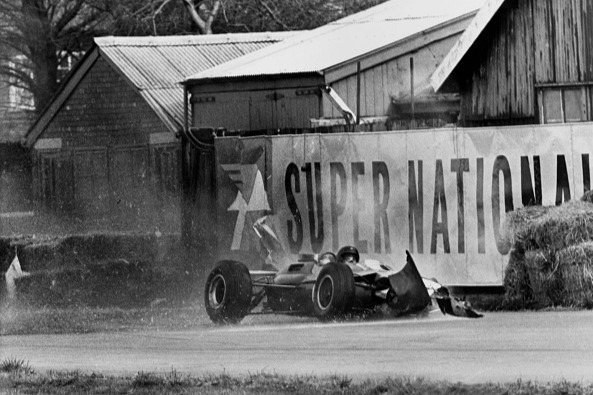
It was once common for F1 drivers to appear in non-championship races
Photo by: Getty Images
This non-championship race at the former home of the British GP featured several leading F1 drivers and was the scene of a rare crash for Clark.
Graham Hill’s BRM P261 took pole, with reigning world champion Clark uncharacteristically starting on row two having been fourth fastest in his Lotus 33. Clark made a poor start and Hill led in the early stages, chased by Jack Brabham and Bruce McLaren.
Clark quickly recovered and joined the leaders just as McLaren’s Cooper retired with overheating, while Brabham took charge. Clark overtook Hill and then grabbed the lead but could not shake off Brabham.
Brabham retook the lead shortly after half-distance and, on lap 47 of 67, the duo came up to lap two backmarkers approaching the fast and tricky Melling Crossing. In the ensuing mix-up, Clark was forced off line avoiding Belgian driver Pilette and crashed, leaving Brabham to win from Hill.
In its editorial, Autosport questioned the mix of F1 and F2 cars allowed in the race, though it’s worth pointing out that Pilette’s Scirocco was an F1 machine: “It seems certain that Clark’s accident was due to the speed differential, always present when a fast car is overtaking slower machinery. In this case, F2 cars were admitted to a race which included some of the most rapid GP cars in the world, driven by very fast and experienced men.
“In a recent editorial, Autosport suggested a 10% qualifying margin in any one practice session, at the discretion of the organisers.”
1980 Spanish GP - Carlos Reutemann, Jacques Laffite and Emilio de Villota
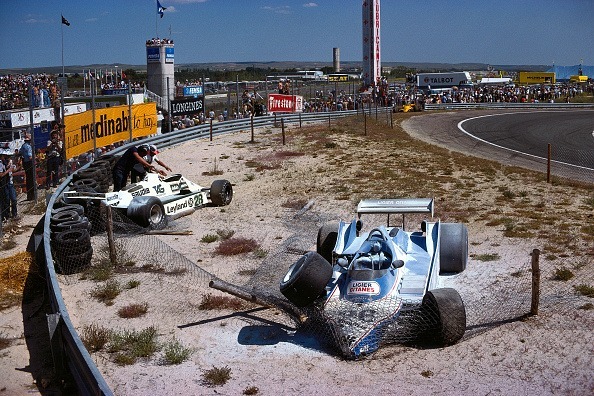
Two in one for de Villota
Photo by: Getty Images
Taking out the top two is quite something, but in de Villota’s defence he was just trying to get out the way. Perhaps it’s just as well for him that this race lost its championship status, so no points were lost for the victims.
Reutemann’s Williams was leading at Jarama from Laffite’s Ligier as they came up to lap the RAM-run Williams. Coming out of the Varzi right-hander, Reutemann moved out to pass on de Villota’s right. The Spaniard moved further to his left, not realising that Laffite – somewhat ill-advisedly – was already committed to that side.
The Ligier hit the Williams, smashing its right-front wheel, and then bounced off and struck the barrier on the left. Laffite slid down the guardrail all the way to the Le Mans left-hander, where he collected Reutemann.
All three retired and at the end of an eventful race it was the Williams of Alan Jones that took an ultimately point-less victory.


When is the next time a backmarker will take the leader out of the race?
Photo by: Clive Rose / Getty Images


Stars, cars and highlights from the 2026 Goodwood Revival

The Egal has landed – again

Autosport magazine: Antonelli and a Can-Am celebration

Top 10 Can-Am drivers

Top 10 Can-Am cars

Top 10 greatest F1 qualifiers

Top 10 Tyrrell F1 drivers: Alesi, Brundle, Stewart and more

Autosport magazine: We grade the 2026 F1 grid so far

Top 10 F1 results changed by backmarkers – the clashes

"Free agent" Ocon talking to other teams with Haas yet to confirm F1 2027 line-up

The initial plan for F1's next engine regulation in 2030

What would you like to ask Emerson Fittipaldi?
Subscribe and access Autosport.com with your ad-blocker.
From Formula 1 to MotoGP we report straight from the paddock because we love our sport, just like you. In order to keep delivering our expert journalism, our website uses advertising. Still, we want to give you the opportunity to enjoy an ad-free and tracker-free website and to continue using your adblocker.


Top Comments