


The McLaren that gave Prost his F1 breakthrough
He could have been world champion in 1982 and 1983. He should have been world champion in 1984. After the closest of near-misses, Alain Prost took his first F1 crown in 1985, but it was a roller-coaster ride

Autosport Retro
Telling the forgotten stories and unearthing the hidden gems from years gone by.
Finally. After coming so close to winning the Formula 1 world title in 1983 and 1984, Alain Prost secured the crown everyone knew he deserved in 1985. Prost scored fewer poles and victories than he had during the 1984 campaign, in which he lost the championship by half a point to McLaren team-mate Niki Lauda.
But, in a season that featured eight winners for five different teams, the 30-year-old Frenchman and McLaren proved the most consistent all-round package.
Autosport is once again at Pembrey courtesy of McLaren, with the car that helped Prost to that first title, the TAG Porsche-powered MP4/2B. While the MP4/4 is often the fan favourite, the MP4/2 is the car that really started the domination of Ron Dennis-era McLaren.
Three consecutive drivers’ titles and two constructors’ crowns also make it the most successful F1 McLaren. It brought together several elements, including the carbon composite monocoque pioneered on John Barnard’s Cosworth DFV-powered MP4/1 and constructed by Hercules Aerospace, Porsche turbo power, and the ‘Coke bottle’ aero concept to tidy up airflow at the rear.
“The start of the MP4 and the use of carbon composite underlined the era, and the change to Porsche TAG and development of the electronics was a key point,” says McLaren chief operating officer Piers Thynne, who was instrumental in making sure that this MP4/2B was ready for 2025 and the 40th anniversary of Prost’s success.
“It was an exciting time. Alain, the engineers and the set-up got to such a focused place. The three years this car was racing is a really important period in our history.”
Harder than it looked
Chassis MP4/2B-3 was built as an MP4/2 in 1984 before being upgraded to 1985 specification. To say ‘upgraded’ might be generous, because McLaren and design boss Barnard faced several challenges after winning 12 of the 16 rounds in 1984.
The first was a change from Michelin to Goodyear rubber following the French tyre firm’s withdrawal. Another was sorting out the aerodynamics thanks to regulation tweaks that banned the use of winglets on the rear wing.

Barnard (right) says 1985 aero rule tweaks posed a challenge, but “luckily we had Alain, the best”
Photo by: Paul-Henri Cahier / Getty Images
“It was a big change,” recalls Barnard, now 79. “In 1984 we had a really good, consistent downforce level, and then they changed the rules last minute and it made a big difference to the rear wing. We never really got back to the level of 1984 in 1985 and the downforce was a lot less consistent. It was slightly more difficult to get right, but luckily we had Alain, the best.”
Barnard also changed the rear suspension to a pushrod for “more freedom with aero and to experiment with different geometries”, which he continued doing through 1985 and into 1986, the last year of the MP4/2 in C specification.
Contemporary reports talk of the Goodyear rear tyre being weaker than the Michelin, which caused traction issues, particularly in the first part of the season. Barnard doesn’t disagree but says: “Michelin had an exceptionally good rear, but more than anything it was a downforce thing.”
Indy Lall, a McLaren stalwart for more than 40 years and who is overseeing the Pembrey running as Heritage manager, was number one mechanic on Prost’s car across 1984-85. He recalls the loss of Michelin as a significant shift.
“When Alain joined us we knew we had a good pilot. It ran in parallel – the carbon chassis, John Barnard I rate very highly. He deserves a lot more credit for bringing F1 to where it is” Indy Lall
“The testing we had with them was quite something,” he recalls. “We took the jump to Michelin and then you get the upper hand of tyres developed for you. In 1985 it almost felt like it went backwards – we didn’t have their facility of Clermont-Ferrand anymore – and you almost had to start again.
“Michelin was a partner and then we were a Goodyear customer – you do try and influence the direction you want things to go but it was limited.”
Lall believes that Barnard, as well as Prost, was key to kickstarting the new McLaren era: “When Alain joined us we knew we had a good pilot. It ran in parallel – the carbon chassis, John Barnard I rate very highly. He deserves a lot more credit for bringing F1 to where it is.
“He was a quiet man but very authoritarian on the direction you want to go and I think that’s what you need. If it’s right, great. It very quickly became apparent how good John was.”

McLaren Heritage chief Lall was number one mechanic on Prost’s car across 1984-85
Photo by: Oliver Read
Prost was the first F1 driver who Tim Wright race engineered, and 1985 was the first of their two years together. Wright soon gelled with Prost and believes the future four-time world champion’s smoothness helped mitigate the traction issues that many teams experienced when they arrived in Rio for the season opener.
“I found him very easy to work with,” affirms Wright. “He’s quite a nervous person but we quite quickly got into a rhythm. Other teams were struggling a lot more. Due to Alain’s very easy driving style he managed to get the tyres to work a lot better in Brazil and ended up winning easily.”
How the opposition missed its chance
If 1984 had been the point at which everything came together for McLaren, the 1985 Brazilian Grand Prix result gave the impression that it was business as usual; McLaren dominating, particularly as Lauda looked set for second until electrical problems intervened. But it was an illusion.
Whereas in 1984 only Brabham really challenged McLaren on pace, and Ferrari and Williams took one win apiece, 1985 was more open. Autocourse selected the Gerard Ducarouge-designed Lotus-Renault 97T as the best car of the season, while Autosport readers voted the Patrick Head-inspired Williams-Honda FW10B as the Racing Car of the Year, even though the MP4/2B won both championships!
On pure pace, the Ayrton Senna-Lotus and Keke Rosberg-Williams combinations were the fastest across the season. Senna took seven poles and led 271 laps to Rosberg’s 231 and Prost’s 178. The Lotus was a decent chassis and, like Honda and BMW, Renault provided the opportunity for big turbo boost levels in qualifying.
Williams had constant developments on both the chassis and Honda engine during the year, and finished the season as the pacesetting force. But neither Lotus nor the first carbon-monocoque Williams, which burned through tyres with its ferocious power delivery early in the season, finished enough races.
Prost invariably charged forward on Sundays, with early leaders Senna and Rosberg sometimes already in trouble by the time the McLaren attack arrived.
An element of that was due to the strengths and weaknesses of the Porsche-designed and built (but not funded) engine. On the plus side, it was one of the most fuel efficient during an era that limited cars to 220 litres per GP, with no refuelling permitted.

Porsche-designed and built engine was fuel-efficient but lacked rivals’ qualifying wallop
Photo by: Oliver Read
On the downside, McLaren never had access to the 1000bhp+ outputs enjoyed by the leading opposition in qualifying, with its 750-800bhp for the races generally thought to be roughly on a par with BMW and Renault, if a bit behind Honda.
Memories of exactly why qualifying boost wasn’t a focus vary slightly. Wright reckons Porsche “weren’t keen on running high boost”, while Barnard points to the limited number of engines.
It should be remembered that this engine project was privately funded and didn’t have the clout behind it that, for example, Honda provided Williams. McLaren simply couldn’t afford to burn through engines in qualifying.
“Driveability was always the task,” adds Lall, indicating a strategic element. “The engine mechanically had peaked. Durability for a race was the focus.”
They might not be the most exciting weapons in a driver’s armoury, but mechanical sympathy and not making errors were important factors – and Prost certainly displayed them in 1985
“They did as much as they could, but it wasn’t the same as the others and the reliability shows,” is Thynne’s view. And reliability was one of the keys to success in F1’s first turbo era.
The average reliability of the field – measured by classified finishers as a percentage of starters – is one of the marked differences to modern F1. In 1985, the average finishing rate was just 46.4%; the number in 2024 was 90.9%.
In other words, getting to the end was a greater challenge and unreliability had a bigger impact on the championship fight. They might not be the most exciting weapons in a driver’s armoury, but mechanical sympathy and not making errors were important factors – and Prost certainly displayed them in 1985.
While luck and team preparation are also key elements for reliability, Prost’s finishing rate of 81.3% was markedly superior to his rivals. Ferrari’s Michele Alboreto, who was Prost’s closest championship challenger, managed 62.5%, while Senna and Rosberg failed to hit 60%. At a time of rapid development and high boost, engines often let teams and drivers down.

1985 Austrian GP-winning car took less than a year to prepare – period electrics consigned to history
Photo by: Oliver Read
Ferrari’s problem was different, at least until late in the season. Reliability kept Alboreto in the game, but the 156/85 was inconsistent from track to track and was eventually left behind in the power stakes. Ferrari also threw a bewildering array of developments at the car across the year, some of which were of questionable value.
While McLaren’s tweaks were largely restricted to suspension, turbo and engine management areas, Ferrari tried everything – but went from qualifying on pole at the opener and scoring a 1-2 in Canada (round five) to lining up 15th and 16th at October’s South African GP.
And Alboreto, who was rated for being able to look after the car years before his podium results at Le Mans, failed to finish any of the final five races. Ferrari was heading into the disarray that would yield a winless 1986.
When asked what made the difference for McLaren in 1985, Wright initially says: “Racecraft. You look at the grids. Alain was rarely on the front row but he could read a race and look after the tyres. When he was comfortable with the car there was no stopping him.”
Wright also believes, however, that other teams missed their chances, either through patchy performances or unreliability: “The McLaren probably was the best car over the year – the Williams was good at the end but we were consistent. Reliability was the key. It wasn’t only Alain’s ability to read a race – it was others having problems.”
The battle unfolds
In Brazil, Prost had qualified sixth and Lauda ninth. In a typical performance, Prost moved to third on the opening tour, while Rosberg led for the first nine laps before suffering turbo failure, handing the lead to Alboreto.
Prost was already looking menacing and, when Alboreto missed a gear on lap 18, the McLaren swept past. Lauda looked set to follow, but a fuel system glitch sent him pitwards. And that was that. Prost continued to lead either side of a tyre stop and lapped everyone except Alboreto.
Senna’s first F1 win next time out in Portugal has gone down as one of the great wet-weather victories, but Prost was challenging the second-placed Lotus of Elio de Angelis when he aquaplaned off the road and into retirement on the start/finish straight. And then came Imola.

MP4/2B’s turbo V6 offers little at low revs, then rush of power is delivered, says Garofall, “like a hammerblow”
Photo by: Oliver Read
In Autocourse, Maurice Hamilton said the San Marino GP “produced some of the best racing seen for a long time but the high standard of driving was to be devalued by the rulebook”. Prost, having climbed from sixth on the grid, put on a superb battle with Senna before dropping back to conserve fuel, which should have been a masterstroke.
Senna’s leading Lotus, with no cockpit-mounted computer, ran dry with more than three laps to go. Stefan Johansson’s Ferrari, which had also overtaken the conservative Prost and been catching Senna, took the lead but barely lasted half a lap before also running out of fuel.
Prost cruised by to cross the line more than half a lap clear of de Angelis, these two the only ones to manage the full 60 laps. But the McLaren ran dry on the slowing-down lap and was then found to be 2kg underweight. Prost, who was proud of his performance and said “I calculated the fuel absolutely right”, was disqualified.
“I was so annoyed, I had to be calmed down in the scrutineering bay,” remembers the usually calm Lall. “You couldn’t be more professional than the standard McLaren were setting. Having a hurtful result like that pushed Bosch into a new era. The disappointments push you. Udo Zucker was a brilliant man with what he developed with Bosch.”
Prost’s incredible level of discipline not to get sucked into using boost (and therefore more fuel) in battle, particularly early in races, really paid dividends
And that was another key to Prost’s success: the development of the Bosch Motronic engine management system. Not only did it help make the engine more efficient, but it also gave more accurate fuel readout information than rivals.
“We spent quite a bit of time developing it to work out what the consumption was,” confirms Lall. “The breakthrough with Bosch was a big thing.”
With that working, Prost’s incredible level of discipline not to get sucked into using boost (and therefore more fuel) in battle, particularly early in races, really paid dividends.
In Monaco, early leader Senna’s engine expired having been over-revved in the warm-up, leaving Prost – once again up from row three after being quickest in warm-up – to battle an inspired Alboreto despite a sticking turbo wastegate on one bank of the V6, his lack of crashing across the kerbs being noted by the press. The Italian held the advantage until he slid off on oil from a dramatic Nelson Piquet/Riccardo Patrese accident.

Prost’s calm and well-controlled races meant less fatigue on the car and components, reckons Lall
Photo by: Getty Images
Then Alboreto charged and retook first – believed to be the last legitimate on-track overtaking move for the lead of the Monaco GP excluding starts – just six laps later. But Alboreto’s greatest drive would not yield victory; a left-rear puncture sent him to the pits, from where he would storm back to second, setting a fastest lap 1.3s clear of anyone else. Prost won, his McLaren this time 2kg above the minimum weight…
With the rapid Senna forced to recover from an early turbo issue, Prost was the only challenger to the Ferraris in Montreal and took third, before street master Rosberg won in Detroit on a day when Prost, Senna and Nigel Mansell crashed, with brakes proving a problem for several teams.
In fact, brakes were a big challenge of 1985, as explained by Barnard at the end of the season: “Most of our year was dominated by incessant work upon the brakes… our blokes will probably remember 1985 as the ‘Year of the Brake Duct’! Throughout 1984 we ran carbon brakes everywhere using our own aluminium twin calipers, no problems at all.
“At the end of the season I was happy with the brakes and felt that was one area at least which could continue unchanged for 1985; I was wrong.
“This year we have been running higher turbo boost in race trim and these cars have generated less aerodynamic drag from the new bodywork, so they have been a lot quicker at the end of the straights. We just ran out of braking.”
In France, Pirelli tyres were the things to have and Piquet’s Brabham-BMW won easily. Senna had gear selector issues before crashing on his own oil, while the latest Ferrari updates seemed to make the cars slower. Prost pulled off one of the moves of the season by passing Rosberg’s rocketship Williams, only for the McLaren to start dying at low revs.
Prost continued by keeping some throttle even when braking and changing gear. Rosberg beat him to second on the last lap, but another four points brought Prost level with the consistent de Angelis and just five behind championship leader Alboreto.
“That was a clever thing with Alain that never changed,” recalls Lall. “He was so gentle on the car and knew how to deal with any situation. There was less fatigue on the car and components. When you can win, win. If you can’t, do the next best position to score points. His drives go underrated; all were well-controlled and calm.”

Prost’s fifth victory of the season at Monza was pivotal in his title pursuit
Photo by: Sutton Images
At Silverstone, Senna and Prost put on another fine duel. The Lotus man probably should have won, but a broken wire in the engine left Prost to win by a lap. Alboreto was second as the top two edged away from the rest in the points battle.
The German GP at Hockenheim was in many ways typical. Senna and Rosberg battled for the lead early on; the Lotus retired, this time a driveshaft CV joint overheating; Prost, with Alboreto in tow, caught Rosberg. This time it was Alboreto who forced an opening to win, while Prost suffered brake problems and a spin but took more points in second.
A balanced chassis was required for the old, rapid Osterreichring and Prost took his first pole of the season, with Lotus and Ferrari off the pace. Williams duo Rosberg and Mansell were quick, but both cars failed early. Prost led in the T-car – our Pembrey machine – until his tyre change, then charged after team-mate Lauda, who had announced his retirement.
A potentially exciting finish was ruined when Lauda suffered a turbo failure, leaving Prost to win again. With six of the 16 rounds to go, Prost and Alboreto were tied at the top of the table, with no one else in sight – de Angelis was third, 22 points behind when nine was the reward for victory.
Lauda showed no intention of assisting friend Prost’s title aspirations and held firm to take his 25th and final F1 victory
Once Rosberg’s Williams retired from the lead at Zandvoort with – you guessed it – engine problems, the Dutch GP became a Prost versus Lauda battle. An earlier pitstop for the Austrian and then a slow tyre change for Prost gave Lauda track position, but Prost flew up to his team-mate’s tail.
Lauda showed no intention of assisting friend Prost’s title aspirations and held firm to take his 25th and final F1 victory, but Prost now had a clear lead in the title race for the first time since the opening round.
In an Autocourse interview with Nigel Roebuck, Prost reckoned Monza was the turning point. Despite lots of testing for its home race, Ferrari was soundly beaten. With Senna struggling with poor fuel consumption and Mansell recovering from an early delay, Prost looked set to finish second to Rosberg until the Honda engine gave up once more. It was Prost’s fifth win of the season – no one else managed more than two.
Now with a 12-point lead and with the memory of his last two championship defeats, poleman Prost ran to a conservative third in the damp at Spa behind Senna and Mansell when he felt the car could have won. “In the previous two years I lost it at the last race, and I did not want that to happen again,” he told Roebuck.

At Brands Prost dropped to 14th at the start, but kept it all under control to finish fourth and claim his maiden championship
Photo by: Ercole Colombo / Studio Colombo / Getty Images
Alboreto had managed just three laps in Belgium before his clutch failed and suddenly Prost stood on the brink of the title with three races to go. Despite being forced onto the grass by a slow-starting Rosberg at Brands Hatch and falling to 14th, Prost drove another controlled race to fourth place to seal the title.
Mansell won – his first GP victory – and Williams-Honda would win the last two races as well, setting itself up as favourite for 1986. “You knew Honda was beckoning – it was clear at the time,” recalls Lall. “Then once we had them on board [for 1988] we realised how formidable they were.” But 1985 belonged to McLaren, Porsche and Prost.
Prost and Lauda
So what of Lauda? Remarkably, any good fortune he’d had on his way to winning the title in 1984 deserted him. Rarely a match for Prost in qualifying, Lauda still sometimes brought himself into contention in races, but just three finishes from 14 GP starts (21.4%) utterly undermined his season – there were errors but chiefly it was car and engine trouble, often different each time, that meant he contributed just 14 of McLaren’s 90 points.
But Lauda’s presence and good relationship with Prost still played its part. At the time, Prost suggested that he’d changed his mentality after losing out to Lauda in 1984 and Wright agrees. “Alain took a leaf out of Niki’s book,” he says. “He matured towards Niki’s way of driving and they had a good relationship. And I think later Ayrton learned from Alain.”
Lall points to another plus: “They had very similar driving styles, very precise, let the car do the work. There was never, ever a clash. Ron had many fortes and one was getting the best out of drivers.”
While some had, somewhat foolishly, started to suggest that Prost would never be champion after 1984, Lall had no doubts. “You could see in Alain that he was going to be champion,” he says. “He was still so young – Niki had made an extraordinary comeback and wasn’t going to be there much longer.
“Losing in 1984 was a bitter pill to take, it means so much to people on the car, even though the team won it. It was tough to take. Winning in 1985 was extraordinary. It meant more having got so close the year before – we knew how hard it was to win.”
For Thynne, the Prost-Lauda line-up is one of the great combinations, perhaps the best example of what can happen when you run two number-one drivers and let them race, as McLaren does today with Oscar Piastri and Lando Norris.
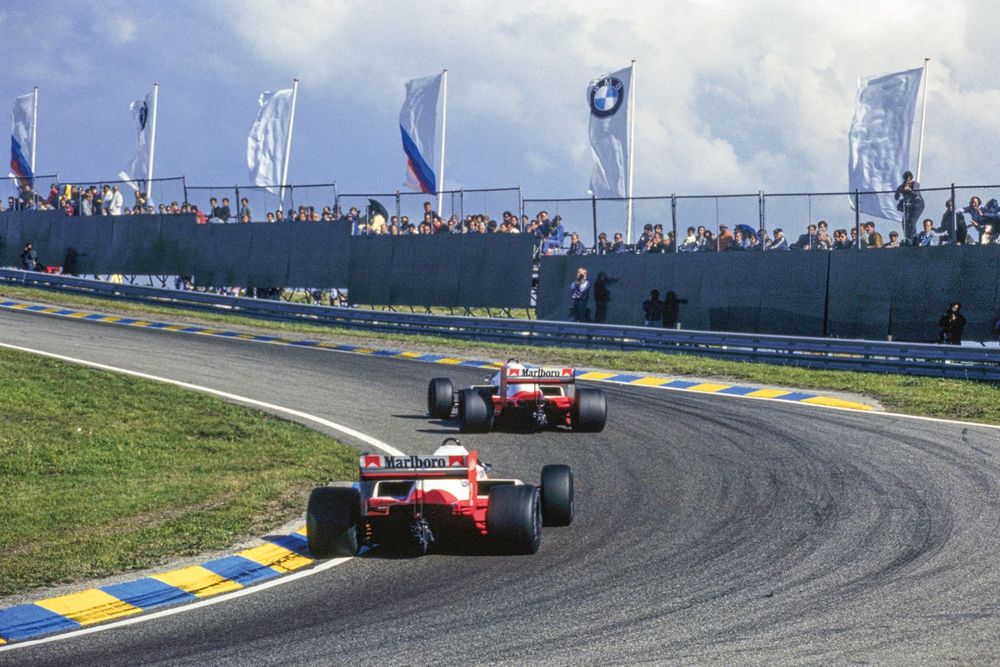
Team-mates got on well, and Lauda’s approach rubbed off on Prost to the Frenchman’s benefit
Photo by: Ercole Colombo / Studio Colombo / Getty Images
“It’s a good example of drivers in different chapters of their careers,” continues Thynne. “Sometimes it’s just meant to be. There was an extremely focused driver relationship with the engineering to get the car to deliver. The closeness of the relationship between drivers and engineers is no different now.
“Alain’s contribution is significant and it’s brilliant to bring him front and centre again.”
Back on track
Which brings us back to why we are here. MP4/2B-3 and MP4/4-4, the car Prost drove to three of his seven 1988 wins and provided by Nicholas and Shelley Schorsch of the Audrain Collection, are being shaken down ahead of the Goodwood Festival of Speed.
There, Prost was reunited with both and drove them up the hill, as well as having a special moment on the Goodwood House balcony, complete with salute from the Red Arrows.
Such outings are important to Thynne, not just because of the experience it gives his team but because of the cars’ importance to McLaren’s past. He estimates it took less than a year to prepare the MP4/2B, though it doesn’t use period electrics due to “the rarity of the engine and because I need total certainty that everything is as it should be. I need to sleep at night!”
“You’ve got to keep that car in boost the whole time. Just by dropping out of the boost could cost you seconds. It was massively important to keep it in boost and not miss a gear” Rob Garofall
So what about driving it? “You can see how fast technology was moving, from the DFV to the turbo,” says McLaren Heritage driver Rob Garofall, on hand at Pembrey to pedal the MP4/2B, as well as the MP4/4 and a DFV-engined M23. “The difference is night and day with the power and the power delivery. It delivers the power in a big rush.
“There’s little at low revs and then it comes in like a hammerblow. You’ve got to keep that car in boost the whole time. Just by dropping out of the boost could cost you seconds. It was massively important to keep it in boost and not miss a gear.
“It’s a very important car to McLaren and it’s early in the Ron story. As a kid I remember watching that car with Alain.”
Prost and McLaren managed to succeed in 1985 by being smart and focused as the opposition caught up and, in the end, surpassed the hardware. What’s more remarkable is that, with pretty much the same ingredients, Prost did it again in 1986, in what he believes was his finest title. But that’s a story for another day…
McLaren MP4/2B-3
Year 1985 (built as MP4/2 in 1984)
Driver Alain Prost
Engine TAG TTE PO1 Porsche 1.5-litre V6 turbo
Power 750-850bhp
Weight 540kg
Wins 1984 San Marino and German GPs, 1985 Austrian GP
Drivers’ championship 1st (Prost)
Constructors’ championship 1st
This article is one of many in the monthly Autosport magazine. For more premium content, take a look at the September 2025 issue and subscribe today.

McLaren MP4/2B shaken down at Pembrey ahead of being reunited with Prost at Goodwood
Photo by: Oliver Read


The greatest F1 campaigns with no wins

Top 10 F1 results changed by backmarkers – the passes

Top 10 F1 results changed by backmarkers – the clashes

Stars, cars and highlights from the 2026 Goodwood Revival

The Egal has landed – again

Autosport magazine: Antonelli and a Can-Am celebration

Top 10 Can-Am drivers

Top 10 Can-Am cars

Top five roles on Motorsport Jobs this week

M-Sport’s 2027 WRC Fiesta Kit car breaks cover

Why Bathurst 1000 has lost its international flavour

A fond farewell to a few BTCC favourites
Subscribe and access Autosport.com with your ad-blocker.
From Formula 1 to MotoGP we report straight from the paddock because we love our sport, just like you. In order to keep delivering our expert journalism, our website uses advertising. Still, we want to give you the opportunity to enjoy an ad-free and tracker-free website and to continue using your adblocker.


Top Comments