


Russell's theory on his big hope for F1 2027 – and Antonelli's reply
Better-balanced tyres could enable a more ‘natural' driving style, but other technical changes could have a greater impact

George Russell, Mercedes
Photo by: Sam Bloxham / LAT Images via Getty Images
From being the 2026 Formula 1 pre-season title favourite to fighting to hold on to second place as Mercedes team-mate Kimi Antonelli accelerates into the distance, George Russell has endured a challenging few months. During that period he has been forced to question his entire approach to driving, owing to the peculiar requirements of the latest technical formula.
Most of the drivers on the grid have voiced reservations – or noisy complaints – about the unnatural driving style required to get the best out of the 2026 cars, but Russell belongs to a subset whose style appears to put them at a disadvantage compared with their team-mates. Most notably at Silverstone and Spa, Russell hit lower peak top speeds than Antonelli on key straights, explained by him using fractionally more electrical power to re-accelerate after scrubbing off more speed through preceding corners.
McLaren's Oscar Piastri is in a similar position.
Although F1's power units are shifting from a 55:45 ratio of internal combustion engine output and electrical power to 58:42 for 2027, this will not bring about a massive shift in performance characteristics. But there are other changes afoot, including a new family of Pirelli tyre compounds which have been developed through this year via testing with the current cars.
Asked in Baku ahead of this weekend's Azerbaijan Grand Prix whether this could promote a more natural style of driving, Russell suggested that it may.
"I think it's been clear this season that the tyres, front to rear, probably have not been well balanced enough," he said. "You look at some tracks that are clearly front-limited and the fronts have stayed pretty strong throughout. It could also be because of the extra power we've got coming off the corners, so the rear tyres are getting a harder time.
"It is quite interesting. I spoke with Antonio Giovinazzi, who drove this new generation of car for the first time a couple of days ago in Imola, and he said how impressed he was at the power of these new cars off the corner. And I think that has quite an impact on the rear tyres.
"Obviously, last year when we developed these tyres, they were with the previous generation of power unit, which had much less power off the corners. So, I don't think it's a big surprise the rear tyres are getting a harder time than we all anticipated."
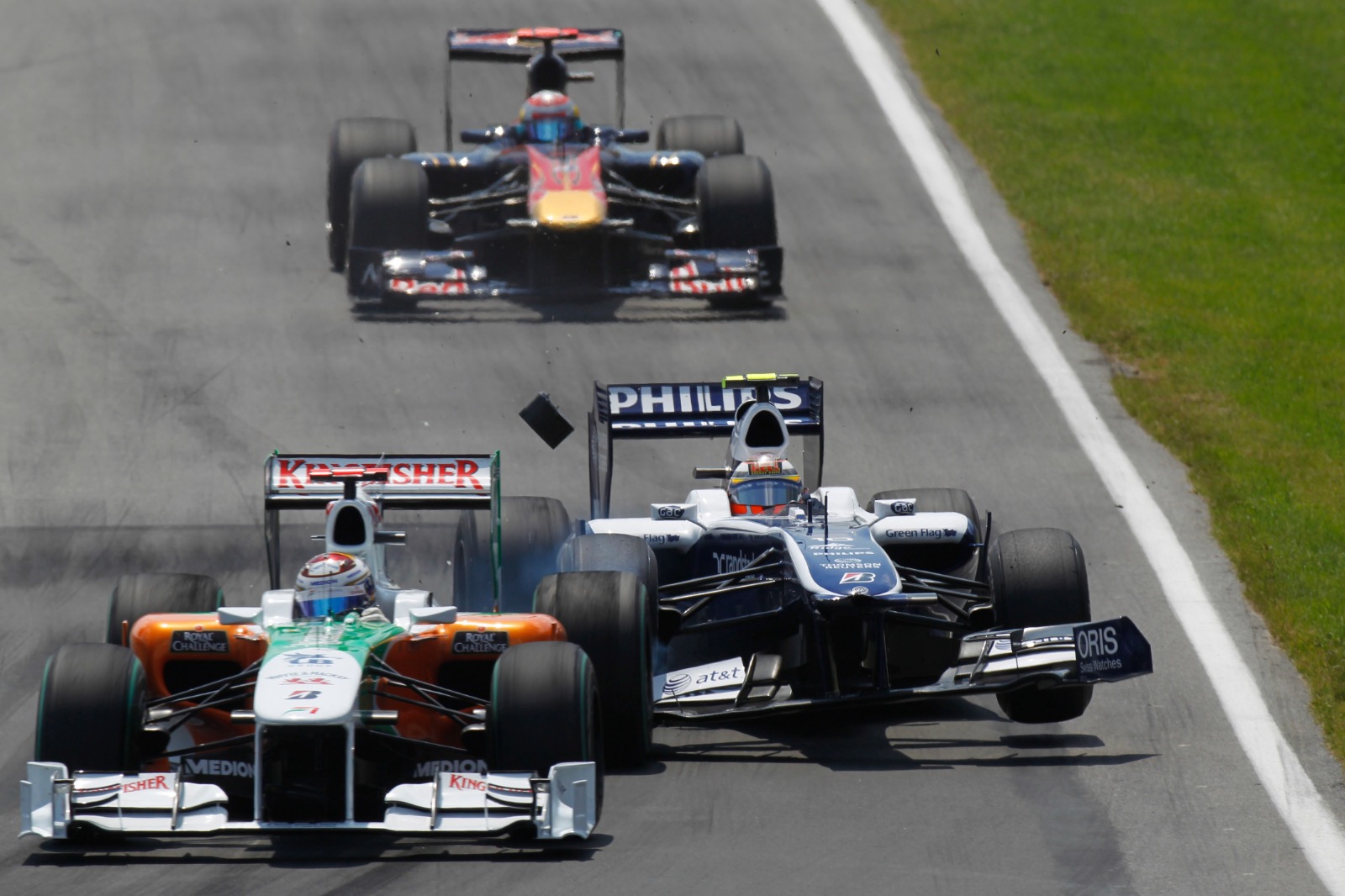
Action-packed 2010 Canadian Grand Prix was the catalyst for the brief handed to Pirelli when it became F1's sole tyre supplier
Photo by: Getty Images
When Pirelli became F1's exclusive tyre supplier in 2011 it was handed a brief to produce compounds which offered strong grip up to a certain point in their use cycle before falling off quickly. The trigger for this was the 2010 Canadian Grand Prix. Complaints about processional racing had been building for years until this point, where a combination of a freshly resurfaced track and mixed weather in the build-up to the event caused the usually robust Bridgestone tyres to degrade rapidly, and an unpredictable race ensued.
But Pirelli has often struggled to find an ideal compromise to fulfil what is a very challenging target. The tyres have often proved too sensitive to degradation, and when Pirelli has toughened them up in response to criticism, it has overshot – not helped by being restricted in terms of how much testing it can complete with relevant machinery. Whenever testing is performed with current cars, competitive paranoia arises as teams suspect each other of covertly evaluating performance upgrades.
While the focus on developing the 2027 tyres has been on ensuring greater lap time differences between compounds, it is understood that tweaking the balance between the front and rear axle has also been on the agenda. But would better balance alone help those drivers who have been losing momentum through rear sliding, then paying the price on the straights?
That is a complicated question to answer, since these changes – even if successful – won't happen in isolation. The FIA is also bringing in a package of aerodynamic changes to curtail the downforce gains teams have been finding through developments, as well as mitigating the straight-line demand on electrical power. What the teams have discovered in simulation is that these tweaks have greater effects than first anticipated – so much so, in fact, that those who had been planning to carry over their 2026 chassis to next year for cost-control reasons have changed tack.

George Russell, Mercedes
Photo by: Sam Bloxham / LAT Images via Getty Images
Besides tidying up some of the loopholes around the rear wing, and making it shallower, the changes mandate fewer vortex generators on the floor leading edge, as well as a significantly shorter (from 900mm to 600mm) ‘tea tray', the section of the floor that extends under the driver's legs. This latter change opens up the possibility of teams adopting very different rake angles, hence the re-think on carrying over chassis designs.
For these reasons, Antonelli takes a slightly different view from his team-mate.
"I think the tyre, also this year the tyre changed completely," he said when Autosport asked for his opinion on the magnitude of the effect the new tyres will have.
"So I think on my side, you try to understand the tyre the best way you can, and you try to adapt. I think the tyres won't be so much different, probably the front tyre will change a little bit, and in terms of structure a little bit, we'll see what Pirelli decides.
"We've done some Pirelli tests and we've given the feedback, but of course we'll see what is going to be decided. But from what we heard, it shouldn't be much different to what it was this year.
"The car will be different – on the aero side the car is changing, especially around the bib area, there's going to be a big change, which is going to implement aero loss. Then the team for sure will find a way to recover that, but the car is going to be a little bit different next year for sure.
"The baseline will be the same I think, but maybe together with the tyre and the car evolving, it's going to feel a little bit different. It's all about adapting at the end of the day, so we'll see."
There's an understandable amount of equivocation here since Antonelli didn't want to publicly contradict his team-mate. But of the Mercedes drivers he is the one who has been adapting best to the requirements of the new regulations, which he is subtly pointing out.
And of course, the risk George runs if he pins his hopes on change is that Kimi will do so again.

Share Or Save This Story


What’s behind the delay in cancelling the Qatar and Abu Dhabi GPs?

What were Leclerc's "other opportunities" before signing new Ferrari deal?

Italy’s next F1 world champion?


Bruising F1 2026 will not be the end for Russell - Wolff

Russell and Hamilton concede F1 2026 title chances as Antonelli dominates

Why Norris doesn’t buy Russell’s driving style theory


Mercedes aims to end pole drought with upcoming Malaysia F1 upgrades

How Antonelli's luxury problem is causing Wolff and Mercedes grey hairs

How Antonelli is proving unbeatable, even when he's beaten
Russell's theory on his big hope for F1 2027 – and Antonelli's reply

How McLaren Hypercar test will help Norris in F1

What’s behind the delay in cancelling the Qatar and Abu Dhabi GPs?

Top 10 F1 results changed by backmarkers – the clashes
Subscribe and access Autosport.com with your ad-blocker.
From Formula 1 to MotoGP we report straight from the paddock because we love our sport, just like you. In order to keep delivering our expert journalism, our website uses advertising. Still, we want to give you the opportunity to enjoy an ad-free and tracker-free website and to continue using your adblocker.


Top Comments