


Why Mercedes was right to temper expectations and how it might recover
Mercedes is no stranger to tempering expectations ahead of a Formula 1 season, only to kick off the season in dominant fashion. But the team's 2022 car has legitimate concerns, leaving the Silver Arrows to pursue "damage limitation" at Bahrain. Here's why Mercedes was right to play its W13 down, and how it might find a return to form

Defending champion Max Verstappen certainly wasn’t buying it. Nor were quite a lot of Formula 1 fans when Mercedes came away from pre-season testing rubbishing its chances of fighting for victories at the start of grand prix racing’s second ground-effect generation.
A large part of that is down to the Silver Arrows having previously quelled expectations only to come up trumps. It was the team that cried ‘Wolff’. Last year was a case in point when new, clipped floor regulations were set to hurt the squad only for Lewis Hamilton to win the season opener at Sakhir to tee up a run to an eighth consecutive constructors’ title.
But Hamilton qualified fifth last weekend and new team-mate George Russell was only ninth fastest - the duo seven tenths and 1.7s respectively off the pace set by polesitter Charles Leclerc. That return swiftly confirmed that Mercedes is currently in the worst shape it’s known since a 2012 run to fifth in the standings.
PLUS: The unseen Verstappen problem that ensured Leclerc's Bahrain GP win
The W13 proved to be well off the pace of the Ferrari and Red Bull challengers and was at no point in contention for pole or victory. Mercedes must now contend with being the third-fastest team. Only the fuel starvation issues that led to the demise of both RB18s afforded Hamilton his podium shot and elevated Russell to fourth.
It’s remarkable for the dominant force since the advent of the 1.6-litre turbo hybrid regulations to label its most recent result as “an effective damage limitation weekend” during which the team was “punching above our weight class”, per motorsport boss Toto Wolff.
So much of the performance loss stems from the porpoising phenomenon that reared its head in pre-season running at Barcelona, when Autosport observed Hamilton’s car violently rocking up and down some 350 metres before the braking zone into Turn 1. To combat the issue, rideheights must be raised, which is the opposite to what’s needed to unlock ground-effect. It also upsets the car balance when the going gets twisty.

George Russell, Mercedes W13
Photo by: Carl Bingham / Motorsport Images
The leading school of thought at present is that the three-pointed star is generating too much downforce. The car has been efficiently sucking the floor to the ground to cause the air to attach and detach on repeat to create the oscillating motion. It’s a process that the perfectly flat conditions of a windtunnel or simulations did not show up for any team.
ANALYSIS: 10 things we learned from the 2022 Bahrain Grand Prix
Further, such was the radical update lavished on the W13 for the second test in Bahrain, when the minimalist sidepods made their debut, Mercedes effectively only left itself with three days of real-world running to get to grips with the biggest regulation change in F1 history. The more consistent designs of Ferrari and Red Bull had six days of troubleshooting.
The W13 proved to be well off the pace of the Ferrari and Red Bull challengers and was at no point in contention for pole or victory. Mercedes must now contend with being the third-fastest team
Wolff added that problems in Bahrain were compounded by a lack of parts, which meant the car ran with too much wing and that increased the drag, with some underwhelming returns in the speed traps. Some have been quick to the point the finger at the Mercedes powertrain overall, given the lacklustre showings from customer teams McLaren, Aston Martin and Williams in Bahrain. But while Hamilton was only 11th in the speed traps and 3.6mph down on straightline king Verstappen, 12 months ago the Briton was 18th and 9mph adrift of the benchmark. The engine isn’t markedly worse off, so it seems.
Russell’s explanation was: “This bouncing and porpoising we’re experiencing on the straight is going to slow you down because we’re smashing into the ground, rather than going forwards. The lap time deficit we have currently, it’s probably 50% in the straight and 50% in the corners. So, it offers a glimmer of hope.
“It was affecting the tyres quite a lot because every braking zone, you’re bouncing into the corner. The rears are just skipping under braking because the car is so unsettled. If we unlock this performance, it’s just going to benefit everything.”

George Russell, Mercedes W13
Photo by: Erik Junius
There is cause for optimism. For one, with every lap completed more is learned about the quirks of the car. Wolff also reckoned that FP3 marked the first time Mercedes had been able to run without porpoising as it homes in on a way to turn it off for good.
The Austrian also remarked that the ultimate performance shown in the windtunnel was enough to bring the gap down to the Ferrari and Red Bull pacesetters to a degree. And because it’s been a full decade since there were three teams genuinely in championship contention, that’s a prospect to be relished.
This weekend in Jeddah for the Saudi Arabian GP will likely arrive too soon for Mercedes to find an ultimate fix. It will more likely have to rely on set-up tweaks to quash its porpoising pains rather than fit new parts. But Australia, Imola and beyond might provide the window of opportunity.
Should the appropriate amendments come, it’s inconceivable to already discount F1’s reigning superteam from featuring at the front by closing the gap to its rivals. But in the meantime, Mercedes was not constructing an elaborate ruse when it issued that competitive health-warning in pre-season testing.
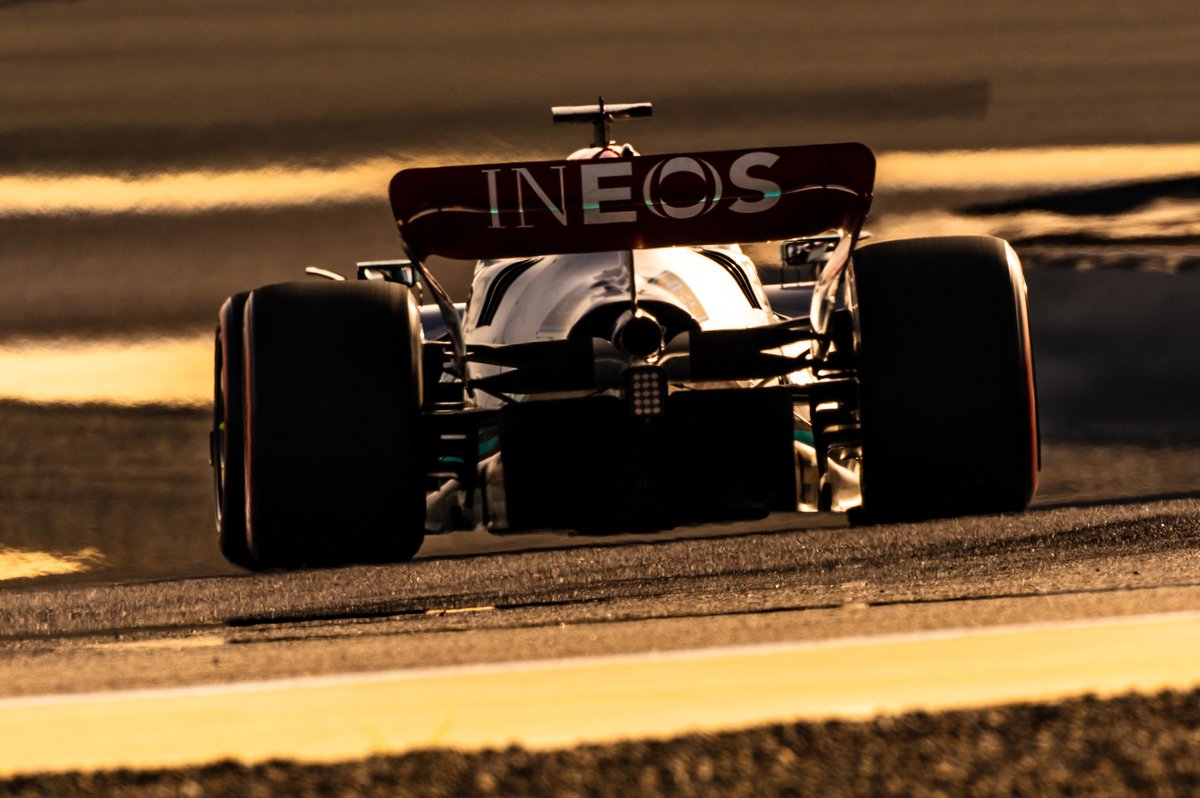
George Russell, Mercedes W13
Photo by: Erik Junius


Marko: Perez improved F1 form because 2025 contract talks are at stake

Russell explains how low-fuel runs expose Mercedes F1 inconsistency

Leclerc: No answer for "once in a season" Japan F1 qualifying struggle

Sainz: Now time to "speed up" talks to find 2025 F1 seat

Hamilton: Vettel an "amazing option" as Mercedes F1 replacement

Sargeant to race repaired F1 car in Suzuka; no spare Williams until Miami

Pirro leaves role as McLaren F1 academy chief

The impatient pair who’d hoped to be a thorn in Red Bull’s side again

WEC Barcelona: Genesis secures maiden series pole from Toyota
What drives Bortoleto as his junior rivals hit new heights in F1

How the M8B became the most dominant car in McLaren’s history

What Verstappen knew about Red Bull’s big upgrade when he signed his new F1 deal
Subscribe and access Autosport.com with your ad-blocker.
From Formula 1 to MotoGP we report straight from the paddock because we love our sport, just like you. In order to keep delivering our expert journalism, our website uses advertising. Still, we want to give you the opportunity to enjoy an ad-free and tracker-free website and to continue using your adblocker.


Top Comments