


Top 10 F1 drivers of the 2010s
In the final part of the top 10s of the F1 decades series, the 2010s witnessed two dominant eras – plus one dramatic title surprise – which has heavily shaped this list

Autosport Retro
Telling the forgotten stories and unearthing the hidden gems from years gone by.
In the last of our series selecting the best Formula 1 drivers of each decade, we’re looking at the 2010s.
The decade started with Red Bull domination during the 2.4-litre V8 era before Mercedes took control with the arrival of turbo-hybrid power. With an increasing number of races, the tallies chalked up by the top runners were impressive.
As usual, we’ve considered many factors, including level of success, machinery at the driver’s disposal, longevity and how highly they were rated by their contemporaries, as well as standout moments.


10. Kimi Raikkonen

Raikkonen's short stint with Lotus gives him the leg up over other contenders to just miss out on this list
Photo by: Glenn Dunbar / Motorsport Images
Decade wins: 3
Decade poles: 2
Decade titles: 0
It’s a very close-run thing between Raikkonen, Nico Hulkenberg and Sergio Perez for this spot. Hulkenberg and Perez were arguably more consistent performers across the decade, particularly given the weaker equipment at their disposal, but Raikkonen had greater peaks and managed three wins across the period.
The 2007 world champion missed the first two seasons of the decade due to his rallying and NASCAR adventures but returned with the Enstone-based ‘Lotus’ team for 2012. An incredibly consistent season, which included victory in Abu Dhabi, brought him third in the championship and it was a similar story in 2013.
The Raikkonen-Lotus combination was kind to the delicate Pirelli tyres, which was underlined by victory in the Melbourne season-opener. Raikkonen added six second-place finishes and was fifth in the points.
There was a suspicion that team-mate Romain Grosjean was quicker at times, particularly towards the end of 2013, but it was Raikkonen’s move back to Ferrari that really hurts him in this list.
The 2014 F14 T was not very competitive in the first year of the turbo-hybrid era and Raikkonen was obliterated by team-mate Fernando Alonso. The departing Spaniard scored almost three times as many points and was 16-3 ahead in qualifying.
Things were a little better alongside Sebastian Vettel from 2015 but it was the German who led the way, taking eight victories across their first three seasons together and finishing second in the points in 2017, while Raikkonen remained winless.
The SF71H of 2018 was Ferrari’s best car for several years. Vettel used it to battle Lewis Hamilton’s Mercedes for the crown, while Raikkonen racked up the podiums. He finally scored his 21st and final F1 win at the United States GP, more than five years since his 20th, holding off Max Verstappen and Hamilton in a fine drive.
But Ferrari had already announced Charles Leclerc was to replace Raikkonen for 2019 and the Finn joined the Alfa Romeo/Sauber squad for the final season of the decade. Raikkonen did a solid job for the midfield stalwart and beat team-mate Antonio Giovinazzi to end up 12th in the standings.

9. Mark Webber

Webber had his day at the start of the era, but was often lacking an edge against his frontrunning rivals
Photo by: Andrew Hone / Motorsport Images
Decade wins: 7
Decade poles: 12
Decade titles: 0
Webber was arguably at his peak as the decade begun, having finally taken his first two F1 victories in 2009. After toiling impressively with uncompetitive equipment for much of the previous decade, he finally had frontrunning machinery with Red Bull.
The 2010 season provided a classic title fight and Webber was in the thick of it, along with team-mate Vettel, Alonso and McLaren duo Hamilton and Jenson Button. Webber was rarely far from Vettel’s pace and sometimes ahead, and four wins helped him to the top of the championship.
But then came Korea, where Webber crashed out in tricky conditions while chasing Vettel. While the other Red Bull later suffered engine failure, Vettel was allowed to win in Brazil in a team 1-2, setting up a four-way fight for the crown.
Pitting early and getting stuck in traffic derailed Webber’s chances in Abu Dhabi and he could only struggle to eighth as Vettel won the race and snatched the crown, with Webber third in the final points.
Thereafter, Vettel tended to set the pace at Red Bull, Webber struggling to get as much out of the blow-diffuser concept as his team-mate. While Vettel reeled off 11 wins and 15 poles in 2011, Webber’s tallies were one and three – and he was beaten into third in the standings by Button.
It was a similar story in 2012, Vettel taking the crown again with Webber down in sixth, though he did take his second Monaco and British GP successes.
Webber was third in the championship for the third time in four years in 2013 but it was a winless campaign – a stark contrast to Vettel’s 13 – and the Australian retired from F1 having scored 42 podiums, 32 of them in this decade. He had contributed to four consecutive constructors’ titles but been a shade behind the frontrunners of the era.
8. Valtteri Bottas

Bottas help contribute to four constructors' titles for Mercedes in the 2010s
Photo by: Glenn Dunbar / Motorsport Images
Decade wins: 7
Decade poles: 11
Decade titles: 0
It’s easy to forget how much Bottas impressed at Williams early in his F1 career. He was a regular points scorer once the famous team switched to Mercedes power for the turbo-hybrid era in 2014 and generally had the upper hand over experienced team-mate Felipe Massa.
The Finn had racked up nine podiums before Nico Rosberg’s shock departure as world champion opened a door at Mercedes. Bottas got the gig and joined Hamilton.
Bottas’s time at Mercedes can broadly be described as a success – he was usually close to Hamilton in qualifying, could win races on merit on his good days and contributed to five constructors’ titles, most notably in 2021, though that doesn’t count here.
But he was invariably in Hamilton’s shadow. That was particularly the case in 2018, when an under-pressure Bottas struggled to fifth in the championship while Hamilton took arguably his finest title.

The 2019 season was better, Bottas taking a career-high four wins on his way to second in the table, albeit 87 points behind 11-time victor Hamilton. He was, perhaps, in the ‘very, very good’, as opposed to great, category.

Like predecessor Rosberg, Bottas was sometimes lacking in wet conditions and wheel-to-wheel combat compared to the top drivers but, unlike Rosberg, he was straightforward off-track and improved team harmony. Given he never got close to emulating Rosberg’s 2016 title, that could be seen as a negative as much as a positive, but it would be wrong to overlook Bottas’s on-track efforts during the decade.
7. Jenson Button
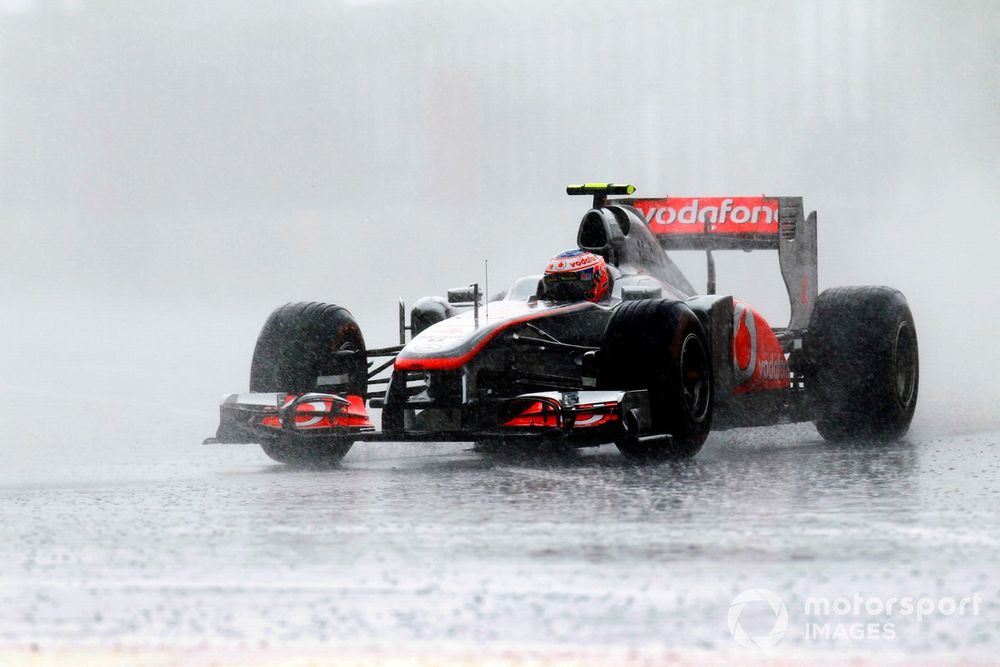
Button did beat both Hamilton and Alonso as his team-mates in the 2010s
Photo by: Steven Tee / Motorsport Images
Decade wins: 8
Decade poles: 1
Decade titles: 0
Joining Hamilton at McLaren was a bold move by Button after winning the 2009 title with Brawn. But, if anything, his performances alongside a driver thought by many to be the fastest around enhanced Button’s reputation.
Yes, Hamilton was often quicker in qualifying, with a greater ability to improvise when the car wasn’t handling right. But Button’s race pace was often impressive and when things were right he could be unstoppable.
Button won as early as his second race with McLaren, his victory in a rain-hit Australian GP setting the tone for his impressive performances in changeable conditions. Two races later, he beat Hamilton in a wet-weather duel in China, and he remained in championship contention until the late stages of the season.

Button finished behind Hamilton in the 2010 standings but a combination of a troubled campaign for Lewis and an inspired one for Jenson turned the tables in 2011. In what was perhaps his finest season, Button was often the closest challenger to the dominant Red Bulls.
He took three excellent wins, including his famous last-lap success in a dramatic Canadian GP, and split Vettel and Webber in the points. It was enough for Autosport to rank him second, ahead of Alonso, in its season review.
McLaren didn’t make the most of its pace in 2012, but Button took another three victories and finished just two points behind Hamilton. Button was so fast at Spa that a disgruntled Hamilton ended up tweeting sensitive telemetry information…
Hamilton headed to Mercedes for 2013, leaving Button as team leader alongside Perez. But McLaren went too radical with its car and started a decline that would last for nearly a decade.
Button was joined by Alonso for the disastrous McLaren-Honda years. He beat the Spaniard in the 2015 championship, thereby becoming the only team-mate to finish ahead of both Hamilton and Alonso over a season in the same car, though Alonso tended to have the edge across their two years together.
Aside from a one-off at Monaco while Alonso competed in the Indianapolis 500, Button retired from F1 at the end of 2016 but continued to enjoy success elsewhere, including winning the 2018 Super GT crown in Japan.
6. Daniel Ricciardo

Ricciardo shone during Red Bull's dip during the middle part of the decade
Photo by: Andrew Hone / Motorsport Images
Decade wins: 7
Decade poles: 3
Decade titles: 0
We’re almost certain that, had he arrived at Red Bull three or four years earlier, Ricciardo would have been a world champion. But the Australian’s best years coincided with a trough between two dominant Red Bull eras.
Ricciardo arrived in F1 during 2011, driving for the minnow HRT operation. He joined Toro Roso the following year and impressed enough to be promoted to the main Red Bull team as fellow Australian Webber retired at the end of 2013.

Alongside four-time champion Vettel, Ricciardo was outstanding, adapting to the turbo-hybrid regulations and outperforming his illustrious team-mate. Amid a season dominated by Mercedes, Ricciardo snatched three wins – his Hungarian GP success being particularly well taken – and he was comfortably third in the 2014 driver standings.
The 2015 season was tougher for Red Bull. Ricciardo was outscored by team-mate Daniil Kvyat, though was the stronger performer overall. That was underlined in 2016, when Ricciardo was again the top non-Mercedes runner while Kvyat struggled and was replaced by Verstappen. It was the second time in three years that Ricciardo topped Autosport’s driver rankings.
Ricciardo continued to lead the team while Verstappen got himself into scrapes and made errors, but it was clear he was a rising threat. Misfortune for an increasingly impressive Verstappen helped Ricciardo finish ahead in the 2017 table and he also started 2018 promisingly.
Ricciardo won the Chinese GP after an overly optimistic move by Verstappen on Hamilton allowed the second Red Bull ahead. And, on a Monaco weekend Verstappen hurt his chances by crashing in practice, Ricciardo took another fine victory despite MGU-K failure.
Thereafter, Verstappen increasingly gained the ascendency, taking two wins and finishing two spots ahead in the table. Ricciardo felt his future lay elsewhere and he joined Renault for the final season of the decade. It was a mixed campaign battling in the midfield but he edged team-mate Hulkenberg and ended the era still regarded as among F1’s best.
5. Max Verstappen

Verstappen became F1's youngest-ever winner at the 2016 Spanish GP
Photo by: Glenn Dunbar / Motorsport Images
Decade wins: 8
Decade poles: 2
Decade titles: 0
In terms of the level reached by the end of the decade, Verstappen would be higher on this list. It was soon obvious he was going to be a superstar, but there were still rough edges and mistakes that were only truly banished towards the end of the 2010s.
Verstappen shot into F1 with Toro Rosso in 2015 after just one year in F3. Fellow rookie team-mate Carlos Sainz ran him closer than many remember but it was the Dutchman who scored the lion’s share of the squad’s points and who got promoted to Red Bull after just four GPs of 2016, replacing Daniil Kvyat.
Verstappen sensationally won his first race for Red Bull, the Spanish GP, and put in several other star performances, including a famous third at a wet Brazilian GP.
His early years were marked by lots of incidents, moving under braking and pushing wheel-to-wheel etiquette to (and sometimes beyond) the limit. But his speed was never in doubt and he was becoming more and more formidable as an overall competitor.
Verstappen was perhaps unfortunate to be beaten by team-mate Ricciardo in 2017 and, once some missed opportunities (most notably in China and Monaco) were cast aside early in 2018, he gained the upper hand within the team.
With Ricciardo gone for 2019, Verstappen became the clear team leader and brilliantly spent the season chasing the pacesetting Mercedes. He took a dramatic win in Austria after banging wheels with fellow rising star Leclerc, spun and won a wet German GP, and was then dominant in Brazil.
Verstappen finished third, best non-Mercedes driver, in the standings and was second in both the Autocourse and Autosport driver rankings. By the end of the decade, it was clear he was the driver most likely to end Hamilton’s reign at the top of F1.
4. Nico Rosberg

Rosberg retired just days after winning the 2016 title
Photo by: Steve Etherington / Motorsport Images
Decade wins: 23
Decade poles: 30
Decade titles: 1 (2016)
Having been a promising newcomer with Williams, Rosberg started the decade at Mercedes alongside returning legend Michal Schumacher. There was always a question mark over the seven-time world champion’s level after his break and motorcycle crash, but the fact remains that Rosberg beat him in each of their three seasons together.
Rosberg took his first pole and win at the 2012 Chinese GP before Hamilton arrived for the following season. Hamilton came out ahead but it was close enough to suggest the Briton wasn’t going to have things all his own way. Rosberg also took the first of three Monaco GP wins in 2013.
Rosberg had the qualifying edge in 2014, but Hamilton tended to be better in races and wheel-to-wheel combat. The double-points Abu Dhabi finale made the title decider a little more tense that it might have been before ERS problems dropped Rosberg from contention and secured Hamilton the crown. Given the final wins tally was 11-5 to Hamilton that was fair enough.
Hamilton stamped his authority more firmly in 2015. He reversed the qualifying form and clinched the title with three rounds to go, having won 10 of the first 16 races. But Rosberg finished the campaign by winning the three final GPs, setting himself up nicely for the following year.
Rosberg duly carried that into 2016, going unbeaten over the first four races of the season before the Mercedes duo infamously took each other out in Spain. Thereafter Hamilton came on strong but a combination of occasional poor starts and retirement from the lead in Malaysia hampered his comeback.
A brilliant pole and win at Suzuka meant Rosberg could afford to finish second to Hamilton over the final four GPs to secure the crown. He duly did just that, despite Hamilton’s best efforts to back up the pack at the Abu Dhabi finale.
Sometimes too soft in wheel-to-wheel combat early in his career, Rosberg seemed to overcorrect later. He was the perpetrator more often than not in the clashes with Hamilton, most notably at the 2014 Belgian and 2016 Austrian GPs.
There were also suspicions about some of his tactics – was his 2014 Monaco qualifying mistake really an error? Having said that, Rosberg showed incredible mental fortitude to keep bouncing back against Hamilton and sensibly retired after taking a hard-earned title he was unlikely to repeat.
3. Fernando Alonso

Alonso's 2012 win at Valencia was one of his greatest of all time
Photo by: Patrik Lundin / Motorsport Images
Decade wins: 11
Decade poles: 4
Decade titles: 0
This writer believes that only Alonso competes with Hamilton in terms of consistency of high performance across this decade. His efforts, often in less-than-stellar machinery, were superb and his 2012 campaign one of F1’s greatest.

But four titles to Alonso’s string of near misses, as well as winning four times as many GPs, means Vettel has to be second in this list and so Alonso completes the top three. Interestingly, Autocourse’s average seasonal ratings for the duo across the era was 3.3 to Vettel and 3.4 to Alonso, while Autosport had Alonso on 3.3 to Vettel’s 4.4.
Alonso began the decade joining a Ferrari team that had struggled in the first season of the new ruleset. The F10 was better and the championship was an open one, with Red Bull and McLaren also in the mix.
Five wins and impressive consistency helped Alonso into the points lead heading into the Abu Dhabi finale. But a strategic miscue and getting stuck behind Vitaly Petrov’s Renault limited Alonso to seventh and he was pipped to the crown by race winner Vettel.
Red Bull was largely untouchable in 2011, but a relentless Alonso won at Silverstone and vied with Button as the best of the rest, again putting team-mate Massa firmly in the shade.
Aside from a start clash at Suzuka, Alonso’s 2012 campaign was near-perfection. In a car that was third or fourth fastest and which didn’t score a fastest lap all season, Alonso kept himself in championship contention. Victory from 11th on the grid in the European GP on home ground was a highlight and Alonso arrived at the Interlagos showdown 13 points behind Vettel.

When the Red Bull driver got himself involved in a first-lap accident and damaged his car, Alonso looked set to take a surprise title, but the German’s RB8 held together and Vettel’s recovery to sixth – with the Ferrari ace second to Button – meant Alonso lost out by three points.
Ferrari’s competitiveness fell away thereafter, though Alonso again finished second in the table and continued to dominate his team-mates, Massa in 2013 and Raikkonen in 2014.
Once the relationship with the team turned sour – not a unique problem in Alonso’s career – he joined the new McLaren-Honda partnership. But that combination never gelled and Alonso often had to perform miracles just to get into the points.
An increasingly frustrated Alonso looked outside F1, first competing at the Indy 500 and then winning Le Mans with Toyota in 2018. That was his final F1 campaign of the decade, as McLaren’s switch to Renault power revealed issues beyond the engine, and Alonso spent a season in the World Endurance Championship, taking the title alongside Sebastien Buemi and Kazuki Nakajima.
2. Sebastian Vettel

Sebastian Vettel, Red Bull Racing, salutes his car
Photo by: Steven Tee / Motorsport Images
Decade wins: 48
Decade poles: 52
Decade titles: 4 (2010-13)
If you had been compiling this list over the off-season of 2013-14, it would have been impossible to put anyone other than Vettel at number one. Despite the heroics of Alonso and Hamilton, Vettel’s four consecutive titles – two dominant and two tighter contests – put him in prime position to fill the post-Schumacher void. But the second half of the decade was very different.
Having missed out to Button and Brawn in 2009, Vettel was in the mix against McLaren duo Hamilton and Button, Ferrari’s Alonso and Red Bull team-mate Webber in 2010. There were still some misjudgements – the crash with Webber in Turkey was Vettel’s fault and he clobbered an innocent Button in Belgium – but his campaign was also hit with technical trouble in Bahrain and Korea that cost likely wins. Vettel kept his head and superb victories in Brazil and the Abu Dhabi finale meant he snatched the crown.
Red Bull was further ahead in 2011 and Webber could not make as much of the blown-diffuser concept as Vettel. Last-lap error in Canada aside, Vettel was hard to fault and he reeled off 11 wins and 15 poles from 19 races to take the title by 122 points.
The 2012 season was far closer, but McLaren wasn’t reliable enough and Alonso’s Ferrari wasn’t quick enough. Vettel was a tad fortunate to survive an early clash in the Brazilian GP finale but then drove superbly to come through to sixth and beat Alonso to the championship.
The following campaign was perhaps Vettel’s best. Red Bull was initially hamstrung by the fragility of the Pirelli tyres but, once the specification was changed, Vettel could use the RB9’s true performance. The result was 13 wins, including nine in a row at season’s end, and Vettel was only off the podium three times in 19 GPs.
The end of the 2.4-litre V8 era marked the end of Vettel’s dominance. He was not as happy in the turbo-hybrid RB10 of 2014 and was comfortably beaten by new team-mate Ricciardo before heading to Ferrari.
The German’s time at the famous Italian team was mixed. He won 14 times, was Hamilton’s closest challenger in 2017-18 and usually had the measure of team-mate Raikkonen, but there were moments when he was also found wanting.
His 2016 was frustrating as Ferrari’s competitiveness fell away and Vettel sometimes seemed disinterested. Things improved but 2018 was perhaps indicative of Vettel’s tricky second half of the decade.
The SF71H was the best package for portions of the season, particularly early on, but Vettel made too many errors in the face of Hamilton’s relentless campaign. Going off while leading in Germany and spinning after being surprised by Hamilton in Italy are perhaps the most famous, but Vettel gave away plenty of other points during the year (Autocourse identified nine significant errors) and there was no chance of a recovery when Mercedes improved the W09.
The arrival of Leclerc at Ferrari confirmed that Vettel’s best days were behind him. The youngster was soon as quick or quicker – and finished ahead in the championship. Vettel scored just one more win, a fortuitous success in Singapore; it would be the last of his F1 career.

1. Lewis Hamilton

No prizes for guessing Hamilton topped this list
Photo by: Glenn Dunbar / Motorsport Images
Decade wins: 73
Decade poles: 71
Decade titles: 5 (2014-15, 2017-19)
The battle to be F1’s benchmark in the post-Schumacher era was between Hamilton, Vettel and Alonso. Like Alonso, Hamilton often performed brilliantly against the pacesetting Red Bulls in the first part of the decade, then had his own extended period of domination with Mercedes to stamp his authority on F1.
Red Bull pace and a couple of clashes late in the season curtailed Hamilton’s 2010 championship challenge despite three wins and he ended up fourth in the standings. Although he took three victories again in 2011, it was arguably Hamilton’s least convincing season of the decade. There were several incidents and Hamilton, who seemed unsettled outside the car, was well beaten by team-mate Button.
His 2012 performance was better and he would have been closer to title contention had it not been for a couple of frustrating car failures that helped push Hamilton to Mercedes for 2013. There wasn’t a lot to choose between Hamilton and new team-mate Rosberg, but Lewis came out on top and scored his first Mercedes win in Hungary.
The switch to turbo-hybrid power heralded a period of Mercedes domination. Hamilton and Rosberg battled for the crown three times, with Hamilton a tad ahead overall. He duly won the 2014 and 2015 titles but lost out in 2016 due to a combination of a consistent challenge from Rosberg, poor starts and the infamous engine failure in Malaysia.
Stung by defeat, Hamilton arguably reached a new peak in the seasons after the arrival of wider, faster cars. He took nine wins in 2017 and saw off a strong challenge from Vettel and Ferrari to secure a fourth title, his third of the decade.
Hamilton’s 2018 campaign was probably his best. Ferrari had an edge for large portions of the season but, while team-mate Bottas toiled to a distant and winless fifth in the points, Hamilton won 11 times and again beat Vettel to the crown.
Impressive Ferrari qualifying pace, the rise of Verstappen and a rejuvenated Bottas kept Hamilton on his toes in 2019 but all still fell well short of toppling the Briton.
Able to raise his game when required (as in Spain), avoiding shunts in the face of aggression (Monaco), knowing when discretion was the better part of valour (Italy), making a different strategy work (Hungary), and looking after tyres when needed (Mexico) – Hamilton showed all this and more in 2019, ending the decade as the target for the next generation, led by Verstappen, to aim for.

Hamilton's move to Mercedes was a masterstroke as he dominated the second half of the decade
Photo by: Clive Mason / Getty Images


How the M8B became the most dominant car in McLaren’s history

Employing team orders can simply be a matter of common sense

The greatest F1 campaigns with no wins

Top 10 F1 results changed by backmarkers – the passes

Top 10 F1 results changed by backmarkers – the clashes

Stars, cars and highlights from the 2026 Goodwood Revival

The Egal has landed – again

Autosport magazine: Antonelli and a Can-Am celebration

WEC Barcelona: Genesis secures maiden series pole from Toyota
What drives Bortoleto as his junior rivals hit new heights in F1

How the M8B became the most dominant car in McLaren’s history

What Verstappen knew about Red Bull’s big upgrade when he signed his new F1 deal
Subscribe and access Autosport.com with your ad-blocker.
From Formula 1 to MotoGP we report straight from the paddock because we love our sport, just like you. In order to keep delivering our expert journalism, our website uses advertising. Still, we want to give you the opportunity to enjoy an ad-free and tracker-free website and to continue using your adblocker.


Top Comments