


Top 10 F1 drivers of the 1970s
In the third part of this top 10 series, it is the turn of the 1970s and the ordering is only getting harder. World champions and F1 icons litter the ranking, while the top two are almost impossible to split

Autosport Retro
Telling the forgotten stories and unearthing the hidden gems from years gone by.

Watch: Top 10 F1 drivers of the 1970s | Autosport Retro
It feels like our series on the top Formula 1 drivers of each keeps decade gets harder. More races and drivers make the selection tougher and the 1970s is no exception.
As usual, we’ve considered many factors, including level of success, machinery at their disposal, longevity and how highly the drivers were rated by their contemporaries. Success outside the relevant decade is not considered.
Perhaps the greatest absentee in this list is four-time 1970s GP winner Gilles Villeneuve. He was undoubtedly one of the best drivers by the end of the decade but was only just getting into his stride as the 1970s came to an end – be sure to check out our upcoming 1980s list if you’re a fan of the great French-Canadian…
10. Clay Regazzoni

Regazzoni narrowly beats Villeneuve into this top 10 for the 1970s
Photo by: Motorsport Images
Decade wins: 5
Decade poles: 5
Decade titles: 0
It’s a close-run thing between Regazzoni and Villeneuve for this spot. Villeneuve was faster and would be higher on an all-time greats list, but we’re looking at it through the lens of the whole of the 1970s and Regazzoni was a factor for far longer.
It’s also easy to forget the immediate impact Regazzoni made, winning as early as his fifth world championship outing. Yes, the Ferrari 312B was a fine car, but to win the Italian GP and finish third in the table despite missing five of the 13 rounds was a truly remarkable effort, up there with the finest rookie seasons in F1 history.
On the downside, Regazzoni would sometimes overstep the mark in wheel-to-wheel combat, at least in his early days, and was often outgunned by team-mates.
Accidents and unreliability hampered Regazzoni in 1971-72 as Ferrari lost competitiveness and team-mate Jacky Ickx beat the Swiss in the standings both times, preceding a switch to BRM. Alongside ‘pay driver’ Niki Lauda, Regazzoni struggled to make an impact as BRM slipped down the field.
Regazzoni returned to Ferrari for 1974 and recommended Lauda as the team began its rebuilding process. The Austrian proved the quicker and took nine poles to Regazzoni’s one but attracted more of Ferrari’s misfortune.
Despite winning only once (at the Nurburgring), Regazzoni’s consistency kept him in title contention with McLaren’s Emerson Fittipaldi and Tyrrell’s Jody Scheckter all the way to the showdown at Watkins Glen. His 312B3-74 suffered a bizarre suspension issue and Regazzoni trailed home 11th, while Fittipaldi took fourth to clinch the title by three points.
Thereafter Regazzoni was cast in a supporting role to Lauda and there were just single wins in 1975 and 1976, but he did contribute to two consecutive constructors’ crowns for Ferrari.
Regazzoni joined the small Ensign team for 1977. Engine issues were a problem and form was inconsistent, but he did manage two fifth places towards season’s end.
After a troubled year with Shadow, which included several failures to qualify, Regazzoni joined the increasingly competitive Williams team. Overshadowed by team-mate Alan Jones, Regazzoni nevertheless gave Williams its first GP win at Silverstone after the Australian retired.
Regazzoni was fifth in the standings and rejoined Ensign for 1980 but suffered a major crash at Long Beach when his brakes failed, leaving him paralysed from the waist down.
9. Alan Jones

Jones caught attention with his stunning win for Shadow at the 1977 Austrian GP
Photo by: Sutton Images
Decade wins: 5
Decade poles: 3
Decade titles: 0
Jones didn’t become a championship challenger until the end of the decade, but there had been plenty of hints of his potential beforehand. A better racer than a qualifier, Jones scored points for midfield squads Hill and Surtees before taking a superb victory from 14th on the grid in the rain-affected 1977 Austrian GP, driving for Shadow.
That helped Jones finish seventh in the standings, despite missing the first three races and only stepping into the team following Tom Pryce’s death at Kyalami. It was probably higher than the DN8 deserved.
Jones then joined the fledgling Williams operation for 1978 and proved to be the perfect fit. He again showed his underlying class with several impressive, battling drives in the FW06, most notably at Long Beach and Watkins Glen.
Once Patrick Head’s ground-effect FW07 had been perfected in 1979, Jones became the man to beat, winning four of the final six races. It meant he ended the decade third in the championship and well placed to give Williams its first drivers’ title in 1980.

8. Carlos Reutemann

Reutemann fared well in the machinery he had through the 1970s, with his 1981 title capitulation not counting in this ranking
Photo by: Rainer W. Schlegelmilch / Motorsport Images
Decade wins: 9
Decade poles: 4
Decade titles: 0
Has there ever been a more enigmatic F1 driver than Reutemann? Brilliant on his day, the Argentinian could also become anonymous for no apparent reason. Nevertheless, nine victories and twice finishing third in the table during the 1970s mean he is worthy of inclusion here.
Reutemann took pole for his first GP, on home ground in 1972, but had to wait a little longer for his maiden win. That came in Gordon Murray’s Brabham BT44 at the 1974 South African GP and Reutemann added two other wins during the season. Unfortunately, a poor finishing record – normally through no fault of his own – limited Reutemann to sixth in the points.
His 1975 season was the opposite. Reutemann was a constant podium threat and was beaten only by Lauda and Fittipaldi in the standings, but there was just one victory. That did come, however, on the fearsome Nurburgring.
Reutemann was less than thrilled by the Alfa Romeo-engined BT45 in 1976 and jumped ship to Ferrari. He won the 1977 Brazilian GP but was not a match for determined team-mate Lauda, who became champion to Reutemann’s fourth.
With Lauda moving to Brabham and rookie Villeneuve joining, Reutemann became Ferrari team leader in 1978. He was often the closest thing to a challenger for the ground-breaking Lotus 79s of Mario Andretti and Ronnie Peterson, scoring four wins to finish third in the championship.
Reutemann’s move to Lotus was ill-timed as Colin Chapman’s team was overtaken, but he did take four podiums and outscored team-mate Andretti before making a successful switch to Williams as the new decade began.
Reutemann would score three more wins before retiring abruptly early in 1982. His 1981 capitulation to title rival Nelson Piquet does not figure in this ranking.
7. James Hunt

Hunt celebrates British GP in 1976 - only to be stripped of it after the race - but he'd take a home win a year later as reigning champion
Photo by: Motorsport Images
Decade wins: 10
Decade poles: 14
Decade titles: 1 (1976)
Hunt’s speed is probably underrated but he can’t climb any higher on this list because his time at the top of F1 was brief. He arrived with a Hesketh-run March in 1973, took his first world championship GP success in 1975, was a frontrunner with McLaren for two years and then faded before retiring early in 1979.
After an infamously rocky ride up the ranks, the fiery Hunt soon impressed in F1. He took a podium at Zandvoort and then chased Peterson’s Lotus at the final 1973 round at Watkins Glen, finishing just 0.7 seconds behind.
His finishing record – sometimes due to unreliability and sometimes through incidents – wasn’t brilliant with the new Hesketh 308 in 1974, but Hunt did score three podiums, plus victory in the non-championship BRDC International Trophy at Silverstone.
In the face of Ferrari domination, Hunt was one of the strongest Cosworth DFV runners during 1975. He was fourth in the championship, the undoubted highlight being a brilliant drive at Zandvoort to hold off Lauda and secure his first GP victory. It was a performance Hunt would later select as the race of his life.
When Fittipaldi shocked McLaren by leaving, Hunt got his big chance in 1976. He grabbed it with both hands. Amid a dramatic season that included protests, disqualifications and the horrendous Nurburgring crash for friend and rival Lauda, Hunt scored six wins and famously took the crown by a single point.
Hunt was arguably even better in 1977 and managed three straight poles at the start of the season with the ageing M23, but bad luck and issues getting the new M26 to work meant his title defence never really got going. He nevertheless took three wins – including the British GP to make up for being robbed of home success the year before – to take his tally to 10.

McLaren was a fading force in 1978 and a move to Wolf for 1979 did not help Hunt’s motivation. He quit after retiring from the Monaco GP having made just 92 starts in the world championship.
6. Ronnie Peterson

Popular Peterson was one of the greats never to win the F1 title
Photo by: Motorsport Images
Decade wins: 10
Decade poles: 14
Decade titles: 0
One of the greatest F1 drivers never to win the title, Peterson was a popular and exciting talent for much of the decade. Perhaps not as complete an all-round package as some of the drivers higher up this list, the Swede was nevertheless regarded as one of the fastest of his generation.
Having spent his rookie season in a privateer March 701, Peterson joined the works team for 1971. He didn’t quite manage a victory in the 711 – coming within 0.01s in an epic Monza slipstreamer – but five podiums helped him to a distant second in the drivers’ standings to runaway champion Jackie Stewart.
March struggled in 1972 and Peterson joined Lotus the following year, driving alongside reigning world champion Fittipaldi. After a difficult start, Peterson and the Lotus 72 showed they were the fastest combination of the season with nine poles. But some misfortune, splitting points with Fittipaldi and Stewart’s superb campaign mean Peterson ended up third in the championship.

With Fittipaldi gone to McLaren for 1974, Peterson led Lotus alongside Ickx, but the 72 was beginning to show its age and its successor, the 76, didn’t quite hit the mark. Peterson nevertheless managed three wins, including holding off Fittipaldi at Monza, and was fifth in the table.
The opposition was too far ahead in 1975 and a switch back to March the following season wasn’t much better, Peterson managing just a single victory – his third at Monza. A campaign in the six-wheeled Tyrrell in 1977 was a struggle, Peterson being beaten by team-mate Patrick Depailler.
A return to Lotus came at the right time as it moved the goalposts with ground effect. Peterson signed as number two to Andretti, who had put in the groundwork in the Lotus revival, and played the team game. How many times that manifested itself in the actual results is open to debate, but Peterson had scored two wins and five other podiums when he arrived at Monza, round 14 of 16.
Starting his Lotus 78 from fifth in a shambolic start, Peterson was involved in a multi-car accident. His legs and feet were seriously injured but he seemed to have survived, only for an embolism to rob F1 of one of its most likeable characters.
5. Mario Andretti

Once Andretti made the full-time switch to F1, he became an instant star in grand prix racing
Photo by: David Phipps
Decade wins: 12
Decade poles: 16
Decade titles: 1 (1978)
An American racing legend who won in multiple categories, Andretti took his first F1 victory for Ferrari at the 1971 South African GP, but it wasn’t until the middle of the decade that he committed to a full campaign over his Indycar efforts.
When his programme with the Vel’s Parnelli F1 squad came to an abrupt end, Andretti joined the beleaguered Lotus team in 1976. While the designers and engineers continued with the study that would result in the ground-effect 78, Andretti toiled with the 77 and won the wet season finale in Fuji.
Armed with the 78, Andretti took seven poles in 1977 and probably should have been champion. But unreliability, often with development Cosworth DFVs, limited him to four wins and third in the standings.
That was put right in 1978. Andretti won the Argentinian GP opener in the 78, then dominated the Belgian GP from pole when the 79 arrived for round six. When Andretti finished in 1978 he usually won and his final tally was six victories, plus a win on the road lost to a harsh jump-start penalty at Monza.
He still finished sixth in the Italian GP, enough to clinch the crown, but his success was overshadowed by the death of team-mate Peterson.
There would be no more F1 wins for Andretti. Lotus was overtaken in 1979 and Alfa Romeo rarely troubled the scorers the following year, but there was one more famous cameo after Andretti switched his focus back to America – pole at Monza for Ferrari in 1982.
4. Jody Scheckter

Scheckter's 1979 title triumph puts him high in this ranking
Photo by: Motorsport Images
Decade wins: 10
Decade poles: 3
Decade titles: 1 (1979)
It was clear very quickly that Scheckter was going to be an F1 frontrunner. He led two of his first three world championship races and might have won the 1973 French GP for McLaren but for a clash with Fittipaldi.
Triggering the infamous multi-car crash at Silverstone next time out did not endear him to the paddock, but the South African showed impressive consistency after joining Tyrrell in 1974. His first win came in Sweden and he added a second at the British GP to head to the American finale with an outside chance of the crown.
After a less competitive 1975, Scheckter took another third place in the drivers’ standings in 1976 with the six-wheeled P34. He was not a fan of the car but took its only win at Sweden and added four other runner-up spots before heading to the new Wolf team.
Scheckter sensationally and fortuitously won the 1977 opener in Argentina. Nine podiums, including two further victories, propelled him to second in the championship behind Lauda.

After a winless 1978, Scheckter joined Ferrari and finished in the points 12 times from 15 races. That included three wins, in Belgium, Monaco and Italy, enough to hold off the late charge of Williams’s four-time victor Jones to become champion.
Much has sometimes been made of team-mate Villeneuve’s assistance in Scheckter’s title challenge, but the two were evenly matched until the championship was won and it’s hard to argue that Scheckter’s wasn’t the more measured campaign.
Although not factored here, Scheckter’s final season in 1980 was horrendous. He scored just two points in the uncompetitive 312T5 and was blown away by Villeneuve before retiring from F1.

3. Emerson Fittipaldi

Fittipaldi became Brazil's first world champion with his 1972 success for Lotus
Photo by: David Phipps
Decade wins: 14
Decade poles: 6
Decade titles: 2 (1972, 1974)
Fittipaldi arrived on the scene with Lotus and, in the wake of Jochen Rindt’s death at Monza, won on his fourth world championship start at Watkins Glen.
Once the Lotus 72 had been made to work with Firestone’s new slick tyres in 1971 and Fittipaldi had gained more experience, the combination became a force in 1972. Fittipaldi battled Stewart’s Tyrrell for supremacy and took five victories on his way to becoming Brazil’s first world champion.
The arrival of Peterson diluted Lotus’s effort in 1973. Peterson was often faster, though Fittipaldi was regarded as better at car set-up. Fittipaldi won three of the first four races but some bad luck, crash at Zandvoort, Peterson’s increasing strength and Stewart’s brilliant final F1 season meant the campaign got away from him.
After Peterson was not ordered aside at the Italian GP and Stewart’s fourth place was enough to secure the crown, Fittipaldi switched to McLaren. Armed with the M23, he took his second title and was the closest thing to a challenger to Lauda’s Ferrari in 1975.
Fittipaldi’s shock move to his brother Wilson’s eponymous team for 1976 halted Emerson’s F1 career momentum. He added only two more podiums before retiring at the end of 1980, but carved a fine second career in America, winning the 1989 CART title and twice winning the Indianapolis 500.
2. Jackie Stewart

Stewart just missed out on top spot in this ranking
Photo by: David Phipps
Decade wins: 16
Decade poles: 15
Decade titles: 2 (1971, 1973)
It’s nip and tuck between Stewart and Lauda to top this list. Stewart was probably the greatest driver of the 1970s but started just 49 races across the first four seasons of the decade. Lauda started 113, took more wins (17-16) and more poles (24-15), being a factor across a longer period.
Nevertheless, Stewart started the 1970s widely regarded as the best driver in the world. Perhaps only Rindt could challenge that status and, after his friend’s death at Monza in 1970, Stewart trounced the opposition in 1971.
His title defence was hampered by a duodenal ulcer and Stewart missed the Belgian GP. He nevertheless took four victories and finished second in the standings to Fittipaldi.
Stewart’s 1973 campaign was one of the greatest in F1 history. Driving the tricky but rapid Tyrrell 006, Stewart battled the faster Lotus 72s of Fittipaldi and Peterson, as well as the growing threat of McLaren’s M23.
Stewart scored only three poles and one fastest lap but managed five victories and three other podiums. That was enough to outscore Fittipaldi (three wins) and Peterson (four) as the Lotus drivers took points off each other. The crown was clinched at Monza, where Stewart put in what he believes was the race of his life to recover to fourth after a puncture.

Stewart had planned to retire at the end of the season but withdrew from what would have been his 100th world championship start when team-mate Francois Cevert, a driver who would probably have made this list, was killed in practice at Watkins Glen. Stewart walked away from F1 while still regarded as the best.

1. Niki Lauda
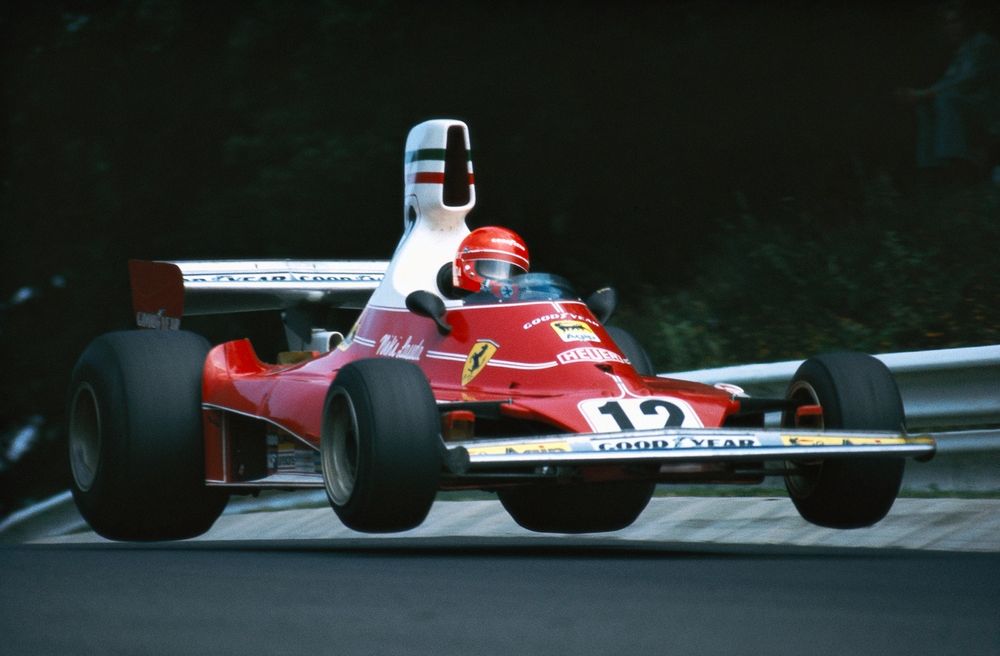
Lauda became F1's next greatest driver when Stewart retired
Photo by: Rainer Schlegelmilch / Getty Images
Decade wins: 17
Decade poles: 24
Decade titles: 2 (1975, 1977)
Lauda picked up the cudgels as Stewart left F1. Having gained experience with March and BRM, occasionally impressing, Lauda joined Ferrari. He immediately started helping designer Mauro Forghieri lift the team out of the doldrums and was arguably the fastest driver of 1974, taking nine poles from 15 races in the 312B3.
Poor reliability and misfortune kept Lauda out of the title fight, but he was the man to beat in 1975. Five wins and three other podiums in the 312T meant he comfortably defeated reigning champion Fittipaldi as Ferrari pressed home its flat-12 advantage over the Cosworth DFV hordes.
Four wins from the first six GPs meant 1976 looked like a repeat. But Lauda’s horrific German GP crash, which nearly killed him and meant the Austrian missed two other races, helped new McLaren recruit Hunt get back into championship contention.
Lauda made a heroic return but lost out by one point when he pulled out of the Fuji finale due to the appalling conditions.

Lauda and Ferrari were not the fastest combination of 1977 but an incredibly consistent and reliable campaign – 10 podiums – meant Lauda clinched his second crown with two rounds to go. Unhappy with the way Ferrari had responded to his crash – Reutemann, never Lauda’s favourite, had been brought in – he then walked away and skipped the Canadian and Japanese GPs.
He then joined Bernie Ecclestone’s Brabham team. Reliability of the Alfa Romeo-engined, Murray-designed BT46 was suspect, but Lauda still managed two wins – including on the one-off outing of the controversial ‘fan car’ variant – and finished fourth in the table during a year dominated by Lotus.
Things got worse in 1979 and, pressed by rookie team-mate Piquet, Lauda decided he’d had enough of driving around in circles; he walked away during the Canadian GP weekend. He would, of course, be back…

Lauda comes out on top in the 1970s ranking
Photo by: Motorsport Images


How the M8B became the most dominant car in McLaren’s history

Employing team orders can simply be a matter of common sense

The greatest F1 campaigns with no wins

Top 10 F1 results changed by backmarkers – the passes

Top 10 F1 results changed by backmarkers – the clashes

Stars, cars and highlights from the 2026 Goodwood Revival

The Egal has landed – again

Autosport magazine: Antonelli and a Can-Am celebration

FIA expects F1 races in Qatar and Abu Dhabi to run as planned

Top five roles on Motorsport Jobs this week

Champions crowned at incident-filled Donington Park 750 Motor Club meeting

Why Toyota’s 2026 WEC triumphs have put it into the all-time greatest endurance racing team debate
Subscribe and access Autosport.com with your ad-blocker.
From Formula 1 to MotoGP we report straight from the paddock because we love our sport, just like you. In order to keep delivering our expert journalism, our website uses advertising. Still, we want to give you the opportunity to enjoy an ad-free and tracker-free website and to continue using your adblocker.


Top Comments