


Top 10 F1 drivers of the 1990s
In the latest instalment of the top 10 F1 drivers of each decade, eras overlap and also come to an abrupt, and sometimes tragic, end in the 1990s. That makes deciding the order of this list even harder…

Autosport Retro
Telling the forgotten stories and unearthing the hidden gems from years gone by.

Watch: Top 10 F1 drivers of the 1990s | Autosport Retro
The 1990s was a big transitional period for Formula 1. The stars at the beginning of the decade were virtually all gone by its end and the deaths of Ayrton Senna and Roland Ratzenberger at Imola in 1994 led to significant rule changes.
For the latest in our series of top 10 F1 drivers of each decade, we’ve tried to select and rank the best performers. As usual, we’ve considered their level of success, machinery at their disposal, longevity and how highly the drivers were rated by their contemporaries.
Success outside the relevant decade is not considered and drivers can appear in more than one list.
10. David Coulthard

Coulthard crosses the line to win his maiden F1 grand prix at the 1995 Portuguese GP
Photo by: Motorsport Images
Decade wins: 6
Decade poles: 8
Decade titles: 0
At either end of the decade, Riccardo Patrese and Heinz-Harald Frentzen put in some fine performances that made them candidates for this list, but Coulthard scored more wins and poles than either, and contributed to McLaren’s revival.
Brilliant on his day, capable of beating anyone, Coulthard didn’t quite manage to put together a consistent enough campaign to topple Michael Schumacher and Mika Hakkinen in the second half of the era.
Coulthard got his chance at Williams following the death of Senna and did enough to secure a full-time drive for 1995. The Scot showed his pace in the FW17, taking five poles, but there were also some notorious gaffes, including spinning on the warm-up lap at Monza and crashing in the Adelaide pitlane.
He took a deserved first win at the Portuguese Grand Prix, then joined McLaren for 1996. It was the start of a long career for the Woking squad that would last for nine seasons.
Coulthard was rarely far behind Hakkinen and took some fine wins, including at Imola in 1998. He was also robbed of several other possible victories, including in Canada and Italy in 1998, and France and Malaysia the following year.
However, there were some errors – skating off at the Nurburgring in 1999 ended his championship hopes – and he had to watch as his team-mate racked up back-to-back titles in 1998-99. “Coulthard drove well for most of the time, it was just that Hakkinen generally drove better,” summarised Autocourse.
Perhaps Coulthard’s best performances came at the start of the next decade, including the race of his life at the 2000 French GP. Had that season and 2001 been counted here, he would have been higher, but he’d proved himself a consistent frontrunner and team player in the 1990s.

9. Gerhard Berger

Berger beats Schumacher in his own backyard in the 1997 German GP
Photo by: Sutton Images
Decade wins: 5
Decade poles: 8
Decade titles: 0
Already a grand prix winner, Berger started the decade joining Senna at McLaren. He outqualified the Brazilian in the 1990 opener but, over their three years together, Berger was rarely a match for his friend. The Austrian took just three wins at McLaren, including one gifted to him by Senna in Japan, before returning to Ferrari for 1993.
That started a long relationship with Jean Alesi; the two would be team-mates for five seasons, across Ferrari (1993-95) and Benetton (1996-97). And separating the two stalwarts of the period is tricky.
Berger took more wins and poles during their time together, but Alesi was marginally ahead in qualifying and scored more points. Indeed, 1994 was the only season of the five in which Berger finished ahead of Alesi in the championship.
Like Alesi, Berger was never quite a title contender, but he had some great moments, particularly at Hockenheim. Berger often excelled at the old, high-speed version of the German GP venue and his victory for Benetton in 1997, following the death of his father and illness, was one of the most imperious performances of the era.
It also meant he bowed out of F1 with his seventh top-five finish in the championship, his fifth of the decade.
8. Jean Alesi

Alesi had shown much promise and despite just one win he still consistently delivered across his F1 career
Photo by: Sutton Images
Decade wins: 1
Decade poles: 2
Decade titles: 0
Others scored more wins and poles, but Alesi was a key F1 figure for more of the 1990s than any other driver. He provided many exciting moments – good and bad! – and appeared in Autocourse’s top 10 more times than anyone else, only missing out on a full set in 1999. He was also very unlucky to score only one victory.
Alesi had risen to prominence in 1989, winning the Formula 3000 title and taking fourth on his world championship debut in the French GP. He then marked himself out as one of the most exciting talents in the first F1 race of the new decade, boldly battling Senna’s McLaren at Phoenix before finishing second.
While there were some errors in his rookie campaign, Alesi continued to impress. He was second at Monaco and attracted Ferrari’s attention. “He carries the stamp of greatness,” said Autocourse while placing him ninth in its 1990 rankings.
Though beaten by team-mate Alain Prost in his first Ferrari season, it was the team’s steep decline that hurt Alesi’s career most. The F92 was bad and the F93A was little better, though Alesi beat colleagues Ivan Capelli (1992) and Berger (1993).
Jean Todt’s arrival at Ferrari started to have an impact in 1994, the 412T being a consistent – if sometimes unreliable – points challenger. Alesi should have won the Italian GP from pole but was thwarted by engine failure and it was Berger who scored the team’s only win, in Germany.
Alesi finally got his victory at the 1995 Canadian GP following problems for Schumacher’s Benetton. He scored four other podiums that year and put in what Alesi regards as the race of his life at Suzuka, charging to second after serving a jump-start penalty before transmission failure. Once again he was robbed of victory at Monza, this time by a wheel bearing failure, and Alesi would have won at the Nurburgring but for one of Schumacher’s great drives.

Did Alesi and Berger become too comfortable as team-mates? Schumacher’s pace when he tested the 412T2 and the duo’s failure to win a race for Benetton in 1996, just a year after the German’s dominant title success there, suggests it’s a possibility.
Alesi nevertheless racked up many podiums, including a second at the 1997 Italian GP, where he led from pole but was jumped by Coulthard during the pitstops. He was fourth in the championship in both 1996 and 1997.
Alesi continued to show the fighting spirit that made him so popular at Sauber over the final two seasons of the decade, though finishes were scarce. Snatching fourth from eighth on the grid and staying there for many laps at the 1998 British GP, then taking his final podium amid the chaos of Spa later that year were among the highlights.
7. Jacques Villeneuve

Villeneuve didn't shine for that long in F1 but he shone brightly when he did
Photo by: Ercole Colombo
Decade wins: 11
Decade poles: 13
Decade titles: 1 (1997)
Villeneuve’s time at the top of F1 was brief and he was not as complete a performer as those above him on this list, but the French-Canadian did produce some swashbuckling drives and won the title in just his second year of F1.
The reigning CART champion made an immediate impact, taking pole on his debut and only losing the Australian GP due to an oil leak following an off. He wasn’t generally a match for Williams team-mate Damon Hill until late in the season, when a brilliant victory at Estoril – which included an outside pass on Schumacher – helped take the title fight to the Suzuka finale.
A lost wheel ended his championship hopes, though Hill was already on his way to victory, making it 8-4 to the Englishman on wins across the season. Nevertheless, with Hill gone and Schumacher still in a building phase with Ferrari, Villeneuve got an even better chance in 1997.
He quickly got the psychological advantage over new team-mate Frentzen but did make slightly heavy weather of his campaign. It didn’t help that Schumacher disappeared down the road every time it rained, while Villeneuve was underwhelming at Monaco and Hockenheim, and spun out of both.
On the plus side, Villeneuve took more wins than anyone else (seven) and arrived at the Jerez finale just one point behind Schumacher. An opportunistic attack led to the controversial contact for which Schumacher ultimately lost his second place in the points, and a conservative Villeneuve nursed his Williams to third to secure the crown.
Arguably as impressive were his spirited efforts in less competitive Williams and British American Racing machinery over the next two seasons. He once again defeated Frentzen in 1998 and scored superb thirds at Hockenheim and the Hungaroring, as well as qualifying second at Monza.
Villeneuve took a gamble by joining friend Craig Pollock’s new BAR team for 1999. He failed to finish the first 11 races and didn’t score a point, but Villeneuve never gave up and provided some demonstrations of class, including qualifying fifth at Imola.
6. Alain Prost

Prost's final F1 bow was to dominate to the 1993 title before retiring
Photo by: Motorsport Images
Decade wins: 12
Decade poles: 13
Decade titles: 1 (1993)
Prost makes it this high as much for his raising of Ferrari’s challenge in 1990 as his title with Williams three years later. After his toxic relationship with Senna made staying at McLaren untenable, Prost moved to the famous Italian team and helped make it a championship contender for the first time in five years.
Prost got the upper hand over incumbent Nigel Mansell and maximised a Ferrari chassis that made up for its lack of power compared to the Honda in Senna’s McLaren. Prost’s Mexican GP win from 13th on the grid was one of the great GP performances and he went to the penultimate round at Suzuka with a chance of the crown.
Infamously removed from that race at the start by Senna, Prost ended up second in the table, though Autocourse ranked him first in its top 10.

Prost’s 1991 season is largely remembered for him being sacked ahead of the finale and for being his first winless campaign since 1980, but it was far from all bad. Prost comfortably outscored rising star team-mate Alesi and took an opportunistic second place in the rain-hit Spanish GP.
After taking a sabbatical, Prost returned having engineered himself a seat at the pacesetting Williams-Renault team. Never as comfortable with the electronic gizmos as predecessor Mansell, Prost was sometimes vulnerable against Senna’s inferior McLaren, especially in the wet, and inexperienced team-mate Hill. Starts were also a problem.

On the other hand, Prost still scored 13 poles and seven wins, including at the rain-affected San Marino GP, and wrapped up the crown with two races to spare before retiring once again.
5. Nigel Mansell
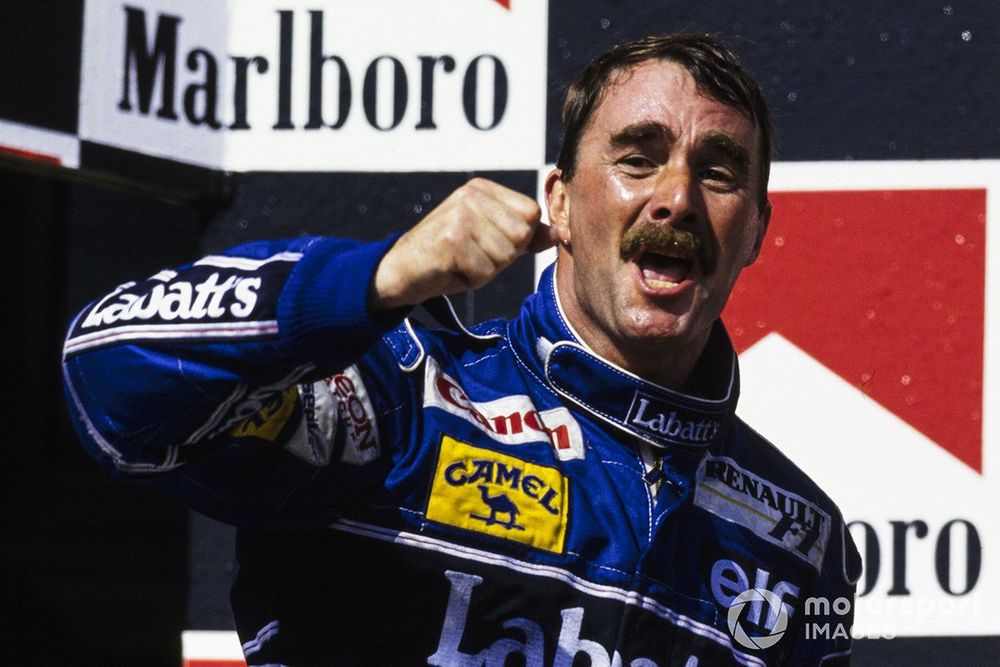
Mansell utterly dominates to take the 1992 title - and promptly departs F1 for 1993
Photo by: Motorsport Images
Decade wins: 16
Decade poles: 20
Decade titles: 1 (1992)
Already a championship-level driver when the decade began, Mansell bore the brunt of Ferrari unreliability in 1990. He won the Portuguese GP and should have taken his home race too, but Mansell was generally outshone by new team-mate Prost.
After his gearbox-induced retirement at Silverstone, Mansell announced he was quitting F1. But Williams enticed him to reconsider, and the Briton became part of the Renault-powered push to topple McLaren-Honda.
Early unreliability and a herculean effort from Senna and McLaren kept the title from Mansell in 1991, but the FW14B moved the goalposts. Armed with active suspension and traction control, Mansell dominated both team-mate Patrese and the rest. A then-record nine wins from 16 races, plus 14 poles, easily took Mansell to a well-deserved title.
With typical drama, Mansell and Williams failed to sort an agreement for 1993, so he left for Indycar – where he promptly won the CART crown as a rookie.
Following Senna’s death, Mansell returned to Williams for four GPs in 1994. He took pole at Adelaide and won the Australian GP after the controversial clash between Hill and Schumacher.
Mansell signed for old rival McLaren for 1995. To call it a failure would be an understatement and Mansell left after just two races, but few managed his box-office appeal – and he’d proved himself one of F1’s best in the first half of the decade.

4. Damon Hill

Hill on his way to sealing an emotional 1996 F1 title
Photo by: Motorsport Images
Decade wins: 22
Decade poles: 20
Decade titles: 1 (1996)
It may surprise some to read that Hill scored more GP wins in the 1990s than anyone bar Schumacher. Yes, all but one of those was with Williams, but Hill often provided Schumacher with his firmest opposition.
It was his work as Williams test driver, rather than his efforts in the awful Brabham BT60B, that earned Hill his 1993 race seat. There were mistakes in his season alongside Prost but he learned quickly and scored a hat-trick of wins across the Hungarian, Belgian and Italian GPs on his way to third in the points.
Hill started 1994 as Senna’s number two but was soon faced with a far greater challenge than developing a tricky car. The Brazilian’s death at the San Marino GP thrust Hill into the lead role and he helped lift the shattered Williams team, much as father Graham had at Lotus in 1968.

Aerodynamic improvements to the FW16 and Schumacher’s controversial season, which included two disqualifications and missing a further two due to a ban, helped bring Hill into contention. A brilliant drive at Suzuka, beating Schumacher’s Benetton in the wet, kept Hill’s championship chances alive for the Australian GP decider, only for his Williams to suffer terminal damage when the rivals clashed.

Hill’s 1995 season started promisingly, with a pole and two wins from the first three races, and the FW17 was undoubtedly fast. But driver errors and team miscues meant the season fell apart in the face of superb Benetton strategy and relentless race pace from Schumacher.
Williams decided to look elsewhere for 1997 but still had 1996 to get through. Having won the 1995 finale in Australia, Hill started the campaign with renewed vigour, revelling in the FW18 that remains his favourite racing car.
He won four of the first five races and was running away with the Monaco GP before a rare Renault engine failure. It wasn’t a perfect season – Hill notably crashing out of an Italian GP lead before being outraced by team-mate Villeneuve in Portugal – but a commanding performance in Japan secured Hill a deserved title.
Hill landed at Arrows for 1997 and, while it meant there was no title defence, there can be little doubt he helped raise the team’s level. A win in Hungary would have been fitting, but a hydraulics leaked denied Hill, who finished second.

His first season with Jordan also started slowly but, again, things developed well. The undoubted highlight was the team’s first victory, Hill winning in the wet at Spa after qualifying a fine third in the dry. He ended up sixth in the points, ahead of the man who had replaced him at Williams: Frentzen.
The German joined Jordan in 1999 and immediately found the team more to his liking. While Frentzen won two races and remained in title contention until late in the season, an increasingly disinterested Hill toiled to complete his final F1 campaign, ending up 12th in the standings.
3. Mika Hakkinen

Hakkinen ended McLaren's F1 world title drought in 1998 and successfully defended his crown a year later
Photo by: Steve Etherington / Motorsport Images
Decade wins: 14
Decade poles: 21
Decade titles: 2 (1998-99)
For someone who was as fast or perhaps faster than Schumacher over a single lap, Hakkinen had to wait a long time before his F1 breakthrough win. He arrived with Lotus in 1991 and showed promise over two seasons before joining McLaren as test driver in 1993.
When Michael Andretti’s unhappy time in F1 came to an end, Hakkinen stepped into a race drive – and immediately outqualified team leader Senna at Estoril. Senna soon reasserted his authority and Hakkinen crashed out of the GP, but the Finn then scored his first podium at Suzuka.
McLaren’s 1994 season was hampered by problems with its Peugeot engine but Hakkinen was one of the outstanding drivers of the season. He took six podiums and finished fourth in the table, with Autocourse rating him behind only Hill, Schumacher and Berger.
Mercedes arrived for 1995 but it would be a while before the relationship bore fruit. Hakkinen managed seconds at Monza and Japan as others faltered but a qualifying crash in the Adelaide finale overshadowed his season. Hakkinen’s injuries were severe and his life was only saved by the efforts of Sid Watkins and the trackside medical team.
The accident and subsequent recovery seemed to strengthen his bond with McLaren, where he was joined by Coulthard for 1996. He came out on top in the intra-team battle and was fifth in the points, although a first win remained elusive.
It was Coulthard who ended McLaren’s win drought in the Australian GP that opened the 1997 season and misfortune seemed to follow Hakkinen. He lost opportunities to win the British and Luxembourg GPs due to engine failures, while Coulthard racked up another success in Italy.
Hakkinen finally got his breakthrough – in his 96th start – when a combination of team orders and Williams-McLaren cooperation helped him lead a 1-2 in the European GP finale.
Adrian Newey’s MP4/13 gave Hakkinen the car his talents deserved in 1998. Following a bizarre Australian GP opener in which Coulthard handed Hakkinen victory after the polesitter had erroneously pitted due to radio confusion, Hakkinen battled Ferrari’s Schumacher for the crown.
Four pairs of victories, including leading at Monaco from start to finish, secured Hakkinen the laurels. Despite a catalogue of errors from team and driver, plus a couple of contretemps with Coulthard, Hakkinen successfully defended his title in 1999.
He probably wasn’t the all-round package that Schumacher was, but Hakkinen’s speed was never in doubt. His silver McLaren on a fully committed qualifying lap was one of the finest F1 sights of the 1990s.
2. Ayrton Senna

Senna took one stunning title and one controversial title in the 1990s before his tragic death
Photo by: Paul-Henri Cahier / Getty Images
Decade wins: 21
Decade poles: 23
Decade titles: 2 (1990-91)
Senna started the decade locked in a bitter rivalry with former team-mate Prost and reeling from his treatment following the 1989 Japanese GP.
The 1990 season, in which Senna and Prost fought an epic contest, was one of F1’s greats and either driver would have been a worthy champion. Right up to the point where Senna decided to crash into the Ferrari driver at Suzuka: it secured the Brazilian the crown but will forever provide a black mark on his career.
Nevertheless, Senna banished any doubts as to who the best driver in the world was in 1991. With Prost struggling at Ferrari, Senna fought a superb campaign against the rising force of Williams-Renault. He combined some brilliant drives, including finally winning his home GP despite gearbox problems, with pushing McLaren and Honda to respond to the threat and deservedly won the championship.
Thereafter, Williams gained the ascendency and Senna had to pick up the scraps in 1992, scoring ‘only’ three wins.
Off-track he was actively working to try and join Williams while looking at CART and started 1993 on a race-by-race basis for McLaren. But on-track he put in some of his best performances, including wet-weather masterclasses at Interlagos and Donington Park.

Senna finally got his hands on a Williams for 1994. Domination looked likely but the banning of electronic aids such as traction control and active suspension hurt Williams more than its rivals and the Schumacher-Benetton combination was stronger.
Senna managed three poles against the run of play but was still fighting an uphill battle when he crashed while leading the San Marino GP. F1 lost its biggest star, leading to changes that are still felt today.
1. Michael Schumacher

After the loss of Senna, Schumacher stood alone at the top of F1
Photo by: Motorsport Images
Decade wins: 35
Decade poles: 23
Decade titles: 2 (1994-95)
From the moment he hit the track at Spa in 1991 with Jordan (or earlier for those watching F3 and sportscars!), Schumacher looked like a future star. After qualifying seventh for the Belgian GP, he was snapped up by Benetton and then outpaced triple champion Nelson Piquet.
In a 1992 season dominated by Williams, he beat Senna to third in the championship and took his first victory. Crossing swords with the Brazilian on-track only served to underline the likelihood that Schumacher was the driver Senna would one day have to worry about.
Senna’s brilliant 1993 campaign bolstered his status as F1’s benchmark, but Schumacher was the next-best non-Williams driver and added another victory, using a fine strategy to hold off Prost at Estoril.
With all the gizmos and Prost gone for 1994, Schumacher and Benetton hit the ground running. As Williams struggled to fix the FW16’s aero problems and Senna grew concerned at what he felt was Benetton’s illegal use of traction control, Schumacher won the first two GPs.
Senna’s fatal crash at Imola robbed F1 of one of its inter-generational contests and left Schumacher at the top of the pile. A combination of a Williams revival, Hill stepping up and several controversies meant the 1994 title fight went down to the wire. Schumacher was probably the right champion but the means by which he clinched it – in a clash with Hill after a mistake – highlighted a ruthlessness that would remain a blot on the German’s career.
Schumacher was brilliant in 1995, winning nine times despite Williams having the faster car and clinching his second crown. He then took on the great challenge of Ferrari, which had not won an F1 championship since 1983 and not taken the drivers’ crown since 1979.

Schumacher's attempted taking out of Villeneuve saw him thrown out from the 1997 F1 world championship
The F310 was no match for the Williams FW18 in 1996 but Schumacher still conjured three victories, including a sensational rain dance in Spain, and he was third in the points.

Schumacher’s 1997 season could be regarded as one of the greatest of all time, scoring five wins and taking the championship down to the wire despite the pace of Villeneuve’s FW19. But his apparent attempted take-out of is rival at Jerez again demonstrated that Schumacher didn’t know – or didn’t care – where the line of acceptable on-track conduct was.
McLaren jumped Ferrari with the new narrow-car, grooved-tyre rules of 1998 but Schumacher again helped the Italian squad rise to the challenge. Now facing arguably his fastest rival in Hakkinen, Schumacher took six wins – including a tactical masterclass in Hungary – to again go to the finale attempting to end Ferrari’s drought.
Stalling at the start and then getting a puncture while on a recovery charge at Suzuka ended the dream once again.
The Jean Todt-Ross Brawn-Rory Byrne-Schumacher superteam was in the mix again in 1999, until Schuey broke his leg in a crash at Silverstone. Eddie Irvine challenging Hakkinen for the title and Schumacher’s pace on his return indicated the accident probably cost him the championship, though Ferrari did get some consolation with the constructors’ crown.
Schumacher therefore ended the decade having not yet hit his Ferrari target, but he had long since established himself as the most-complete driver of the post-Senna era. And he’d racked up more wins in the 1990s than anyone else.

A first Ferrari drivers' title eluded Schumacher in the 1990s, but it wasn't to be that way for very long...
Photo by: Motorsport Images


How the M8B became the most dominant car in McLaren’s history

Employing team orders can simply be a matter of common sense

The greatest F1 campaigns with no wins

Top 10 F1 results changed by backmarkers – the passes

Top 10 F1 results changed by backmarkers – the clashes

Stars, cars and highlights from the 2026 Goodwood Revival

The Egal has landed – again

Autosport magazine: Antonelli and a Can-Am celebration

Inside the competition building F1’s future engineering talent

WEC Barcelona: Toyota scores dominant 1-2 to clinch manufacturers’ title

When Can-Am made its controversial comeback

Mercedes explains why its upgrade made its F1 car harder to drive
Subscribe and access Autosport.com with your ad-blocker.
From Formula 1 to MotoGP we report straight from the paddock because we love our sport, just like you. In order to keep delivering our expert journalism, our website uses advertising. Still, we want to give you the opportunity to enjoy an ad-free and tracker-free website and to continue using your adblocker.


Top Comments