


How Antonelli found half a second to thwart Verstappen in Belgian GP qualifying
Red Bull successfully orchestrated a tow for Max Verstappen from team-mate Isack Hadjar, but it was Kimi Antonelli's mighty first two sectors that secured pole position

The execution was better second time around, but how much difference did it make?
On Max Verstappen's first run in Q3, his Red Bull team-mate Isack Hadjar was directed to furnish an aerodynamic ‘tow' along the back straight between Blanchimont and the Bus Stop chicane. This entailed Hadjar throwing his own lap under the bus, as it were, but this was of little consequence since he was facing the prospect of a back-of-the-grid start for taking on new power unit components anyway.
After a brief red-flag interruption to sweep away gravel drawn onto the track by Oscar Piastri straying off-track at Stavelot, they did it again. This time the two cars looked so much more joined up, meeting neither too soon nor too late, Verstappen closing in and sweeping by without having to lift the throttle.
That lap was good enough for provisional pole for a handful of seconds before Kimi Antonelli posted a lap 0.317s faster, but the Dutchman still praised Hadjar's "tow and a half", claiming he wouldn't have been on the front row without it.
"He did amazing," said Verstappen. "I initially thought, 'Oh my God it's too close,' but then actually it worked out well to the last corner. It was close, but I trusted him."
High praise indeed, but the raw timing doesn't quite support the hyperbole – Verstappen only gained a tenth in that sector over his previous flying lap, 28.185s compared with 28.279s.
At the time of the red flag, Lando Norris was fastest with a 1m44.801s lap, with Antonelli second on 1m44.840s, Charles Leclerc third on 1m44.893s and Verstappen fourth with a 1m44.984s. Just 0.183s separated P1 and P4 at this point.
Whatever happened, Norris was out of the running for pole given his own engine-penalty situation. It was all going to come down to the second Q3 runs.
It's known that Mercedes has found a clever (and legal – for now) way to bypass the mandatory electrical ramp-down phase, which is supposed to kick in as the battery levels diminish. Particularly effective at tracks with a short stretch between the final corner and the timing line, this requires the drivers to lift off the throttle just before the line, at a preordained point that they rehearse carefully in simulation.
The car's Engine Control Unit (ECU) is programmed to keep the electrical motor delivering maximum power at this point rather than ramping down. But this wasn't a factor in Antonelli's final margin of superiority over Verstappen; the gap was already there.
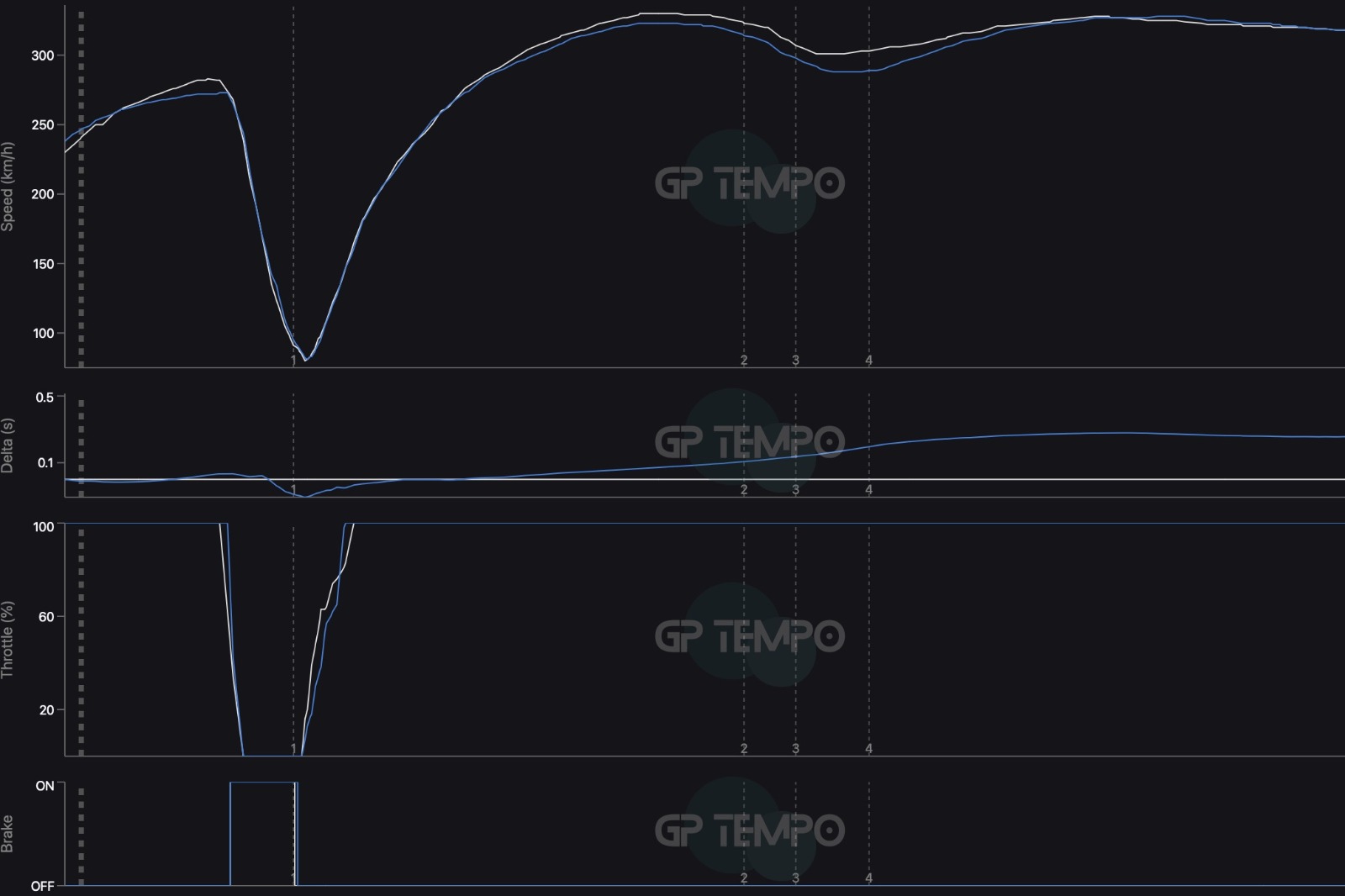
Antonelli faster but not fastest in sector one
In their first Q3 runs, Antonelli traversed sector one in 30.206s, Verstappen in 30.520s. At the second time of asking, the Italian improved to 30.160s, Verstappen to 30.443s.
Small but crucial steps, as it would turn out, since both drivers would go on to find bigger gains in sector two.
The picture the data paints is consistent with Mercedes having a better overall power unit package, despite Red Bull's internal combustion engine being the best according to the FIA's Additional Development and Upgrade Opportunities (ADUO) framework. Antonelli (white trace) enjoyed a top speed advantage over Verstappen (blue trace) on the pit straight, then again on the run downhill towards Eau Rouge, and up and through Raidillon.
On the Kemmel Straight their top speeds converged, but Antonelli's ability to carry more cornering speed through Raidillon (despite both drivers having the throttle pinned) set up an advantage he would not lose, even though they reached broadly similar top speeds – before, that is, Verstappen entered the super clipping phase first on the approach to Les Combes.
One reading of this data would suggest Red Bull and Mercedes were fairly equally matched when running in Straight Line Mode, but that isn't always evident elsewhere. Perhaps Red Bull could pick up some tips from Racing Bulls? Arvid Lindblad ended up going through sector one faster than both Verstappen and Antonelli…
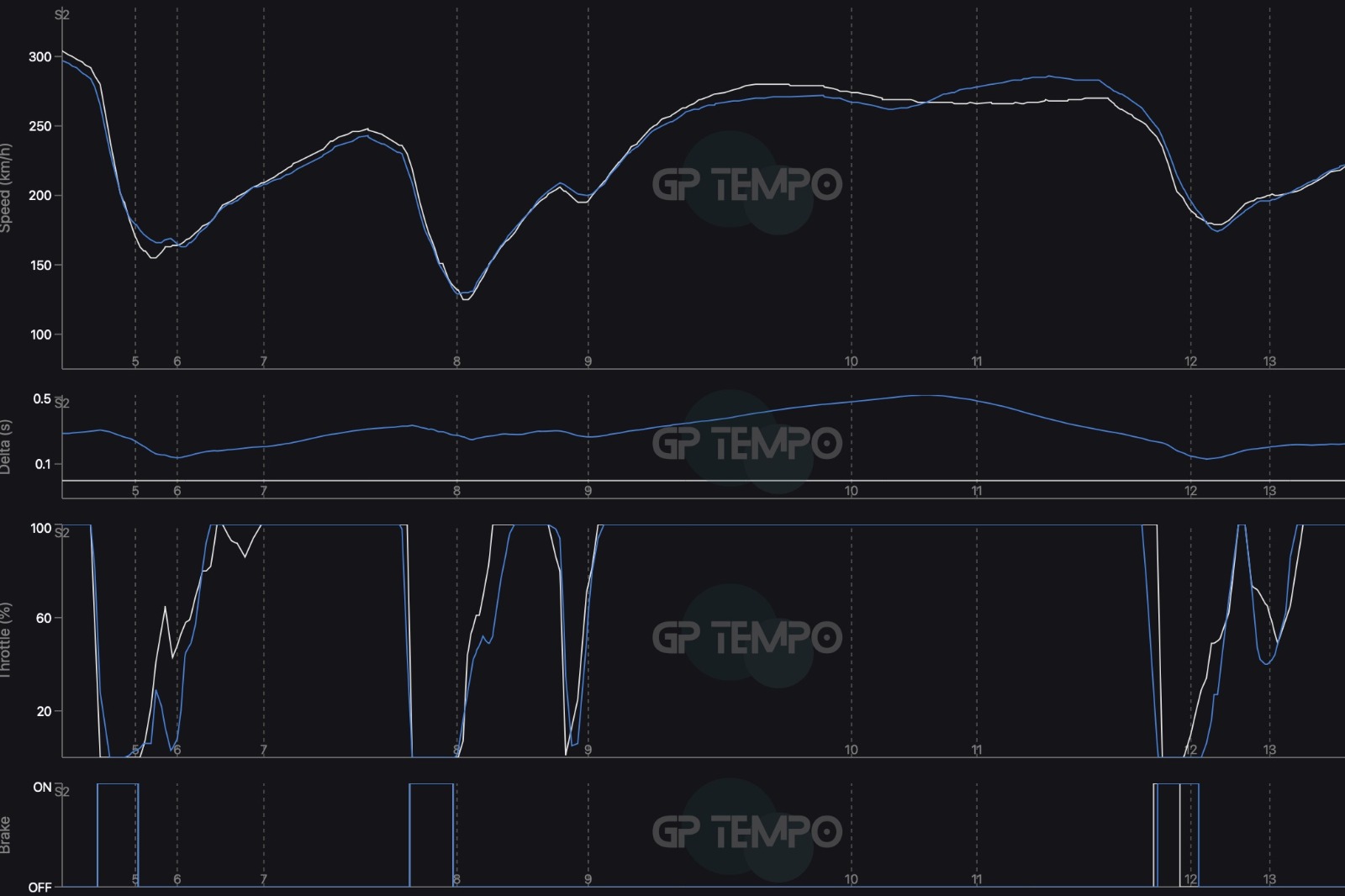
Half-second gain keeps Antonelli ahead
On his first Q3 run, Verstappen went through sector two in 46.185s, bettered only by Norris. Antonelli's first run was a more modest 46.534s.
Had this pattern been repeated through the second runs, the battle for pole position might have panned out rather differently – but Antonelli found the better part of half a second, going through in 46.059s; Verstappen's improvement was more modest, though he was still fractionally quicker: 46.050s.
So, Antonelli entered this section of the circuit, very much Red Bull's strong suit, three tenths up but facing the prospect of losing all of it and more. Instead, he emerged having lost just thousandths of a second.
Again, disappointingly, much of this is a factor of electrical deployment. Verstappen began nibbling away at the Mercedes' advantage by carrying more speed through Les Combes but Antonelli was able to find more speed as the track began to wind downhill, despite having to feather the throttle at Malmedy.
Perhaps the most egregious effect of the 2026 technical regulations has been to utterly neuter Pouhon, one of the most magnificent corners on the F1 calendar. The onboard cameras revealed Antonelli's car beginning to harvest energy half-way round this turn and the data backs this up – there's a crossover in speed half way round as the Mercedes clips more aggressively, enabling Verstappen to recoup a couple of tenths on the run towards Fagnes.
The speeds then converged as Verstappen got off the throttle earlier.
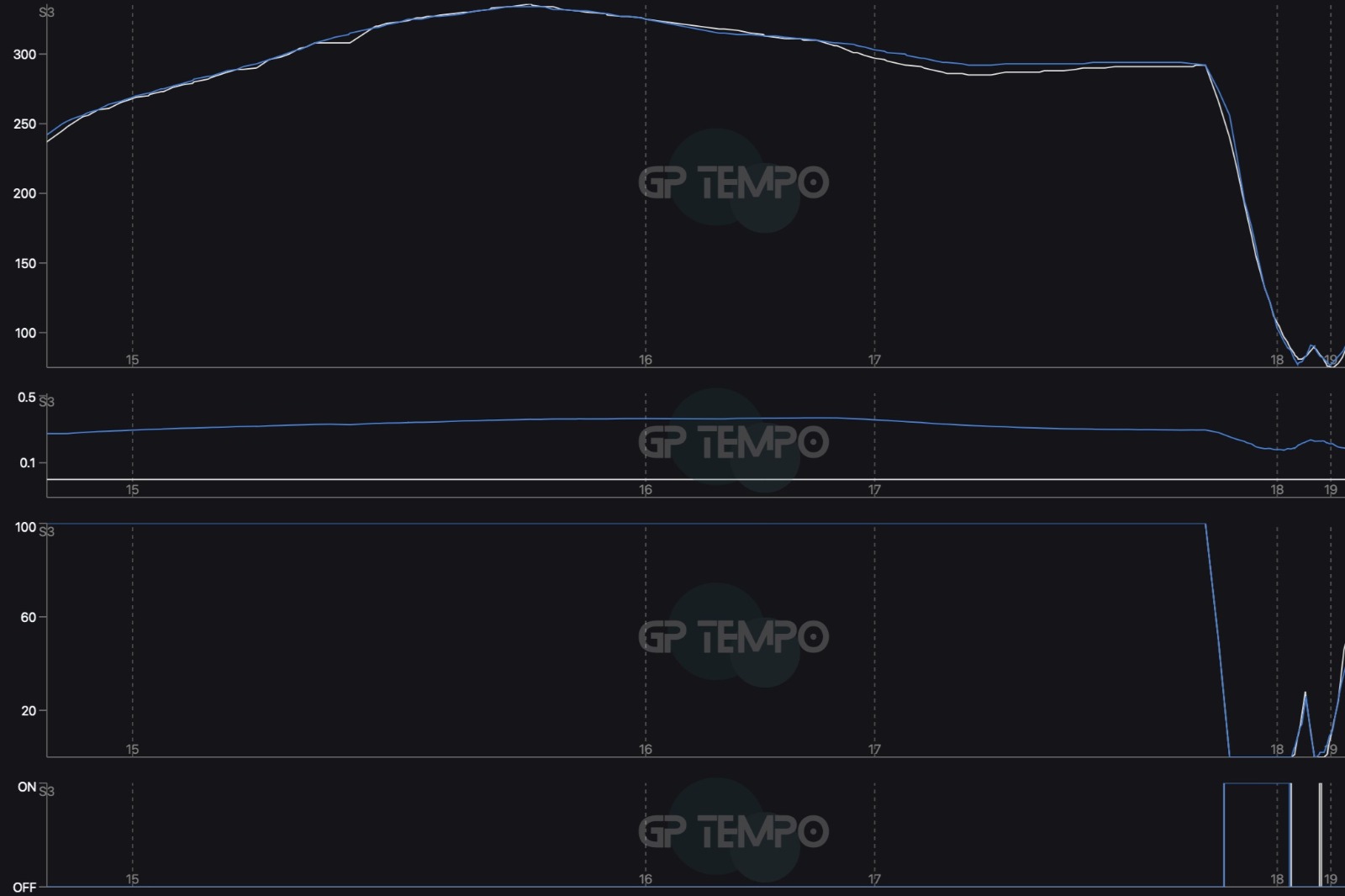
Tow can't do enough for Verstappen in sector three
Having found half a second through the middle sector, Antonelli preserved the advantage he'd built in sector one. In the final phase of the circuit it was a case of clinging on as Verstappen went for a tow from his teammate once again.
While Verstappen improved to 28.185s over the 28.279s he set on his first run, with the less obviously well-executed version of the tow, Antonelli was fractionally slower than his first run – 28.142s versus 28.100s.
Again, the data shows remarkable parity in top speed while running in this particular Straight Line Mode zone. And Verstappen was at his fastest after rather than before he'd left Hadjar's slipstream at Blanchimont.
The speed differential was in the region of 5-8km/h until the final approach to the Bus Stop, where once again the traces converge – reaching an identical peak just as they got off the throttle and braked at the same point. Here the gap had ducked slightly below three tenths, so not enough for the Mercedes' slightly better acceleration curve – again, likely a consequence of more electrical deployment – to make a massive difference in the lunge to the tape.
Often in 2026 it feels as if there should be some forfeit whenever the dread word "deployment" is required for exposition. But Antonelli, for one, felt that his half-second gain through the second sector was built on skill, application and enterprise rather than the exigencies of battery power.
Asked where he pushed more through there, Antonelli was clear.
"Every corner," he said. "I was just carrying a bit more speed. It was a bit hard to judge at times because super clipping was coming more and more, so it was changing the reference a little bit.
"That was the tricky bit in qualifying. But on the last lap, I just tried to carry a bit more speed everywhere, and the car stuck, so I'm happy with that."


'Senior moment' or breakdown of trust? The implications of Hamilton's Singapore GP meltdown

Why Verstappen's dominance left rivals scrabbling for alternatives in Singapore

A "better job" or more engine power? Verstappen's Singapore pole unpicked

FIA reveals "human error" caused latest software glitch in Singapore sprint qualifying

F1 Singapore GP live commentary and updates - Verstappen takes sprint pole

F1 Singapore GP live commentary and updates - Verstappen wins sprint while McLarens collide

F1 Singapore GP live commentary and updates - Verstappen on pole

LIVE: F1 Singapore GP - Verstappen dominates to victory from Leclerc, nightmare for Hamilton

WEC Barcelona: Genesis secures maiden series pole from Toyota
What drives Bortoleto as his junior rivals hit new heights in F1

How the M8B became the most dominant car in McLaren’s history

What Verstappen knew about Red Bull’s big upgrade when he signed his new F1 deal
Subscribe and access Autosport.com with your ad-blocker.
From Formula 1 to MotoGP we report straight from the paddock because we love our sport, just like you. In order to keep delivering our expert journalism, our website uses advertising. Still, we want to give you the opportunity to enjoy an ad-free and tracker-free website and to continue using your adblocker.


Top Comments