


Gilles Villeneuve's 10 greatest F1 drives
Formula 1 lost one of its brightest stars when Gilles Villeneuve was killed during practice for the 1982 Belgian Grand Prix. Forty years on, Autosport picks out the greatest drives by a Ferrari legend

Autosport Retro
Telling the forgotten stories and unearthing the hidden gems from years gone by.
Gilles Villeneuve was one of the standout drivers of his era. Still regarded as one of the fastest Formula 1 drivers of all time, the French-Canadian was killed at Zolder in 1982 just as he looked like he finally had a car to match his talents.
PLUS: The untold Gilles Villeneuve story from inside Ferrari
Villeneuve, who won six world championship grands prix from his 67 starts, was exciting and flamboyant to watch, but he developed much more finesse and racecraft than some have suggested.
For this list, we’ve taken into account the machinery and opposition involved, and the circumstances surrounding the races. Here’s our ranking of his 10 best F1 drives.

Gilles Villeneuve, Ferrari Ferrari 312T3, leads the original start of the race from polesitter Mario Andretti, Lotus 79
Photo by: Sutton Images
10. 1978 Italian GP, Monza
Car: Ferrari 312T3
Started: 2nd
Result: 7th
The 1978 Italian Grand Prix is infamous for Ronnie Peterson’s death following a multi-car accident at the shambolic start. That overshadowed an event in which the Swede’s Lotus team-mate Mario Andretti clinched the world title – and in which Villeneuve starred.
Following a long delay after the early accident, the race was restarted over 40 laps. Villeneuve had qualified a brilliant second, over a second clear of team-mate Carlos Reutemann in 11th, and remained in his Ferrari during the stoppage.
Unlike the first start, there was a long hold on the lights and Villeneuve went too early, chased by Andretti’s groundbreaking, ground-effects Lotus 79. They soon pulled clear of the rest, Villeneuve rebuffing Andretti’s early challenge and eking out a small lead.
Then both were handed one-minute penalties for jumping the start. “This, particularly in the case of Andretti, seemed unnecessarily harsh,” reckoned Autosport’s reporter Nigel Roebuck. “The two men were head and shoulders above any of their rivals on the day.”
Despite brake and tyre issues, Andretti attacked in the closing stages and finally made it by on lap 35. The “tenacious” Villeneuve nevertheless finished just over 2s behind, the duo then being demoted to sixth and seventh respectively by the penalties.
A month later Villeneuve took his first world championship GP victory on home ground in Montreal, but only after Peterson’s replacement, poleman Jean-Pierre Jarier, had retired from a dominant lead with a holed radiator on his 79. At Monza, Villeneuve had taken the fight to the Lotus team leader.
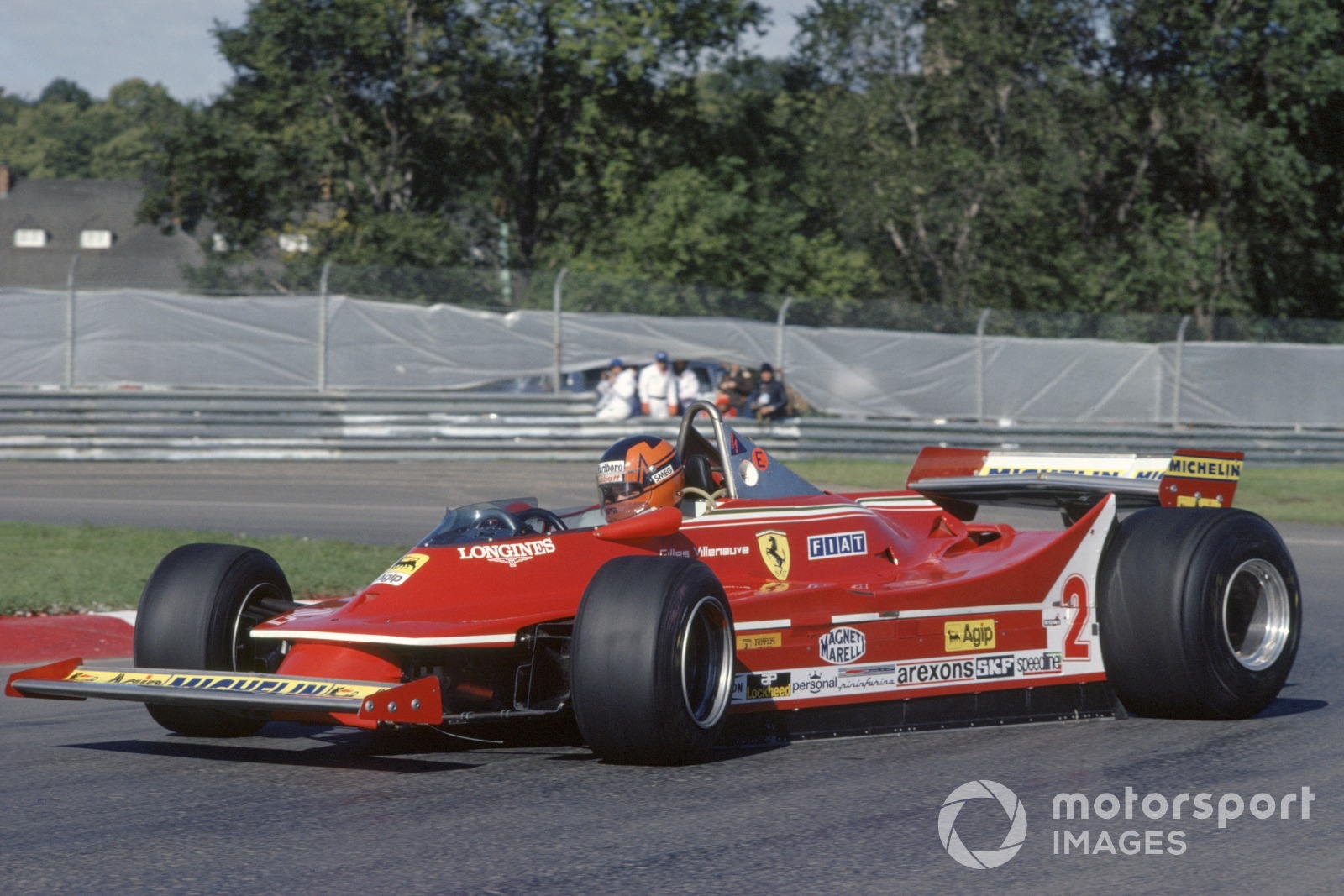
Sliding his Ferrari 312T5, Villeneuve took an unlikely fifth at home in 1980
Photo by: Motorsport Images
9. 1980 Canadian GP, Montreal
Car: Ferrari 312T5
Started: 22nd
Result: 5th
Not only was the 312T5 an uncompetitive machine in 1980, at Montreal the Michelin tyres used by Ferrari struggled in the cold conditions more than the Goodyears run by most of the field. The problem was so bad that reigning world champion Jody Scheckter failed to qualify for the 24-car grid, with Villeneuve scraping in 22nd, 0.8 seconds quicker than his team-mate.
Things didn’t look much better at the start. Villeneuve was involved in a multi-car crash, triggered by title contenders Alan Jones and Nelson Piquet, that forced him into the spare Ferrari after the race was halted.
But he immediately started making progress following the restart. There were many incidents and problems for those ahead, but Villeneuve also made some overtaking moves as he was cheered on by his home crowd. As early as lap nine he picked off Jean-Pierre Jabouille’s Renault to run ninth. That became eighth when runaway leader Piquet’s Brabham blew its Cosworth DFV.
Just before half-distance of the 70-lapper, Villeneuve overcame the second Brabham of Hector Rebaque and he made it into the points when Alain Prost’s McLaren crashed with suspension failure. When Jacques Laffite’s Ligier ran out of fuel on the penultimate lap, Villeneuve inherited an unlikely fifth. Autosport described it as “a drive that certainly flattered his Ferrari”.
Villeneuve’s best lap, though 1.5s slower than the inspired Didier Pironi’s Ligier, put him sixth in the fastest laps list – in a car that had qualified 3.5s off pole. It was one of the finest examples of Villeneuve’s fighting spirit and never-give-up attitude.
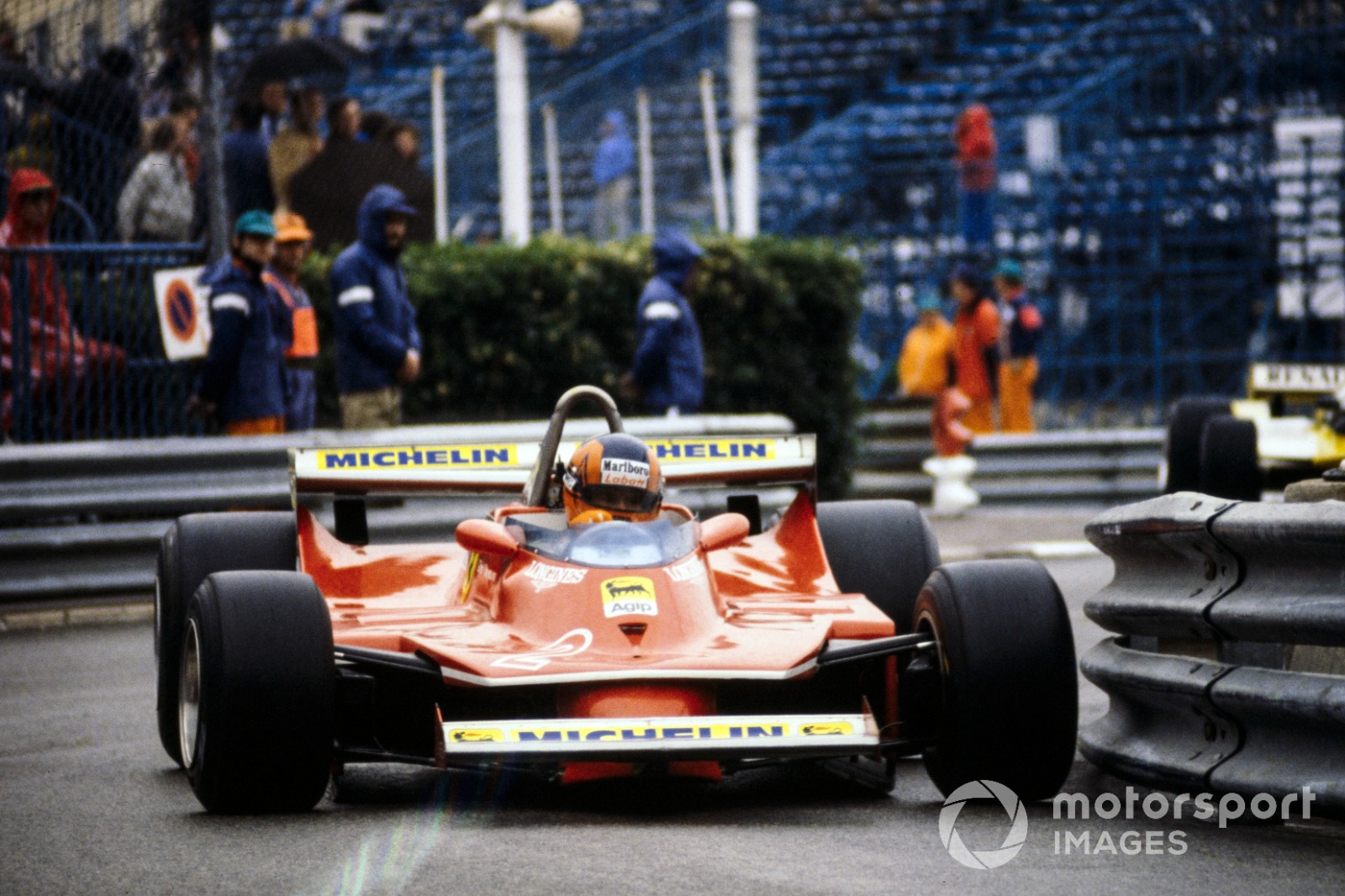
Gilles Villeneuve (Ferrari 312T5) battled to fifth at the 1980 Monaco GP
Photo by: Motorsport Images
8. 1980 Monaco GP, Monte Carlo
Car: Ferrari 312T5
Started: 6th
Result: 5th
The 1980 Ferrari 312T5 remains one of the team’s worst cars in its seven-decade history in F1. Villeneuve always pushed it to its limits (and sometimes over) and utterly trounced team-mate Scheckter.
In first practice at Monaco on Thursday, Villeneuve was predictably rapid in slippery conditions before going down an escape road and accidentally triggering his fire extinguisher. He rushed back, jumped in the spare car – and skimmed various barriers on his way to second fastest.
A clash with eventual polesitter Pironi’s Ligier then damaged the Ferrari on Saturday, but he still qualified sixth with a damaged wishbone, over a second quicker than Scheckter.
There was shambles into Ste Devote at the start – most famously Derek Daly landing on Tyrrell team-mate Jarier – and Villeneuve had to take to the escape road. He completed the first lap in ninth.
Villeneuve quickly overcame Jabouille’s recalcitrant Renault and then closed on Scheckter, who had benefited from the opening lap shenanigans. Scheckter waved his team-mate by but both Ferraris were soon in trouble with their tyres and pitted, Villeneuve falling to 14th. He started another climb.
Jones retired from second with diff failure and, shortly after half distance, it began to drizzle. Villeneuve, now running 10th, soon overtook Emerson Fittipaldi and gained another spot when Patrick Depailler’s Alfa Romeo suffered engine failure. On lap 55 worsening gearbox problems finally caused leader Pironi to hit the barriers, elevating Villeneuve to seventh.
Andretti’s Lotus was forced to pit with gear linkage issues and his team-mate Elio de Angelis crashed. That left Villeneuve, the fastest driver on track in the tricky closing stages, chasing the Arrows of Jochen Mass for fourth.
Villeneuve had a spin but pressed on and, when Mass also had a moment on the final lap, the Ferrari followed the Arrows across the line in fifth. Scheckter had long since given up, complaining of ill-handling…
"When you're stuck with a shitbox, everything is a matter of little victories – and today feels like one of those,” Villeneuve told Roebuck. “I tell you, I could not have driven that car faster.”

Gilles Villeneuve celebrates victory on the podium in South Africa
Photo by: David Phipps
7. 1979 South African GP, Kyalami
Car: Ferrari 312T4
Started: 3rd
Result: 1st
Ferrari brought its new 312T4 to the third round of the 1979 championship and Villeneuve put on one of his most accomplished F1 drives yet.
At Kyalami’s high altitude, the turbocharged Renault had a significant power advantage and Jabouille took pole, with Scheckter’s Ferrari second and Villeneuve third, just 0.03 seconds slower having missed some of qualifying thanks to a cracked rear suspension mounting point.
The two Ferraris battled the Renault early on and the trio swapped places several times. Scheckter was ahead, with Villeneuve second, when the race was stopped as rain arrived.
The circuit was wet for the restart, Villeneuve selecting grooved tyres and Scheckter slicks. Villeneuve raced away from the grid and started to build a lead before making an inevitable pitstop on lap 15 of the 78-lapper as the track dried.
Scheckter, who had hung on well in the early going, moved to the front and had a lead of half a minute. But he’d taken too much out of his tyres, later admitting he also left his second stop too long, allowing Villeneuve to close.
Scheckter had a lock-up and then finally decided to pit on lap 53, handing Villeneuve the lead. The home hero charged, cutting the gap from more than half a minute to just 3.4s at the flag, but Villeneuve had judged things perfectly and looked after the softer rubber he’d selected.
“I waited until the fuel load lightened before pushing the tyres too hard,” he explained. “Then, when I felt either the front or back tyres going off, I adjusted my driving style to bring them back again.”

Gilles Villeneuve and Alan Jones had a thrilling duel at Canada 1979
Photo by: Motorsport Images
6. 1979 Canadian GP, Montreal
Car: Ferrari 312T4
Started: 3rd
Result: 2nd
Jones and the Williams FW07 was the combination to beat at the end of 1979. The Australian had won three of the four races heading into the Canadian GP, qualified on pole by nearly 0.7s and beat team-mate and third-placed finisher Clay Regazzoni by more than a minute. Everyone behind Regazzoni, including recently crowned champion Scheckter, was lapped.
But the winning margin was only 1.1s because Jones and Villeneuve engaged in an enthralling battle for supremacy for the entire race.
Villeneuve used the torque of the flat-12 to jump into the lead at the start and the two immediately began pulling clear of the rest. Jones was initially content to sit behind but kept the pressure up and on lap 51 he got a better run on the stretch to the hairpin.
The Williams dived down the inside. Villeneuve gave Jones room, they touched wheels and the lead changed.
Jones initially pulled out a small lead but, typically, Villeneuve would not give up and clawed his way back to shadow Jones to the flag. The duo had been together virtually throughout and been in a class of their own.
“Apart from the lead battle, it had not been much of a race but, with a battle like we had for the whole 72 laps, it didn’t have to be,” wrote Jeff Hutchinson in our report.
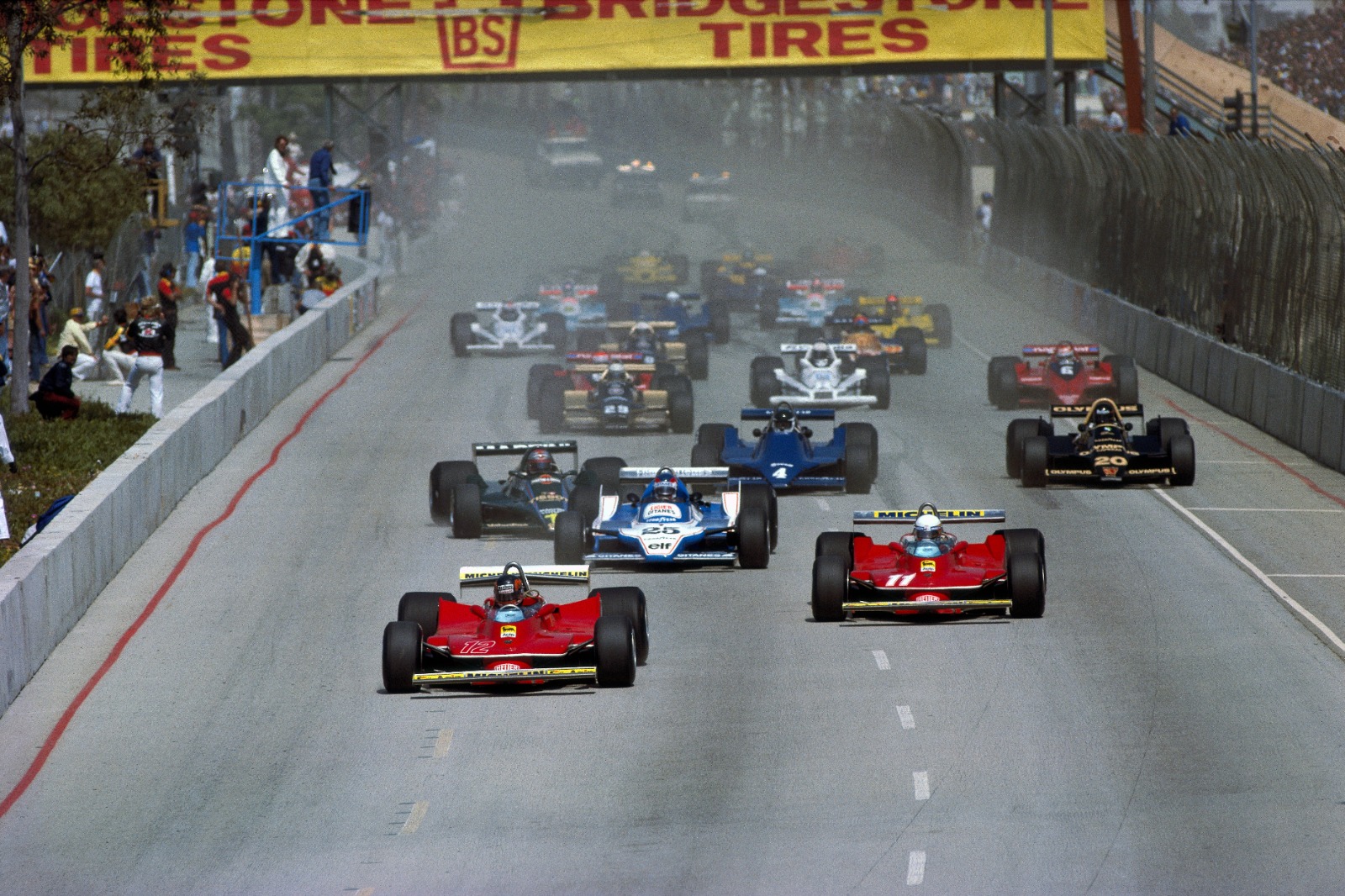
Villeneuve would dominate at Long Beach in 1979
Photo by: Motorsport Images
5. 1979 US GP West, Long Beach
Car: Ferrari 312T4
Started: 1st
Result: 1st
Not all of Villeneuve’s drives were heroic performances against the odds. He could utterly dominate, too.
Before that, though, there was confusion at the end of warm-up lap. With no one at the startline to direct the drivers to the grid, Villeneuve (on pole for the first time, despite a crash in practice) inadvertently overshot his slot, was followed by several others and chaos ensued. Villeneuve was handed a fine Autosport described as “ridiculously harsh” but received no penalty.
Once order had been restored, Villeneuve held off Scheckter at the start and then the second Ferrari lost out to Depailler’s Ligier. Scheckter got bogged down battling Depailler and then a charging Jarier’s Tyrrell, which caught and passed both to move into second, with Scheckter soon following him by the Ligier.
Scheckter, having knocked his nose askew, finally secured second on lap 27 of 80, by which time Villeneuve had disappeared into the distance. Villeneuve had again selected a softer compound Michelin than Scheckter, but never looked like being in danger as he managed his delicate rubber.
Villeneuve set fastest lap, led every tour and took the flag 29.4s clear to move into the lead of the championship.

Villeneuve excelled in mixed conditions
Photo by: Motorsport Images
4. 1979 US GP East, Watkins Glen
Car: Ferrari 312T4
Started: 3rd
Result: 1st
Forget the famous practice session in the wet. Yes, Villeneuve was 9.7s faster than Scheckter but only six cars recorded times and the Michelin wets were superior to the Goodyears. It certainly showed Villeneuve’s passion and car control, but the performance in the race is what gets this event on the list.
Villeneuve qualified third in the dry, a considerable 1.3s behind the Williams of Jones, with Piquet’s Brabham in between. But rain arrived shortly before the start.
Brabham couldn’t get its airgun equipment working in time, so Piquet was forced to start on slick tyres. He was easy meat for Villeneuve but the Ferrari had to be right on the edge at the first corner to get ahead of Jones as both went in deep.
Villeneuve quickly pulled away from the Williams in the early stages but, as the track dried, the harder Goodyear tyres came into their own and Jones started closing.
Scheckter had already stopped for his switch to slicks, giving Ferrari useful information about when it would be best to pit Villeneuve, but his times hadn’t yet surpassed his team-mate’s.
Jones eventually grabbed the lead on lap 32 of 59 and Villeneuve pitted to switch to slicks on lap 34. Jones came in two laps later and the enthralling fight looked set to continue as Villeneuve swept back into the lead. But Williams hadn’t been able to get the right-rear wheelnut secured properly and the wheel parted company, putting Jones out.
That should have made the rest of the race easy for Villeneuve, but low oil pressure gave him concern over the closing 20 laps. He nursed the car home, allowing his remaining pursuers to unlap themselves, though he still took the flag 49s clear of Rene Arnoux’s Renault in second.

Luck played a part, but Villeneuve put in an impressive performance to win 1981 Monaco GP
Photo by: Motorsport Images
3. 1981 Monaco GP, Monte Carlo
Car: Ferrari 126CK
Started: 2nd
Result: 1st
Villeneuve needed luck to win the 1981 Monaco GP, but his performance all weekend meant he deserved some. Although team-mate Pironi suffered a torrid practice, with crashes and engine failure, Villeneuve’s qualifying effort was still remarkable.
He took the cumbersome 126CK, Ferrari’s first turbocharged F1 car, around in 1m25.788s. That was just 0.078s slower than poleman Piquet’s far more suitable Brabham BT49C and 2.478s faster than 1980 Monaco polesitter Pironi, who qualified 17th. It was one of the finest qualifying laps in history.
PLUS: The greatest qualifying laps in F1
“Compared with the Williams, Brabhams and Arrows, the Ferraris looked a little clumsy, but Villeneuve’s genius had every pound of boost working for him,” reported Roebuck. “It was very dramatic indeed.”
Villeneuve held on to second at the start but predictably had no answer to Piquet’s Brabham. He was further hampered by a wet patch in the tunnel, the result of a fire in the Loews Hotel. With less grip than its rivals, the Ferrari had to take a different line and lost one of its few areas of advantage from practice.
After 15 of the 76 laps, Villeneuve was 8.5s behind and had a different problem to worry about. Jones had jumped from seventh on the grid to fifth on the opening lap and made it into third when team-mate Reutemann hit Nigel Mansell’s third-placed Lotus.
Jones quickly closed on Villeneuve and, on lap 20, dived for the inside into Mirabeau. Villeneuve left just enough room – indicating he knew when to fight and when not to – and the Williams was through. As Jones headed off in a chase of Piquet, the Ferrari also fell prey to Riccardo Patrese’s Arrows, underlining the quality of Villeneuve’s qualifying effort.
The Arrows soon expired and then Jones’s fantastic pursuit of Piquet paid dividends as the Brabham slid into the barriers at Tabac while attempting to lap backmarkers on lap 54.
Jones inherited a lead of more than half a minute. It all looked over, only for the Williams to start struggling with fuel vaporisation. Jones shot into the pits, hoping a fuel top-up would solve his engine’s hesitancy. But all it did was reduce his lead – with eight laps to go it was just 6.4s.
Villeneuve smelled a chance and pressed on, setting his best lap – still 1.5s off Jones’s earlier benchmark and 0.6s clear of Pironi’s best – on lap 71. As they crossed the line to start lap 73 the Ferrari powered past the hobbled Williams, Villeneuve going on to take the flag an unlikely victor by 40s. Pironi was fourth, a lap and a half behind his team-mate.
“It was one of the most tiring races of my life,” said Villeneuve. “I had problems with the brakes and the traction, but the engine was fantastic all the way through.”
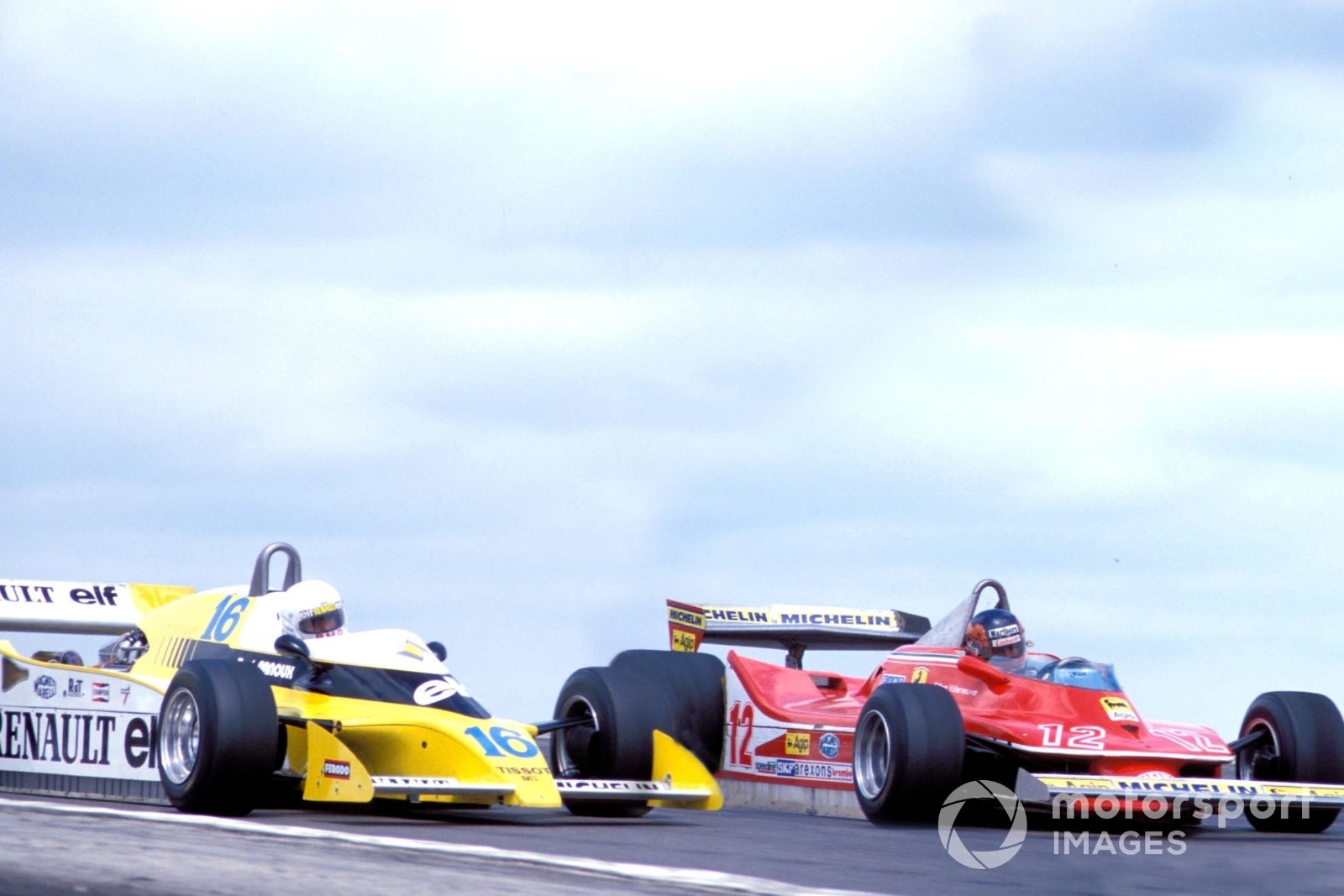
Arnoux and Villeneuve put on a battle in the closing laps which has gone down in folklore
Photo by: Motorsport Images
2. 1979 French GP, Dijon
Car: Ferrari 312T4
Started: 3rd
Result: 2nd
The battle between Villeneuve and Arnoux in the closing stages of the 1979 French GP has become part of F1 folklore, but there was much more to the performance than the scintillating wheel-to-wheel contest.
Jabouille had qualified on pole in the now twin-turbo Renault, with team-mate Arnoux alongside. Villeneuve was within half a second of pole and punched his way between the Renaults to lead at the start.
He initially edged clear, but eventually and inevitably Jabouille’s response came. Around quarter distance, the Renault started reeling in the Ferrari. Villeneuve’s tyres were past their best after his early charge and Jabouille sailed by as they started lap 47, swiftly building a lead.
While Scheckter, who complained his engine wouldn’t pull its usual revs and was running fifth, decided to pit for fresh tyres, Villeneuve pressed on.
Arnoux had recovered from an appalling first lap that had briefly left him ninth. He had reached third on lap 15 of 80 and finally started to close on Villeneuve as the Ferrari lost grip. How hard the two were trying was demonstrated by both setting their fastest laps – Arnoux’s 1.7s faster! – on lap 71 despite their fading rubber.
With five laps to go they were together. Arnoux got alongside on the start/finish straight and took second on the inside despite the Ferrari trying to hold on. But Villeneuve had sensed the Renault was not 100%.
“I expected him to run away down the straight, just as Jabouille had done, but he wasn’t getting away,” said Villeneuve of Arnoux’s slight fuel pick-up issue.
With a huge lock-up, the Ferrari lunged down the inside into the first corner at the start of the penultimate lap. Arnoux pulled alongside again as they raced onto the final lap and the two cars banged wheels.
Arnoux ran wide exiting the Sabelliers left-hander, allowing Villeneuve alongside. They bashed wheels again and Villeneuve turned into Gauche de la Bretelle with the Renault alongside. There was more contact – enough to probably put modern F1 cars off – but they somehow both survived, with Arnoux now ahead.
But approaching the uphill Parabolique right-hander, the Renault driver left a gap on the inside and Villeneuve filled it. Arnoux couldn’t respond and the duo flashed across the line with Villeneuve ahead by 0.24s.
Both had enjoyed what was – and still is – regarded as one of the most tenacious battles in F1 history, a battle Villeneuve had won with a slower car.
And Scheckter? He was seventh, a lap behind.
PLUS: Grand Prix Gold – 1979 France
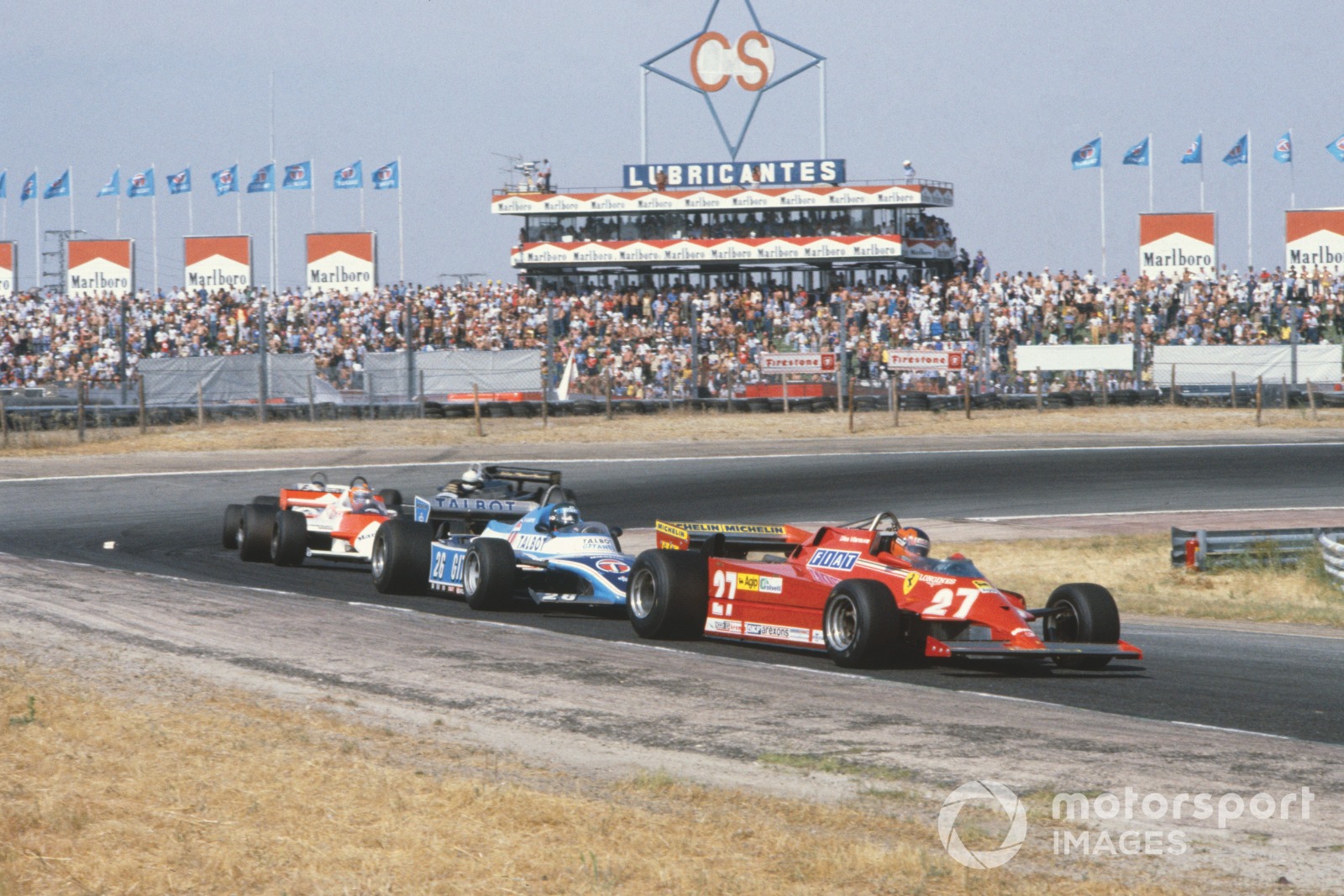
Villeneuve put in arguably his greatest drive at Jarama in 1981, holding off much faster cars
Photo by: Motorsport Images
1. 1981 Spanish GP, Jarama
Car: Ferrari 126CK
Started: 7th
Result: 1st
If the 1981 Monaco GP qualifying showed Villeneuve at his improvisational best, perhaps the Spanish GP two weeks later showcased more of his great qualities than any other.
“This one was against the run of play,” reported Roebuck. “In theory, at least, a race at Jarama is won on handling.”
Qualifying had backed up that view. Laffite’s Ligier took pole ahead of the two Williams FW07Cs of Jones and Reutemann. Villeneuve was the top turbo runner in seventh, 1.2s off pole and ‘only’ 0.7s quicker than Pironi this time.
Villeneuve’s first crucial moment: the start. One of the few cars in the top five rows not to creep, he got it just right and powered into third, slotting in behind Jones and Reutemann.
The second moment: on it straight away, he then used the power of the Ferrari to get alongside Reutemann – on the outside – into the first corner on lap two. Somehow, he came out ahead and was now second.
Jones simply walked away from the field in the early stages. After 10 laps he was 7.9s ahead of Villeneuve. But on lap 14 of 80, Jones went off and threw away his likely victory.
Villeneuve now led from Reutemann, who had a minor gear lever issue but looked faster. Villeneuve’s long test began as Reutemann got alongside on several occasions but could not make a move stick.
Laffite, having fallen as far as 11th after his bad start, had been making progress. He got stuck behind John Watson’s McLaren for some time but finally found a way by on lap 50 to take third. He closed on the leading duo, with Villeneuve now in race management mode.
“I was figuring to try and control the race,” said Villeneuve. “I knew that to make the tyres and brakes last I had to slow the pace, make use of my straightline speed to keep ahead and not make any mistakes anywhere.”
On lap 61, Laffite outbraked Reutemann on the outside at the end of the pitstraight and now the poleman set his sights on the Ferrari. “The most powerful engine in the race faced the most effective chassis,” reckoned Roebuck.
Laffite did indeed challenge hard, Villeneuve knowing where to defend and doing just enough to stave off his challenges. Such was the leader’s slow pace in the closing stages that, with 14 laps to go, just 2.3s covered the top five: Villeneuve, Laffite, Watson, Reutemann, de Angelis (Lotus).
Laffite nearly got alongside into the last corner on the final lap, but Villeneuve was not to be denied. He crossed the line 0.22s ahead, with 1.24s covering the top five.
For nearly an hour and a half Villeneuve had held the lead under increasing pressure. He had not made a mistake on a day when Jones, Pironi, Prost and Piquet had.
“One of the finest drives I have ever seen in grand prix racing,” reckoned legendary commentator Murray Walker.
Villeneuve himself had mixed feelings about it: “I don't feel it was any better than others I've had. It's nice, of course, because I really didn't think I had much chance of winning here.
“I knew I had to go like hell from the start and of course it was lucky for me that Alan went off and Jacques made a bad start. There was a lot of pressure for sure. I feel I worked hard today!
“For me the perfect race would be when I had a problem, went to the pits, caught everyone – and took the lead on the last corner of the last lap.”
On the face of it, this wasn’t a typical Villeneuve drive. But he showed exactly the sort of precision, racecraft and cool-headedness his critics claimed he lacked, while his sheer speed and opportunism got him the chance in the first place.
It was a GP very few drivers would have won in the 1981 Ferrari.
PLUS: Grand Prix Gold – 1981 Spain

Exhausted race winner Gilles Villeneuve, Ferrari, centre, takes the applause as Jaques Laffite, Ligier, left, and John Watson, McLaren, right, look on
Photo by: Sutton Images


Autosport magazine: Hamilton at Ferrari – and champions crowned

How the M8B became the most dominant car in McLaren’s history

Employing team orders can simply be a matter of common sense

The greatest F1 campaigns with no wins

Top 10 F1 results changed by backmarkers – the passes

Top 10 F1 results changed by backmarkers – the clashes

Stars, cars and highlights from the 2026 Goodwood Revival

The Egal has landed – again

F1 United States GP live commentary and updates - FP3 starts

James Hunt’s 10 greatest races

The intrigue caused by Cadillac's F1 boss dodging driver market question

How Marquez changed his approach to launch late MotoGP title challenge
Subscribe and access Autosport.com with your ad-blocker.
From Formula 1 to MotoGP we report straight from the paddock because we love our sport, just like you. In order to keep delivering our expert journalism, our website uses advertising. Still, we want to give you the opportunity to enjoy an ad-free and tracker-free website and to continue using your adblocker.


Top Comments