The weird F1 races that Melbourne has thrown up over the years
Since moving from Adelaide to Melbourne for the 1996 season, the Australian Grand Prix has thrown up more than its fair share of freak results and thrilling races. Ahead of Formula 1's latest visit to Albert Park, let's reflect on some of these memorable encounters
To those of a certain age (or, to put it more clearly, to those my age), the Formula 1 sun always rose for a new season at Albert Park. The generation before might consider Interlagos or perhaps Kyalami as the de facto break point of F1's hibernation, but for viewers like this writer, the anticipation of a new season was inextricably linked to an early wake-up call and a hushed tip-toe to the warming glow of a weighty Sanyo CRT television, volume hastily dialled into the single figures.
For those in the UK, presenting veteran Jim Rosenthal would cheerfully regale the bleary-eyed fandom from a studio, flanked by Tony Jardine and a cast of special guests - their location ambiguous. Had they truly embarked upon a full day's flying to sit in ITV's studio within the city of Melbourne? Or were they broadcasting from afar, and the apparent windows overlooking the circuit merely a screen? Perhaps the mystery will one day reveal itself. They'd throw down to Martin Brundle's grid walks, then still in their infancy and less populated than today's melange of megastars, and then that guitar riff would precede Murray Walker's fortnightly state of the nation addresses.
The joyous thing about those days was that you truly didn't know what was about to unfold. Albert Park, owing to its unpredictability as a street circuit by stealth and considerably less constrained by nondescript barriers, has plenty of pinch-points that entices cars to coalesce upon the same patch of road. Turn 1. Turn 3. Turn 6, sometimes. Turn 11 (formerly Turn 13, when the Clark Chicane existed) also has form here. Thankfully, the reticence to taint the Melburnian parkland with run-off also means that these clashes are punished. You can't be a hero and try to win on lap one here - it's not going to go well.
Another variable was that, in its position as season opener, teams were still exploring the extremities of reliability at the Australian Grand Prix. Sure, winter testing was far more extensive compared to today's three days in the Bahraini desert, but there was much more capacity for engines to go pop or for parts to fail simply because technology wasn't quite as advanced. Nowadays, reliability engineers spend hours stress-testing parts virtually through finite element analysis simulations, which are becoming much more representative of the real world.
That's not to say that Albert Park can't still produce weird results, because it's a truly unique circuit, and last year's shunt-fest proved that it can still deliver in its instigation of chaos - even if the ultimate winner was overwhelmingly predictable. But predictable winners are, to some degree, rarer than other venues. Only 53% of winners at Albert Park have gone on to win the title, and many of them led to close fights between two or more protagonists. And, of course, there's a smattering of winners who took advantage of the title contenders' early misfortune to bag a win against expectations.
As an ode to the circuit's 28 years of producing chaotic races and memorable moments that often kicked off a season in earnest, here's a look back at some of the weirder races that have defined the Albert Park Circuit's history. We won't recap last year's grand prix, but we hope that 2024's edition can capture some of the magic that many of its predecessors had delivered.
1997 - McLaren breaks three-year winless streak, Williams 1-2 turns to dust
Coulthard took McLaren back to the top step of the podium, with team-mate Hakkinen second. Michael Schumacher split the pair
Although 1996 had offered a great first outing at Albert Park to partially placate those mourning the loss of Adelaide from the calendar, as Damon Hill and Jacques Villeneuve enjoyed an almighty scrap for victory, it was altogether dominated by the Williams pair. It looked to be the case again, when Villeneuve took pole by 1.7s over new team-mate Heinz-Harald Frentzen, who joined the Canadian on the front row. But there was to be no repeat of a Williams 1-2 here, as its hopes of locking out the top two podium positions ended on the first lap.
Villeneuve had got a rather poor getaway from the front-most grid box, giving Frentzen a clean run into the first corner. Behind them, Eddie Irvine had coaxed his Ferrari into a pretty rapid egress from the grid, but an immediate lock-up at the first corner left him to careen into Villeneuve and the similarly fast-starting Johnny Herbert and put the Williams and the Sauber permanently into the gravel.
Frentzen scampered off into the lead, gapping David Coulthard as the McLaren driver stole past Michael Schumacher into Turn 1. The Williams driver was aiming to build up a buffer to make his two-stop strategy work, countering the one-stop efforts from the cars behind, and started to chalk off a number of quick laps once the trio had done their first stops to ensure he came out ahead after his second. During that stop, the pit crew encountered a recalcitrant right-rear wheel, delaying him by about nine seconds which handed the lead to Coulthard.
His path was eased when Schumacher had to make a quick splash-and-dash at the end of lap 51. Attempting to close in on Coulthard, however, Frentzen's front-left brake disc shattered itself to pieces at the start of lap 55 and speared the German into the Turn 1 gravel - the brake dust suffusing his car over the race becoming more acrid as the lap counter ticked down. This freed up Coulthard, who took his second F1 win and McLaren's first since Ayrton Senna won at Adelaide in 1993.
It was also the only grand prix weekend that the beleaguered MasterCard Lola team took part in with its sluggish T97/30, but failed to qualify
Schumacher and Hakkinen completed the podium, ahead of Gerhard Berger; the Austrian rescued points for Benetton as team-mate Jean Alesi famously pulled over earlier in the race having run out of fuel after missing a pitstop. Olivier Panis bagged fifth in Prost's first grand prix since taking over Ligier, as Nicola Larini scored his only point for Sauber.
It was also the only grand prix weekend that the beleaguered MasterCard Lola team took part in with its sluggish T97/30, but failed to qualify as both Vincenzo Sospiri and Ricardo Rosset spectacularly missed the 107% time in qualifying.
1999 - Irvine bags first F1 win in attritional Australia opener
The race in 1998 had been dominated by McLaren, and its liberal use of team orders garnered column inches in the subsequent weeks. Mika Hakkinen and David Coulthard lined up on the front row to threaten a repeat, followed by Michael Schumacher's Ferrari and Rubens Barrichello's much-improved Stewart on the grid.
The race's start had been delayed by both Stewarts spontaneously combusting on the grid, although Barrichello was able to atone for it in the spare car for the restart. Then, Hakkinen and Schumacher stalled on the added formation lap - the Finn got away before the final car had passed, but Schumacher could not and had to start alongside the equally stationary Arrows of Tora Takagi.
Once the drama had subsided, the McLarens led the field away - Hakkinen from Coulthard - and immediately made a point of dropping Eddie Irvine straight out of the gate, as the Northern Irishman came under scrutiny from Frentzen's Jordan.
The McLaren duo was well over a second per lap faster than the rest of the field, Coulthard a whopping 17 seconds clear of Irvine by the 13th lap, but this was the Scotsman's last when he peeled in with an engine problem. Hakkinen's massive lead was simultaneously wiped away when the safety car was produced when Villeneuve's BAR parted company with its rear wing on Lakeside Drive.
Hakkinen then lost power on the lap 18 restart, allowing Irvine to scream past at the start-finish straight ahead of Ralf Schumacher, who had backed off before gunning the throttle to get past Frentzen - albeit only for a few corners as his Williams predecessor re-passed into Turn 3.
Although Hakkinen got going again, albeit some distance down on the rest of the field, he eventually called it a day and had to retire. The attrition continued; the returning Alessandro Zanardi began a miserable season with his Turn 5 trip into the wall, Marc Gene and Jarno Trulli collided, Pedro Diniz's gearbox packed up, the recovering Michael Schumacher had to make an unscheduled stop with a puncture, and Alex Wurz's suspension gave up. But Irvine was serenely leading, and claimed his first-ever grand prix win in a madcap outing down under - a second clear of Frentzen and seven clear of Ralf Schumacher. Giancarlo Fisichella and Rubens Barrichello also scored points, as did Arrows' Pedro de la Rosa - the Spaniard coaxing the difficult A20 into sixth in his first F1 race.
2003 - Drying track helps Coulthard prevail over Schumacher, Raikkonen, and Montoya
From P11 on the grid, Coulthard took advantage of conditions and problems for others to take an unexpected victory
Photo by: DaimlerChrysler
A new one-shot qualifying system had built hopes that Ferrari would not be so dominant in 2003, but Michael Schumacher and Rubens Barrichello nonetheless locked out the front row for the Melbourne opener despite continuing with the F2002 in the interim as the F2003-GA was still under development. Rain before the race had largely dried up, but damp conditions had prompted a split in tyre compounds: both Ferraris began on the intermediate rubber, while Juan Pablo Montoya started with dry tyres having expected further rain not to appear.
It seemed to suit Ferrari in the early stages of the race, as Schumacher and Barrichello - who had jumped started - had gapped the Colombian by a considerable amount, helped by Nick Heidfeld passing the Williams driver as the Saubers looked strong in the early stages on wets. But the circuit began to come to the dry runners; Montoya got back past Heidfeld and McLaren brought David Coulthard in at the end of the second lap to ditch his intermediates, having switched Kimi Raikkonen to the drys at the end of the formation lap.
Barrichello was slapped with a stop-go penalty for his jump start, but ended up producing a carbon copy of the first part of Zanardi's 1999 incident before he could serve it. Jordan's Ralph Firman suffered a similar crash at Turn 5, and Toyota's Cristiano da Matta also crashed to bring out a safety car; although Schumacher had pre-empted this and stopped just before, a slow pitstop put him down the order behind Raikkonen and thrust Montoya into the lead.
Although Montoya recovered to finish ahead of Raikkonen, he'd thrown the win away - and Coulthard claimed it after starting 11th on the grid
Raikkonen moved into the lead when Montoya, Jarno Trulli, and Ralf Schumacher pitted, with Schumacher accosting the Finn. But their battle had to wait as the safety car appeared once more to clear Mark Webber's stricken Jaguar, and Raikkonen gunned the throttle on the restart to leave Schumacher in the hands of Coulthard, whose early stop had helped him move up the order. Montoya remained close behind, and resumed the lead when the cars ahead of him made further pitstops to shuffle the pack once again - Raikkonen also copping a speeding penalty which effectively removed him from victory contention.
When Montoya made his final stop, Schumacher moved back into the lead - but the reigning champion's bargeboard fell off and required a further stop for a quick check-up and a splash of fuel. Thus, he again ceded the lead to the Bogota-born driver, but the pressure from a rapidly chasing Coulthard forced Montoya into a mistake; he spun at Turn 1 at the start of lap 48 and handed the lead to the McLaren driver on a silver platter. Although Montoya recovered to finish ahead of Raikkonen, he'd thrown the win away - and Coulthard claimed it after starting 11th on the grid.
2010 - Button claims first win for McLaren in wet race
Button topped the podium in only his second outing as a McLaren driver
The Australian Grand Prix did not open the 2010 season; those duties were assumed by Bahrain on its aptly named 'endurance' layout. But it did nonetheless deliver a thriller thanks to wet weather at the start. Red Bull, fresh from losing the season opener due to a gearbox fault on Sebastian Vettel's car, locked out the front row - but were split from the off by a fast-starting Felipe Massa. His Ferrari team-mate Fernando Alonso ended up facing the wrong way, after being tagged by Jenson Button, which also collected the returning Michael Schumacher in the process.
Button nonetheless held sixth ahead of team-mate Lewis Hamilton, but the field was neutralised as Kamui Kobayashi's Sauber lost its front wing and the Japanese driver careened into Nico Hulkenberg and Sebastien Buemi. After the safety car, Webber re-passed Massa and Hamilton dispatched Button, prompting the 2009 champion to ditch his intermediate tyres and make a bold call for slicks as the circuit began to dry. He dropped to the back of the order, allowing him to bring his tyres up to temperature and start closing down the stragglers at the rear.
It looked like a hubristic call as Button slid off the track at Turn 3, but the Briton soon hooked himself up to the drying racing line and started to make progress. His rapidly escalating pace soon caught the attention of the other teams, who soon began to switch to slicks en masse, save for the Red Bull pair at the front of the field. Button's pace had been such that he cycled out in fourth, and dispatched Robert Kubica's Renault as the Pole was still warming up his own new tyres. Vettel stopped a lap later to stay ahead of Button, but Webber had to wait and dropped down the order after a brief Turn 1 off.
Button then began to hunt Vettel down, but the German suffered a braking failure into Turn 13 and skittered into the gravel on lap 26, ending his race. The stage was set for Button to clinch his first win for McLaren, his second race for the team, 12 seconds clear of Kubica at the flag. Kubica had been put under scrutiny by Hamilton in the fight for second, but a McLaren call to pit had irked the then-one-time champion, who reckoned the team had thrown away a podium. Felipe Massa completed the top three, winning out in a fearsome battle between himself, Alonso, and Nico Rosberg.
This was one of the key races that reinforced the legend of Button's abilities on a drying circuit, with Canada 2011 later becoming another race to demonstrate his skill in low-grip conditions.
2014 and 2015 - Turbo era kicks off in bizarre fashion
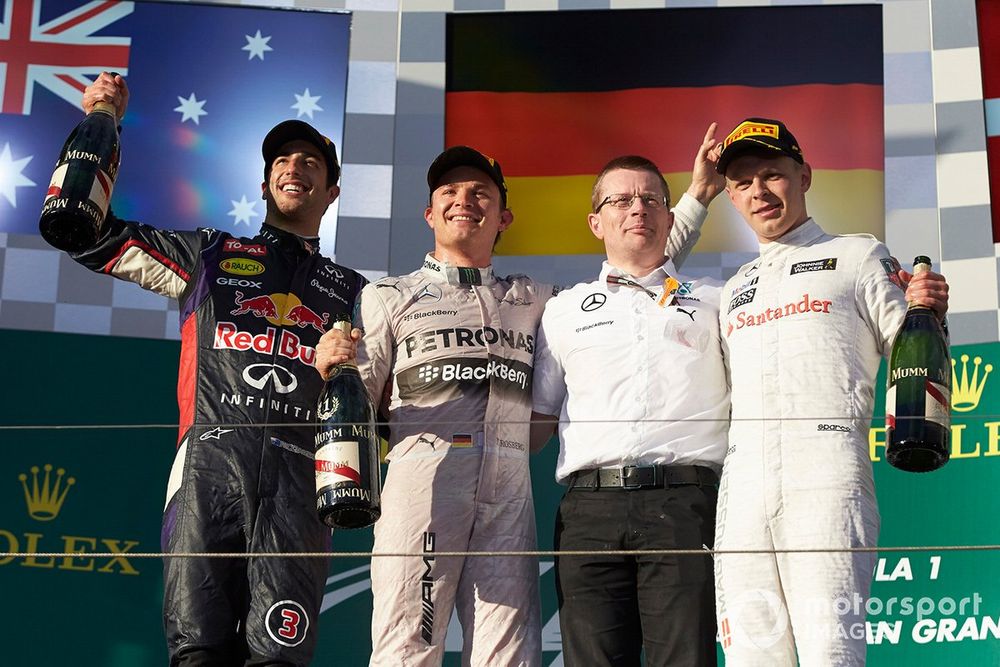
Ricciardo stood on the podium in Australia for the only time in 2014, but was later disqualified
After four years of dominance from Red Bull and Sebastian Vettel, the order was shuffled by the advent of the turbo-hybrid regulations. Mercedes had produced by far the most efficient power unit, getting a significant advantage over Ferrari and Renault, and its works team reaped the rewards - although Daniel Ricciardo denied the Brackley squad a front-row lockout in the Australian's first race with Red Bull in a wet qualifying session. Hamilton collected pole over Ricciardo and Rosberg, as newcomer Kevin Magnussen impressively put his McLaren on the second row.
Rosberg made the most impressive start and chopped past Ricciardo and Hamilton to collect the lead into Turn 1, but the latter's race was short-lived; a misfire had already cost Hamilton a place to Magnussen, and forced the Briton's retirement shortly after to leave Mercedes' hopes in Rosberg's hands. The German had pace in hand over Ricciardo, however, and ensured that his W05 made it to the finish to begin the team's spell of dominance over the next six years.
Although Ricciardo held on to finish second ahead of Magnussen, the Australian was disqualified from his first podium trip as Red Bull surpassed the new fuel flow regulations at 100kg/hour. This promoted Magnussen to second, his only podium so far in F1, and put Button third - his early pitstops giving him track position over the chasing Fernando Alonso and Valtteri Bottas.
It was service as usual at the front as Hamilton retained the lead from pole over Rosberg
The 2015 race was arguably more bizarre as only 15 cars started the race: the two Marussia Manor cars had just made it to Australia after a late buyout, but couldn't run as a legacy of its computer systems being prepared for auction prior to its survival. Bottas sustained a back injury in qualifying and also could not start, and both Daniil Kvyat and Kevin Magnussen (the latter a replacement for the injured Fernando Alonso) stopped on the way to the grid.
Fifteen cars became 14 when Pastor Maldonado was tipped into a spin in the opening corner by newcomer Felipe Nasr, who'd been stuck between him and Raikkonen, and the Venezuelan's Lotus team-mate Romain Grosjean retired at the end of the lap with a power unit issue. But it was service as usual at the front as Hamilton retained the lead from pole over Rosberg, as Massa kept ahead of the Ferraris.
That was until the sole round of pitstops, where newly minted Ferrari driver Vettel got clear of Massa for third place, although Raikkonen's ambitions to secure a Ferrari 3-4 was ended when a left rear wheel issue in his second stop forced him to pull over. This elevated Nasr to fifth, securing Sauber's first points since 2013 with a double-score no less as Marcus Ericsson finished eighth.
What does Albert Park have in store this time around?
Jake studied engineering at university, as his original ambition was to design racing cars. He was bad at that, and thus decided to write about them instead with an equally limited skillset. The above article is a demonstration of that. In his spare time, Jake enjoys people, places, and things.
Subscribe and access Autosport.com with your ad-blocker.
From Formula 1 to MotoGP we report straight from the paddock because we love our sport, just like you. In order to keep delivering our expert journalism, our website uses advertising. Still, we want to give you the opportunity to enjoy an ad-free and tracker-free website and to continue using your adblocker.




Top Comments