


Aston Martin's heavily updated AMR26 breaks cover in Hungary pitlane
After falling to the back of the grid, Aston Martin's wide-ranging updates have finally been seen in the wild. Here's what the team has brought

Aston Martin's wealth of Hungarian Grand Prix updates to its recalcitrant AMR26 Formula 1 car have been revealed, featuring vast changes to its front end, floor, and rear.
The Silverstone team has just one point to its name this season, having propped up the field across the season, and a litany of reliability issues in the opening rounds of the season led to the decision to postpone all performance-related updates until now as it set to work on fixing its key problems.
The car has received a complete overhaul to the front end, with a more slender nose to work with the redistribution of front wing element sizes and endplate. This has been elongated at the tip, allowing the nose to droop more - very much akin to McLaren's 2026 design.
Additionally, the front wing no longer features the outboard "crease" and instead sweeps up more towards the endplate - which in turn is less triangular in shape and features a revised footplate. This also appears to fold inwards at its lowest part, supplying simultaneous inwash and outwash.
This feeds a new front brake duct package, which features a series of revisions to the deflectors to define the airflow structures moving further downstream.
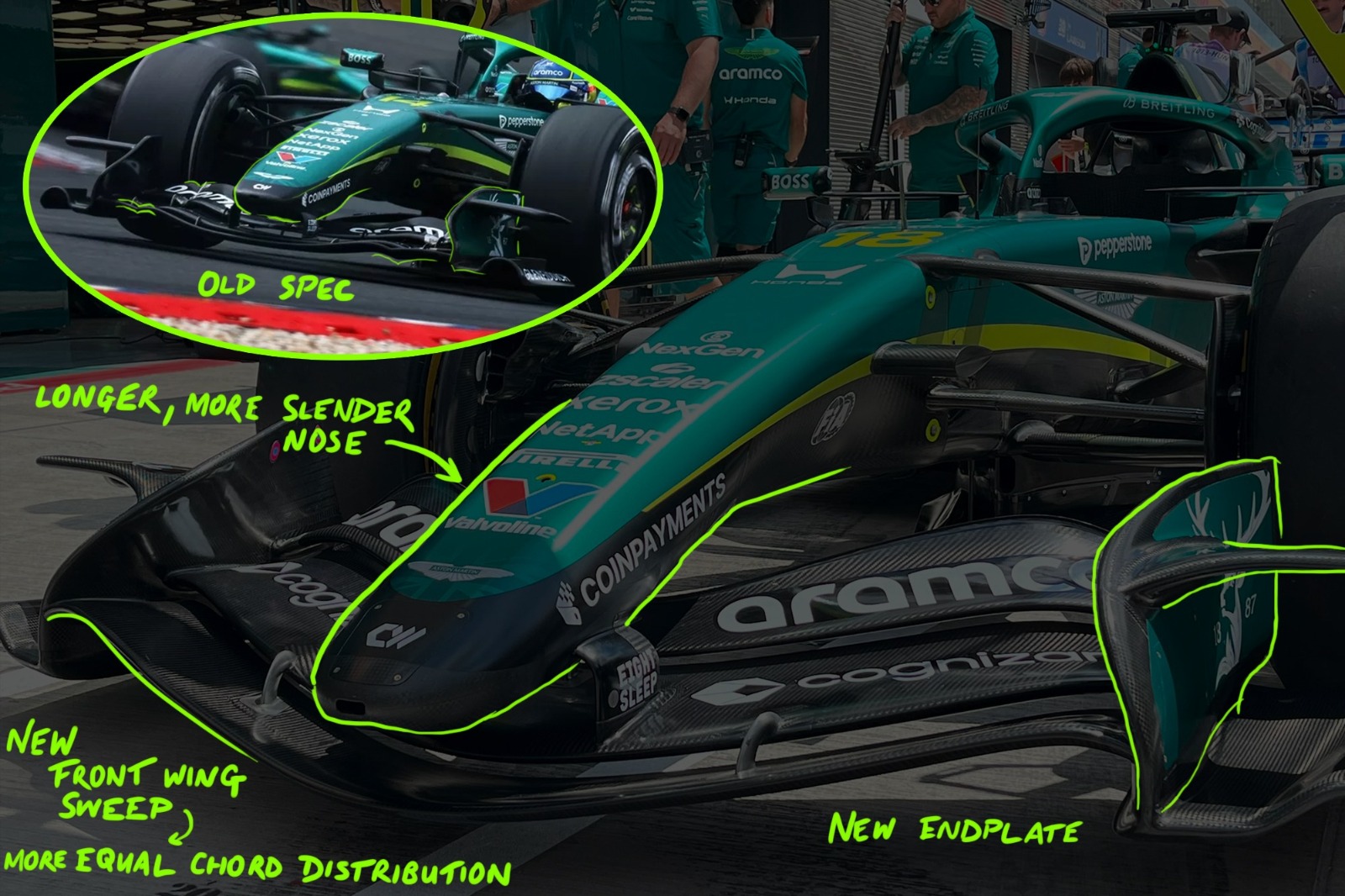
Photo by: Stuart Codling, Annotations: Jake Boxall-Legge
Aston Martin also has an entirely new floor. The team reports that the floor body has had every surface addressed and features an updated array of leading edge elements.
This includes a redefined bargeboard construction, which now is of a shorter, trapezoidal shape compared to the triangular board used previously. The elements underneath the upper board have been redefined to produce outwash at the front, and upwash at the rear.
The new floor edge is visible, featuring increased complexity to manage the flow ahead of the rear tyre. Previously, the team had a trio of slots that concluded in exposed tips, aiming to generate vorticity ahead of the rear tyre, and this is retained on the new edge. The rearmost slot has been extended further inboard, with changes to some of the topography here. The diffuser has also received plenty of attention to increase the floor's downforce output.
A minor change to the sidepod inlet has been implemented to lift the lower 'underbite' edge, increasing the scope of the undercut around the sidepod body.
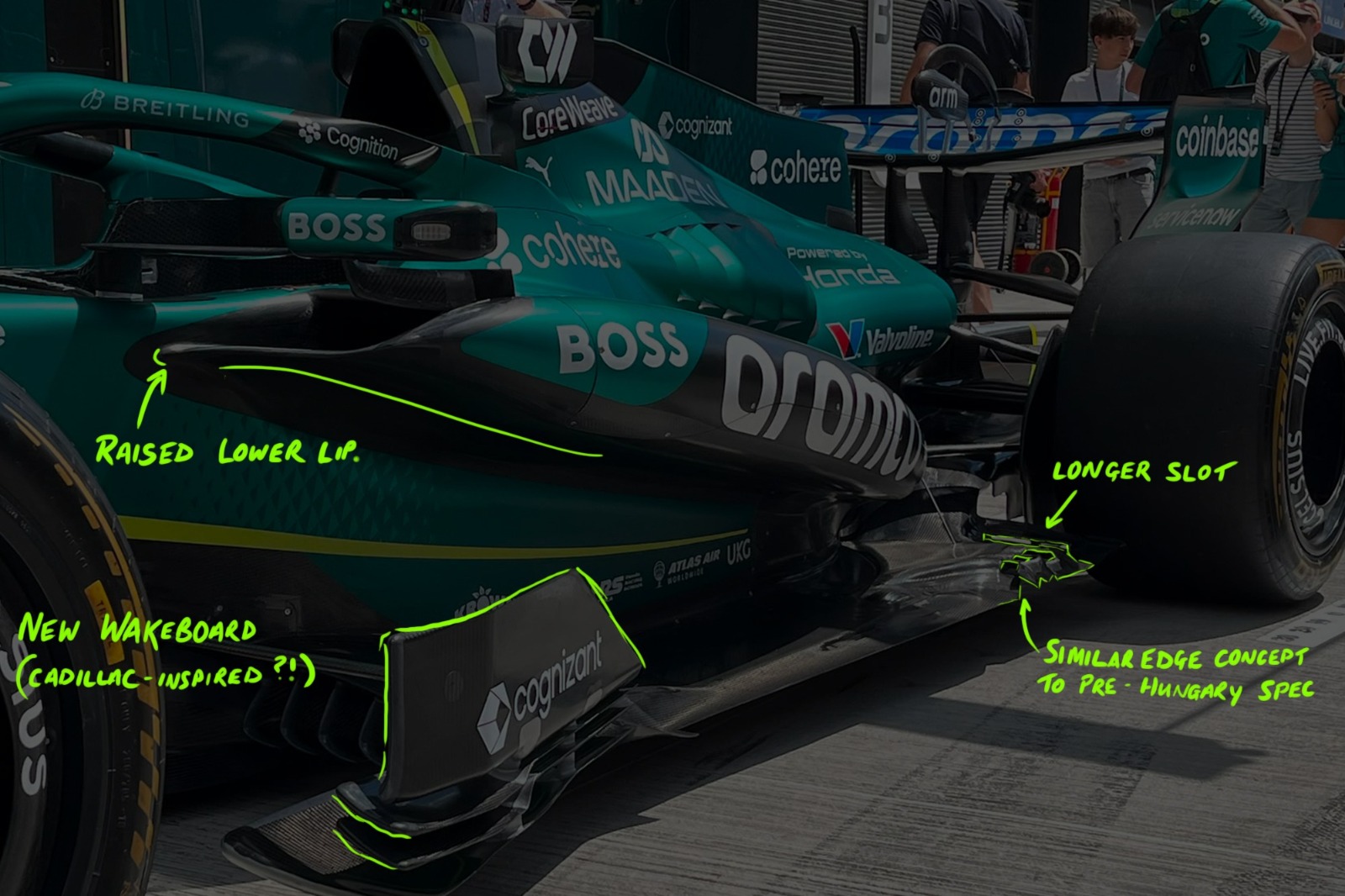
Photo by: Stuart Codling, Annotations: Jake Boxall-Legge
At the rear wing, the uppermost element has been shortened in chord length, and the wing actuator package has also been redefined.
The upper element also features the trailing edge furniture explored by other teams earlier in the season; there are additional elements perched on the top plane next to the endplates, a la Mercedes, plus a central element within the bounding box for the actuator. The latter was explored by a number of teams in Monaco, and kept on as a cheap way of increasing corner-mode downforce.
Aston Martin's pre-event technical presentation document states that the revisions also reduce drag in straight mode, improving the balance between the two modes.
The inner mountings of the rear suspension legs, incorporated into the rear wing pylons, have been raised even higher, now angled above the exhaust and supported by a vertical element sitting above the exhaust exit.
This comes with revisions to the brake ducting, plus the additional winglet furniture mounted to the inside of the duct assembly.
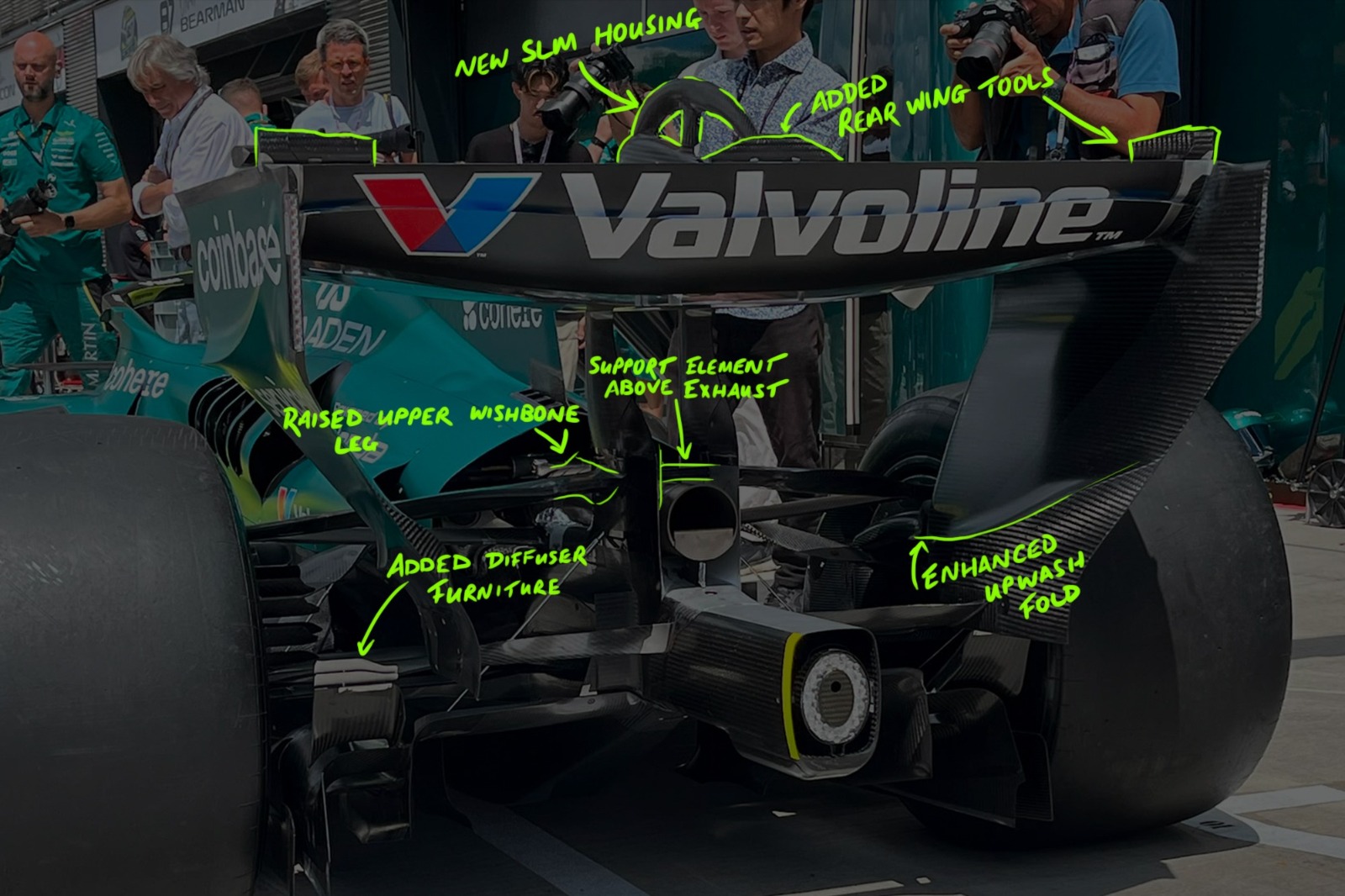
Photo by: Stuart Codling, Annotations: Jake Boxall-Legge


Mission control: Inside the FIA and F1's latest answer to football's VAR

FIA expects F1 races in Qatar and Abu Dhabi to run as planned

Why Piastri has struggled to show his best with this year's McLaren MCL40

Lights, Camara, action: How Haas picked F1's latest rookie for 2027

Horner's inside story of how Red Bull built its own F1 engine

Why Mercedes' latest 2026 F1 update is no downgrade

Singapore Grand Prix Driver Ratings 2026

What we learned from the 2026 F1 Singapore GP sprint race and qualifying

Renault to sell former F1 engine facility in Viry

"It's pretty bad" – Why Norris needs headache tablets for bumpy Austin circuit

Why it's now Bearman versus Camara for the next Ferrari vacancy

MotoGP Australian GP: Bezzecchi leads Aprilia 1-2-4-5 in Friday Practice
Subscribe and access Autosport.com with your ad-blocker.
From Formula 1 to MotoGP we report straight from the paddock because we love our sport, just like you. In order to keep delivering our expert journalism, our website uses advertising. Still, we want to give you the opportunity to enjoy an ad-free and tracker-free website and to continue using your adblocker.


Top Comments