


The human cost to replacing Formula 1's cancelled rounds
OPINION: With the global pandemic still lingering, Singapore's grand prix has been cancelled for 2021, with more looking likely to follow. Although Formula 1 has TV deals and profits to chase, retaining a 23-race calendar could be most harmful to those who sacrifice the most for the championship

“As flies to wanton boys, are we to the gods; they kill us for their sport.” The King Lear quote, famously borrowed by footballing royalty Eric Cantona in a cryptic UEFA award acceptance speech, explores the unjustness and inequitable nature of the world in which we live. In the play, the Earl of Gloucester makes the remark after having his eyes gouged out.
What parallels does this have to Formula 1: a microcosm of society filled with money, privilege and power? Such is its bargaining power across the world, F1 arguably is one of the gods of which Gloucester speaks. It extracts great sums of money from the worlds’ biggest sporting promoters, governments and businesses for the privilege of hosting 20 speedy technological triumphs around a circuit. Of course, the usual offset is the chance to recoup that investment with ticket sales – a revenue stream that has been impacted greatly by the current global health crisis.
That health crisis, still ongoing and still as virulent as it was last year, looks as though it will eventually be routed with the power of vaccines. But access to “the jab” is mixed throughout the world; the UK has only very recently acquiesced to the rest of the world’s pressure to share its stockpile (and rightly so) with countries who have been unable to attain the same level of preparation. Although the global population will eventually achieve some degree of immunity, COVID will never truly disappear – but instead join the other clusters of coronaviruses that cause the common cold.
But at the moment, the lack of immunity and dearth of vaccines in some territories is causing further spikes in cases – and for our little, unimportant corner of the world, this means further F1 rounds either have been cancelled, or could be later.
Prior to the wild Azerbaijan Grand Prix, F1 had to concede that the Singapore race was not going to happen this year. That’s not completely down to increasing cases, but rather that the Singaporean government has managed to turn around a huge spike in infections last year into a relative flat-line thanks to tough immigration policy and a strong test-and-trace infrastructure. The city-state was at risk of another outbreak, as its Changi Airport posed as the exhaust shaft of the Death Star – travellers from other countries were able to encounter airport staff, who would also come into contact with the general public. Thus, the passenger terminals were shut down – and hence, no F1.

Red Bull personnel pack away equipment in the paddock
Photo by: Andy Hone / Motorsport Images
It’s expected that further rounds will fall. We’d lost Canada early on from the calendar, and the replacement pencilled in for Turkey was also crossed off the list. Australia currently has incredibly tough restrictions – not only for entering the country, but for crossing state lines too. The Supercars paddock has twice had to indulge in hurried border-hopping to make it to the next round, with transporters presumably being threaded through closing gates. If those restrictions continue to be imposed, it’s not inconceivable that F1 will skip its visit to Albert Park for a second year – after everything kicked off following its cancellation in 2020.
Skipping Brazil would also be wholly unsurprising at this point. President Jair Bolsonaro has been much maligned for his Trumpian approach to pandemic-handling, attempting to dilute any form of response from the scientific community. He abhors mask-wearing, labelled COVID as “a little flu”, and suggested that vaccines would turn people into “crocodiles”. Let’s hope he’s never Googled “Krokodil” in a late-night internet black hole. Thus, it’s no surprise that a) Brazil doesn’t look to be getting any better, and b) the rest of South America is becoming affected by its neighbour’s indifference.
A second race at the Red Bull Ring became the replacement for Turkey on this year’s F1 calendar. A popular pair of season-openers last year, the Austrian venue is a modern classic – and few would begrudge a pair of races at a circuit once dismissed as a “tapeworm” within the old Osterreichring. However, there is something that unfortunately rankles; the two races form a triple-header with the French Grand Prix.
If those restrictions continue to be imposed, it’s not inconceivable that F1 will skip its visit to Albert Park for a second year – after everything kicked off following its cancellation in 2020
In 2018, F1 held a triple-header with France, Austria and Britain forming the three legs. It was a wholly exhausting experience if you were simply working in the paddock at the time – so one cannot fathom how draining it was for the part of the championship fraternity that never sleeps. Teams have to pack up and ship out on the Sunday night, drive to the next venue and set up again. To do this three weeks in a row requires the endeavour of a superhero – and yet, it goes unsung. One marvels at the teams’ motorhomes, along with their sartorial flair and the ever-escalating size, but rarely does one stop to applaud those who build them numerous times a year. They at least deserve a Grand Designs special.
It was agreed that F1 would avoid triple-headers after that. The 2019 season featured none, but the need to get a 15+ race calendar together amid the pandemic last year did sadly necessitate three groups of triple headers to kick off the season with – followed by another one to close the season. Having been under lockdown for months, it probably was no bad thing last year, but as the world begins to tiptoe towards the precipice of “normality” then attitudes will be different this time around.

Valtteri Bottas, Mercedes F1 W11
Photo by: Steve Etherington / Motorsport Images
As the F1 calendar was extended to 23 races this season, bolstered by the controversial addition of Saudi Arabia’s planned venue on Jeddah’s corniche, thankfully many did stop to think about the human side of F1. 20 years ago, the calendar was pegged at 16-17 races; now, there’s six or seven extra rounds in far-flung places to contend with. That’s six or seven fewer weeks spent with family and loved ones; six or seven extra weeks toiling away instead of indulging in the finer facets that life has to offer.
In addition to the France-Austria triple-header coming up, there’s also a Belgium-Netherlands-Italy trio following the summer break, plus the USA-Mexico-Brazil run-in towards the end of the season. If further rounds end up getting called off, depending on the pandemic state of play later in the year, the FIA will be looking to secure replacements. Indeed, F1 is already looking to cement a new venue to cover for the loss of Singapore from the calendar – Turkey is once more in the frame, as is apparently China. Another option appears to be the installation of a second race at the Circuit of the Americas – which on the face of it, poses the prospect of a quintuple header if it slots in the week before the currently scheduled US Grand Prix.
The notion of four races on the bounce is insane enough – five would be a farce.
Of course, as previously discussed, other cancellations look likely. Aside from Brazil and Australia, the likes of Japan and Mexico could be at risk – which would turn that quintet of races into something more digestible.
PLUS: Where F1's calendar shuffling hurts its new drivers
It could be argued that, at this point, the triple-header is still a necessity to get enough races on the board to fulfil TV contracts and the like – but it cannot be viewed as a sustainable format going into 2022. F1 owners Liberty Media has spoken of potentially expanding the F1 calendar to 25 races, which would not only further dilute each race, but extend the periods of time where people working in F1 are away from home. With budget caps in place too, the options for teams to rotate personnel working at events will also be severely limited.
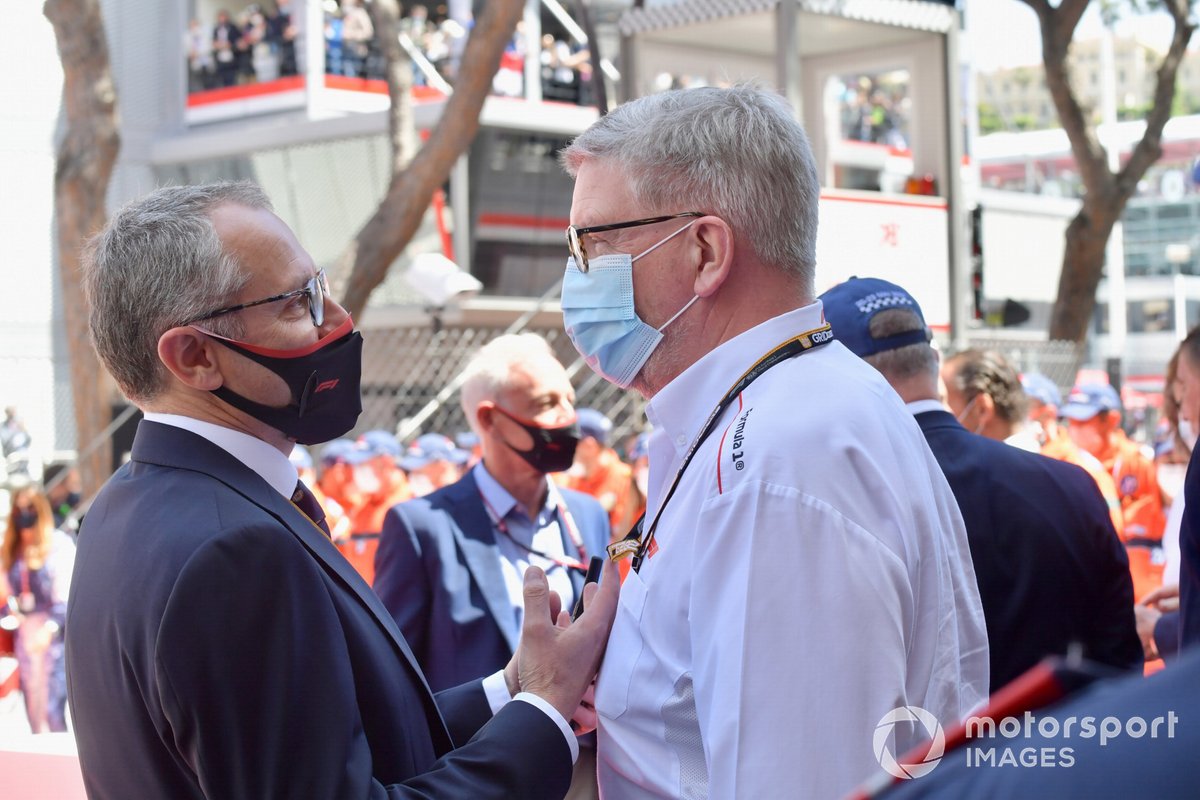
Stefano Domenicali, CEO, Formula 1, with Ross Brawn, Managing Director of Motorsports
Photo by: Jerry Andre / Motorsport Images
It comes to a point where Formula 1 must consider people over profits at some point. At what point does scooping in the rewards of hosting a race in unlikely locales end? Of course, the counter-argument offered by a more belligerent soul would be “if you don’t like it, do something else” - but it's not unfathomable that the F1 calendar expands into something completely off-putting to everybody. If a balloon inflates too much, it eventually bursts.
F1’s management, as the gods who rule the paddock, have the chance to change that – and it begins with realising that less is, sometimes, more
Thus, that circles back to Gloucester’s lamentations in King Lear. The unsung heroes of F1, those who work hardest to put on a show, are treated as mere flies to the wanton boys in the boardroom; their wings plucked off and legs dissected for their sport. And that cannot be a sustainable situation for anyone.
F1’s management, as the gods who rule the paddock, have the chance to change that – and it begins with realising that less is, sometimes, more. If further rounds are cancelled – so be it, and reward those who labour hardest with a chance to rest.

Lando Norris, McLaren MCL35M, in the pits
Photo by: Glenn Dunbar / Motorsport Images


FIA expects F1 races in Qatar and Abu Dhabi to run as planned

Why Piastri has struggled to show his best with this year's McLaren MCL40

Lights, Camara, action: How Haas picked F1's latest rookie for 2027

Horner's inside story of how Red Bull built its own F1 engine

Why Mercedes' latest 2026 F1 update is no downgrade

Singapore Grand Prix Driver Ratings 2026

What we learned from the 2026 F1 Singapore GP sprint race and qualifying

The political minefield set out by F1’s recent cost-cap grievances

FIA set to close F1 cost cap loophole with new rules

Norris promises to make "better decisions" following fresh talks over Singapore GP clash

FIA expects F1 races in Qatar and Abu Dhabi to run as planned

Top five roles on Motorsport Jobs this week
Subscribe and access Autosport.com with your ad-blocker.
From Formula 1 to MotoGP we report straight from the paddock because we love our sport, just like you. In order to keep delivering our expert journalism, our website uses advertising. Still, we want to give you the opportunity to enjoy an ad-free and tracker-free website and to continue using your adblocker.


Top Comments