


The details in Mercedes' Montreal F1 updates
Early signs suggest that Mercedes' latest updates have restored some of its early advantage in F1 2026. Here's a closer look at the team's latest add-ons...

After losing a smidgen of time to its nearest Formula 1 rivals in Miami, Mercedes aimed to reclaim its early-season advantage in 2026 with its first larger-scale batch of updates.
On first glance, the latest delivery of parts appears to have worked. Although Mercedes faced sporadic challenges from McLaren and Ferrari through sprint qualifying, George Russell ultimately eased to pole for Saturday's shorter race and was joined on the front row by championship leader Kimi Antonelli.

Among the key updates was a new front wing, and a revised floor. Mercedes detailed the changes in the customary pre-event technical presentation notes, noting 'more robust flow structures' produced by the new geometry at the front and a rework to the floor structures to imbue its W17 with more downforce.
"We still need to understand a little bit more the package because the balance has changed a little bit," Antonelli reckoned. "But overall, it seems to have given us a little bit of an edge again."
Let's look at the changes in a bit more detail, starting with the front wing.
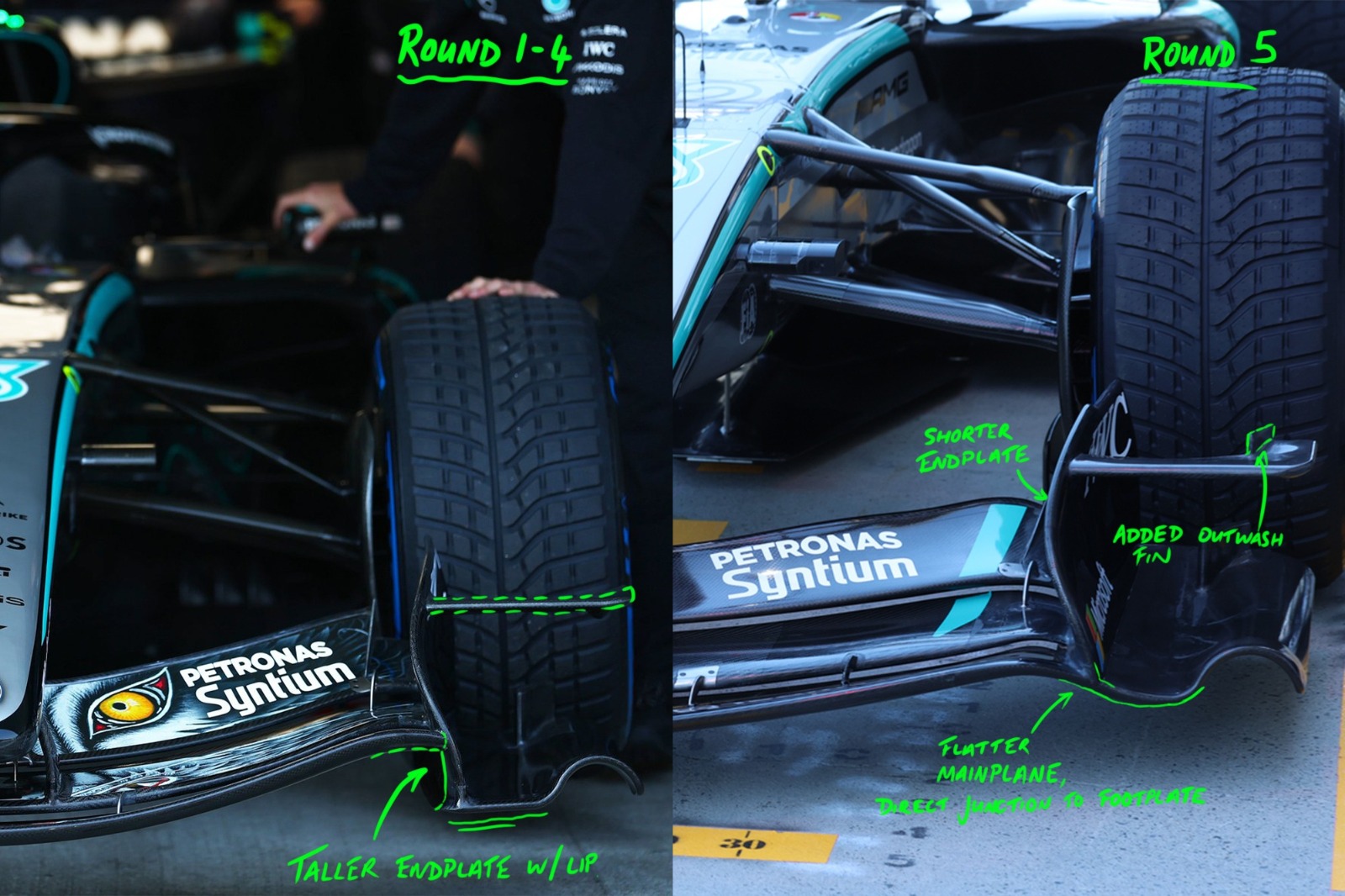
The previous front wing had connected to the endplate about a third of the way up, aiming to use the lip on the inside of the endplate to strengthen the airflow in this area. This way, the majority of the aerodynamic load shifts towards the centre of the wing, as the outer sections are less cambered overall.
Perhaps with the intent of controlling the flow lower down, Mercedes has shifted the outer parts of the front wing downwards, creating a flatter profile perhaps more akin to that seen on Red Bull's wing design.
As such, the endplate can transition directly into this, and Mercedes has reprofiled the footplate to produce the outboard vortex tunnel at the same position. Presumably, this creates a bit more of an even spread in load output to help the front end of the car bite. The endplate itself is shorter to facilitate these changes.
The footplate's vortex tunnel also seems to have a marginally larger radius, with a strake installed within to allow the air to be bundled up into a vortex and then bounced out around the front tyre using the strake for direction. Since this is underneath, it cannot be seen from these images.
What can be seen, however, is the addition of a small vortex generator at the end of the diveplane - the element sitting towards the top of the endplate. This helps with flow direction, using the vortices it generates to help direct those produced at the diveplane's tips. There is also a small circular cutout on the top corner of the endplate, which should also produce some degree of vorticity here.
It also gets a lot more complex around the corner of the floor, where Mercedes has reconfigured the slots here.
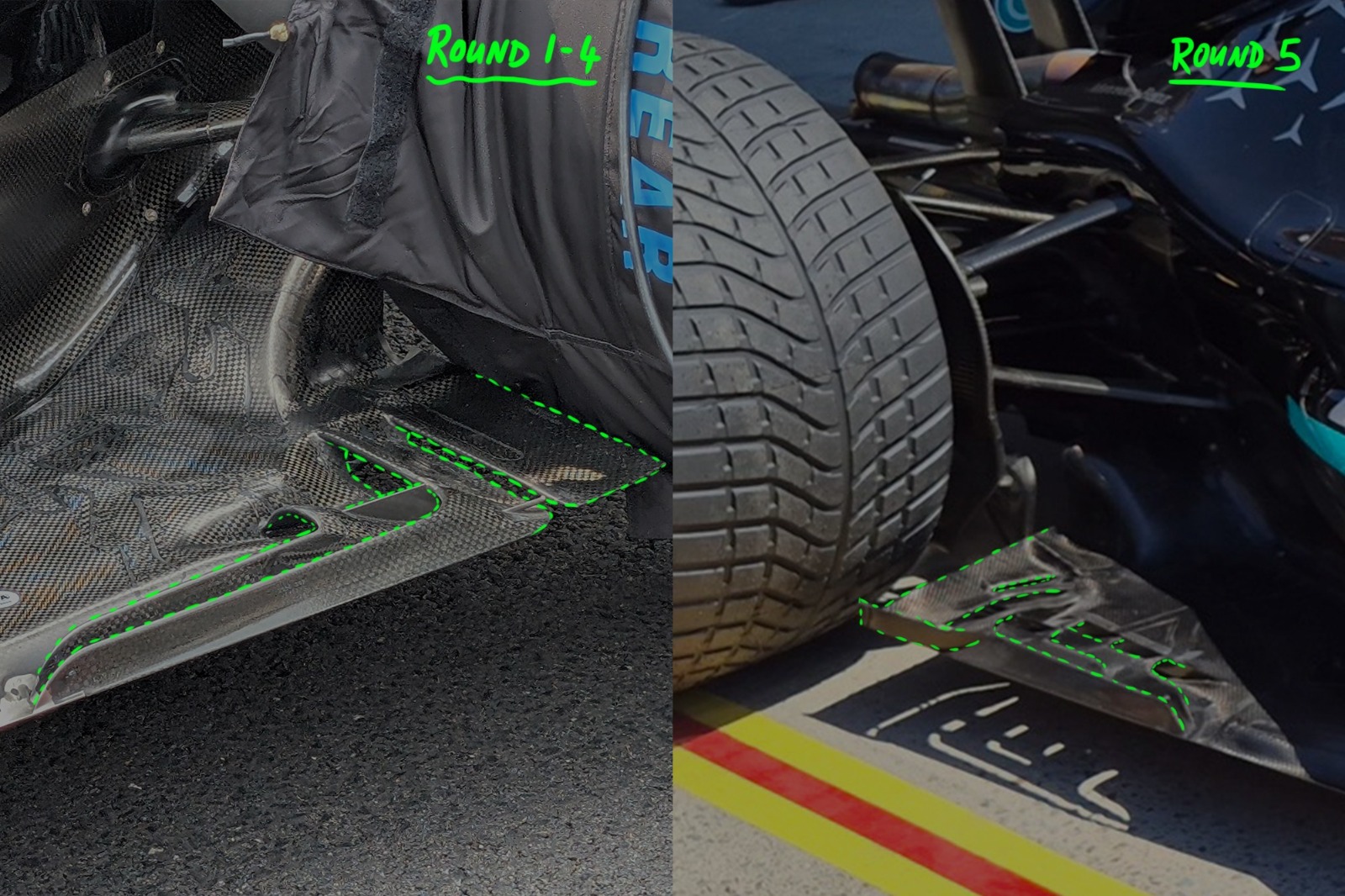
These slots assist with conditioning and directing air around the rear tyre, something particularly helpful in ensuring that the "squirt" produced by the tyre (effectively when a tyre runs over a small pocket of airflow, causing turbulence to burst sideways) does not affect the diffuser too much.
Previously, there were two main L-shaped slots in the corner, supplemented by a horizontal slot at the rear. Now, there's a bit more complexity, with a bank of slots replacing the 'inner L-slot' and a pair of horizontal slots at the back. The rear corner also gets an upright lip, effectively an endplate.
Overall, this should not only improve the immediate downforce produced in the area, but also offer greater conditioning to the airflow that gets diverted towards the diffuser.
The diffuser is a lot less potent when turbulence, e.g. from tyre squirt, enters it as it can reduce the expansion needed to help the acceleration of airflow underneath the car - which is what helps to produce downforce. Using the rear corner of the car like this ensures that the diffuser has a bit more defence against turbulence mixing with the underbody flow.
There were a few other updates around the car; the front brake duct area received some attention to link up with the new front wing, with the addition of some circuit-specific cooling updates to contend with Montreal's braking demands.
The elements on the bargeboard were also slightly reworked, as was the top of the diffuser.


How much time has Aston Martin gained with its F1 Hungarian GP update?

What we learned from Friday practice at the 2026 F1 Hungarian GP

Aston Martin's heavily updated AMR26 breaks cover in Hungary pitlane

Russell: Data shows software calibration behind recent F1 struggles, not driving style

Hamilton takes "full responsibility" for disappointing Belgian GP

The expectation on Aston Martin's shoulders as it prepares to debut its Hungarian GP updates

What we can learn from Mercedes' floor after Russell's Belgian GP retirement

Belgian Grand Prix Driver Ratings 2026

How much time has Aston Martin gained with its F1 Hungarian GP update?

Antonelli hit with grid drop for yellow flag infringement in F1 Hungarian GP qualifying

Hamilton slapped with grid drop for impeding Piastri in F1 Hungarian GP qualifying

Russell to undergo Mercedes engine change but avoids F1 Hungarian GP grid drop
Subscribe and access Autosport.com with your ad-blocker.
From Formula 1 to MotoGP we report straight from the paddock because we love our sport, just like you. In order to keep delivering our expert journalism, our website uses advertising. Still, we want to give you the opportunity to enjoy an ad-free and tracker-free website and to continue using your adblocker.


Top Comments