


How Russell sees his place in the Mercedes-Hamilton F1 superteam
George Russell joining Lewis Hamilton at Mercedes this year gives it arguably the best line-up in Formula 1 – if it can avoid too many fireworks. After serving his apprenticeship at Williams, Russell is the man that Mercedes team believes can lead it in the post-Hamilton era, but how will he fare against the seven-time champion? Autosport heard from the man himself

Sorry, Ferrari, but the mantle of having the best driver line-up in Formula 1 may well be about to slip. That’s after just one season of the Charles Leclerc/Carlos Sainz Jr pairing. And that’s because one of the championship’s ‘superteams’ just got a few more powers.
There’s still the rest of the off-season to go before it becomes known how the reigning constructors’ champion has coped with the second major rules reset to come its way since mastery of the V6 hybrid switch catapulted Mercedes into heading F1’s pecking order. But, on paper at least, the second change to its driver line-up since 2014 – and the first one it has decided to do all by itself considering the circumstances of Nico Rosberg’s post-title retirement five years ago – provides a big boost. Because, alongside statistically F1’s greatest ever racer, Mercedes now has the driver it considers to be the next Lewis Hamilton primed to race alongside the real one.
George Russell is finally where he’s long wanted to be. The aim back when he was fresh from winning what was then known as BRDC Formula 4 in 2014, when he was impressing Mercedes’ motorsport boss Toto Wolff with his determined attitude at their initial meetings, was to one day be in his new situation. And that is, after two years as a Mercedes junior in the lower categories that yielded back-to-back GP3 and Formula 2 titles, then three seasons honing his F1 craft with customer squad Williams, a works team driver taking on Hamilton.
“Teaming up with Lewis is obviously incredibly exciting,” says Russell, just a few days before his penultimate race as a Williams driver will be ended in the pile-up at the second start in Jeddah. “I am in a privileged position. To go alongside the best ever. It’s an amazing opportunity to again progress myself as a driver and see how I fare.”
Russell has got his opportunity at the expense of Valtteri Bottas, who has been ushered out of the Mercedes line-up for 2022. He’s now at Alfa Romeo, albeit with the considerable public expressions of fondness and farewell from his former squad still ringing loudly. The many heartfelt goodbyes made by Mercedes’ employees and its official social media accounts stand as a testament to how well regarded Bottas was at Brackley and beyond.
PLUS: Why 2022 progress is crucial after Alfa's year of F1 turmoil
On his day, Bottas was capable of besting Hamilton – over a single lap or a race distance. The problem was these days turned out to be pretty few and far between. He was regularly undone by his comparative weakness with either getting the best out of the Pirelli tyres or keeping them alive long enough to make the ultimate difference. This is one of Hamilton’s best attributes, alongside the searing speed that has resulted in 103 F1 poles and counting. In five seasons as team-mates, Bottas’s Mercedes stats sit at 10 wins and 20 poles, to Hamilton’s 50 and 42.

Age also counted in Russell's favour. At eight years Bottas's junior, his signing allows Wolff to future-proof Mercedes
Photo by: Steve Etherington / Motorsport Images
But that imbalance alone was not what sealed Bottas’s fate. After all, he helped Mercedes on its way to eight straight constructors’ titles. More importantly, it was Wolff’s need to future-proof Mercedes, a team run as a franchise-type business. Hamilton turns 37 tomorrow (Friday), while his latest former team-mate is now 32. Leclerc and Sainz are 24 and 27, with Red Bull and McLaren also possessing youthful stars, and in the former’s case the new reigning world champion Max Verstappen. Russell, at 23 (he’ll be 24 in February), gives Mercedes a glimpse of its potential future.
Although F1 careers are lasting ever-longer in the modern era, there’s simply no guarantee that Hamilton will continue racing as he heads into his forties. At the time of writing, speculation continues to mount that he could walk away from the championship entirely given his dissatisfaction at how the Abu Dhabi finale farce played out, even if that is an extremely unlikely outcome…
As his words above demonstrate, Russell is keen to make his case as a team player. It was there in his radio message during the 2021 Hungarian Grand Prix, when he told Williams to “prioritise Nicky” to aid former team-mate Nicholas Latifi’s first chance to score points in that chaotic event, and in the process end that squad’s two-year top 10 results drought. It was evident again in the emotion Russell showed after he’d eventually finished eighth to take his first points for Williams, with Latifi seventh on what turned out to be the first of two bumper days for the Briton’s previous team last year. The other was Russell’s first experience of an F1 podium – albeit in the strange circumstances in the Spa washout.
PLUS: The jubilation and sorrow Williams experienced in its 2021 F1 recovery
Taking on Hamilton with the same machinery is his privilege right now, but that comes with the added responsibility of keeping Mercedes’ title streak up – as Bottas helped to do so well.
Russell has a reputation for leaving few details untouched, and of being very demanding as he works to uncover such aspects, but also of understanding the value of appearances and getting the right messages across. But he’s far more than that too
“I am really excited to see the new cars and what they offer for everybody,” Russell says of the new era about to begin. “I think that is really exciting but also I’m looking forward to being part of the development of a car that will be progressing drastically throughout a season. So, working with the designers, working on the simulator, putting lots of work into progress because I’m sure it won’t necessarily be whoever is quickest at race one that will win [the title]. It will be who progresses fastest.
“I am sure there will be some interesting designs out there and there might be some underdogs who prevail in the opening tests or races. It is whoever develops the fastest, whoever develops the best and to build those foundations for the coming years. That is a side I am really excited for – from an engineering perspective.”
Russell is smart enough to know the benefits of emphasising his collegial attributes as he walks through the doors at Mercedes for the first times as a full works driver. He has a reputation for leaving few details untouched, and of being very demanding as he works to uncover such aspects, but also of understanding the value of appearances and getting the right messages across. But he’s far more than that too.

Russell has a reputation for being demanding and working his team hard to achieve the best results
Photo by: Steve Etherington / Motorsport Images
In 2022, Russell will enter his second season as a Grand Prix Drivers’ Association director, a position he moved into ahead of last season following Romain Grosjean’s F1 exit. With the responsibility that comes with that position, he’s unafraid to speak his mind when needed – such as following the Jeddah race shunt-fest and Russell’s comments about the track producing “unnecessary danger”. He also is keenly aware that he owes Mercedes plenty given that its support got him where he is, with quite the burgeoning reputation. Russell has already got a plan to help his new team from the off in 2022, after taking an important “good holiday at the start of the year”.
“I believe that is important because I think 2022 will be the most intense year of my life in terms of racing schedules, but also from an off-track and marketing side of things,” he adds. “Going from Williams, where I have been pretty fortunate in a way not having to do so many marketing activities just because of the nature of the position we’ve been in, to Mercedes where we’ve got tons of sponsors and lots of commitments that drivers need to attend to.
“This will be also off the back of COVID, when for all the drivers and all the teams next year it is all going to ramp up – because the partners have missed out on 18 months’ worth of activation. From a racing side and off-track side, it is going to be incredibly intense. So, January – take 10 days off, a nice holiday, reset – and then hit the ground running mid-to-end of January. Then put everything on the table and go for it.”
Russell will be doing that under the greatest scrutiny he’s yet faced in F1 – although he’s already had quite the taste of what it means to try to deliver in a frontrunning, uber-successful team given how things panned out in his one-off 2020 Mercedes outing in the Sakhir GP.
The added expectation coming his way in 2022 is something Russell feels “absolutely fine about” and is “not something I’m going to shy away from” – because he can reflect positively on his first opportunity of stepping up the grid, even if that race didn’t turn out as brilliantly as it looked on course to be once he’d led 59 of the opening 63 laps.
“When the helmet’s on, you forget everything else,” he says. “I was obviously fortunate to have the experience in 2020 with Mercedes [after Hamilton contracted COVID-19 with two races remaining]. Lining up on the grid on the front row when the helmet was on, it hadn’t even crossed my mind that I was going into Turn 1 fighting for the lead because you’ve got one vision, which is go as fast as possible and attack.
“When I was leading, it felt like another race. There was no additional pressure when I was driving because that is what I was there to do.”

Russell led on his first Mercedes appearance in the 2020 Sakhir GP before tyre fumble cost him dear
Photo by: Andy Hone / Motorsport Images
And Mercedes will need Russell to do it again as it looks to extend the streak that started with the Hamilton/Rosberg line-up and carried on all the way through Bottas’s time. But the constant part of Mercedes’ hybrid era driver line-up remains the most important. He’s proved why time and time again.
Hamilton says, “I really want to see him succeed” when it comes to Russell’s arrival, because “there’s going to be a point where I don’t continue in this sport”. He adds: “He’s my team-mate and he’s going to be the next Brit that I want to see win a world championship. So, I really hope that, while we are going to be competing and I want to win on track, I can have a positive influence on how he conducts himself within the team.”
But there was a sense that Hamilton would have preferred Bottas’s tenure as his team-mate to continue. The seven-time world champion, who in 2022 is entering the first year of his latest two-year contract at Mercedes, said three months before Mercedes’ decision on its 2022 driver line-up (which was finalised just before the Spa round last year) that he did not “necessarily see that it needs to change”.
"I’m grateful for the difficulties I’ve faced on the track and throughout these years. Because quite often when you get in a faster car and a car that is more complete, things just naturally feel easier" George Russell
From Hamilton’s point of view, it’s easy to see why he would have wanted Bottas to stay on. He knew he had him covered from a championship challenge perspective and the Finn didn’t cause intra-team instability – as famously happened regularly during the Hamilton/Rosberg years. Hamilton insists he is now a better team-mate five years on from his former karting rival and friend’s F1 departure and his respect for Bottas was clear.
But the additional benefits of bringing in an established junior in Russell, aside from his comparative youth, also stand out when considering Wolff’s thinking in finally changing his team’s driver line-up. For a start, Russell learned exactly how badly rocking the boat can go – he earned public and private dressing downs from Wolff in the aftermath of his ill-judged, heated comments following his crash with Bottas at Imola last year. That doesn’t mean he’s necessarily cowed by the experience, but a driver as sharp as Russell will think twice before making such a play again.
And this is a key part of what Russell now brings to Mercedes. He’s done his learning and under a far lower degree of scrutiny. Of course, every F1 team gets a great deal of media attention, but drivers away from the victory fight always naturally fly under the radar. The bad performances can be covered, the better ones often struggle to poke out. Russell is thankful for three years of this learning with Williams – a period in which he played a role in helping the team battle back from its results nadir of 2018-19.
“I’m grateful for the difficulties I’ve faced on the track and throughout these years,” he says. “Because quite often when you get in a faster car and a car that is more complete, things just naturally feel easier.

Russell says his years of toil in difficult Williams have made him a better driver
Photo by: Steve Etherington / Motorsport Images
“[At Williams we] had so many limitations – whether it was trying to get the tyres in the right window, the brakes in the right window, following other cars has been incredibly difficult, [as has] really fighting in battles and to hold onto positions. When the car is faster often everything feels good. The strategy always feels good when the car is fast. These sorts of things start feeling your way.
“I feel a more rounded driver because of these lessons. I talk about it with my trainer – about building this toolbox of experience and knowledge. I’m sure throughout my F1 career I’m never going to have the best car year after year. But, if I do have a car that’s very difficult to drive, I’ve had these experiences – that I can just go back into the toolbox and remember what I experienced throughout 2019 or these last few years. So, I feel pretty fortunate to have had this.
“It’s all subconscious. You’re always learning and you’ve always got these experiences – good ones, bad ones – and you know how to exploit them in given circumstances. I want to win; I want to be a winner and obviously it would have been nicer fighting for points week after week for the past few years, but I’m sure if I was in a McLaren and was fighting for points week after week I’d still want more. Ultimately it’s never enough until you win.”
Russell says being out of the frontrunner spotlight meant he was able to “explore quite drastically with the set-up and with my driving style” because “we were effectively in this big and long test session”.
This and his growing experience with every F1 race, Russell says, has given him “a better understanding of the technical side”. Here is a further benefit he brings to Mercedes, with Williams understood to highly value his decision-making on car set-up and tyre preparation. Plus, his progress on the delicate tyre management skill continues, with his drive to 12th at Paul Ricard one of three highlights he picks out from 2021 (the others were two bright weekends in Austria, the second including a scintillating battle with Fernando Alonso’s quicker Alpine).
But even when the spotlight is trained away from the back-of-the-grid battles, it can swing back very quickly when things go wrong. Russell knows this painfully well, as he still selects four moments that exposed “the ruthlessness of F1 – if you have a bad day everybody’s watching, everyone knows” as ones that aided his progression and will serve as key lessons when embarking on his Mercedes move.
These are: the 2020 Tuscan GP, the 2020 and 2021 Emilia Romagna GPs, and of course the Sakhir GP. In the first instance, Russell was running ninth and on for his first F1 points as he held off Sebastian Vettel’s faster Ferrari, but a poor third start following the second red flag meant he dropped back to eventually finish 11th.
On F1’s return to Imola after 14 years, he famously crashed under the safety car while running 10th and then earned further infamy with his shunt and remonstration with Bottas last season. While his Sakhir GP result was due to Mercedes’ pitstop calamity (and the additional misfortune of the late puncture), losing a near-certain win left a painful memory.
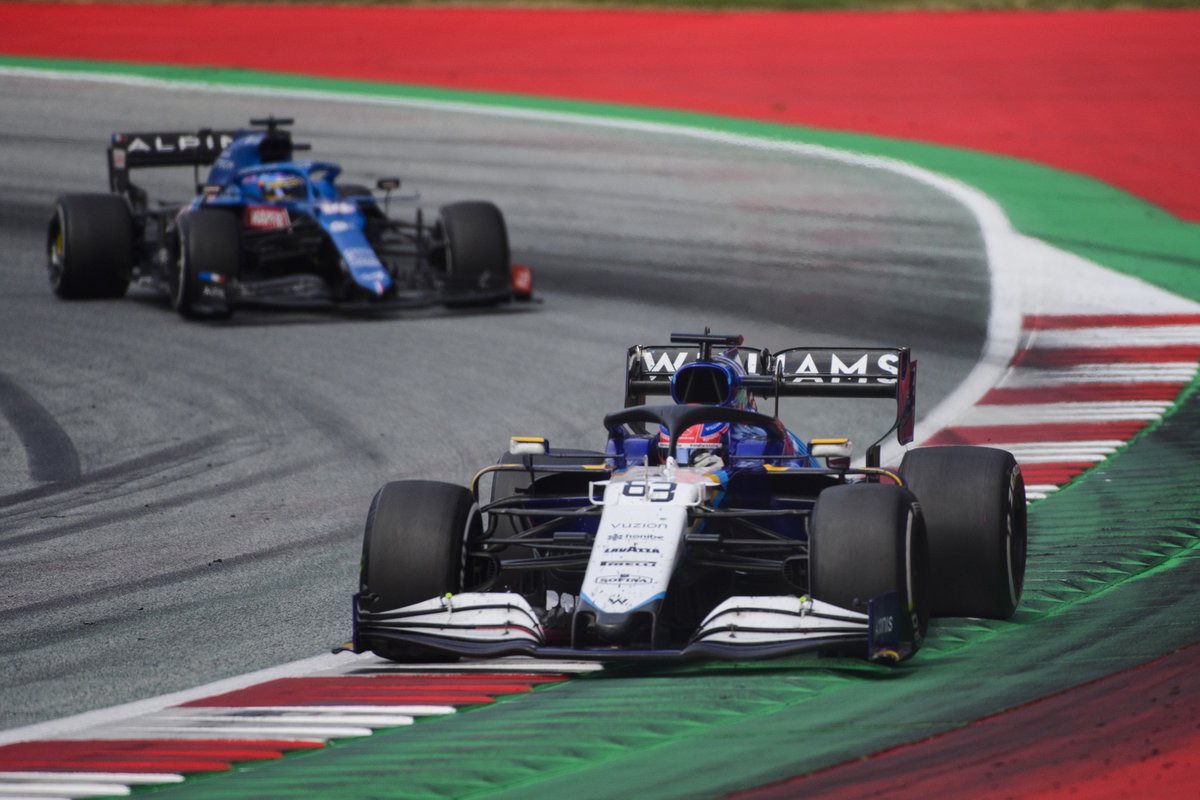
Russell has done much of his learning out of the public eye, but impressed during his battle against Alonso in Austria
Photo by: Erik Junius
“These are the four moments in my three years that stick out to me that were pretty brutal emotionally,” Russell explains. “It was just learning how to deal with that. You often feel like you’ve let the whole side down if you make a mistake, and letting that not drain you [is vital] because ultimately if you want to win a championship you need to perform over 23 races.
“You might have a bad race at race one, but you need to bounce back from that. Or you might have a bad race mid-season – you can’t let that affect the races following. So [you must] almost forget, move on and try to focus on the next race, because memories live short in Formula 1. I look back on Bahrain with no frustration or hard feelings. It’s something that I guess has moulded me into a stronger driver.”
Mercedes is gaining a driver that has completed the oft-trodden journey of plying their trade at the back of the grid and has learned the value of failure along the way. At the same time, Russell has forged a reputation as a rapid and consistent qualifier with his 56-2 record in comparison to Robert Kubica and Latifi (Q1-Q2-Q3 sessions only), which includes four Q3 appearances in 2021 and only three times of not escaping the opening qualifying segment last year.
"I am not an engineer, but the driver can have a massive influence in the direction that a team can take so that is something I’ll be really focused on because I see this next chapter as a long journey together" George Russell
Russell also knows this move is one with long-haul potential. Not only will he have to produce his best consistently to earn a lengthy deal along the lines of those Verstappen and Leclerc were handed by Red Bull and Ferrari respectively, but he will have to aid Mercedes’ development through the new design rules era. He must work to prove his late-2021 dip in form was just a blip, put in more consistently excellent race starts (something both Hamilton and Bottas have struggled with in the Mercedes package) and continue to show the adaptability and leadership that so impressed Williams, all while doing so with potentially rapidly changing machinery.
“The engineering side is something that I have definitely progressed a huge amount in these three years at Williams,” Russell says. “The simulator side of things is going to be very important to help work on the correlation and the development and try to direct the team on where the car’s limitations are and where it needs improving.
“I am not an engineer, but the driver can have a massive influence in the direction that a team can take so that is something I’ll be really focused on because I see this next chapter as a long journey together. Obviously, I want to win next year but it will be important to make sure we have got a car that is capable of winning over the next four years.”

Russell is looking to put his newly-developed engineering skills to use in developing a front-running car
Photo by: Steve Etherington / Motorsport Images
And here we arrive at the main conclusion from Wolff’s move to upgrade his superteam with a new driver versed in what Mercedes does and what it is. If it can be taken as read that Russell won’t destabilise his new environment given his proven nous and fast learning, then it appears right now to be win-win.
There’s how Hamilton may react to having a highly rated up-and-comer slot in on the other side of the Mercedes garage. Matching an older superstar with one projected to one day emulate them is a recognised tactic throughout sport. Hamilton has been open about how the new generation of stars has raised his own incredibly high level – now with one installed next to him it is logical to expect a further response.
If Hamilton goes on to take an eighth world title, that’s a win for Wolff and Mercedes. Should Russell sensationally take the title at his first shot, that’s another. But these are of course assumptions based on the team being in contention at the front of the grid for yet another year. That won’t be known until the new cars hit the track, but Mercedes maintaining its supremacy through the 2016-17 rule changes gives it a certain amount of credit on that front. Of course, the new duo will need to work together to secure a ninth straight Mercedes constructors’ title.
But as 2022 begins, Russell knows one thing for sure. His Mercedes move gives him his best chance to be a world champion. And, potentially, be champion many more times in the years to come.

How Russell fares alongside Hamilton is expected to be one of the storylines of the season
Photo by: Steve Etherington / Motorsport Images


Why Britain’s role in Formula 1 endured a troubled start

Why Bottas believes his F1 reserve driver role is the fastest route back to a race seat

Why Norris is now ready for his final exam

The key advantage for Bottas vs Perez in the 2026 F1 return race

Why Ferrari's management is under pressure after its bad start to F1 2025, not Hamilton or Leclerc

Why Red Bull can’t solve its second F1 car problem with a simple paint job

Hirakawa replaces Doohan at Alpine for Japanese GP FP1 outing

How Alonso and Bortoleto can be F1 rivals in a unique driver management deal

Why F1's Madring debut was a wasted opportunity

Bruising F1 2026 will not be the end for Russell - Wolff

Haas confident of getting 2027 F1 budget closer to cap with new partner talks

Top 10 Can-Am drivers
Subscribe and access Autosport.com with your ad-blocker.
From Formula 1 to MotoGP we report straight from the paddock because we love our sport, just like you. In order to keep delivering our expert journalism, our website uses advertising. Still, we want to give you the opportunity to enjoy an ad-free and tracker-free website and to continue using your adblocker.


Top Comments