


Why 2022 progress is crucial after Alfa's year of F1 turmoil
One driver allowed to quietly retire, another one fired in a blaze of rancour. An American buy-out that never happened. A title sponsor demanding an annual right of review. No wonder Alfa Romeo is looking to start 2022 from a clean sheet, says ROBERTO CHINCHERO
While the results on track were thoroughly unexceptional, for Alfa Romeo Racing 2021 was a year destined to play a very important role in the future of the team. Behind the scenes of the Sauber Motorsport-operated organisation in Hinwil, Switzerland, cogs have been turning with the express purpose of executing great change on the financial and technical front – and, of course, the driver line-up.
As Kimi Raikkonen and Antonio Giovinazzi laboured in vain to secure points on track, around the boardroom table the top management laid their plans. But among the various news to come out of the team, paradoxically the most important event, one which attracted great interest, was a decision... not taken. And it was a huge one: to sell or not to sell.
For many months negotiations had been underway which would end in a change of ownership of the Sauber Group, which since July 2016 has been the property (via various holding companies) of Finn Rausing, the reclusive businessman known for being co-owner of the Tetra Laval packaging company and the grandson of the inventor of Tetra Pak.
Enter and exit Andretti
Last spring Rausing received a purchase offer from a US consortium which included the large insurance holding company Group1001, a sponsor of the Andretti Autosport IndyCar team co-owned by Michael Andretti, who was acting as figurehead for the bid. Andretti’s consortium had identified the Sauber Group as a means of bringing another US team into Formula 1 without the start-up complications that would otherwise ensue – not least the requirement to pay $200million up front into a pot to be shared among the existing teams.
Sauber wasn’t officially for sale, but Rausing decided to start negotiations by evaluating the benefits of the offer. Since 2016, the 67-year-old Swedish billionaire has made significant investments in Sauber’s Hinwil facility to bring the struggling Formula 1 team back to the level of performance which made it a championship contender during its years under BMW’s ownership.
The F1 organisation expanded from 220 employees in 2016 to the current 500, and strategic investments in infrastructure enabled it to acquire must-haves such as a simulator. It also embarked on new long-term technical collaborations with suppliers.

Andretti was linked with team buy-in, but Rausing elected not to sell
Photo by: Geoffrey M. Miller / Motorsport Images
Sauber also launched a new division, similar to McLaren Applied and Williams Advanced Engineering, which operates not only in the automotive sector but also in industrial fields where the Group’s F1 technology can be adapted to profitable use. Rausing has never closed the doors where the possibility exists to work with partners who could make a strategic contribution: joint ventures that would allow the sharing of effort on a financial and organisational level, strategic and managerial, with partners who add value through their own expertise and networks. So long as these arrangements offer the potential to move the team forward they will be entertained.
Andretti’s proposal was therefore considered worthy of attention. In fact the negotiations continued for several months, even reaching a final phase which seemed to be a prelude to Rausing handing over control and remaining only as a minority shareholder. But precisely in that final phase, divergences of strategic vision emerged – and not only related to the management of the F1 team.
The Alfa Romeo partnership was renewed in July 2021 with a new multi-year agreement, but one featuring significant changes compared with the previous arrangement. Most threatening is the contractually enshrined right for Alfa Romeo to review the partnership every year
Contrary to what has been reported or assumed elsewhere, GP Racing understands it was Rausing who called off the negotiations and not by the group represented by Andretti. They simply had to accept their counterpart’s decision. The reasons for the breakdown in negotiations are many, but it’s certain the current ownership of the Sauber Group would not have accepted the likely dismemberment of the Hinwil facility. It is believed Andretti’s plans included moving part of the business to the United States.
Where does Alfa Romeo stand?
In November 2017 Alfa Romeo became the main sponsor of the Sauber F1 team, a relationship which evolved to the point of a name change to Alfa Romeo Racing at the beginning of 2020. The arrangement has been transformative not just for the team’s branding and image, which was dour and anonymous, but also for its finances. At the time of the Rausing acquisition in 2016 the team’s sponsorship take was practically zero, its share of F1’s ‘prize pot’ negligible.
Sauber-Alfa Romeo’s form has fluctuated, though: after an initial improvement it peaked at eighth in the constructors’ standings in 2018, and has risen no higher since. The partnership was renewed in July 2021 with a new multi-year agreement, but one featuring significant changes compared with the previous arrangement. Most threatening is the contractually enshrined right for Alfa Romeo to review the partnership every year; along with that, as a concession, Alfa has given up its right to nominate one of the team’s two drivers.

Alfa has relinquished control over a seat in return for an annual review of its title sponsorship
Photo by: Jerry Andre / Motorsport Images
The old contract granted Alfa Romeo the choice of a driver, which in the case of both Charles Leclerc (in 2018) and Antonio Giovinazzi (in the past three seasons) has meant drawing on the Ferrari Driver Academy programme. On several occasions during the past two years, team principal Frederic Vasseur has publically referred to the constraint on the team’s choice of drivers, so it wasn’t too surprising that in the new contract he managed to eliminate this condition, reserving the freedom to choose both. The team has pushed hard to be able to evaluate all the options offered by the drivers’ market – which doesn’t preclude the possibility of having a driver linked to Ferrari in the team, just that it no longer represents an obligation.
As quid pro quo Alfa Romeo got greater flexibility, guaranteeing the possibility of re-evaluating the contract every twelve months. While this naturally cast the new agreement in a more precarious form, Alfa Romeo CEO Jean-Philippe Imparato painted a more reassuring context, but one with nuances – as you might expect from a senior manager who once declared “motorsport is dead unless it’s electrified”.
After the merger last January between Fiat Chrysler Automobiles and PSA, Alfa Romeo is now part of what has been renamed the Stellantis Group, which includes fifteen manufacturers. Marketing strategies and even entire brands will be fluid in the years to come. Alfa Romeo needed the annual review clause in the event of further Covid-related chaos in the car market (in any case, the brand has effectively been on life support for several years), but it also offers the option of evaluating a brand change. Should it become strategic to promote other Stellantis brands, such as Maserati, the switch would be applicable without contractual changes.
Why 2022 will be crucial
For Alfa Romeo, the renewal of the contract on an annual basis enables it to evaluate the team’s results more regularly. With this, the pressure on the team increases. It must demonstrate significant progress in 2022.
The team was aware the 2021 season was going to be very difficult, given the carry-over of much of the technical package from the previous season: 70% of the 2021 car was the same, and this obviously had an impact on relative performance to those teams which had directed resources to development. Sauber’s decision to focus technical and financial resources on the new rules package to come meant no meaningful in-season development on the 2021 car, a sacrifice it hopes will yield benefits in 2022.
Unlike Haas, which buys in many components from external suppliers and has a direct link with Ferrari, Sauber has always sought to maintain its autonomy. That represents a challenge from many points of view, but it has never been questioned internally. Today in Hinwil the team can design and build the entire car in-house with the exception of the power unit, a philosophy which allows the team not to depend on others, and which enables it to theoretically have a choice of power unit suppliers.

Williams demoted Alfa Romeo to ninth in the constructors' this year, putting more pressure on 2022
Photo by: Zak Mauger / Motorsport Images
For all these positives, however, the reality of 2021 has been grim. Alfa was overtaken by Williams for eighth in the constructors’ championship, which had been its minimum target for the season. Clearly Williams has made progress with its car and profited from George Russell’s excellence.
PLUS: The jubilation and sorrow Williams experienced in its 2021 F1 recovery
This aspect affected another of Alfa Romeo Racing’s strategic choices. At the start of the 2021 season it was still not clear who would be driving the following year, since both Raikkonen and Giovinazzi were out of contract. Vasseur wanted to wait for Raikkonen's decision on whether to retire or not, but at the same time he evaluated Valtteri Bottas’s intentions regarding his future after being informed he would be giving up his Mercedes seat to Russell.
"We have to go back to the midfield. We want to be in Q3 regularly. I’m sure Ferrari will also take a step forward with its power unit and I’m convinced we can go back to where we were in 2018" Frederic Vasseur
When Raikkonen confirmed his decision to retire, Vasseur closed the deal with Bottas, securing the Finnish driver for the next two seasons as the team’s point of reference. While there are those who view Bottas as something of an also-ran after five years of being number two to Lewis Hamilton, he remains quick enough and is younger and hungrier than Raikkonen.
A bitter end for Giovinazzi
Bottas’s appointment was formalised on 6th September but, in the wake of the announcement, Vasseur remained tight-lipped about the identity of the second driver, leading many to conclude that Giovinazzi remained in the frame for 2022. In fact the impression which emerged between the weekends at Zandvoort and Monza was that the team had already decided to end its relationship with the Italian driver.
Giovinazzi was always a slightly peculiar choice, having spent two seasons on the sidelines after finishing as runner-up to Pierre Gasly in the 2016 GP2 Series. Twice in 2017 he substituted for the injured Pascal Wehrlein at Sauber, without greatly distinguishing himself, and through that season and 2018 he was Ferrari and Sauber’s nominated reserve driver.
To his credit, he grew up fast after being promoted to a race seat for 2019. But Vasseur expected more from his driver, even if he never publicly expressed such sentiments. Giovinazzi’s principal flaw has been his tendency to make small but costly errors in races, such as when he crashed out while running in the points at Spa in 2019.
PLUS: Why Alfa's ousted F1 driver can be "happy" despite losing his drive
For his part, Giovinazzi can wag a finger at the team over ‘finger trouble’ and peculiar strategies which have denied him opportunities to score. He went as far as to harangue the team publicly after it called him in for an early stop in Mexico, from which he emerged behind the long-running Bottas and Daniel Ricciardo. But at that point Alfa had already made its choices, announcing the agreement for 2022 with Guanyu Zhou, and Giovinazzi’s departure, right after Interlagos.

Giovinazzi harboured hopes of remaining in 2022, but has been replaced by rookie Zhou
Photo by: Alfa Romeo
Vasseur’s decision to drop Giovinazzi was also central to Sauber chairman Pascal Picci’s resignation, announced before the Mexican GP. In an interview with the Italian edition of GP Racing’s sister website Motorsport.com Picci, a key figure in saving Sauber in 2016, was critical of Vasseur.
“I do not want to be associated with the management of Fred Vasseur in the future,” Picci said. “The way in which the drivers were chosen was one of the points that broke the table between me and the current management.”
The hiring of Bottas had already been taken as a rejection of Giovinazzi, who hoped to inherit the role of ‘reference driver’ after Raikkonen's retirement. It’s clear the will to change has prevailed, and the beginning of a new technical cycle in F1 as a whole has provided an ideal context for starting work with a new driver, especially a rookie such as Zhou. The Chinese driver also came with 25 million good reasons – in dollars – for choosing him, courtesy of his personal backers, but it wasn’t just this which excluded Giovinazzi from the running for 2022.
PLUS: Ranking the top 10 F2 and F3 drivers of 2021
Essentially the team doesn’t believe its car was slower than the Williams, and that its drivers let the side down. As Vasseur pointed out: “We finished most of the races ahead of the Williams, but we lost in Hungary and Belgium, and this made a lot of difference.”
Vasseur has never articulated it explicitly, just as no one in the team has ever expressed opinions about drivers, but the impression is that the performance of Alfa Romeo’s drivers has also been subject to a rigorous assessment. And they have been found wanting in comparison with Russell, who has created points-scoring opportunities seemingly from nothing by regularly outperforming his car in qualifying.
“We have to go back to the midfield,” Vasseur says. “We want to be in Q3 regularly. I’m sure Ferrari will also take a step forward with its power unit and I’m convinced we can go back to where we were in 2018.”
The certainty is that 2022 will be a crucial year for the future of this team as it embarks on a completely new programme, with new drivers in a new car which has had the benefit of Hinwil’s entire technical resource focused on it. It’s not only the outcome of a season which is at stake, but the future of a team in search of its identity.
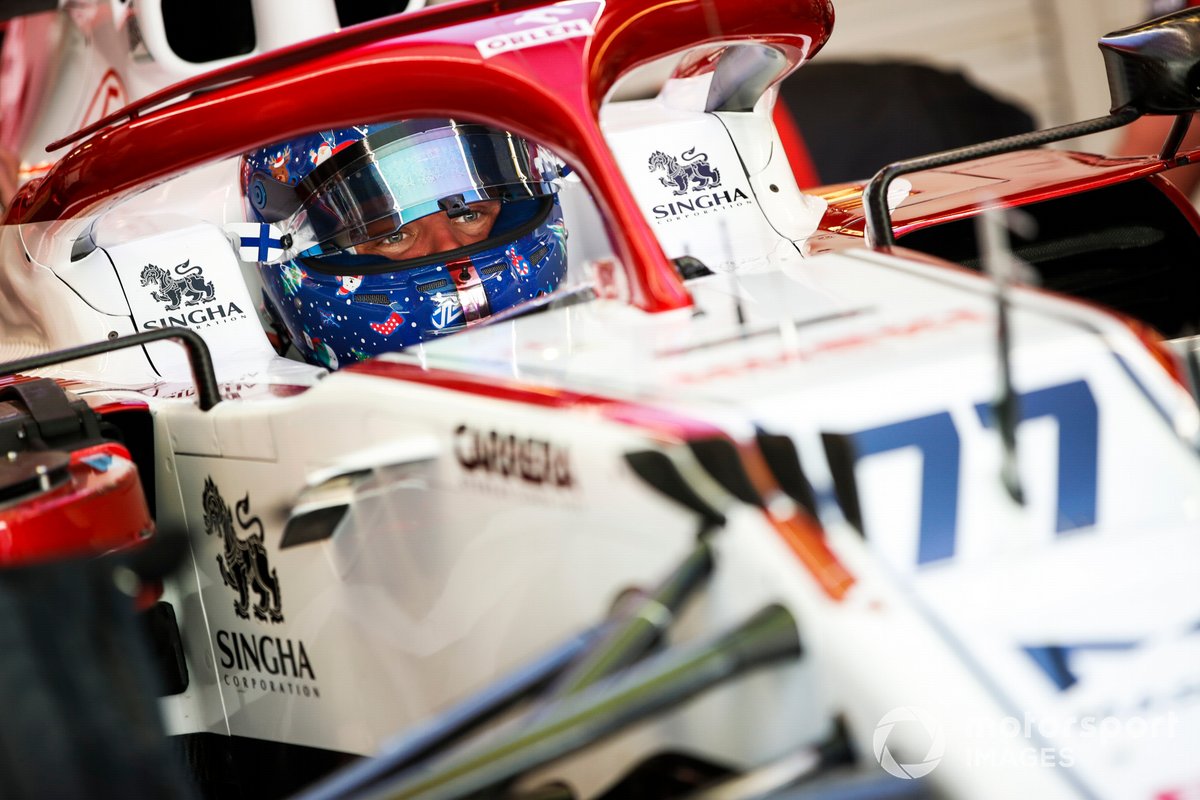
With new signing Bottas bringing expertise from Mercedes to the team, 2022 will be an important year for Alfa
Photo by: Zak Mauger / Motorsport Images

How Ratzenberger beat the odds to realise his cruelly short-lived F1 dream

F1 uncovered: A weekend behind the scenes with a chief mechanic

When McLaren was pipped by Red Bull in a modern F1 classic

The big opportunity Sainz’s Williams switch affords to F1’s latest centurion

Inside the science of F1 fuel

How F1’s plan for rotating races could look in practice

The early decisions that set Sauber’s rookie for success

How F1 media coverage has evolved in line with its subject

Why Cadillac F1 boss provoked fresh intrigue by dodging driver question

Marquez: “In the first half of 2026, all I wanted to do on Sundays was lie on the sofa”

Vinales: “If I stay at home, I don’t get paid”

The unexpected issue Honda faced with upgraded F1 power unit
Subscribe and access Autosport.com with your ad-blocker.
From Formula 1 to MotoGP we report straight from the paddock because we love our sport, just like you. In order to keep delivering our expert journalism, our website uses advertising. Still, we want to give you the opportunity to enjoy an ad-free and tracker-free website and to continue using your adblocker.


Top Comments