


Behind the scenes at Pirelli: The hidden factors that go into developing F1 tyres
Tyres are, arguably, the most important component when it comes to Formula 1 car performance. But what exactly goes into developing and testing them? A visit to Pirelli offered a rare behind-the-scenes look at the process

Formula 1 tyre supplier Pirelli has a new head of motorsport, Dario Marrafuschi, who has taken over from Mario Isola, and he opened up its Milan headquarters for a private tour.
This is not the location where its F1 tyres are produced, as that takes place in Slatina in Romania, with a back-up factory in Izmit in Turkey. Milan is where several crucial steps take place before production begins, from research and development to the equally important testing process.
This work is carried out across several floors, from the ground floor down to level -2, which, according to Pirelli, is by design. All testing machines and simulation tools need to operate in complete isolation and be free from vibrations that could potentially cause interference.
The Milan facility is also a place where modern and traditional methods come together. The tour begins in a room dedicated to the so-called sgorbiatori, where different tread patterns are manually cut – still old-fashioned craftsmanship. Despite all the modern simulation techniques available today, this manual method is still used to validate on a real tyre whether a certain pattern works or not.
"We still use this technology to develop and to optimise the tread pattern," explains Guido Carosio, who leads the tour as Pirelli’s indoor testing manager. "Thanks to the virtual approach, we can develop and design the tread patterns, but even with all the virtual testing that you do, you still need some physical tyres to test, especially for things like the noise, outdoor performance, aquaplaning and braking in the wet."
Cutting the pattern using the sgorbiatori — the device used to carve into the rubber — can be a time-consuming task. Precisely creating all the grooves and lines according to the design can take as much as three to four working days per tyre, with the Lamborghini Urus mentioned as one of the biggest challenges. For an F1 intermediate or full wet, however, it turns out to be considerably easier.
"It's not so complicated. The F1 full wet and intermediate are complicated and very, very high level from a compound point of view, but they are not so complicated from a design point of view. I believe one day is enough to cut a Formula 1 tyre by hand."

Pirelli's Milan base is its test and development centre before the tyres are manufactured either in Romania or Turkey
Photo by: Pirelli
Why 2026 sometimes felt like an ‘Italian casino’ for Pirelli
While cutting the tread pattern for full wets and intermediates is relatively straightforward, the opposite is true when it comes to developing F1 tyres. Determining both the construction and the various compounds requires an enormous amount of R&D and testing work, for which Pirelli uses many of its nearly 80 underground machines.
Much of the development work now takes place digitally, yet before a tyre ever reaches the track, three crucial steps still take place in Milan: testing small rubber samples in a so-called linear friction test, evaluating the performance of the complete tyre, and assessing its safety in Pirelli’s testing environment.
With the linear friction test — the first of these steps — Pirelli can test small pieces of rubber in a dynamic machine capable of replicating speed. The surface can be adjusted to simulate different types of asphalt, specific circuits on the F1 calendar and varying weather conditions, including rain and ice. "Although we hope we’ll never need the ice setting for F1!" Pirelli head of R&D Stefano Bizzi retorts. "The machine is fully automatic, we have different tyre samples with different features, and we can test those here on the same surface, in the same cycle, and you can run the machine automatically to compare the properties of all the materials."
For Pirelli, it is an important intermediate step between digital models and the real track, allowing different compounds and possible solutions to be compared under exactly the same conditions.
"We received simulations in June [last year about 2026 F1 performance levels], and at the beginning, those could be massively different" Pirelli head of R&D Stefano Bizzi
Following positive results with these small rubber samples and further development work, Pirelli has several machines available to test a complete tyre. One of the most important is the flat track machine, whose name already gives away much of how it works.
"With our three flat surface machines, we are close to the real world. Because with this machine we can set a combination of different loads, slip angle, steering angle, camber angle and also positive or negative torque. So on a flat surface, under controlled indoor conditions, we can set all the parameters that our tyre will experience in the real world," Carosio explains. "Based on the data from this machine, we can compare tyre model A versus tyre model B. And at the same time, we can also feed modelling information of these tyres into our driving simulator."
For F1 tyres, these tests are all about evaluating performance. Integrity and reliability are assessed in greater detail elsewhere, but here the focus is purely on establishing outright performance, for example when comparing different compounds.

Pirelli's test bed machines each focus on key targets: safety and performance
Photo by: Peter Fox / Getty Images
"The purpose for us is to have stable performances of the tyres during the cycle, both from the physical point of view – degradation and so on – and from thermal point of view," Carosio adds. "So our goal is to have dedicated methods to keep the conditions constant and to compare one tyre with the other, or one compound with the other compound."
When developing a new compound for F1, Pirelli can therefore test various options to measure both peak performance in short runs and degradation over longer runs, before comparing that data across all potential compounds.
These tests are always dependent on the data fed into the machines, and that is precisely where the 2026 season has presented an interesting challenge for the tyre supplier. To begin with, Pirelli had to partly rely on simulations when homologating the new tyres, but the teams’ simulations differed significantly in the early stages.
For safety reasons, Pirelli naturally had to take the highest downforce prediction for Abu Dhabi 2026 into account, but beyond that, the wide range of simulations proved difficult. Did the large differences indicate a huge field spread under the new regulations, or did they simply show that some teams’ simulations were more accurate than others?
"Exactly, that is the whole point. We received simulations in June [last year], and at the beginning, those could be massively different," Bizzi admits. "So sometimes we had to run very quickly."
Asked whether this resulted in a certain safety margin — for example in the tyre construction — Pirelli explained: "In terms of the safety margin, we have more or less some indication from the FIA in terms of the load and the characteristics during the year. Maybe we are compromising a bit in the beginning, because teams will try to extract the best from any rules."
As a result, Pirelli may have gone somewhat conservative with the construction, especially because it can only be homologated once per year. In theory, this could mean a slightly suboptimal product for the opening races of the season, but it serves a purpose: the tyres need to be strong enough to cope with the loads expected in Abu Dhabi if all teams discover significantly more downforce.
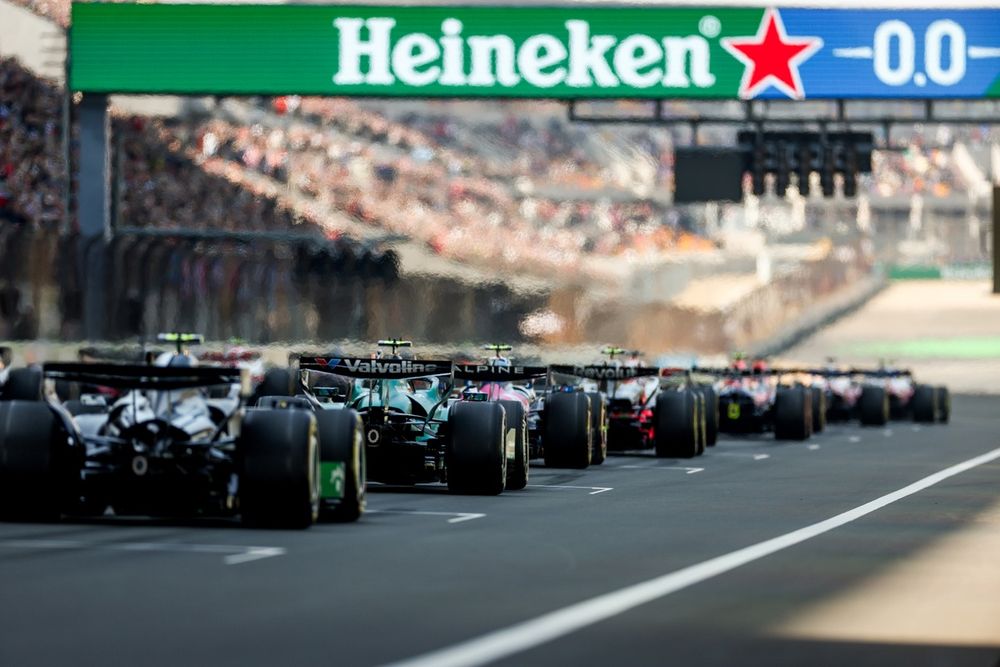
F1's tweaked rules has posed an extra headache to Pirelli and its 2026 tyre construction
Photo by: Peter Fox / Getty Images
As for the compounds, Pirelli has maintained slightly larger gaps between each compound this year, giving it more flexibility to react on a race-by-race basis with either harder or softer compounds depending on what the on-track picture reveals.
Besides that, there has been another complicating factor for Pirelli: rule changes during the season. While several drivers in Miami indicated that the recent tweaks had not made a “fundamental” difference behind the wheel, every adjustment is still complex from Pirelli’s perspective.

"This year, frankly speaking, it's an Italian casino," Bizzi laughed. "Because we have straight mode 1, straight mode off, straight mode on, with intermediates or not, so to make the prescription at any time can be really, really chaos."
Changes to the regulations logically affect the loads on the tyres. If there is less super clipping, for example, drivers again arrive at braking zones with greater speed, making those braking zones more severe than before the regulatory changes. And this naturally affects the loads the tyres have to deal with.
Pirelli emphasised that most of the machines in its Milan facility can theoretically be purchased by anyone, but that the real difference lies in how they are used, especially in F1
"Because you can imagine that first, we had less severe braking, but the drivers used that to recharge the battery. Now, we arrive in the braking zones and boom [increased load on the tyres]. That changes the cycle completely, and also, we need to re-adapt our methodology to follow," Bizzi explained.
Precisely because tyres play such an important role in F1 and understanding them is crucial for teams, every team is allowed to use Pirelli’s flat track machine for eight hours per year. This can help improve their own understanding, which is important to feed into their own simulation models.
Testing up to 500 km/h and the Qatar example
Aside from pure performance, there is naturally another aspect that stands above anything else: safety, the ultimate priority. For that reason, Pirelli has several machines in Milan that allow new F1 products to be tested long before they ever see a race track, including the integrity test machine.

Qatar's pyramid kerbs threw a curveball at Pirelli in 2023, but the tyre manufacturer has learned from this experience
Photo by: Alex Kalinauckas
"The scope of this test is the integrity of a tyre at very high speed. In this case, we run on a drum, not on a flat surface. That’s because on a drum we can test even more severe conditions in comparison with the flat surface test," Carosio explained during the tour.
"For normal production tyres, you have a speed symbol marking on the tyre. That means that a certain tyre is homologated for this maximum speed. But Pirelli has its own cycle and method for motorsport, to be sure that even in very extreme conditions, and even in misused conditions, the tyre always has a very important safety margin. For your information, the speed of this machine is up to a maximum of 500 km/h."
Where the previous machine focused on performance and highly-specific measurements, this one is primarily about ensuring that the tyre’s construction does not fail under extreme conditions. It is designed to prevent unpleasant surprises on-track, although testing models do not always capture everything.
The Qatar Grand Prix, for example, has posed challenges on two occasions: first because of the so-called pyramid kerbs that cut into the tyres, and later due to the extreme wear combined with the temperatures, leading Pirelli and the FIA to impose a maximum stint length.
"Qatar is aggressive in general, with the sequence of corners at very high speed, and then in combination with the kerb speed and also temperatures," Carosio acknowledged.
When something like that happens, the information gathered from the actual track is fed back into Pirelli’s tools so that those scenarios can be simulated in the future and the necessary safety margins can be incorporated.
"At the end, the track is a further source of information for us, and a very important one. So we don't want it to be separated. The whole development process has different inputs, predictive ahead of the races, data coming from the races, data from our engineers and so on. It's always a mix of information," Carosio explains.

Simulator work also feed into Pirelli's development stage
Photo by: Pirelli
"And with that mix of information, we constantly study the methodology. We use the best methodology at the moment in high severity conditions to cover, let’s say, 95% of the races. But after that Qatar example we needed to use another methodology to evaluate the level of safety margin."
That final point is the crux of the matter. At the end of the tour, Pirelli emphasised that most of the machines in its Milan facility can theoretically be purchased by anyone, but that the real difference lies in how they are used, especially in F1. It comes down to methodology and accumulated know-how — and both are constantly evolving in the world of F1.
And of course, after all these stages — R&D, performance testing and integrity testing — one final step remains decisive: what happens on the actual track.
But if one thing became clear at Pirelli, it is that countless steps have already been taken before a new tyre or compound ever reaches the circuit — steps that normally remain hidden from F1 fans and followers.

Pirelli's behind the scenes efforts often go unnoticed by the wider watching world in F1
Photo by: Pirelli


Red Bull explains why Verstappen and Hadjar's 'silly' problems won't all be fixed in 2026

The two recurring issues that hampered Verstappen and Red Bull again at the US GP

Red Bull no longer falls away on difficult days: What Austin qualifying reveals about its progress

Verstappen responds to COTA boss and proposes drastic measures to tackle bumps

The unexpected issue Honda faced with upgraded F1 power unit

Verstappen enjoys promising start to US GP - but Red Bull pinpoints areas of improvement

Verstappen warns COTA bumps are “unacceptable” and “out of control”

Verstappen’s words explained: Why Red Bull’s turnaround is so different this time

Mercedes has a Russell-sized problem and it is sharing responsibility

Phillips wins inaugural GB4 Winter Series in dramatic circumstances at Snetterton

Rally US host city announced ahead of WRC return

The role Friday practice played in Hamilton failing to achieve a podium at the US GP
Subscribe and access Autosport.com with your ad-blocker.
From Formula 1 to MotoGP we report straight from the paddock because we love our sport, just like you. In order to keep delivering our expert journalism, our website uses advertising. Still, we want to give you the opportunity to enjoy an ad-free and tracker-free website and to continue using your adblocker.


Top Comments