


How Monza only added more questions to F1's sprint race conundrum
With two sprint races under its belt, Formula 1 must now consider its options for them going forward. While they've helped deliver exciting racing on Sundays, the sprints themselves have been somewhat lacking - creating yet another conundrum for F1 to solve...

Formula 1’s Monza sprint race was a boring spectacle that was pretty much done and dusted by the time the cars hit the brakes for the first corner.
Formula 1’s Monza sprint race played a pivotal role in lifting the entire Italian Grand Prix weekend and helped set up a more spectacular race on the Sunday.
Those two comments may appear to disagree with each other, but actually they are both true when it comes to understanding the conundrum the championship’s bosses face right now over sprint races.
With two of the three experiments having taken place, the arguments about the pros and cons of the sprint race cannot simply be boiled down to a simple good or bad answer. Like most things in F1, the sprint race debate is proving to be incredibly complicated to unravel, which makes it even more difficult to work out what series bosses should do next.
There are some obvious wins from the new format. Having qualifying on Friday appears to be a big benefit for the vast majority. It delivers a highlight of action on a Friday, rather than two pretty dull practice sessions, and that is good for media/TV coverage and fans at the track (although whether running it so late in the day is best or not is another debate).

Valtteri Bottas, Mercedes, 1st position, with his winners medal after Sprint Qualifying
Photo by: Jerry Andre / Motorsport Images
The Friday shift also appears to be much better for the show too. With just a single practice session before teams are hemmed in to parc ferme conditions, there is no way they can perfectly hone their set-ups and tyre knowledge like they do on more regular weekends. Gone are the long Friday nights on simulators and a Saturday morning chance for redemption if the first day of action did not go the way you wanted.
It’s added more jeopardy to the system, and that is only a good thing when it comes to delivering a more entertaining race on Sunday. But Friday’s win appears to be Saturday’s loss. And on the sprint weekends, it is the second day of action that has taken a bit of a hit.
The second free practice session has become something of a strange spectacle. For the teams it is hugely valuable in putting the mileage on tyres to get their strategies perfected for the sprint and main grand prix. However, that means a session that is hard for observers to follow unless you are logging long run times and know exactly what tyre compounds and the mileage each set has. But who wants to watch F1 cars in action with the need for a spreadsheet to be open?
What incentive was there for drivers to risk much in a Saturday race when the points don’t count for much if you aren’t a title contender?
Perhaps worse than that, though, is that whereas the lack of running on Friday adds to the jeopardy, this hour session on Saturday has become something that gives teams too much back. With the car set-up fixed, teams can focus entirely on the tyres – giving them all the answers they need to ensure there are no slips up in either the sprint or the grand prix. It takes away from the spectacle, rather than adds to it.
It’s something that even FIA president Jean Todt has questioned. Speaking to Italian media at the weekend, he said: “For the moment this [sprint] format leaves me a bit perplexed over what happens between 12pm and 1pm on Saturday morning.
“This free practice hour is not understandable to the public nor the media. It can only be of interest to the teams to collect information, for example on tyre wear. From the point of view of the show, it makes no sense.”
But worse than even the Saturday practice, is the spectacle of the sprint qualifying itself – which appears to be struggling to impress after the two we’ve seen so far.
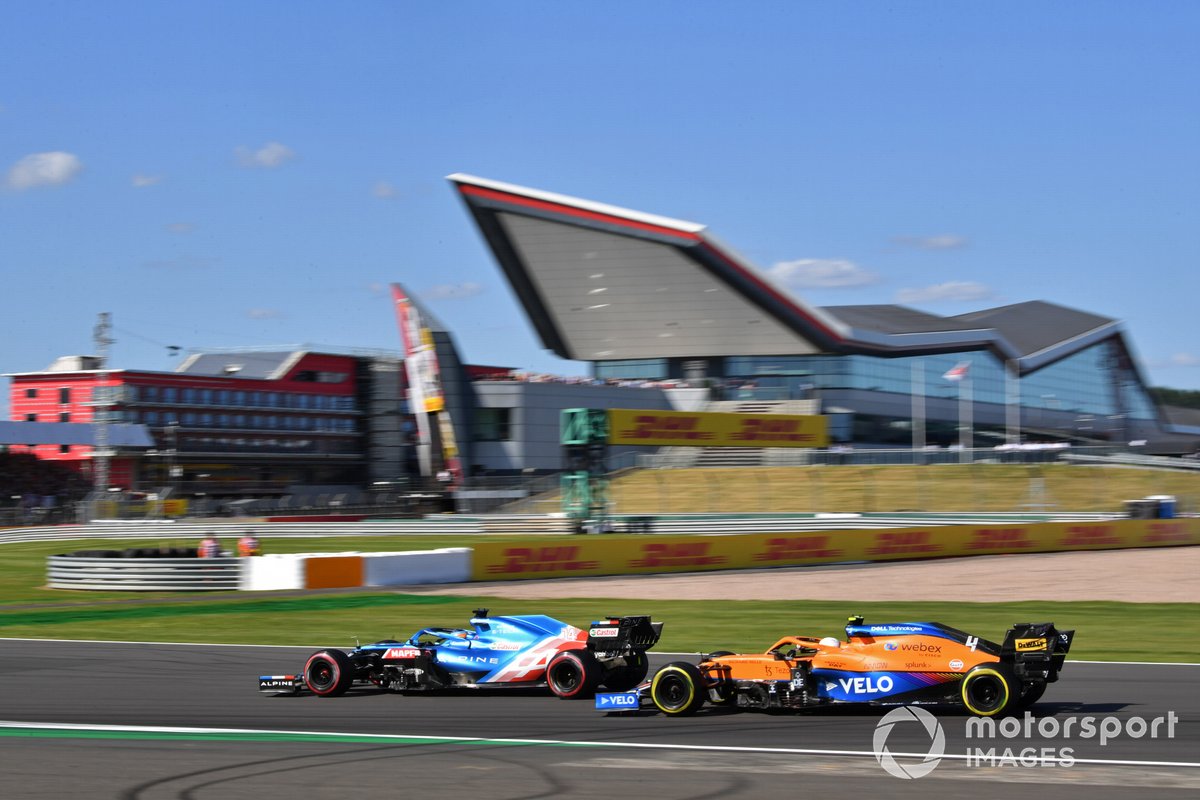
Fernando Alonso, Alpine A521, Lando Norris, McLaren MCL35M
Photo by: Mark Sutton / Motorsport Images
Coming out of the British Grand Prix, there were some concerns that the Saturday event there was only lifted by Fernando Alonso pulling off a masterstroke on the soft tyre. His surge up the order on the first lap, and the brilliant holding off of rivals after that, was great to watch.
But Monza didn’t have anyone pulling off similar heroics. In fact, the only real talking point was that Lewis Hamilton made a poor getaway from the front row of the grid and dropped behind the two McLarens and Red Bull's Max Verstappen.
As a spectacle, thereafter, it failed. The gaps quickly stretched out among the frontrunners and there was not a single overtake in the top eight positions: nor even a sniff of one. However much F1 chiefs raved about a bit of action in the midfield, it’s ultimately irrelevant when you hold a race that only offers points for the top three.
The trigger for Monza’s sprint not working is multi faceted though, and it’s not just related to the 100km format. The Monza circuit has never really been a great venue for overtaking, and a look through the history books has always shown the grands prix to be dictated by the pitstop windows.
Allied to that, the current generation of cars don’t help much. Super low drag wings means DRS is far from effective, and the energy management of power units means that overtaking chances only come when the drivers are running out of their battery boost.
Plus, as a pretty low-degradation track, tyre life was pretty straightforward for the 18 laps (especially since the teams knew which way to go after FP2). Throw in to the mix too that, on a track where track position is king, what incentive was there for drivers to risk much in a Saturday race when the points don’t count for much if you aren’t a title contender? The downside of a broken car and a back-of-the-grid start on Sunday was simply not worth it.
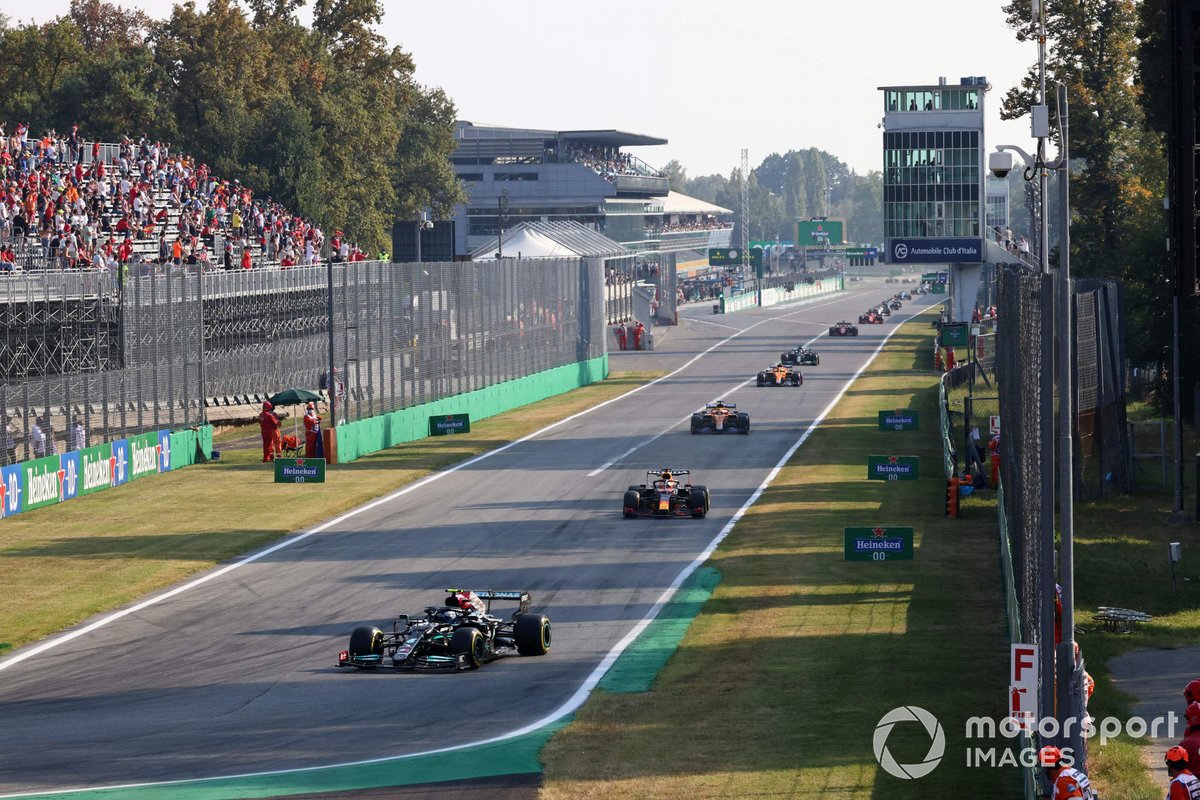
Valtteri Bottas, Mercedes W12, Max Verstappen, Red Bull Racing RB16B, and Daniel Ricciardo, McLaren MCL35M
Photo by: Steve Etherington / Motorsport Images
But while Saturday was a damp squib, the impact that it had on what unfolded on Sunday cannot be underestimated; if we had gone from Q3 straight to the race, things would have been less exciting.
On very basic terms, the grid itself had shuffled a bit. And that meant for McLaren, it had moved itself from what have been P3 and P4 behind Max Verstappen and Lewis Hamilton (Bottas taking his engine penalty come what may), into a front row start.
Had the main event played out in the way the sprint did, then Verstappen would have stayed in front and, most likely, gone on to an easy victory.
Also requiring consideration is the fact that the very elements that made Saturday so boring – especially the difficulty in overtaking – were what made Sunday so special
That single position gain McLaren had, in Ricciardo getting his nose in after the getaway from the front row, was critical to the way events turned out so brilliantly on Sunday.
For the top three teams, McLaren, Red Bull and Mercedes, they had also all gone in to the race with the clear knowledge that overtaking was going to be incredible difficult: even with a tyre offset. That meant, from McLaren’s perspective, it knew that if it could get one of its cars ahead of the Red Bull on the first lap then it could stay there as long as it wasn’t jumped at the stops. The huge databank of knowledge it had from running the softs on Saturday meant it felt more comfortable switching to the mediums for the race.
The lack of overtaking prospects also pushed Mercedes to the hard, for it knew it needed to open up Hamilton’s strategy options for Sunday if it was going to find its way past the two McLarens. So it was the offset grid and the slightly tweaked tyre calls – all as a result of the sprint event/lessons – that played their part in triggering the spectacular Italian Grand Prix.
Were it not for the sprint, then we could have had a pretty processional race up front – and certainly without the way circumstances brought Max Verstappen and Lewis Hamilton together.

Lewis Hamilton, Mercedes W12 and Max Verstappen, Red Bull Racing RB16B collide
Photo by: Jerry Andre / Motorsport Images
Also requiring consideration is the fact that the very elements that made Saturday so boring – especially the difficulty in overtaking – were what made Sunday so special. Ricciardo was able to pull off the win because the ultimately quicker Red Bull of Verstappen could not find a way past. And surely both Hamilton and Verstappen knew, as they battled wheel-to-wheel at the first chicane, that who came out of that corner second was on the losing side.
Based on Monza, the difficulty F1 faces in unpicking the pros and cons of the sprint format is immense. Saturday morning’s practice doesn’t really work, but equally ditching it and having F1 cars just run for 30 minutes later in the day would not be good either.
Then, the sprint qualifying concept has big flaws it its success in isolation on Saturday, as it encourages too much a procession. The rewards on offer aren’t big enough for drivers/teams to risk too much; and the downsides are immense if things go wrong. Would removing it as a ‘qualifying’ race make it better – so it’s just a battle for points? Perhaps.
But throw more points on offer so everyone has reason to push, and that opens the danger of the world championship being decided on Saturdays. Plus the Sunday spectacle could be weakened. Make it a reverse grid standalone and there’s a risk it turns off F1’s hardcore audience: and would world title protagonists at the back of the grid really risk much to charge up the order?
One idea that’s been suggested is to produce a bespoke ‘sprint race’ tyre that teams have no knowledge of beforehand, and that is marginal for the 100km. But would that make it too much of a lottery, or risk Saturdays becoming boring economy runs?
There is no right and wrong answer on the sprint debate right now. It doesn’t work and it does work. It was boring but it helped make Sunday exciting. For now, all we can do is sit and wait for the third experiment in Brazil and see if the themes are consistent.
Then, F1 faces a real headache in trying to unpick it all and work out what happens next.

Lewis Hamilton, Mercedes W12, Charles Leclerc, Ferrari SF21, and Carlos Sainz Jr., Ferrari SF21
Photo by: Mark Sutton / Motorsport Images


Brundle awarded OBE in King’s New Year’s honours

The new rules dilemma that will define the 2025 F1 season

Verstappen issues Red Bull title warning in push for RB21 progress

Mercedes opens up on the factors that hurt Hamilton with the W15

How McLaren faced up to the misinformation, noise and distractions of being an F1 title challenger

Why Bottas is not letting the “worst-case scenario” end his F1 career

Jon Noble: An unfair perception or a genuine concern? Lifting the lid on Red Bull’s Tsunoda scepticism

Binotto on Audi's F1 reality check after finding team "frozen" with no plans

Portugal to be absent from WRC 2027 despite date agreement

Whether Baku was Red Bull's last realistic opportunity of winning in F1 2026

Why there’s no perfect solution to the WEC safety car conundrum

Keen and Bryant snatch last-gasp Spa Six Hours win
Subscribe and access Autosport.com with your ad-blocker.
From Formula 1 to MotoGP we report straight from the paddock because we love our sport, just like you. In order to keep delivering our expert journalism, our website uses advertising. Still, we want to give you the opportunity to enjoy an ad-free and tracker-free website and to continue using your adblocker.


Top Comments