


How Formula 1 teams coped with Canadian Grand Prix brake demands
The Canadian Grand Prix is one of the toughest of the Formula 1 season for brakes with almost one quarter of the Montreal circuit spent slowing the cars down

F1 brake supplier Brembo classifies Turns 6, 8, 10 and 13 as "hard" braking events, with Turn 13 posing one of the biggest decelerations with cars slowing from 199mph to 93mph in around 50 metres.
Every year, as teams push ever closer to the cooling limits, the challenge for engineers gets increasingly hard.
Extra difficulty comes from the fact that in recent years the brake duct and drum designs have become increasingly more complex, as teams try to balance the needs of brake cooling with closed channel effects that improve aerodynamic performance.
Here we look at top teams' different approaches to the 2018 Canada weekend.
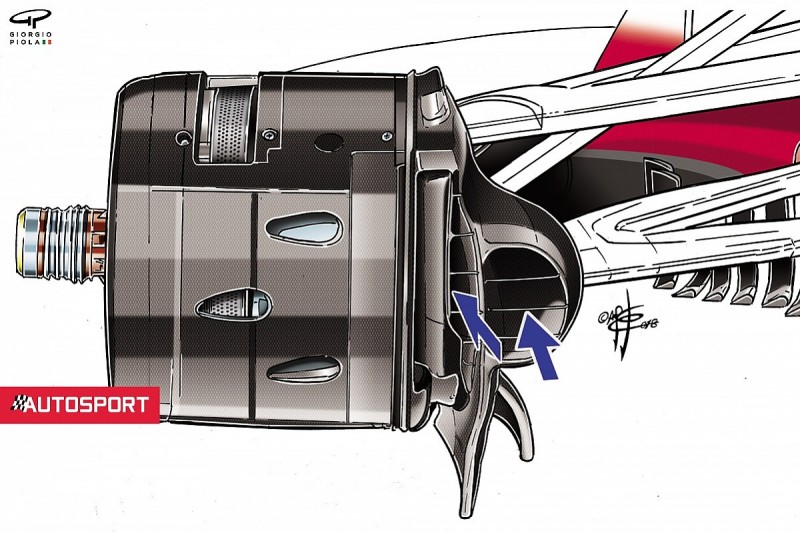
This year Ferrari continued the recent trend of using some of the brake duct's design to power a blown axle, improving the aerodynamic footprint around the wheel rim and tyre.
But this doesn't compromise brake cooling, with the designers carefully sending cooled airflow to the brake discs and calipers.
The brake drum also features numerous apertures from which heat being generated by the brakes can be released.
All of this hot air is carefully placed in order to maximise how the heat is rejected in order that it also interacts with the wheel rim and consequently the tyre in the most effective manner too.
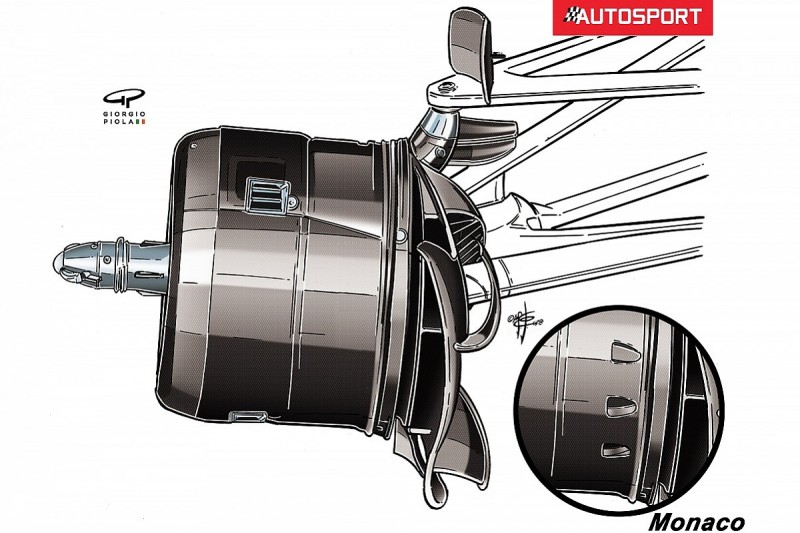
Mercedes had a more tame solution in comparison, disregarding the blown axle and instead focusing its efforts on minimising the brake duct's aerodynamic footprint. As the above image shows, its design features a much smaller inlet scoop.
Like Ferrari, the Mercedes concept rejects heat generated under braking through windows in the brake drum but for Canada it reduced the number of openings compared to Monaco.

Each team comes up with its own solutions based on individual requirements and the prevailing conditions, which often leads to teams trialling various solutions during free practice sessions to see what suits each driver's needs.
As we can see in this example of Renault's front brake assembly, the team's decision is driven by both mechanical and aerodynamic decisions.
The open basket arrangement on the left allows more heat to escape through the wheel face, whereas the solution on the right controls how that airflow escapes and is transmitted to the tyre via the wheel rim.
Share Or Save This Story

The downforce choices that proved key at the Saudi GP

Revealed: Ferrari’s radical 2022 F1 nose idea

Piola: How new parts will influence 2020 designs

F1 champion Norris completes first full test in McLaren’s Le Mans Hypercar

How Solberg lit up WRC title fight in Chile

F2 adds extra Baku feature race and insists Qatar, Abu Dhabi still on – what does this mean for F1?

Healeys, MGBs and Lotus Elans top Castle Combe Autumn Classic
Subscribe and access Autosport.com with your ad-blocker.
From Formula 1 to MotoGP we report straight from the paddock because we love our sport, just like you. In order to keep delivering our expert journalism, our website uses advertising. Still, we want to give you the opportunity to enjoy an ad-free and tracker-free website and to continue using your adblocker.


Top Comments