


Formula 1: Details of new McLaren upgrade revealed at Spanish GP
McLaren introduced its major Formula 1 upgrade package in first free practice for the Spanish Grand Prix, with both Fernando Alonso and Stoffel Vandoorne running its extravagant new nose

The team described the upgraded car as its 'real' 2018 F1 car earlier in the season, and the modified nose takes several cues from rivals.
The nose tip extension, which overcomes the requirement for a low nose, has an opening at the front like the one used by Red Bull since the start of last season.

McLaren has also been influenced by this year's Sauber, introducing a pair of channels either side of the nose that allow airflow to move under it.
Both solutions are an attempt by McLaren to make the lower surface 'invisible' from an aerodynamic perspective, while meeting the cross-sectional area criteria of the regulations.

The elongated and holed front wing pillars have been cast aside, replaced by a set of pillars that converge on a Mercedes-style cape.
This funnels and realigns the airflow so it can be better used by the new turning vanes mounted beneath the chassis.
Although the nose design features a collection of ideas already seen on other cars, there is a novelty in that the main body is flanked by a pair of panels that give a more decisive direction to the airflow passing around the nose.
The complexity of the nose package shows how hard McLaren is pushing to close the gap to the front of the midfield, given how difficult it will have been to design such a structure to pass the mandatory crash tests.
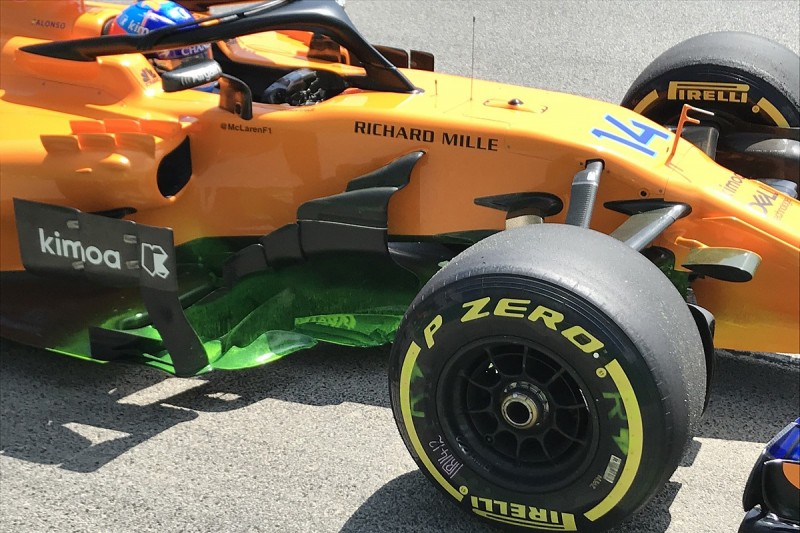
Both cars both ran with new sidepod deflectors, adding a forward element that stretches down to the floor's 'axehead' in order to limit the disturbance caused by the front tyre wake.
The bargeboards themselves are untouched at this stage, but the team ran with flo-vis paint in that area to evaluate whether the nose is delivering the performance promised by CFD and the windtunnel.
Share Or Save This Story


Gallery: How F1 tech evolved during the 2024 season

How McLaren’s rear wing push changed the game in F1

What controls the frontline in the latest F1 design tech battles

Friday favourite: The last all-French F1 pairing that reunited a title-winning duo

Ranking the 10 best drivers of an F1 junior series stalwart

Friday favourite: The F1 champion who became a "perfect team-mate"


F1 doesn't need to change its VSC rules despite Norris' Spain loss

Norris completes first full test in McLaren’s Le Mans Hypercar

How Antonelli is proving unbeatable, even when he's beaten

What's behind the talks between the FIA president and Alonso over ADUO?

Evans favourite to become WRC champion as Rally Saudi Arabia is cancelled

Alonso is right to sound the alarm about F1 - but history seems to be repeating itself

Ogura set to make MotoGP return in Austria
Subscribe and access Autosport.com with your ad-blocker.
From Formula 1 to MotoGP we report straight from the paddock because we love our sport, just like you. In order to keep delivering our expert journalism, our website uses advertising. Still, we want to give you the opportunity to enjoy an ad-free and tracker-free website and to continue using your adblocker.


Top Comments