


Formula 1 rethinking all its TV camera positions for 2019
Formula 1 is having a major rethink of its trackside television camera strategy for 2019 in order to better translate the speed of the cars to the screen


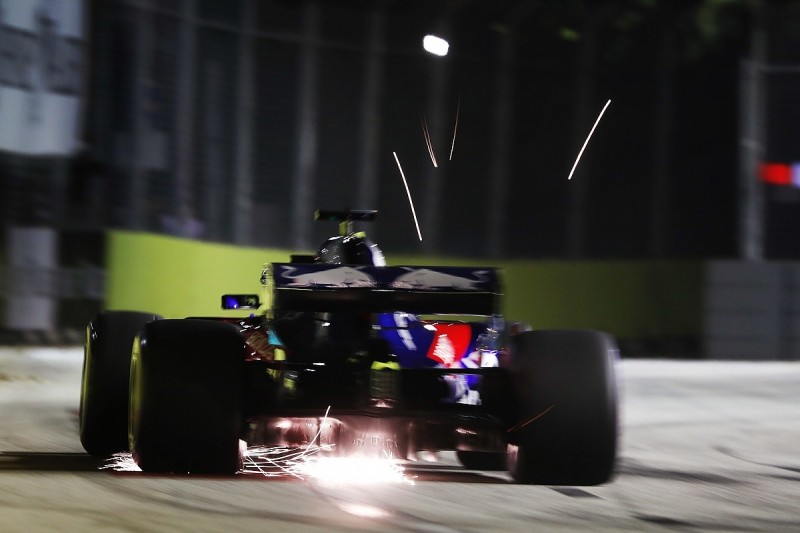
The championship's head of TV and media Dean Locke explained that F1 wants to make the current generation of high downforce cars look more "edgy" for viewers than they have done in the past.
"There's a big push for 2019 to reflect the speed of the sport, and the pace of the cars," Locke told Autosport.

"There's a rethink on all camera positions. If you're in the grandstand and watch them, they look incredible, don't they?
"Camera angles, or lenses, can cheat that quite a lot, and make them look not so dramatic and not quite as quick.
"So we looked at different ways to do that, a few little tricks.
"We've always been good at doing whip-pans to show the high speed of the cars, making them look a little bit more edgy in places.
"There were some tracks last year - in Japan for instance - where we really highlighted where these cars are good."
Work is also continuing on how to broadcast F1 engine sound, which has been problematic since the hybrid era began in 2014, adequately.
"Audio has changed quite dramatically," Locke added.
"We've done a lot more around the car and on the car.
"If you look at the pictures, they tend to be at the front, and the audio out the back. A lot of thought went into that in 2018, and a lot more for 2019.
"It is successful, but at some tracks it's better than others. The Honda engines sounded really good last year. We've done some really exciting stuff on that."
In another TV development for 2019, F1 has formed a partnership with Amazon Web Services that will enable it to add more strategical elements to its on-screen graphics.
"We're doing lot of work with AWS and their machine learning capabilities to explain things like the undercut/overcut," Locke explained.
"We're using their platform to give us the data, the information, for some graphics.
"It's a pretty powerful tool, and we're just touching into it now, what we can achieve or can't achieve.
"For example, the pitstop strategy - why did they come in, why didn't they come in?
"We're relying on a very good commentary team to explain that, which in the UK we're very lucky to have. You can't take it for granted in the other 200 territories and over 90 broadcasters.
"We have graphics that can actually explain, 'He started on those tyres, he's going to stop then,' while actually making it more dynamic, because if the VSC comes out it can throw those kind of things out.
"We're using all the data from Friday and Saturday to come up with that algorithm of what we think will happen.
"If we can explain that in a simple and easy to read manner, it will be a huge win."
Share Or Save This Story


Krack: Aston Martin F1 team no longer in “no-man’s land”

Gasly rues costly floor damage from Ocon contact in F1 Japanese GP

How an F1 underachiever became a Japanese political player


Formula 1: The groundbreaking women who drove in F1

Friday favourite: When a GP2 race winner “ate steering wheel” in Alpine's F1 winner

The potential pitfalls Mercedes is working to counter in 2021

Vinales: “If I stay at home, I don’t get paid”

The unexpected issue Honda faced with upgraded F1 power unit

Supercars Gold Coast: Chaz Mostert dominates wet race for Walkinshaw Toyota

Red Bull identifies two "key focus" areas after Max Verstappen's promising start in Austin
Subscribe and access Autosport.com with your ad-blocker.
From Formula 1 to MotoGP we report straight from the paddock because we love our sport, just like you. In order to keep delivering our expert journalism, our website uses advertising. Still, we want to give you the opportunity to enjoy an ad-free and tracker-free website and to continue using your adblocker.


Top Comments