
The entry level series turning trackday fans into GT champions
Low-cost. Easily accessible. And the perfect route for trackday drivers into competitive motorsport. It’s easy to see why Super Lap Scotland’s time-trial format is proving popular and encouraging new people to try it for themselves

It’s an age-old question asked by event organisers: how to get more people involved in motorsport? One logical group to target as potential future competitors is trackday drivers – after all, these are people who are already showing an interest in cars and visiting a circuit.
In 2013, the Knockhill Motor Sports Club recognised this and has aimed to reduce the gap between trackdays and racing north of the border via its Super Lap Scotland series.
“The realisation came to us that the popularity of trackdays is huge but from trackdays to racing is a ginormous step for so many people,” says KMSC chairman Stuart Gray. “They love driving fast, they love going on track but the first step in motorsport was then full-blown racing and, for that reason, it was a giant leap.
“Traditional sprinting had been around a long time, but is expensive per lap so we looked around and adopted a Super Sprint format. It has become a stepping stone to allow trackday drivers to have competition without the giant leap to having a bespoke competition car and all the paraphernalia that goes with circuit racing.”
The KMSC is not alone in targeting trackday drivers as possible racers – MotorSport Vision Trackdays has successfully introduced many of these men and women to competition via its hugely popular entry-level Trackday Trophy and Trackday Championship categories, but the jump to actually race against other drivers on track can still be daunting for many. And that is where the real strength of SLS lies. Its time-trial format was devised to allow drivers to compete against the clock rather than directly with each other.
“It’s really grown,” continues Gray. “I think the first year we had about 12-15 entries and now we’ve got maybe 80-90 drivers who take part in a year, with around 65 per event.”
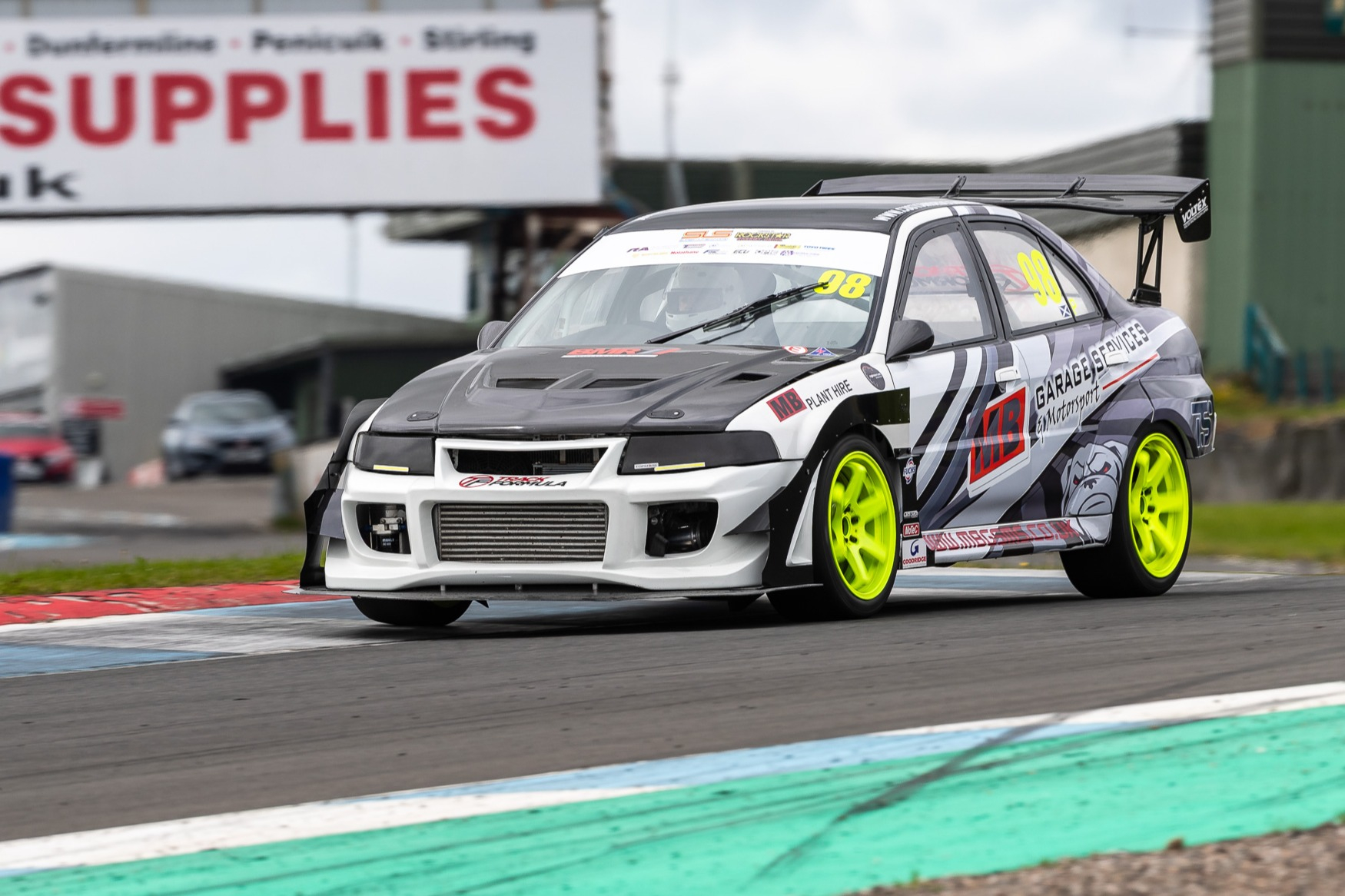
Super Laps Scotland action
Photo by: Flat Out Photography
An SLS round starts with warm-up and practice sessions in the morning, ensuring competitors get plenty of track time, before things get more serious with a 15-minute qualifying session that determines the order drivers complete their Super Lap in – and then it all comes down to that one hot lap in the final.
“You get points for qualifying, so it’s important, and they’re in the pits and out the pits, simulating the Super Lap – which, at the end of the day, is an out-lap, a fast lap and then an in-lap,” says championship coordinator Duncan Vincent. “If you qualify fastest in your class, you would run last, so slowest would go first.”
Gray adds: “The Super Lap at the end is where all the pressure’s on because each class lines up in the pitlane and the cars get released one at a time. Basically every 10 seconds or so a car gets released.”
SLS has evolved over time to cater for an incredibly diverse range of cars, split into groups by power-to-weight ratio, featuring commuter Minis up to track-focused Radicals in its new Pro Extreme class, while there is also a division for retro machines.
"SLS was good because it allowed me to get into motorsport and I was learning about how to drive and how to find the limit of the car in an environment that I wasn’t racing someone else, causing me financial damage and crashes. It was just down to me" Graham Davidson
“You don’t need to have a 1000bhp Mitsubishi or Subaru to win the overall King of the Hill,” explains Vincent. “So, a Class G car, which is the slowest and littlest engine, could actually be the King of the Hill champion, if they win each of their events all the way through. So that’s a bit of fun. As long as you’ve got a competition licence, we’ll give you some stickers and away you go after a proper safety video from the clerk of the course.”
For drivers in the majority of classes, it is the Rally Speed Interclub licence that’s required – for the Pro divisions it’s Race Interclub – and, in terms of equipment, drivers just need an approved helmet, racesuit and gloves in the lower groups.
One of the best case studies of a driver who has progressed from SLS to enjoy great success in racing is 2019 British GT champion Graham Davidson. He used to take part in trackdays at Knockhill in his Noble and was persuaded to join SLS – and says he would never have started racing without it.

Graham Davidson, British GT champion 2019
Photo by: JEP/Motorsport Images
“Some of the staff there said, ‘Graham, you should try racing’, and I said, ‘I don’t know, I don’t want to damage the car and the costs seem astronomical’, but they convinced me it was worth trying this new SLS series,” he recalls.
“It was just you against the clock and you try and do the best lap you can. SLS was good because it allowed me to get into motorsport and I was learning about how to drive and how to find the limit of the car in an environment that I wasn’t racing someone else, causing me financial damage and crashes. It was just down to me.
“Had it not been for SLS, there’s no way I would’ve gone into a full grid of cars – I probably wouldn’t have made the big step to do it. Starting racing can be quite daunting, but with SLS you’ve got just one or two things to focus on.”
After achieving podiums and wins in SLS, Davidson progressed into racing Sports and Saloons at Knockhill and says competing has had a transformative effect on his life.
“Getting into the car gave me something to focus on,” he says. “Racing helped me out of my rut – it’s been the making of me.”
Another driver singing the praises of SLS is Classic Sports Car Club director David Smitheram. He headed to Knockhill last year to discuss the CSCC racing at the venue and, while there, took part in an SLS event in his road car.
“I did one round and it was brilliant,” Smitheram says. “It’s probably an hour’s track time for less than £200 and that’s pretty good.

Super Laps Scotland action
Photo by: Flat Out Photography
“The competitors were friendly and welcoming and I was able to push hard like I can when racing but without the normal fear of car-to-car racing. I would be lying if I said it’s as exciting as racing – you’ve not got that element of battling for position and ‘how do I defend from this person?’ – but it was a close second and good value for money.”
Smitheram believes KMSC has struck gold with the format, and can easily see why SLS is proving popular. Gray and Vincent attribute that success to a number of different factors, including being able to compete on the clockwise and anti-clockwise configurations of Knockhill over one weekend and the fact that competitors can share a car to reduce costs.
"Motorsport’s got this big perceived barrier of you need a lot of money, you need a special licence, you need this and you need that, and there are a lot of misconceptions out there" Stuart Gray
“I think it’s value-for-money, and there’s a very wide knowledge in a friendly paddock – people are here to help, whether it’s your fellow competitors or us as organisers,” says Gray. “Track time is good and I think also you’re not diving into Duffus Dip wing mirror to wing mirror where you could have contact.
“I’m always keen to make things as easy as possible, take away the barriers to anything. Motorsport’s got this big perceived barrier of you need a lot of money, you need a special licence, you need this and you need that, and there are a lot of misconceptions out there.
“One of the things we’ve been so proactive with is, any time we’ve got a trackday here, we go round the paddock and look who’s driving well and got an appropriate car, we’ll go up and chat to them and say, ‘You could be competing in this car, all you need is your racesuit, helmet, gloves, get a licence and you can be competing’. And, for half the people, there’s shock they’re so close to competing without realising it.
“We’re very proactive in encouraging people to make that step and that’s where this is the stepping stone to future competition. If people come into SLS, do SLS and then don’t do anything else, then it’s not really achieving its goal. The goal is to get people into full-blown racing.”
The inspirational example of Davidson is perfect proof that SLS can achieve exactly that.

Super Laps Scotland action
Photo by: Flat Out Photography


Voisin grabs Carrera Cup crown early despite messy Silverstone opener

The exciting changes afoot to transform Thruxton

Why a more open mindset is making life less stressful for serial winner Slater

New Porsche 911 Challenge car to be introduced to Sprint Challenge GB

Hurd's hat-trick heroics as he storms through Mini field at Donington Park

The Radical rise of a top prototype squad

Mini masters put on another entertaining show at Thruxton

Is this Porsche’s latest superstar?

MotoGP Indonesian GP: Fernandez claims pole, Marquez outqualifies Martin

The political minefield set out by F1’s recent cost-cap grievances

Singapore sprint qualifying chaos leaves F1 teams furious

FIA reveals "human error" caused latest software glitch in Singapore sprint qualifying
Subscribe and access Autosport.com with your ad-blocker.
From Formula 1 to MotoGP we report straight from the paddock because we love our sport, just like you. In order to keep delivering our expert journalism, our website uses advertising. Still, we want to give you the opportunity to enjoy an ad-free and tracker-free website and to continue using your adblocker.


Top Comments