
Was the 'Justin Bieber of NASCAR' the giantkiller of the decade?
In 2011, one driver went from a relative nobody fighting for a future in one of racing's biggest series, to gracing TV sets, meeting his heroes and being called by the US President. Is this the biggest giantkilling performance of the 2010s?
Getting a call from the US President may have become a little less fashionable in the last three years or so, but back in 2011 there would have been few bigger honours for an American citizen. And why shouldn't the winner of 'The Great American Race' get that call?
The race in question, the Daytona 500, has long caused debate between NASCAR fans. The debate being, what's bigger; winning the 500, or clinching NASCAR's Cup series championship title.
The Daytona 500 acts in many ways like the Le Mans 24 Hours in that many believe it surpasses the championship it lies within. And in 2011, the biggest shock in the race's history was delivered as Trevor Bayne claimed the spoils in just his second Cup start.
Bayne left Knoxville to travel east for the home of NASCAR, North Carolina, when he was 15, uprooting over 200 miles after karting between 2002-06. His career breaks came in the K&N Pro Series East, and something called the Hooters Pro Cup. We'll leave that there.
Bayne never came with enough backing to fund his car racing career, but each year he trusted the path that he had been set on - Bayne is a devout Christian - and, after bouncing around the Nationwide (now Xfinity) Series, he landed a deal with then crack squad Roush Fenway Racing.

RFR gave him a Nationwide drive for 2010 and a Cup series debut with the Wood Brothers later that year in Texas, where 17th didn't reflect how much he had impressed an ageing giant - Wood Brothers Racing, having once been a NASCAR and American motorsport's juggernaut, were at this point reduced to a RFR affiliate team with one car only.
At the end of 2010 the money dried up, but impressing Wood Brothers at Texas paid off and - with the encouragement of RFR - it signed him up for a part-time programme including the Daytona 500.
The race itself, despite being one of the upsets of the motorsport decade, was pretty straightforward. Bayne ran up front for most of the race and missed 'the big one' - an inevitable pile-up that wipes out a large majority of the field in any superspeedway race. When David Ragan was penalised for jumping the restart on the penultimate lap after the 16th caution of the race, Bayne inherited the lead. But he knew, at that moment, sat deep within his Ford Fusion, that taking the lead could be an awful thing for his chances.
"I had been watching the other races that weekend, the Truck race, the Nationwide race," Bayne told Autosport two months after his 500 win.
"All the races I watched were won by a different driver than the one who was leading on the last lap. I was concerned about that. But I really couldn't have planned it any better. I didn't plan it that way. To be honest with you I planned it totally different. [My plan] probably wouldn't have worked."

Ultimately he didn't need a plan, as everything worked out perfectly.
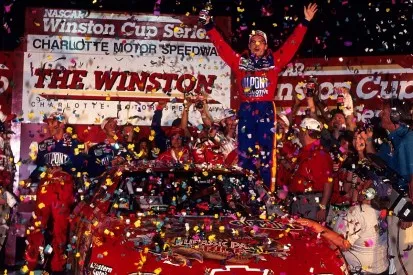
He got a great shove from fellow privateer Bobby Labonte, and held the lead over the final two laps. RFR's top driver Carl Edwards came on strong pushed by David Gilliland, and nudged Labonte out of the way to push Bayne after the final turn. Edwards squirmed and wriggled at Bayne's rear but didn't turn the youngster into the wall, leaving Bayne clear to take the victor's spoils - becoming the youngest winner of the Daytona 500 ever, and the Wood Brothers' first since Davey Pearson's victory over Richard Petty in 1976. That was an almighty affair between the two drivers who top the most number of wins in NASCAR Cup history, Petty heading the late Pearson who passed in 2018.
For Bayne, the win sent his life into a spiral. He still had to fund the rest of his season, and yet hours after the 500 win, his phone went into meltdown.
"When the White House called and said the President would like to speak to us within the next few days, I was blown away by that," he said.
After he was dubbed 'NASCAR's Justin Bieber', magazine and TV appearances followed for Bayne during what was a whirlwind year. He even got to meet one of his heroes, Pittsburgh Steelers American Football linebacker Troy Polamalu.
"I don't want to have anything to hide, I want to be as public as possible and truthful as possible," he added, speaking about his approach to what came next.

"It is crazy how much attention has been drawn to this. I never expected it. I'm so thankful for the fact that this might help our race teams to find partners to go on these race cars.
"I had that plain white suit on for the Roush Fenway Nationwide car [in 2010]. That thing was not looking good. I hope this draws some more interest. I just have to manage the mountaintops - know there might be bad days ahead, but be excited when we do get them because this is a really good sport and we're really excited about everything."
Despite enshrining himself in NASCAR folklore and becoming a name that will never be forgotten by true NASCAR fans, the win failed to provide the kickstart Bayne needed for his career.
Later that year, Bayne reported fatigue, nausea and double vision, and before the 2014 season he announced he had Multiple Sclerosis. He maintains that has not had an effect on his training to stay sharp as a top driver, but it's something that team owners and drivers must have had in the back of their minds when hiring Bayne.
From 2012-15 he combined myriad Sprint Cup outings with Nationwide title attacks with RFR, but failed to finish higher than sixth in the latter. RFR did bump him up to the Sprint Cup for '15, but it tied in with a dip in form for the squad and Bayne was dropped during the '18 season.
He was replaced by Matt Kenseth - 2002 champion - but he didn't do much better than Bayne, sparking support from Bayne's fanbase that the now 28-year-old driver should have kept his drive.
Bayne is now back in the Knoxville area and has reportedly opened a coffee shop. He uses his platform as a Daytona 500 winner to preach his faith and encourage people to trust 'God's plan', which Bayne is adamant has blessed him with a fruitful career even if he never competes at the top level again. He hasn't ruled out a top-line return though; what a story that would be.

NASCAR's highlights through the decade
2010 Jimmie Johnson lands his fifth NASCAR Cup Series title, kicking off a decade that would produce seven different top-line NASCAR champions, a new record in the Cup series. Johnson's 2010 title is significant because it was his fifth straight, two more than the next best driver (Cale Yarborough - 1976-78) has managed.
2011 Widely considered one of the most exciting seasons of all time, Tony Stewart wins the title on a tie-break and the smallest points margin in NASCAR history. The most drivers since 2001 - 19 - win a race, underdog Trevor Bayne is a shock Daytona 500 winner, and the second Talladega race of the season has the top six cars divided by 0.059 seconds, with the closest winning margin, 0.002s, since NASCAR adopted electronic timing in 1993. Jimmie Johnson is the victor.
2012 For the first time in its history, the Daytona 500 is delayed due to rain delays. In an extraordinary incident, ex-Formula 1 driver Juan Pablo Montoya crashes his Chip Ganassi Chevrolet into one of the track's jet dryers, his car instantly bursting into flames, though nobody is hurt. NASCAR switches from the carburettors used from its founding in 1949 to fuel injection. It's the last year of the 'Car of Tomorrow' framework, which is replaced by the 'Gen 6' cars used from 2013 onwards.

2015 In what can only be described as an unbelievable feat, Kyle Busch misses the first 11 races of the season but goes on to win the title. After showing much promise, and earning the nickname 'Rowdy Busch' for his aggressive nature on and off the track, he suffered a broken leg after the Xfinity Series season opener at Daytona. In 2019 he would earn his second title, though without the tribulations of his first success.
2016 Jeff Gordon retires at the end of the season. The four-time champion is credited for giving NASCAR its commercial image, the well groomed and presentable Californian a far cry from NASCAR's past. Without the introduction of the Chase playoff system in the 2000s, with points adjusted he would have take the equal-most number of championships (seven). A career Hendrick Motorsports driver, he retires after an emotional farewell tour and moves into the commentary box.
2016 As Gordon retires, the driver whose car he part-owns - Jimmie Johnson - seals a seventh Cup title (pictured below), and matches Richard Petty and Dale Earnhardt as the most successful NASCAR drivers of all time. In the race Johnson seals the title, three-time champion Tony Stewart, and one of NASCAR's most popular drivers in history, retires. Monster energy drinks takes over from Sprint as title sponsor. In 2019, Johnson reveals '20 will be his last season at NASCAR's top level.
2017 Martin Truex Jr tops off a stunning ascent by taking his first Cup Series title. It is his 13th season in the top series, but he proves ultra-impressive with independent squad Furniture Row Racing. At the end of the year, one of NASCAR's most popular drivers, Dale Earnhardt Jr, retires from Cup competition.


Williams reserve Aitken remains with Campos, targets F2 title

Rookie Tyler Reddick thinks he can make 2020 NASCAR Cup playoffs

The Daytona 500's greatest upset, 30 years on

Jimmie Johnson eyes Le Mans, IndyCar after NASCAR exit at end of 2020

Why 2020 isn't just a farewell tour for Johnson

Ogier hoping lower road order will help to end Sweden "struggle"

Tanak to "focus more than ever" on Sweden rebound after Monte crash
The "bad to the bone" NASCAR dinosaur way ahead of its time

Acosta's long road to his maiden MotoGP win

MotoGP Austrian GP: Acosta finally claims maiden win

Great debate: Which circuit should host the F1 2026 finale if the calendar has to change?

Live: MotoGP Austrian Grand Prix updates as it happens
Subscribe and access Autosport.com with your ad-blocker.
From Formula 1 to MotoGP we report straight from the paddock because we love our sport, just like you. In order to keep delivering our expert journalism, our website uses advertising. Still, we want to give you the opportunity to enjoy an ad-free and tracker-free website and to continue using your adblocker.


Top Comments