


How Quartararo cast aside prior doubts to become MotoGP's new king
Doubts were cast over Yamaha’s French recruit after his disastrous end to the 2020 MotoGP season with Petronas SRT, but Fabio Quartararo answered them convincingly in 2021 to claim a MotoGP title that exhibited both his devastating speed and mental strength

“They were a total disaster. I just wanted to finish the championship whatever the position was.”
This was how Fabio Quartararo began to reflect on his historic MotoGP title success at the conclusion of October’s Emilia Romagna Grand Prix. He was referring to the final three rounds of the 2020 campaign, his second in MotoGP, which had started with wins in the first two races and ended with his title hopes crumbling to nothing after a nightmare end to a season in which he would ultimately finish eighth.
The Yamaha package with which Quartararo had been armed for 2020 was wildly inconsistent. With COVID-19 forcing a development freeze on engines, that bike would carry over into 2021. He was already fielding questions about how worthy he was of a place in MotoGP, and those were only heightened by the fact that he was stepping into the factory Yamaha seat from which the Japanese manufacturer had ousted the icon Valentino Rossi, a move confirmed in January 2020.
So Yamaha had its work cut out over the winter to engineer its way out of the hole it had dug itself with its troubled 2020 challenger. But Quartararo also knew he needed to effect change within, and opened up about his work with a sports psychologist.
“My main goal was for him to help me to stay calm,” Quartararo explained.“He gave me some exercises that I do before the practices or when I feel I need to do these exercises. It’s just a reminder that when I’m angry or unhappy, I just do these exercises and it’s keeping me calm – it’s nothing more.”
It’s clear how this manifested itself. In the Qatar Grand Prix opener in March, Quartararo says he rode like a bit of an amateur to fifth, while Yamaha team-mate Maverick Vinales stormed to his best win in the premier class. But a week later he responded emphatically by taking victory in the Doha GP, after qualifying fifth and dropping to the fringes of the top 10 in the early stages.

Quartararo reponded after tough season-opener in Qatar to win the second race of the year with a rousing comeback
Photo by: Gold and Goose / Motorsport Images
He struggled to 13th when arm pump robbed him of a surefire victory at Jerez, and a fortnight later, following surgery on his arm, the Frenchman guided his Yamaha to third at Le Mans in flag-to-flag conditions (where changeable weather necessitates a bike swap) that had previously caused him no end of problems. Demoted to sixth following a penalty for a leathers issue at Barcelona, he rebounded in Germany to take third, and won at Silverstone after struggling to seventh in the Austrian GP.
After a tyre problem forced him to wobble to eighth at the Aragon GP, Quartararo responded with a second-place finish at the San Marino GP. His ability to emphatically respond to setbacks was arguably the key to his title success, something Marc Marquez noted: “Fabio did an incredible season. He was able to be fast, he was able to be consistent. But especially, and it’s something very difficult to have, he was able to suffer.”
That ability “to suffer” was also married to devastating speed. The more consistent M1 package in 2021 allowed Quartararo to claim five wins across the campaign at the Doha, Portuguese, Italian, Dutch and British GPs. His victory charges at Losail and the Algarve circuit, when he was forced into recovery rides after shaky starts, highlighted how much the Yamaha had improved – pack races, particularly against Ducatis, were the bane of the manufacturer’s riders in 2020.
Promotion to the factory Ducati squad for 2021 alongside Jack Miller led to Bagnaia making big strides as a rider. Chiefly, his area of focus was tyre warm-up, something he spent hours working on at Misano on his Panigale street bike and at mentor Rossi’s ranch on off-road machinery
The Mugello victory proved that both rider and bike could be strong at venues that exposed the M1’s chief weakness of top speed, while his Assen and Silverstone wins were the ultimate display of rider and bike working in harmony.
PLUS: Why Quartararo has evolved more than Yamaha on his road to the MotoGP title
Quartararo called his Mugello win “the key point”, since he came out of it with the full 25 points on a weekend when Ducati’s Francesco Bagnaia was “super-strong” and “took a lot of confidence back” after putting another Ducati, that of Pramac’s Johann Zarco, in his place in an early duel.
Bagnaia himself has repeatedly pinpointed Mugello as a critical moment in his unsuccessful title bid – not that he had any preconceived notions about mounting a challenge in 2021. That was borne out of two incredibly difficult years in 2019 and 2020 on the Pramac Ducati. But a promotion to the factory Ducati squad for 2021 alongside Jack Miller led to the Italian making big strides as a rider. Chiefly, his area of focus was tyre warm-up, something he spent hours working on at Misano on his Panigale street bike and at mentor Rossi’s ranch on off-road machinery.
Three podiums from the first four races offered Bagnaia a solid platform to build his season around, but his results took a slight dip from May’s French GP through to the Styrian in August. Here, he registered a fourth, a DNF, seventh, fifth, sixth and 11th, though the last of those, at the Red Bull Ring, was due to misfortune when the tyre he switched to for the restart after a red flag proved to be dodgy. This would strike him again at Silverstone, where he struggled to 14th.

Victory at Mugello was a crucial psychological boost for Quartararo given its historical straight-line disadvantage to the Ducatis
Photo by: Gold and Goose / Motorsport Images
Silverstone aside, Bagnaia’s second half to the 2021 campaign was truly stunning. A maiden victory at Motorland Aragon after fending off a charging Marc Marquez was followed by a second win at Misano, where he held his nerve on fading soft rubber while Quartararo on a medium Michelin rear hunted him down. By now he had also nailed qualifying.
Quartararo himself went on a run after April’s Doha GP to October’s Americas GP of qualifying on the front row, but from Assen in late June through to the end of the year, Bagnaia was always inside the top three on Saturdays. Even so, he was continuing to pay for his early-season inconsistency.
With 52 points splitting him from Quartararo heading into the Emilia Romagna GP, Bagnaia needed a win. But he would crash late on as he led, throwing away a golden opportunity to at least keep the game alive into the penultimate round presented by his pole and Quartararo’s poor grid spot of 15th. How different things could have been…
PLUS: The three factors that crowned MotoGP’s newest champion at Misano
Quartararo crashed out of the November Algarve GP to register his first DNF, and struggled to fifth in the Valencia finale, while Bagnaia won both. It’s all ifs and buts in the end, but Ducati spent 2021 refining its bike into arguably the best on the grid – one that had brute power, but could also turn and was consistently quick.
It’s no wonder Quartararo ended 2021 “worried” about the Borgo Panigale marque’s potential for next year. Initial tests of the 2022 Yamaha yielded little positivity from Quartararo, and he’s issued an ultimatum: he won’t sign anything for 2023 until he sees tangible progress from Yamaha, particularly with its engine.
PLUS: How Ducati has drawn first blood in the 2022 MotoGP title race
Ducati had a complement of riders who could challenge at the front in 2021, with Miller winning twice, Pramac rookie Jorge Martin claiming victory at the Styrian GP, while team-mate Zarco scored four second-place finishes. Even Avintia rookie Enea Bastianini on a two-year-old Ducati managed two podiums, at both Misano races.
Yamaha, on the other hand, had a more fragmented campaign. Vinales’s strong start in the Qatar GP would prove to be his sole victory in 2021. From then on he struggled for consistency, with the nadir coming at the German GP where he qualified 21st and finished the race 19th. This is when the cracks in the relationship between Yamaha and Vinales really appeared, but in truth it had been souring for months.
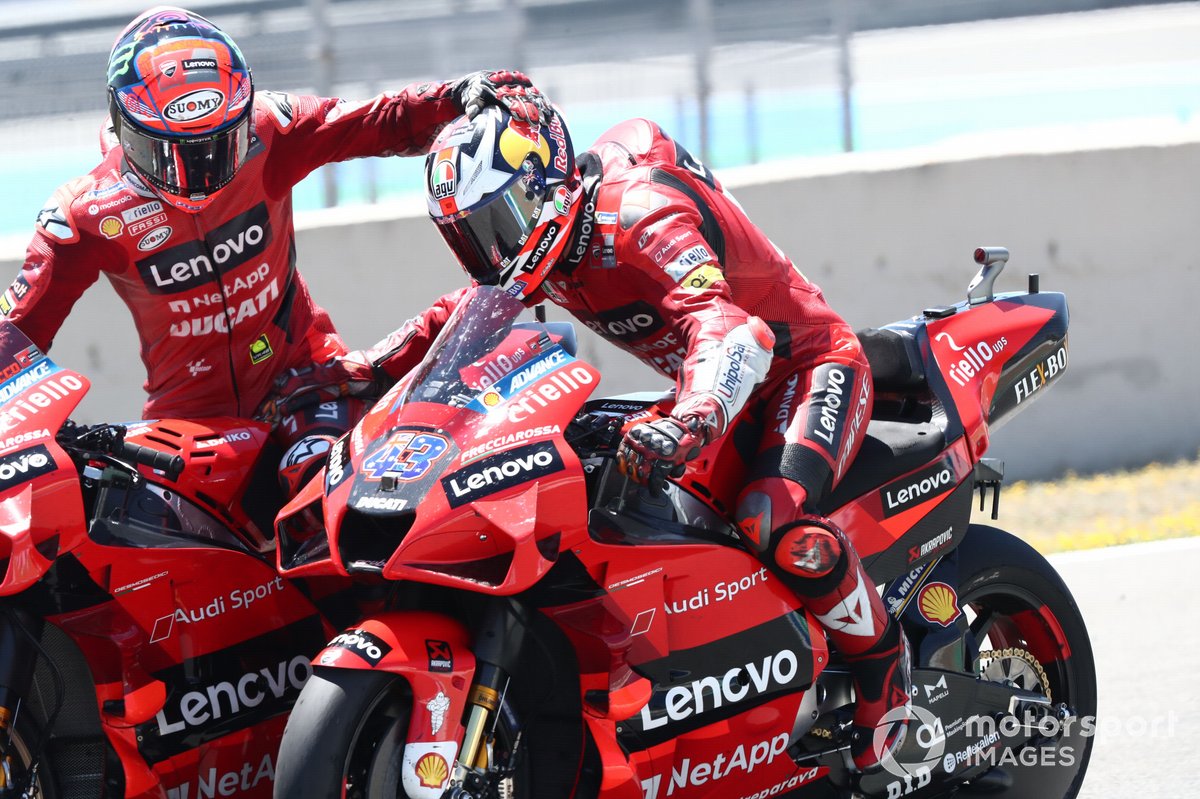
Miller led Bagnaia in a Ducati 1-2 at Jerez, but it was the Italian who led the marque's challenge to Quartararo
Photo by: Dorna
After finishing second at the Dutch TT, Vinales announced on the Monday that he was quitting the team a year early. And as frustration boiled in a difficult Styrian GP, he was suspended before being dropped by Yamaha for deliberately trying to damage his M1’s engine in the race. He would find sanctuary at Aprilia from the San Marino GP onwards as he begins a new chapter.
PLUS: The next steps in the rebuilding of a stalled MotoGP career
But Yamaha’s fortunes with its other riders were hardly better. Franco Morbidelli, 2020 runner-up, managed third at Jerez but could do little on an ageing 2019 Yamaha run by Petronas SRT, before a knee injury ahead of the Assen round completely wrecked his campaign.
Mir was severely hampered by a lack of development in the GSX-RR in 2021. His season wasn’t awful, the outgoing champion generally extracting the absolute maximum from what he had at his disposal
With Morbidelli promoted to the factory squad from the San Marino GP, the rest of the year was about learning his new team and bike. At Petronas SRT, his replacement Andrea Dovizioso was in the same boat, while Rossi was underperforming on the championship-winning bike. Yamaha boss Lin Jarvis summed up his marque’s season as “one up, but three down”.
PLUS: Why Dovizioso is more of a temporary fix than a Yamaha gamble
But it’s not just Yamaha scrabbling for an answer to quell the oncoming Ducati onslaught in 2022. Suzuki was dealt a major blow in the off season when talismanic team manager Davide Brivio upped sticks and headed to Formula 1 with Alpine. The team elected against replacing him, instead forming a seven-person management committee. It would prove to be a major error, as disharmony started to fill the team’s ranks.
PLUS: Why Suzuki's quest for a new MotoGP boss may be too late
Joan Mir spent the winter batting off suggestions that his 2020 championship victory wasn’t legitimate given the absence of Marquez. These were, of course, nonsense, but Mir was severely hampered by a lack of development in the GSX-RR in 2021. His season wasn’t awful, the outgoing champion generally extracting the absolute maximum from what he had at his disposal as he scored 12 top-six finishes, including six podiums.
But a second MotoGP victory did not come to pass and third in the standings, 70 points adrift of Quartararo, led him to concede that he “couldn’t have done better” in 2021. The same couldn’t be said of team-mate Alex Rins, who scored just one podium – a second at Silverstone – in a campaign in which he finished with just 99 points after crashing far too many times while in podium positions.

Defending champion Mir ended the year winless and frequently cut a frustrated figure
Photo by: MotoGP
Save for a victory at Barcelona for Miguel Oliveira following a chassis change at Mugello, and Brad Binder’s heroic ride to win a rain-hit Austrian GP on slick tyres, KTM’s high points were few and far between as it struggled for consistency with its RC16. Aprilia scored a breakthrough podium at Silverstone courtesy of Aleix Espargaro, but remains some way off regularly achieving such results.
PLUS: Why the British GP was a triumph for MotoGP
But the biggest mountain facing a manufacturer over the winter is that of Honda. In 2020 it endured its first winless campaign in the premier class ever since it returned full time in 1982, and 2021 remained largely difficult. A lack of rear grip on the RC213V caused problems from corner entry to corner exit, while a lack of testing pre-season hindered new signing Pol Espargaro’s season – a single podium, albeit his best result in MotoGP of second at the Emilia Romagna GP, was all he had to show for a campaign he later admitted he was underprepared for.
Salvation for Honda, as it has done so often, rested on Marc Marquez’s shoulders. After spending the 2020 season on the sidelines following a career-threatening arm break at the Spanish GP, he made an emotional return at the third round of 2021 in Portugal – three surgeries later and with a right shoulder severely lacking in strength. Marquez scored Honda’s best result of the season straight away with seventh, but there was no hope of a resurgent title challenge.
The limitations in his right shoulder hampered him at clockwise circuits, while it shackled his otherworldly ability to wrestle the difficult Honda into submission. The was evident when he crashed out of four races. But when Marquez got to anti-clockwise venues, flashes of the ‘old’ six-time MotoGP world champion emerged.
PLUS: Why Marc Marquez has to reinvent himself as a MotoGP rider
He won at the Sachsenring to keep his unbeaten grand prix streak at the German track intact, narrowly missed out on the win at Motorland Aragon to Bagnaia, and dominated at the Circuit of The Americas. A win at the Emilia Romagna GP on the clockwise Misano also heralded positive signs in his recovery and for Honda’s desire to win championships again.
But once again uncertainty hangs over Marquez and Honda heading to 2022. A training incident ahead of the final two races resulted in a return of the vision issues he suffered in 2011. No one is sure what the outcome will be, but the ramifications of a further Marquez absence won’t only come as a major blow to Honda, which ended 2021 with the Spaniard as its top runner, despite him missing four races.
A missing Marquez would also hit MotoGP itself, because its biggest star is bowing out – after 432 grands prix, 26 seasons, 115 total grand prix wins and nine world championships (seven in the premier class), Rossi will not be present at the start of a new season for the first time since 1999. The results required in 2021 for him to continue never materialised.

He wasn't fully back to his old self, but Marquez was still capable of wins on the Honda - including at COTA
Photo by: Dorna
That wasn’t because he had lost any of his speed, the Italian regularly lapping circuits faster than he ever had, but the ultra-competitive nature of MotoGP meant a matter of tenths was the difference between finishing in the top 10 or out of the points. Michelin’s tendency for constructing rear tyres from a softer casing than the Bridgestones of pre-2016 also worked against Rossi and have done for a while.
Quartararo can trace his title success back to Rossi’s revival of Yamaha in the early 2000s, while Bagnaia has inherited Ducati’s most competitive machinery – something made possible by the mistakes Ducati learned from its 2011-12 disaster with ‘the Doctor’
None of that robbed the 42-year-old of his fight. He rode, as Morbidelli put it, in an “unattackable” fashion in his final race at Valencia, lapping at podium pace to end his time in MotoGP arguably still as one of the top 10 riders in the world.
PLUS: The Rossi-less future MotoGP must now navigate
MotoGP’s future without Rossi is one that has been pondered for a while, but his legacy will live on in numerous ways, not least through 2021’s leading riders. Both Quartararo and VR46 protege Bagnaia grew up on the legend of Rossi, and their successes in many ways are owed to him. Quartararo can trace his title success back to Rossi’s revival of Yamaha in the early 2000s, while Bagnaia has inherited Ducati’s most competitive machinery – something made possible by the mistakes Ducati learned from its 2011-12 disaster with ‘the Doctor’, who moulded his grand prix career.
That both will likely engage in one of MotoGP’s most mouthwatering championship duels since Rossi’s own legendary rivalries is a fitting way to carry on the icon’s legacy as the series fully undergoes a changing of the guard.

Fabio Quartararo, Yamaha Factory Racing, Francesco Bagnaia, Ducati Team
Photo by: Dorna


MotoGP 2025: Full rider line-up revealed

A year on from Marquez’s Germany MotoGP meltdown, has Honda improved?

What’s behind MotoGP’s right-hander chaos in Germany practice?

MotoGP German GP: Vinales on record pace in FP2 as Marquez suffers huge crash

MotoGP German GP: Martin leads Marquez, Vinales in first practice

F1 champion Hamilton “interested” in MotoGP amid Gresini buyout links

Quartararo outlines his preference for Pramac’s 2025 MotoGP line-up

The hockey expansion rule that could benefit Andretti's F1 bid

How Antonelli levelled up his character to be F1 2026's world champion-elect

FIA set to close F1 cost cap loophole with new rules

Norris promises to make "better decisions" following fresh talks over Singapore GP clash

FIA expects F1 races in Qatar and Abu Dhabi to run as planned
Subscribe and access Autosport.com with your ad-blocker.
From Formula 1 to MotoGP we report straight from the paddock because we love our sport, just like you. In order to keep delivering our expert journalism, our website uses advertising. Still, we want to give you the opportunity to enjoy an ad-free and tracker-free website and to continue using your adblocker.


Top Comments