
Why Britain's greatest sportscar was eclipsed on the world stage
The E-Type may be the most famous of all road-going Jaguars, but that didn't always translate into success on the track. After winning on its competition debut in 1961, motorsport success seemed an inevitability, but things didn’t turn out to be quite that straightforward

When Graham Hill and Roy Salvadori finished first and third on the Jaguar E-type’s competition debut at Oulton Park in April 1961, the future looked bright. The new and striking Big Cat was only denied a 1-2 by Innes Ireland’s Aston Martin DB4 GT in the closing stages, and the best Ferrari was a distant fourth.
With the world sportscar championship becoming the International Championship for GT Manufacturers in 1962, there was a feeling that Ferrari’s hegemony might finally be challenged. “Britain’s hopes are as bright as they could be, for the new Jaguar should be more than a match for the pre-eminent 250 GT Ferraris,” reckoned Autosport.
It proved to be something of a false dawn. The E-type, still in reasonably standard form, did score further national successes in 1961, but by the end of the season it was clear that a well-prepared and driven 250 GT Berlinetta could still deliver. Stirling Moss won the Peco Trophy at Brands Hatch in August, driving Rob Walker’s Ferrari, and Mike Parkes remained tough to beat in his Maranello Concessionaires example.
“We thought we had a winner,” concluded Autosport in its season summary. “Unfortunately, however, when the E-type came up against the Berlinetta it was found that a well-driven Prancing Horse could massacre any number of well-driven Jaguars.”
Things didn’t get much better in 1962. Although the 240bhp Jaguar remained competitive in some UK events, particularly with Formula 1 star Graham Hill in the John Coombs-run E-type, international pickings were slim as Ferrari again moved the GT-racing goalposts.
The lighter 250 GTO, pushing the homologation game yet further and essentially powered by the three-litre V12 engine from the Testa Rossa sports-racer, maintained Ferrari’s dominance. The 260bhp (300bhp was quoted at the time but probably only reached later) Ferrari, much more aerodynamic than its predecessor, was the better all-round package, with superior handling and braking than the early E-types.
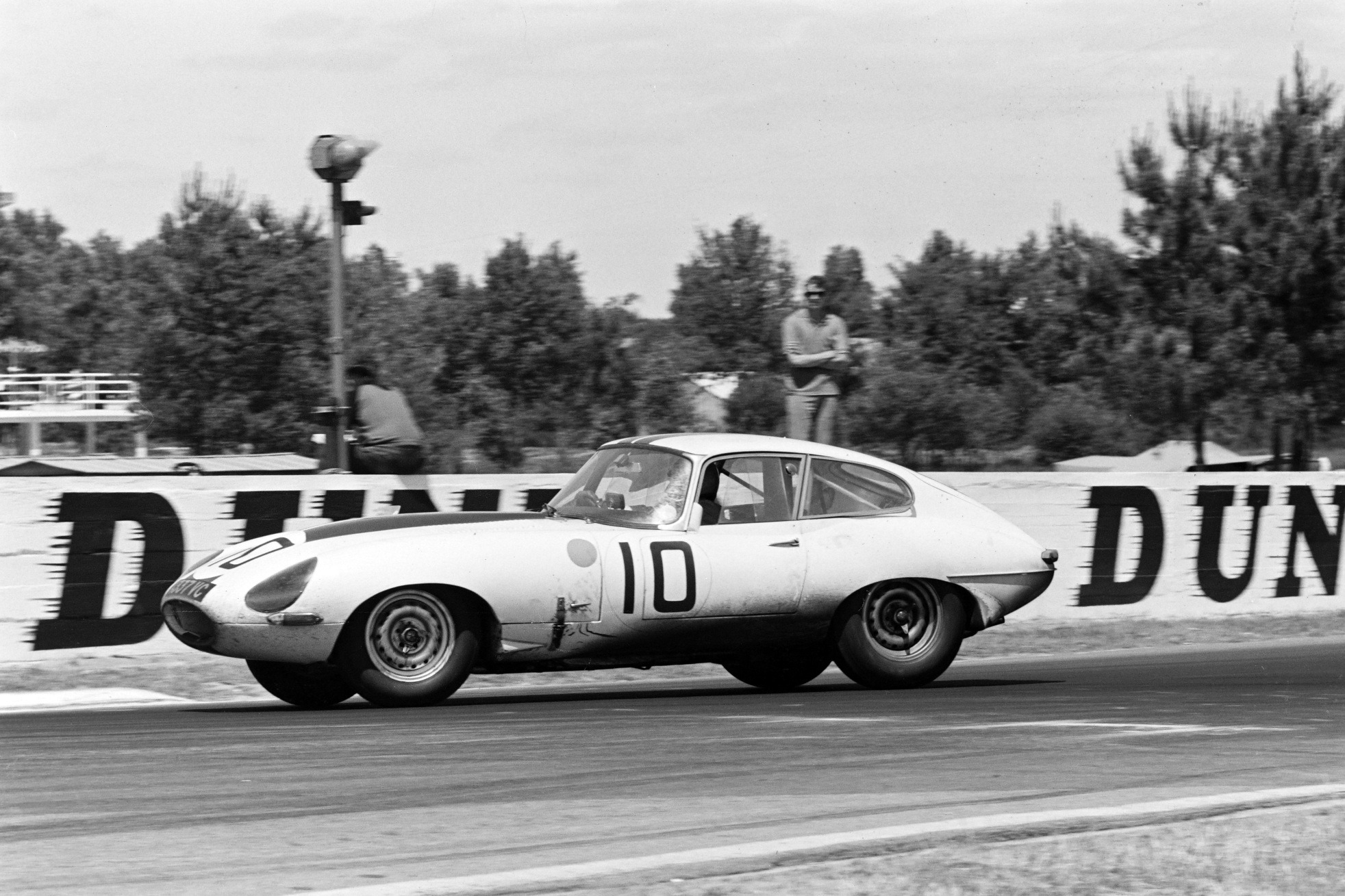
Cunningham and Salvadori finished fourth at Le Mans in 1962, trailing a trio of Ferraris
Photo by: Motorsport Images
There was a good reason for that. While GT and endurance racing were key for Ferrari, Jaguar did not want to commit a factory programme to developing the E-type. The road-going car was desirable and incredibly cheap for its level of performance. And Jaguar also had the impressive MkII and MkX saloons to produce – a full-on competition programme simply wasn’t a priority.
“As a road car the E-type was a masterpiece,” says historic racer and Jaguar expert Gary Pearson. “It was like a concept car that went into production. Jaguar were on the top of their game, but the factory had stopped racing as a works entity.”
PLUS: Why the Jaguar E-type remains special at 60
There were still developments during 1962, such as aluminium panels to save weight and increased power, and some highlights. Briggs Cunningham/Salvadori and Peter Sargent/Peter Lumsden finished fourth and fifth overall with their E-types at Le Mans, though they were overshadowed by GTOs finishing second and third.
“Jaguars, deeply involved in the serious business of producing sufficient motor cars to meet the demand, must have been pleased at the performance of the two E-types,” suggested Autosport. “One must come to the conclusion that factory-entered cars might even have stood a chance, but the addition of Weber carburettors and practically D-type engine specification is evidently not enough to give the GTO Ferraris a run for their money.”
"Only a couple of GTOs were faster. Handling and brakes were good, the only serious disadvantage compared with the GTO being the lack of a five-speed gearbox" Bruce McLaren
It was a similar story at the Goodwood Tourist Trophy, Salvadori coming home fourth (one lap adrift) behind three Ferraris. Hill remained a threat in national events, but Parkes – armed first with a 250 GT Berlinetta and then a GTO – still tended to set the GT pace in the UK and won the 1962 Autosport Championship.
Ferrari’s domination, and perhaps Coombs’s and Equipe Endeavour’s purchases of GTOs, sparked a response from the Jaguar factory, which also got its hands on one of the pacesetting Italian cars. The famous Lightweights, of which 12 were originally made (Jaguar produced another run of six in the middle of the last decade), were the result and arrived in 1963.
The use of aluminium instead of steel saved weight, there were suspension improvements, and power was eventually pushed to around 340bhp, the introduction of a wide-angle cylinder head that allowed larger valves being the single biggest improvement.
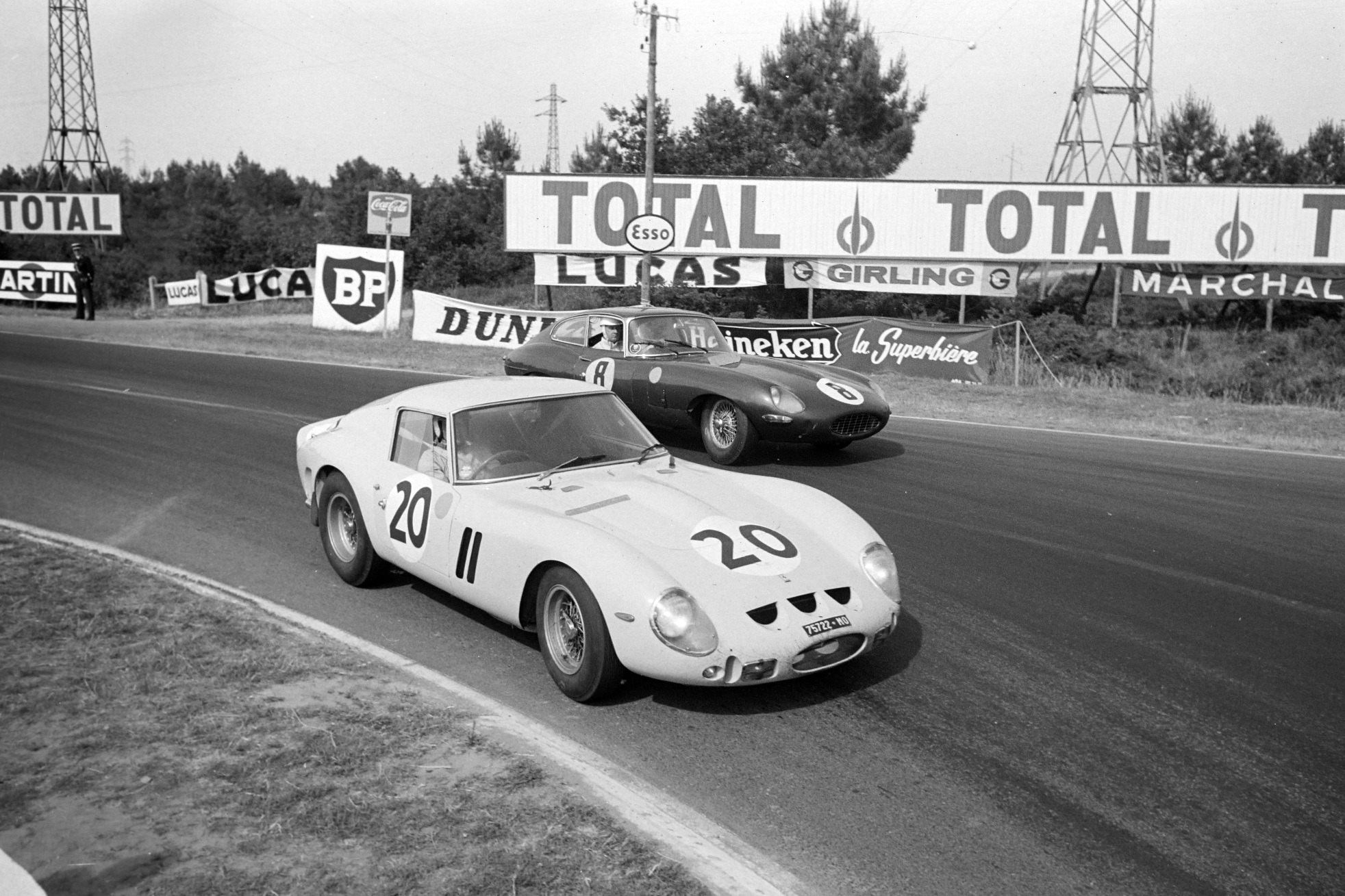
As Ferrari pushed development to the limit in its quest for on-track success, Jaguar focused on production car-building
Photo by: Motorsport Images
Bruce McLaren, who completed an E-type 7-8 in the 1963 Sebring 12 Hours (behind three GTOs), was impressed enough: “Only a couple of GTOs were faster. Handling and brakes were good, the only serious disadvantage compared with the GTO being the lack of a five-speed gearbox.”
Hill won the Sussex Trophy at Goodwood, the Grovewood Trophy at Mallory Park and the BRDC International Trophy-supporting GT race at Silverstone after Parkes spun his GTO. Peter Lindner sensationally led the opening lap of the 1963 Nurburgring 1000km overall in his Lightweight, while Dick Protheroe’s low-drag car, which had work done to improve the brakes, also beat all the GTOs at Reims in June.
Jaguar had moved much closer, but Ferrari remained ahead. And V8-engined AC Cobras started showing their strength as the campaign wore on, comfortably beating the Cunningham-run Lightweight of track expert Walt Hansgen in September’s Bridgehampton Double 500 GT encounter, despite questionable aerodynamics. E-type reliability wasn’t always brilliant either – the heavy ZF gearbox hanging off the back of the engine led to blocks cracking or head gaskets failing, and there were transmission issues at Le Mans in 1963.
The Lightweight cars were developed, Hill’s feedback proving particularly useful and assisting upgrades such as the move to wider wheels. By 1964 the different special low-drag coupes of Peters Nocker and Lindner (to be killed in the car at Montlhery), and Peters Lumsden and Sargent, were the ultimate expressions of the theme. The fuel-injected Lumsden/Sargent car, ‘49 FXN’, had bodywork developed by Sami Klat. Along with suspension improvements, the effort helped the car top 170mph at Le Mans, while Lindner won a race at Avus.
But even these privately developed/funded Lightweights got nowhere near preventing Ferrari retaining its international GT crown. The GTO, which gained new bodywork for 1964 and now produced around 330bhp, continued to rack up GT wins and impressive results in the major endurance events. There were simply too few Jaguars, and the company’s priorities meant that the GT programme was never pursued with as much vigour as it was at Ferrari, even if running GTOs was often in the hands of privateers.
It was left to the rise of the well-run Shelby Cobras, now with more suitable Daytona Coupe bodies, to provide Ferrari’s real challenge, finally knocking it from its GT perch at Le Mans in 1964 and the championship in 1965.
“At that time it was an arms race between Ford [with the Cobra] and Ferrari,” concludes Pearson. “Jaguar did some great stuff with the Lindner/Nocker E-type but that was all privately funded by Peter Lindner, so it wasn’t the Jaguar factory putting its might behind the Lightweight to try and compete against Ferrari and Ford. As a factory effort I just don’t think the funds were there to do it. The E-type was dragged along; its development was pushed by customers.”
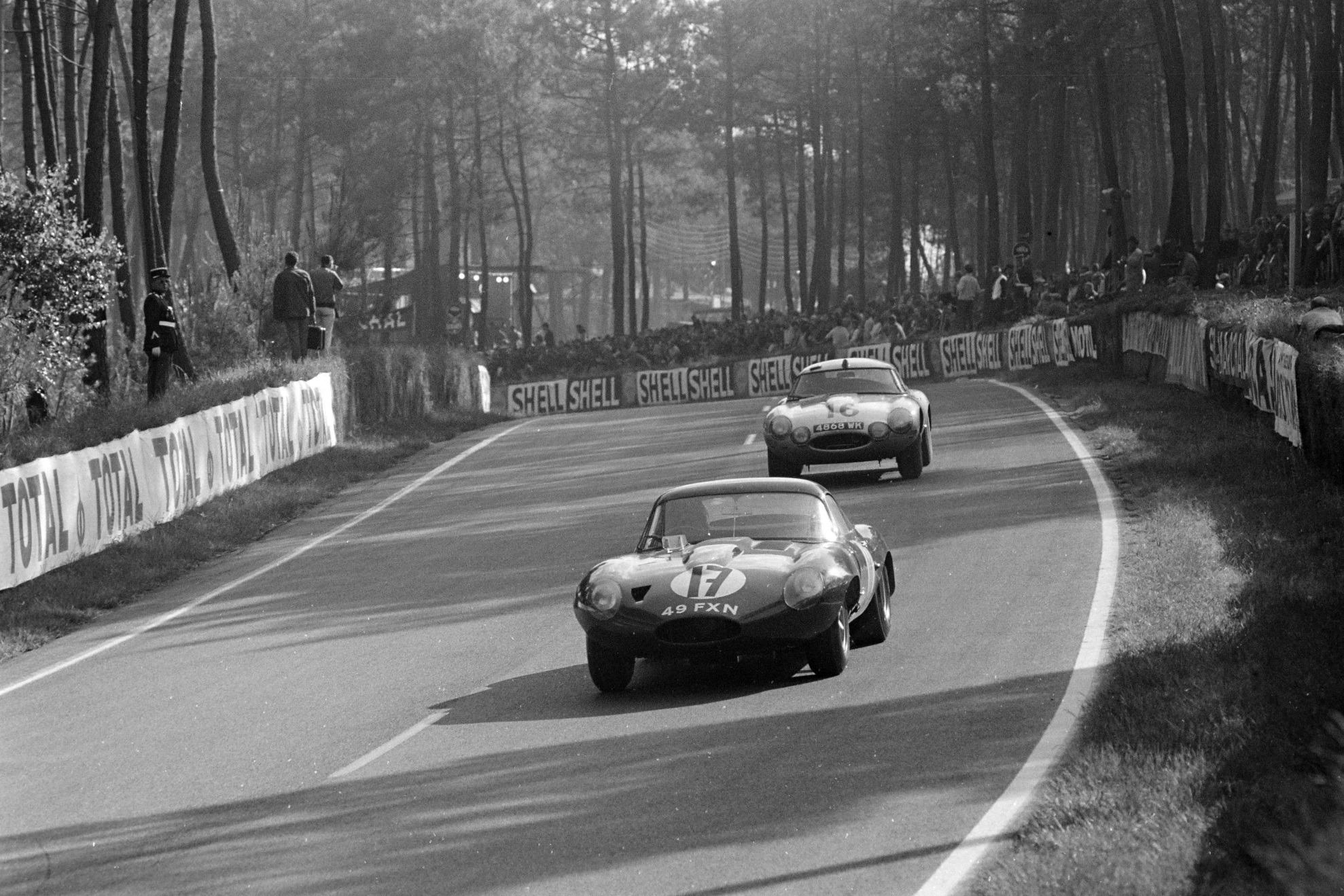
The Lightweights of Sargeant and Salmon run in formation at Le Mans in 1964, but neither would finish
Photo by: Motorsport Images
Aside from club racing, including some mighty Modsports machines, that was pretty much it for the E-type in contemporary racing. But there was one last hurrah in the United States.
The V12-engined Series 3 was not the most attractive model but it took the E-type into the 1970s, and two teams – Huffaker Engineering and Group 44 – developed cars for Sports Car Club of America competition. Both were successful, but it was Bob Tullius’s Group 44 version that is most famous. A race winner in 1974, Tullius took the Class B Production Car title with his 460bhp E-type the following season before beginning an all-new programme with the XJS…
The E-type was not Jaguar’s most successful car in racing, but it didn’t need to be. Its impact was much wider than that, and it remains one of the great automotive designs. Whether on the road or race track, most would agree it still looks pretty good at the age of 60.
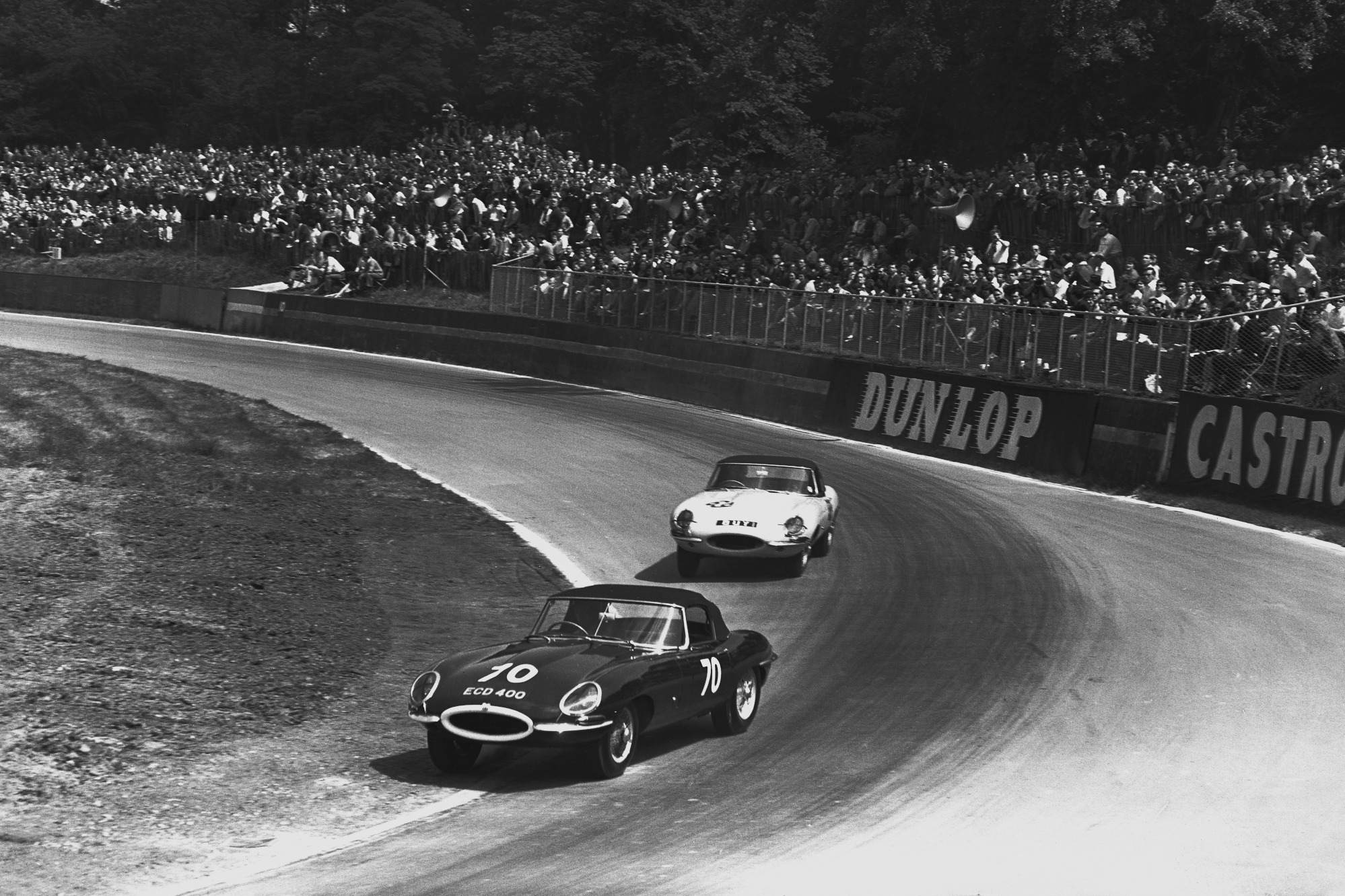
The national success of the E-Type was rarely replicated abroad, but that did little to harm its appeal
Photo by: Motorsport Images
The heart of the greatest Jaguars
Jaguar produced some of the finest vehicles in the decades following the Second World War, but even more important was the engine that powered most of them. The work of William Heynes, Walter Hassan and Claude Baily, the straight-six XK engine first appeared in the XK120, which caused a sensation at the London Motor Show in 1948.
While the XK120 established Jaguar as a major player in sportscar production, the 160bhp dual overhead camshaft engine was also used in the enormous MkVII saloon.
Competition success with some lighter, mildly modified XK120s encouraged Jaguar to design a proper competition version, to become known as the C-type. Wins in the Le Mans 24 Hours followed in 1951 and 1953, the latter success by Tony Rolt and Duncan Hamilton being the first victory in the French classic by a car with disc brakes. Both were scored with the 3.4-litre XK engine, which by then was producing around 200bhp.
The dramatic lines of the D-type arrived in 1954. Narrowly defeated on its Le Mans debut, it would win the 24 Hours for the following three years. By 1957 the Jaguar factory had withdrawn from competition, but produced a 3.8-litre version of the XK engine for leading customers. The Ecurie Ecosse D-type that won the 1957 Le Mans was a 3.8 – and led home three 3.4s in a crushing display.
It wasn’t just Jaguars that used the unit in competition. Most notably HWM and Lister did too, Archie Scott Brown dominating the UK scene in 1957 in his Lister-Jaguar.
At the same time, Jaguar set the pace in the early days of saloon car racing. The standard 3.4 powerplant and a short block 2.4-litre version were used in the saloon that became known as the MkI, which was replaced by the MkII in 1959. With those, Jaguar dominated saloon car competition until the arrival of American V8s in 1963.
A three-litre version, to comply with post-1957 world sportscar regulations and which was used by the experimental E2A at Le Mans in 1960, was less successful, before the E-type arrived in 1961 with the 3.8-litre variant. Power outputs of the day were often disputed, but the E-type’s engine provided significant improvement over the original XK120 powerplant largely thanks to development on valve ports, valve sizes and induction passages.
The E-type got a 4.2-litre upgrade for 1964. It ended its life with the next great Jaguar engine, the V12, but the XK would go on for many more years. It was used in the XJ6, launched in 1968, and the last Daimler DS420 Limousine rolled off the production line in 1992 after nearly 700,000 XK engines had been produced.
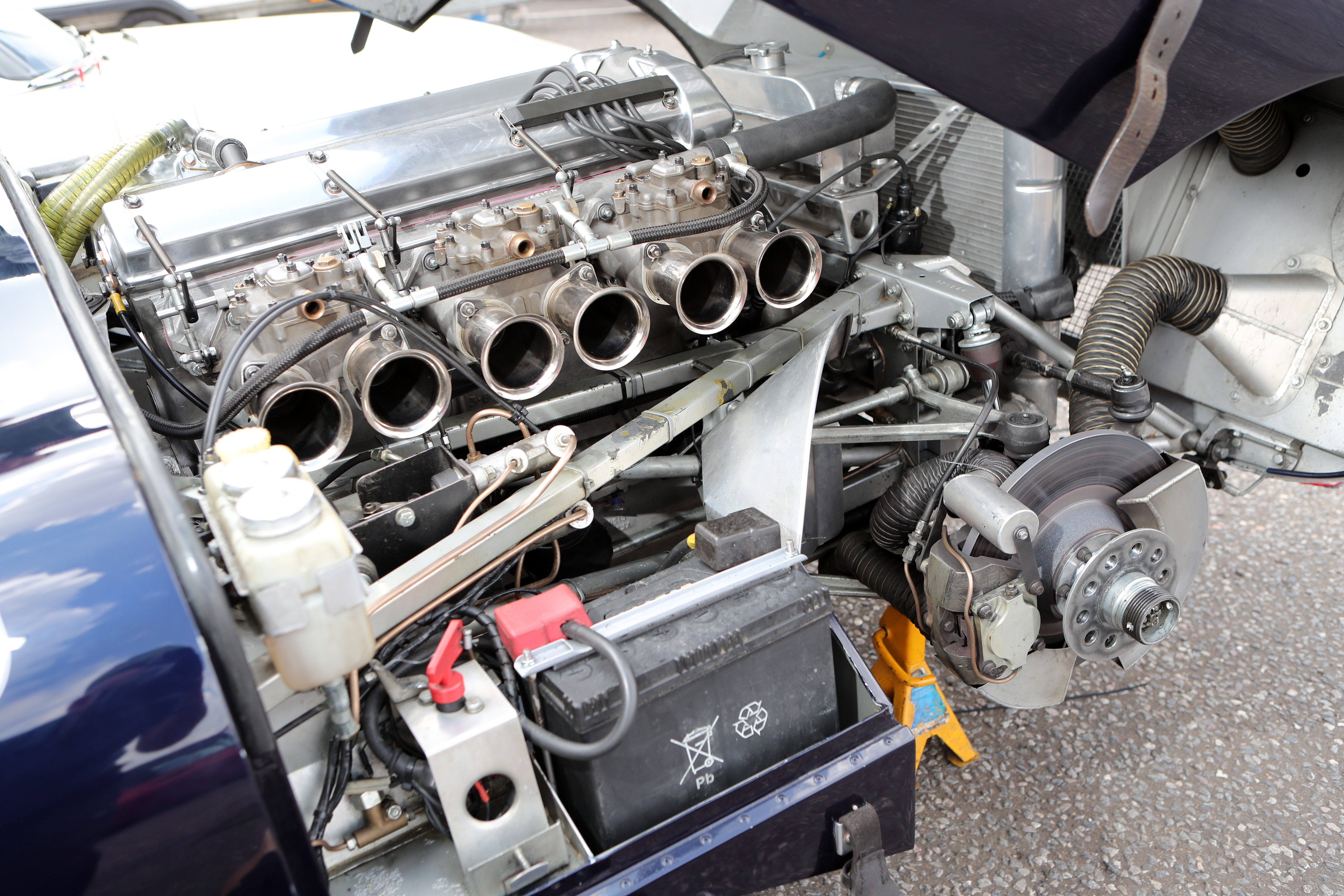
XK engine had a remarkable lifespan powering the greatest Jaguars
Photo by: Gary Hawkins


How the M8B became the most dominant car in McLaren’s history

Employing team orders can simply be a matter of common sense

The greatest F1 campaigns with no wins

Top 10 F1 results changed by backmarkers – the passes

Top 10 F1 results changed by backmarkers – the clashes

Stars, cars and highlights from the 2026 Goodwood Revival

The Egal has landed – again

Autosport magazine: Antonelli and a Can-Am celebration

FIA expects F1 races in Qatar and Abu Dhabi to run as planned

Top five roles on Motorsport Jobs this week

Champions crowned at incident-filled Donington Park 750 Motor Club meeting

Why Toyota’s 2026 WEC triumphs have put it into the all-time greatest endurance racing team debate
Subscribe and access Autosport.com with your ad-blocker.
From Formula 1 to MotoGP we report straight from the paddock because we love our sport, just like you. In order to keep delivering our expert journalism, our website uses advertising. Still, we want to give you the opportunity to enjoy an ad-free and tracker-free website and to continue using your adblocker.


Top Comments