


Five times F1 drivers starred at the Nurburgring
Max Verstappen’s Nurburgring 24 Hours entry has grabbed attention given how rare it is for an active F1 driver to take part in a race at the Nordschleife. Here’s a look back at other grand prix drivers who have shone at the ‘Ring

Autosport Retro
Telling the forgotten stories and unearthing the hidden gems from years gone by.
Max Verstappen’s GT3 outings at the fearsome Nurburgring have rightly captured the imagination. Ahead of his biggest endurance challenge yet against the cream of GT drivers at the 24 Hours, we thought we’d take a look at other Formula 1 drivers who have starred on what is widely regarded as the world’s greatest circuit.
It’s striking how few current F1 drivers have taken on the challenge in recent decades, underlining both how focused on their discipline most drivers are and the enthusiasm Verstappen has for experiencing competition outside F1.
It’s probably fair to say that his current disillusionment with F1 and Red Bull’s relative lack of competitiveness has made the Dutchman’s GT outings more appealing. Like Fernando Alonso with his Indianapolis 500 and Le Mans 24 Hours efforts, a team allowing its star driver to race elsewhere when things are less than rosy on the home front is probably a good way of keeping people happy.
Also worth noting is that some of the early entries here aren’t one-offs. In the 1950s and 1960s, F1 drivers often drove in other disciplines, sometime combining major sportscar events with GPs. Ferrari, for example, often signed drivers to do both. We’ve included the best here, but they are not the same sort of ‘one-off’ that Verstappen is attempting.
Similarly, the Nordschleife was part of the F1 calendar until Niki Lauda’s life-threatening crash meant the 1976 German GP was the final championship race there. Until then, F1 drivers were more familiar with the circuit than Verstappen was when he started his GT adventure.
We’ve limited these entries to drivers who were already established grand prix winners at the time of their selected Nurburgring outings. So, that means Jim Clark’s famous 1962 1000Km drive in a Lotus 23 in not eligible and nor is Lauda’s 1973 24 Hours success with BMW. And sorry Ayrton Senna fans, but his 1984 1000Km outing came on the ‘new’ 2.8-mile layout.
Stirling Moss, 1959 1000Km

One of Moss's all-time great drives came at the Nurburgring
Photo by: Bernard Cahier / Getty Images
Result: 1st
Moss’s famous 1959 1000Km victory is one of the all-time great Nurburgring drives.
Moss, winner of the event in 1956 and 1958, had to persuade Aston Martin to enter a car thanks to the team’s focus on Le Mans. The DBR1 had won the 1000Km for the previous two years but faced factory Ferrari and Porsche opposition, while Moss chose the solid-but-not-outstanding Jack Fairman as his co-driver.
Ferrari’s Jean Behra set the pace in practice, but Moss stormed to the front from the start and opened up a lead of around half a lap, smashing his own sportscar lap record, before pitting.
Fairman, not helped by a sprinkling of rain, started losing the advantage. And then he was caught out in traffic and went off. Fairman dug the car out to bring it back to Moss, now a minute and a half behind in fourth.
Moss took huge chunks out of the Ferraris and was virtually with leader Behra, having overcome Olivier Gendebien, when the 250 Testa Rossas came in. Moss continued charging and was nearly three minutes ahead when he handed back to Fairman once more.
Fairman immediately lost much of the lead and was soon called in, allowing Phil Hill (in for Gendebien) ahead. Moss charged again and overcame the future world champion with fewer than six of the 44 laps to go.
The Aston crossed the line 41 seconds ahead of Hill/Gendebien, with the Behra/Tony Brooks Ferrari third. Moss had lowered his 1958 record of 9m43s to 9m32s.
“The race must go down in history as an unrivalled demonstration of supremely skilled high-speed driving,” reported Autosport magazine.
The victory would turn out to be a crucial one for Aston Martin, which scored a 1-2 at Le Mans two weeks later. It meant it could win the world sportscar championship at the Goodwood finale, which it did thanks to another Moss recovery drive.
Moss was far from done with the world’s greatest circuit. too. He’d take a fourth 1000Km victory with Dan Gurney in a Maserati in 1960, then humble the otherwise dominant Ferraris at the rain-hit 1961 German GP.

John Surtees, 1965 1000Km

Surtees and Scarfiotti saw off the Fords with ease
Photo by: GP Library / Universal Images Group via Getty Images
Result: 1st
Like Moss, Surtees was already a Nurburgring master when his non-F1 highlight there took place. His first world championship F1 victory had come there in 1963, and it was the scene of the first of his two successes on his way to the 1964 F1 title.

He’d also won the 1000Km sportscar race in 1963, but the field was arguably stronger two years later. In particular, there were four Ford GT40s as the Blue Oval pressed on with the project that would eventually end Ferrari’s domination of Le Mans.
All four Fords has bigger engines than Surtees’s four-litre 330 P2, with the entry for Bruce McLaren and Phil Hill having a 5.3-litre V8. BRM F1 team-mates Graham Hill and Jackie Stewart also proved rapid in the 3.3-litre 275 P run by Maranello Concessionaires.
Nevertheless, Surtees took pole with 8m53.1s to the 8m58.8s of Hill/Stewart. McLaren was the fastest Ford, fourth on 9m00.2s.
Surtees led Hills Graham and Phil from the off. The big Ford overtook the 1962 world champion but could do nothing about Surtees, who completed lap one an incredible 18s clear. He then set a new sportscar lap record of 8m50.5s on lap two to extend his advantage to 23s.
The chasing Ford put on a charge and looked the sole likely challenger to Surtees, only to retire with transmission failure just over an hour into the race. Graham Hill’s battle for second with the works 275 P of Mike Parkes ended when the Maranello Concessionaires car suffered electrical failure.
All that left Surtees, who shared with Ludovico Scarfiotti, unchallenged. Parkes briefly overtook Scarfiotti after the leading car made a pitstop, then came in himself to hand over to Jean Guichet, restoring the number one car’s 90s lead.
Despite Surtees easing up and handing over to Scarfiotti at the end so the Italian could take the flag, the winning margin was still 45s, with the surviving Ford a lapped eighth. It was the first time that the 1000Km had been won in under seven hours, a barrier Surtees/Scarfiotti broke by nearly seven minutes.
Jackie Stewart, 1969 F2 Eifelrennen

The F2 Eifelrennen was flooded with grand prix talent in 1969 - no more so than Stewart who dominated
Photo by: McKlein
Result: 1st
Stewart was already on his way to his first F1 world title when he arrived for the 1969 Eifelrennen. The event stretched back to the 1920s and had been run for many categories, but in the 1960s and 1970s it was for F2. And for 1969, it moved from the 4.8-mile Sudschleife to the 14.2-mile Nordschleife.
The third round of the European F2 championship attracted a strong field and an estimated crowd of nearly 250,000. It wasn’t unusual at the time for current F1 drivers to compete in F2 and the three-wide front row was filled with GP winners.
Ferrari entered three cars, as did BMW, which put in a major effort led by 1968 British GP winner Jo Siffert. Stewart’s Ken Tyrrell-run car was one of three Matra MS7s, which were two years old, while Winkelmann Racing had Lotus 59Bs for F1 team-mates Jochen Rindt and reigning world champion Graham Hill.
Siffert’s Lola-BMW took pole in a rain-hit qualifying session, from Stewart and Hill, with Rindt heading up row two.

Hill grabbed an initial lead but Stewart soon hit the front, with Rindt chasing. Hill fell behind Siffert and Jean-Pierre Beltoise (Matra) on the fourth lap of 10, just as Rindt retired with wishbone damage, the bottoming-out around the circuit’s undulations proving too much.
Hill retired with the same issue, leaving Siffert, Beltoise and Hubert Hahne (Lola-BMW) chasing runaway leader Stewart. But there was no catching the Matra and Stewart took the flag 1m16.2s clear of Siffert.
With the 1968 German GP having been wet (and won by Stewart, proving he was already a Nurburgring maestro), the F1 lap record was Dan Gurney’s 8m15.1s from 1967. Stewart’s fastest lap in his 1600cc Matra was 8m05.3s, an outright lap record Autosport described as “an astonishing feat”.
In Stewart’s absence, Rindt dominated the following year’s Eifelrennen, though his fastest lap of 8m16.2s was still well down on the high-winged 1969 pace.
Jochen Mass, 1977 F2 Eifelrennen
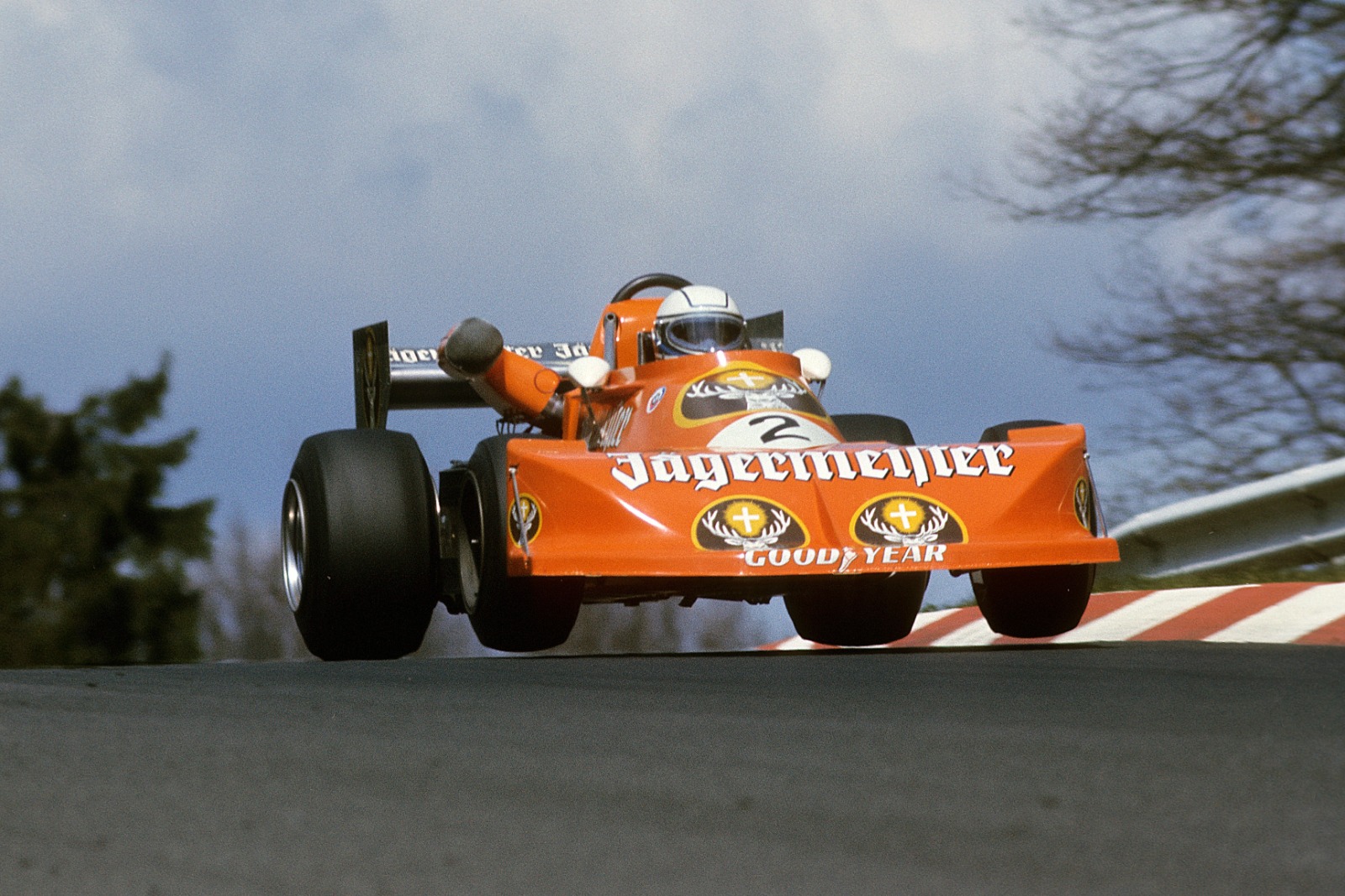
Mass held off a charging Cheever to clinch another Nurburgring victory
Photo by: McKlein
Result: 1st
Mass had already won the Eifelrennen in 1972, when was an up-and-comer. His only GP victory had come at the shortened 1975 Spanish GP and 1977 was his third season with McLaren in F1.
Mass, who’d also started four German GPs before the Nurburgring fell off the F1 calendar, therefore had a lot more circuit experience than many of his rivals – Autosport already described the German as a “Ringmeister”. He’d also won on another F2 outing at Hockenheim the month before.
Driving the works March 772P, Mass missed out on pole to the Chevron of Riccardo Patrese, who impressed despite crashing during practice.
“Whether it’s F2 or F1, there is still the same unique challenge that makes any race at the Nurburgring a very special event,” said Autosport.
Future F1 drivers Bruno Giacomelli and Didier Pironi, having their first taste of the Nurburgring, filled row two, ahead of another returning GP driver, Clay Regazzoni.
Mass got too much wheelspin at the start and fell to fourth as Patrese led the field away. But once Mass had got by a typically obstructive Regazzoni to take second, he closed on Patrese, who promptly went off on the second lap of nine.
Mass’s biggest challenge came from an unexpected source. Eddie Cheever had suffered a crash and overheating in practice, limiting him to 13th, but he was one of the stars of the race.
Cheever got his Project Four Ralt up to second, within 1.5s of Mass, before a combination of wanting to make sure of maximum F2 points – Mass wasn’t eligible – and fastest lap from the leader settled things. Mass took the flag 13.2s ahead.
“He was driving bloody hard for 19 years old,” said a modest Mass of Cheever. “I’m beginning to think it’s time I ought to retire!”
Keke Rosberg, 1983 1000Km

Rosberg led the charge for Canon Racing in an eventful race to claw back to third place
Photo by: LAT Images via Getty Images
Result: 3rd
Stefan Bellof’s remarkable 6m11.13s pole lap is probably the most famous thing about the 1983 1000Km – that or the fact that the German crashed heavily during the race. But he was a sportscar regular and wasn’t yet an F1 driver, whereas the reigning world champion did the race because it was likely to be the last ‘big’ race on the Nordschleife – Autosport called it: “Swansong at the ’Ring.”
Rosberg knew the circuit from his time in F2 – he’d scored a couple of podiums in the Eifelrennen on his way up – and joined Richard Lloyd’s Canon Racing squad for round three of the 1983 world sportscar championship. Just two weeks after taking a brilliant Monaco GP victory, the Finn drove alongside Jan Lammers and Jonathan Palmer in a Porsche 956.

The works Rothmans Porsche team had been testing and had tweaks on their 956s – and they proved unapproachable on pure pace. Behind Bellof, Mass qualified the car he shared with Jacky Ickx on 6m16.85s. Though new to a turbocharged racing car, Rosberg was fourth on 6m39.52, with the similar Joest Porsche (with the same high-compression engine used by the factory entries) of Bob Wollek ahead on 6m31.59s.
The track was damp in parts for the race, Wollek starting on wets while the works Porsches and Rosberg (perhaps unsurprisingly given the nature of his Monaco success) on slicks. After early exchanges on the first lap, Rosberg moved into third behind the works cars when John Fitzpatrick pitted for slicks.
While Rosberg suffered with severe handling problems and Wollek was hampered by a gearbox problem, the factory Porsches streaked away. A relatively slow handover to Lammers allowed the Joest car ahead and the Dutchman later fell to fifth.
When Bellof took his 956 back from Derek Bell with a narrow lead he pumped in a new lap record – and then flew off in an enormous accident. That handed fourth to Palmer, which the car held when the race was stopped due to another big crash around the three-hour mark.
Following the restart, the Joest Porsche hit engine trouble, allowing Rosberg to sweep into second on the road and he led when the remaining works car stopped. Mass was delayed by a suspension problem and, with Palmer now back behind the wheel, the Canon Porsche won the second part of the race on the road. That became third on aggregate, behind Mass/Ickx and Wollek/Stefan Johansson.

Can Verstappen add his name to this list at the Nurburgring 24 Hours this weekend?
Photo by: Red Bull Content Pool


How the M8B became the most dominant car in McLaren’s history

Employing team orders can simply be a matter of common sense

The greatest F1 campaigns with no wins

Top 10 F1 results changed by backmarkers – the passes

Top 10 F1 results changed by backmarkers – the clashes

Stars, cars and highlights from the 2026 Goodwood Revival

The Egal has landed – again

Autosport magazine: Antonelli and a Can-Am celebration

How Antonelli levelled up his character to be F1 2026's world champion-elect

FIA set to close F1 cost cap loophole with new rules

Norris promises to make "better decisions" following fresh talks over Singapore GP clash

FIA expects F1 races in Qatar and Abu Dhabi to run as planned
Subscribe and access Autosport.com with your ad-blocker.
From Formula 1 to MotoGP we report straight from the paddock because we love our sport, just like you. In order to keep delivering our expert journalism, our website uses advertising. Still, we want to give you the opportunity to enjoy an ad-free and tracker-free website and to continue using your adblocker.


Top Comments