


Will 2022's all-new cars look like F1's concept model?
Formula 1 provided its clearest example yet of what the 2022 cars are set to look like when it presented a full-scale concept to the world during the build-up to last weekend’s British Grand Prix. Underneath the special shiny livery was a design that hinted at the future, but teams will be digging into key areas that may reap differing results

There was the inescapable feeling of a primary school “show-and-tell" session when it came to Formula 1’s approach to the British Grand Prix. First, it (re-)unveiled its 2022 concept mock-up, decked out in a holographic livery more suited to an early-2000s Clinton Morrison football sticker. Then came the sprint qualifying – definitely not a race, according to the FIA – race, one of F1’s experiments with a new weekend format. One can only imagine The Simpsons' Edna Krabappel’s sardonic retort of “thank you F1, I look forward to seeing it again in a few races time”.
As the sprint racing-style-motorsport-event came to a close, and the drivers hastily shoved into the back of a van akin to a scene from Withnail & I, the social media discourse erupted into determining whether the race was any good, and if the half-hour spectacle augmented the race weekend rather than hindered it.
OPINION: The successes and warning signs from F1’s first sprint race
With the sprint-not-a-race taking top billing then, the 2022 concept idea had been largely left forgotten within a matter of days. F1 didn’t want to give it too much room to breathe, evidently. Admittedly, it’s been through this all before after unveiling the concept during 2019’s US Grand Prix weekend – thus, it’s arguably managed to double-dip on the media attention. Now, we’re about to fall into the same trap by writing about it once more.
But there’s a different feeling about this time. Back in 2019, this was a vision of the future, and the windtunnel model that accompanied the original Austin press conference (pictured below) represented an exciting new path. The long-overdue return of ground effects, the simplified bodywork and throwback nose design whet the appetite, and the accompanying figures produced by the FIA and FOM promised the moon in terms of on-track action.

The 2021 Formula 1 technical regulations are unveiled in a press conference, Jean Todt, President, FIA, Ross Brawn, Managing Director of Motorsports, FOM, Chase Carey, Chairman, Formula 1 and Nikolas Tombazis
Photo by: Mark Sutton / Motorsport Images
This time around, the teams have now all been hard at work developing their own designs for next season. It’s not unimaginable that, during this process, the drivers will have dipped in and out of design meetings to keep track of what developments are on the table for next year. Thus, dangling a microphone in front of them for their thoughts on an almost two-year-old design concept was not the greatest concealer of their relative apathy.
Bottom line is, the cars won’t entirely look like that next year. Despite the fears that the regulations are too prescriptive for next season, there’s plenty of space for the teams to explore and hone their 2022 challengers into very different machines to each other.
When F1 first unveiled the upcoming rules (initially planned for this season, until a pandemic brought the global economy to its knees), different car shapes were included within the presentation, offering a glimpse at some of the variation that the teams could employ.
The more stringent regulations do provide designers less room to manoeuvre but, as has always been the case in F1, the design departments are stocked with some of the brightest minds in the engineering world and will find ways to sidestep some of the regulations’ intent
But still, F1 had to pick its most attractive designs to sell the ruleset to the fans. F1 teams rarely stop to consider the aesthetic qualities of a design; pragmatism reigns after all, and the engineers will thus take the opinion that whatever works best in the windtunnel is the most attractive solution for them.
When it comes to the nose design, for example, the teams will have to consider the benefits of a wider nose – which can offer a larger pocket of low pressure underneath to introduce more front-end downforce and yield more control over the car’s centre of pressure – or a more slender design to reduce the blockage to the underbody tunnels. This will affect how the rest of the car’s aero surfaces are defined, and so the teams will have to use the bounding boxes available to determine the best fit for its aero direction.
F1 has also showcased the variance in nose position too; the physical model itself showed a nose design that protruded forward beyond the wing elements, but the nose of the renders provided stopped at the third wing element, leaving a free leading element to try and expand the efficiency of the front wing design.

The 2022 Formula 1 car launch event on the Silverstone grid. Front detail
Photo by: Charles Coates / Motorsport Images
One area where the wing is restricted is that the bounding boxes define an anhedral shape, where the elements sweep downwards towards the endplates. This is down to the way that those elements now bend around to form the endplate, which should eliminate the outwashing effect that the footplate generates in current F1.
It’s much harder to specifically define the bounding boxes as they are no longer illustrated in the rules, but rather part of F1’s CAD-first approach in generating those areas. The teams are handed a file and their car’s dimensions must now fit into that depending on parameters such as wheelbase and other properties.
The more stringent regulations do provide designers less room to manoeuvre but, as has always been the case in F1, the design departments are stocked with some of the brightest minds in the engineering world. Thus, they’ll naturally find ways to sidestep some of the regulations’ intent.
In the previous decade, changes to the F1 nose regulations produced a range of solutions to overcome the losses in opening up the underside of the nose section. Although the intent was to reduce the height of the nose to avoid potentially impacting the driver in a collision, the teams did not wish to shift the chassis bulkhead or turn the nose downwards – which both would create more blockage to the airflow moving underneath the car.
In 2012, the reduction in nose height was met with the stepped nose solution, where the teams opted to keep the chassis bulkhead as high as possible to reduce the aero impact, and create a sudden transition to the nosecone to meet the regulatory requirements. Unfortunately, many found the solutions across the grid to be particularly unsightly, and the FIA permitted a “vanity panel” to be attached to the top of the nosecone to ease the strain on the spectators’ retinas.
The FIA took the nose-height rules a step further for 2014, mandating that the crash structure at the front must be far lower to the ground. Although Mercedes sidestepped that with a crash structure design that produced a more attractive nose, it opened the floodgates to a collection of long, proboscis-style structures that met the regulatory intent while keeping the underside of the nose open to clean airflow.
As mentioned before, aesthetics is rarely a consideration when it comes to cold, hard data and, although the additional appendages looked particularly phallic, they were particularly potent at developing the right aero effect.
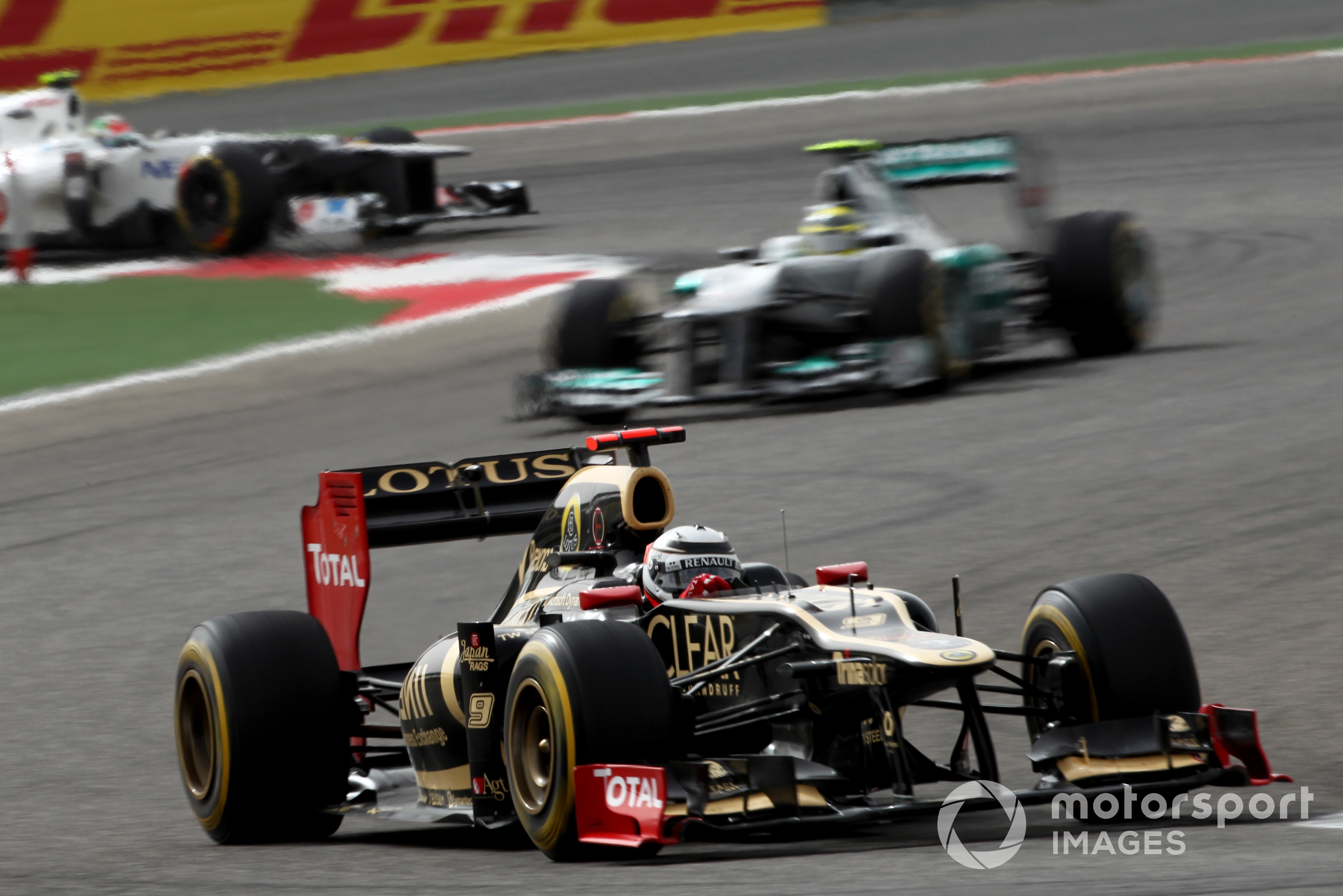
Kimi Raikkonen, Lotus E20 Renault, leads Nico Rosberg, Mercedes F1 W03, 2012 Bahrain GP
Photo by: Andy Horne / LAT Photography
While the 2022 rules thankfully seem to restrict the level of ugliness that past F1 regulations allowed, there will be no focus on making the cars look good and the attention will instead hinge on ensuring that the car is effective. It’s not a team’s prerogative to completely toe F1's line on abetting close wheel-to-wheel racing, as they will want their cars to be difficult to overtake, but sensibly the technical group behind the regulations’ creation has attempted to pick holes in its own concept and address any concerns afterwards.
Once the season begins, the designs will then be exposed for all the other teams to look at – and F1 will embark upon the usual degree of convergence as the best ideas are implemented
What we’ll likely see is a collection of cars with different concepts behind them, with a range of bodywork solutions to fit the cooling demands of the powertrain, and to enclose the floor to ensure the Venturi tunnels are as effective as can be. Once the season begins, the designs will then be exposed for all the other teams to look at – and F1 will embark upon the usual degree of convergence as the best ideas are implemented on other cars.
Either way, it’s going to be great to see what all the teams come up with - and if switching to 2022 early will yield greater rewards than keeping up development over 2021. We might be having a great F1 season now, but the new rules can potentially yield even better ones - just as long as they deliver what they promise.

Drivers' group photo with the 2022 F1 car
Photo by: Liberty Media


How Norris shrugged off his first-lap error to deliver on McLaren's Hungarian GP pace

How much time has Aston Martin gained with its F1 Hungarian GP update?

What we learned from Friday practice at the 2026 F1 Hungarian GP

Aston Martin's heavily updated AMR26 breaks cover in Hungary pitlane

Russell: Data shows software calibration behind recent F1 struggles, not driving style

Hamilton takes "full responsibility" for disappointing Belgian GP

The expectation on Aston Martin's shoulders as it prepares to debut its Hungarian GP updates

LIVE: F1 Hungarian GP updates - Norris wins from Verstappen, Piastri retires with gearbox failure

How Ferrari's Hungarian GP meltdown cost a shot at the F1 podium

Where to next after the Bahraysian Grand Prix?

What McLaren thought of Piastri's explosive F1 Hungarian GP radio outburst

How Norris shrugged off his first-lap error to deliver on McLaren's Hungarian GP pace
Subscribe and access Autosport.com with your ad-blocker.
From Formula 1 to MotoGP we report straight from the paddock because we love our sport, just like you. In order to keep delivering our expert journalism, our website uses advertising. Still, we want to give you the opportunity to enjoy an ad-free and tracker-free website and to continue using your adblocker.


Top Comments