


Why Piastri was unassailable even without Norris' bumpy path at the Bahrain GP
Oscar Piastri’s charge to a first ‘home’ win for McLaren at the Bahrain Grand Prix never looked in doubt, while a team 1-2 was possible but for Lando Norris picking up a penalty and George Russell keeping clear in a short-circuiting Mercedes. Here’s how the Sakhir race unfolded

Out of context, the chatter in the prelude to the Bahrain Grand Prix was little different to what it was a week ago. When Max Verstappen snared pole for the Japanese Grand Prix, the expectation was that the polesitter had already done 95% of the job - he just needed to see the chequered flag to sign for his victory.
Seven days later, Oscar Piastri's plunder to pole was held to the same metric. But this was very different; where Verstappen's win carried inevitability because of the Suzuka circuit's nature and the overwhelmingly low levels of degradation seen at the circuit, Piastri's was anticipated simply because of McLaren's strengths in high-degradation races. Plus, the fact that Lando Norris had made a bit of a pig's ear of qualifying rather took the main opposition out of the reckoning.
There was no chance that anyone was going to beat Piastri. He parked himself on pole position, albeit with his job made slightly easier when Charles Leclerc, not George Russell, lined up next to him. Russell did clear Leclerc, as revenge for losing a solitary grid slot when Mercedes jumped the pitlane gun under the Q2 red flag, and attempted to stand alongside Piastri into the first corner - but he'd locked up, while Piastri coolly held the inside line. A fast-starting Norris also broke past a medium-shod Leclerc around the outside of Turn 4; forlorn after qualifying, Norris seemed to be in a far more rambunctious frame of mind by Sunday and made his way up to third by the opening corners.
If anything, he was too rambunctious. Feeling that he was too far back in his grid box for the start, Norris let the clutch slip and rolled too far forward; that minor incorrection provoked a five-second penalty, to be served at his opening stop. As long as he could clear Russell and starting getting closer to Piastri, it might not have been such a burden. Instead, the first indication that Norris had only brought blunt knives to Bahrain began to materialise.
Having been unable to find a way through, Norris pitted on the 10th lap in an attempt to leverage some kind of undercut on Russell - although with the five-second penalty being applied to his stop, this was going to be optimistic. Two laps in the mid-1m37s on fresh mediums helped eat some of the deficit produced by the penalty, but this wasn't enough for Norris; Russell came out of the pits on lap 14 with about three seconds in hand. His swifter clearance of the yet-to-stop Alex Albon helped him extend that to about 3.4s until Norris finally broke past the Williams.
The lack of an incisive pass from Norris on Russell was of great benefit to Piastri. Out front, he could keep trucking on with the soft compound to set a string of laps in the mid-1m38s, extending his stint to lap 14 before calling in to switch to the mediums. Once equipped with the C2s, he simply pressed on. There's genuinely very little that one can say to gild the lily here; during the crushing Verstappen wins of 2023, it was a genuine struggle to paint each one in a different light. Only when McLaren found a little more competitiveness did they start to find a bit more of a dimension, as there was often a bit of ebb-and-flow to the race before Verstappen lit the touchpaper on his final stint.

The race start and safety car restart were the only times Piastri's win looked under threat
Photo by: Kym Illman - Getty Images
It's like, in that Verstappen era, the Dutchman was trying to at least create some semblance of a race narrative before putting the hammer down. Such gratuitousness would never be of interest to Piastri; there was never really any jeopardy through the stint, even if Mercedes tried to engineer something through the stops. Norris' penalty meant that he didn't have to be covered off right away, so Russell could instead respond to him when needed, and try to dovetail that with a Piastri undercut.
Piastri returned to the circuit two seconds ahead of Russell, as the Briton had nibbled about a second and a half out of the pre-pitstop arrears. But realistically, Russell wasn't going to carve into that gap; when the two Ferraris pitted later on to gather a tyre delta, Piastri hit the front and started to rebuild his advantage. He was in absolute control.
At this juncture, another salient question was answered: had Norris not had the five-second penalty, could he have challenged Piastri for the win?
In reality, the only real challenge to Piastri's victory was instigated by a lap 32 safety car, waved onto the circuit as the marshals needed to clean up the debris produced by a skirmish between Carlos Sainz and Yuki Tsunoda
We know that Norris started the first round of pitstops about 0.8s shy of Russell, and ended it around three seconds behind. Through the exceedingly complex mathematical challenge of deleting Norris' five-second penalty, he'd theoretically have about two seconds or so over Russell - assuming Russell pits on the same lap in either instance. Mercedes would cover Norris off here, although a one-second difference can be easily accrued with a well-timed undercut. For this thought experiment, let's say that Norris gets a slender advantage with an undercut and moves ahead.
What this likely does is puts Piastri on a marginally earlier stop, McLaren electing to cover off both drivers to preserve the status quo. In this instance, Norris no longer ends up falling behind Leclerc again - Ferrari delayed its first stops and built a significant tyre advantage on the mediums, which gave Leclerc licence to catch Norris hand-over-fist to reclaim third. Thus, his average pace over this stint - 1m38.008s over 20 laps - is probably going to end up closer to Piastri's average 1m37.676s (over 16 laps).
If we assume Piastri is around two seconds clear of Norris, one could charitably suggest that the Briton might find the wherewithal to provide a challenge - but in reality, given the difficulty that he faced in passing other cars over the grand prix, one would strongly suspect that Piastri would either hang on, or just simply turn up the wick.

The mid-race safety car provided a strategy dilemma, only for McLaren to remain in the right path
Photo by: Andrej Isakovic - AFP - Getty Images
In reality, the only real challenge to Piastri's victory was instigated by a lap 32 safety car, waved onto the circuit as the marshals needed to clean up the debris produced by a skirmish between Carlos Sainz and Yuki Tsunoda. The race director thankfully timed it in a way that caused minimal disruption to the order, and offered Piastri and the other frontrunners a chance to conduct their second stops relatively cheaply.
But this final stop rather illustrated the point of what Suzuka was missing, as the top five runners all opted for very different tyre choices for the final stint. The Ferraris had done two medium stints, and so had to switch to the hard tyre. McLaren began with the softs, and had given itself two sets of mediums to play with for the latter two stints. Russell had a hard tyre left, but Mercedes likely knew that taking the hard was going to make Russell easier prey for Norris - and thus, it gambled on a set of used softs from qualifying.
Russell suggested that this was an "audacious" idea. Taking a set of softs through 24 laps of one of F1's most abrasive surfaces sounded like a bit of a challenge, but the immediate grip on the restart gave him a glimmer of a chance to mount a pass on Piastri - surely it was worth a try?
Piastri gunned the throttle out of Turn 14, but Russell stayed with him and got a run - evading the McLaren's sparky wake - towards Turn 1. In truth, Russell was probably too far off, and wisely decided not to put the moves on Piastri. But he could have done it if he'd wanted to; if he'd released the brake a little bit and stayed to the inside, there was half a chance. "Lando and I were the only ones with another medium, and that was the tyre to be on," Piastri mused, "so from that side of things, it was relatively straightforward. Obviously, you try and get a good restart - you never quite know how it's going to go - but no, I was never going to let that one go."
Ultimately, it'd have been for naught; Russell then started to suffered with a weird and varied range of electronic issues that sparked memories this writer's old Renault Clio - you'd press one button, and it would do something else entirely.
"It was exceptionally difficult towards the end," Russell explained. "I had all sorts of problems with the car. The steering wheel, I was losing all my data and the brake pedal went into a failure mode, so I had to do all these resets. One minute the brakes were working properly, the next they weren’t."
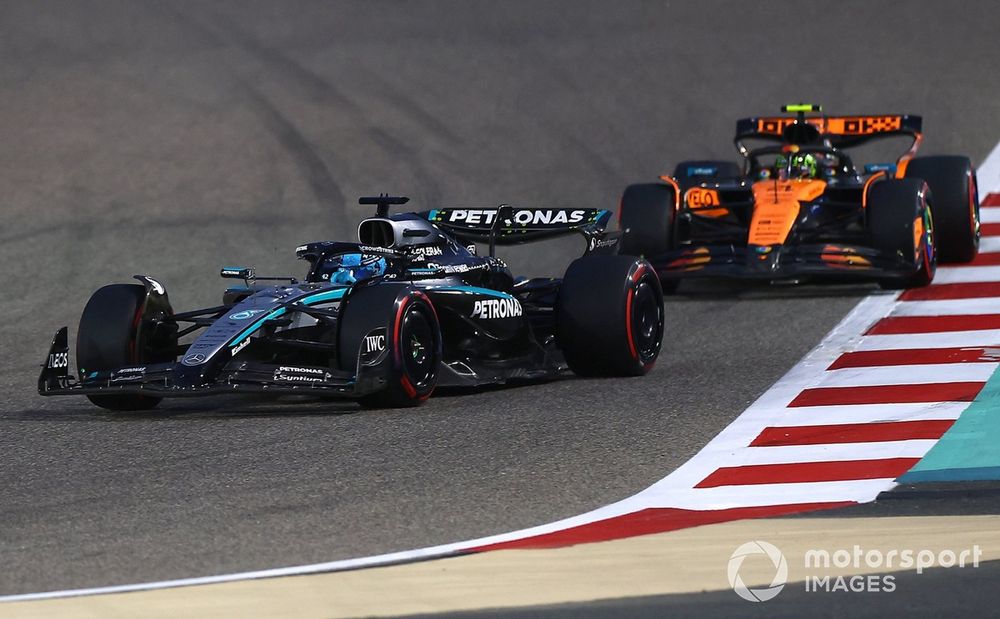
Russell was able to keep clear of Norris while his Mercedes electronically malfunctioned
Photo by: Sam Bloxham / Motorsport Images
At one point, Russell attempted to press the auxiliary radio button on his steering wheel, which ended up opening DRS. He quickly turned it off and backed off by a smidgen to appease the FIA, who decided not to stick the boot in amid the cavalcade of control complications.
Before this, Russell had been homing around Piastri by just under two seconds, likely helped by the performance of the softs versus Piastri's mediums. But as the two-pronged attack of degradation and electrical issues plagued Russell, the gap grew again at a seemingly exponential rate. By the chequered flag, he was 15.5s behind Piastri.
Norris had come back at Russell after getting gazumped by the Ferraris on the restart; an overtake on Hamilton had to be reversed as McLaren believed he was out of bounds at Turn 4; Norris simply did the move again a couple of laps later. But Leclerc held the Bristolian back from putting Russell under any further scrutiny, as the Ferrari driver frustrated Norris until eventually cracking five laps from the end.
Norris felt that this was a difficult weekend but still came out of it with third having extended his championship lead, which is indicative of something else: the threat Piastri is going to offer all year
That Norris felt that this was a difficult weekend, and still comes out of it with third having actually extended his championship lead (by two points), is more indicative of something else: the threat Piastri is going to offer all year.
Piastri's skills have been dissected at length over the past two seasons, with the narrative being that if he could just find that extra tenth in qualifying and a little more in his tyre management approach, he'll be a champion.
On the evidence of the first four rounds of 2025, he's there.

Piastri is just three points behind Norris in the drivers' standings after Bahrain GP victory
Photo by: Mario Renzi - Formula 1 - Getty Images


What caused Mercedes' pace deficit at Sepang despite upgraded W17?

Three kings: F1's generational stars shone at Sepang

Bahrain Grand Prix in Malaysia Driver Ratings 2026

The slick tyre gamble that hurt McLaren and Ferrari's chances in Bahrain GP in Malaysia

The wide world of strategy options expected in F1's Bahrain GP in Malaysia

McLaren explains recurring Norris straightline speed issue after Bahrain GP qualifying

How drivers waiting in the wings can still make their presence count in F1

What we learned from Friday practice at the 2026 Bahrain GP in Malaysia

MotoGP riders divided on contentious 2027 weekend format change

FIA completes investigation into F1 chaos in Malaysia and announces measures

Peugeot promotes test driver Quinn to race seat for 2027 WEC

No denying it now – the one reason why F1’s ‘horrible’ start in Malaysia could be a good thing
Subscribe and access Autosport.com with your ad-blocker.
From Formula 1 to MotoGP we report straight from the paddock because we love our sport, just like you. In order to keep delivering our expert journalism, our website uses advertising. Still, we want to give you the opportunity to enjoy an ad-free and tracker-free website and to continue using your adblocker.


Top Comments