


Hill's 1996 F1 title - in Autosport covers
Damon Hill was in Suzuka for the 30-year anniversary of his F1 title in 1996. To mark the occasion, we took him on a trip down memory lane - with help from a few period-appropriate Autosport covers

Autosport Retro
Telling the forgotten stories and unearthing the hidden gems from years gone by.
"I love the way Martin Brundle is always the subheading", Damon Hill chuckles, after we've shown him a few Autosport covers from his Formula 1 championship-winning 1996 season.
The bottom strapline in question read: "Brundle predicts the 1996 winner", below the motion-blur cover shot of Hill's Williams FW18 - overlaid on a very-'90s gradient scheme. Cover art like that today might get you sarcastic "graphic design is my passion" comments, but it was a different time; designers were only just working out how to use computer-aided tools, after years of playing with paper trimmers and Letraset.
Hill was in Suzuka to celebrate the 30-year anniversary of his F1 title win and, on being offered an interview slot, we figured that he'd be sick of being asked the same questions. So, we hatched a plan: to mix it up, our idea was to run through Hill's career through the medium of magazine covers.
Our pitch to Hill was met with one raised silver eyebrow; he'd seen a hair in the soup almost immediately. "I think I know which one you're going to show me," he contends, with a sense of affability that suggests that he's generally on board with the idea. We ask to make sure he's comfortable. He confirms that it's fine but, as it happens, we don't get to that point - there simply isn't time before he's whisked off for media duties ahead of FP3.
Of course, this is in reference to the edition of Autosport released on 25 July 1996, emblazoned with the cover headline, "Has Hill been dumped?" - ex-Autosport man (now of BBC Sport) Andrew Benson had broken the news that Heinz-Harald Frentzen was due to take Hill's seat for 1997, regardless of the title outcome. It's well known that Hill took significant umbrage to Benson's scoop, even though the news turned out to be true, but later made amends for it by asking to work with Benson on a driver column.
Although we didn't 'reunite' Hill with that particular cover, we rifled through a few other examples, hoping that the of-the-time graphics would transport him back to the '90s, the days of colourful knitwear, Britpop, and the Sony Playstation. This included the key moments: the prelude to his Williams debut, and the key moments in his title-winning season among them.
Between his amusement over the various repeated cover references to former Sky colleague Brundle, and recommendations that Autosport should experiment with pink typefaces, Hill took us through the stories behind the headlines from the time.
Next stop: memory lane.
1993: Britain's next world champion?
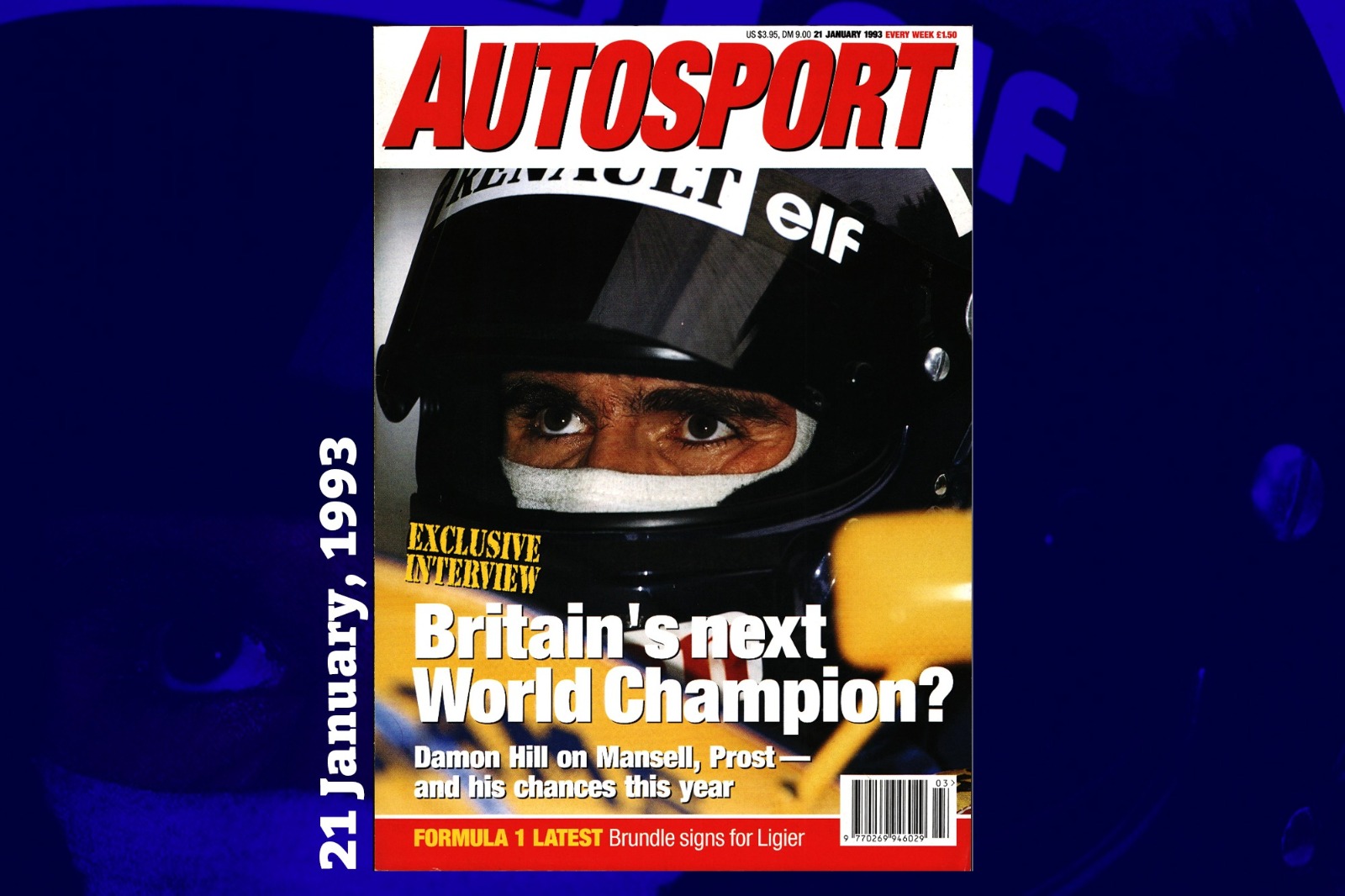
"I like that they've put a question mark," Hill says of this cover's headline. One must assume the art director of the time was no clairvoyant.
Those who are unaware of Hill's route to F1 would likely assume, being Graham Hill's son, that he was destined to follow in his father's footsteps - or, as the Gen Z readers might contend, "a nepo baby". But this couldn't be much further from the truth; Hill's family was left destitute after his father's death in 1975 from his Elstree plane crash, and ended up working as a labourer and a dispatch rider to help fund his path to F1.
A late bloomer, Hill was 30 when he joined Williams' test team in 1991, and 31 when he made his F1 debut with the moribund Brabham team.
"They didn't come and knock on the door - I had to press [Brabham] to have a go," Hill recalls. "I knew that I couldn't just be a test driver. People asked me, 'what the hell are you doing driving that?' with a team that's on its last legs and had to go through pre-qualifying and all the rest of it.
"But the fact is, I think that was important because that showed Williams that I could be in F1. And I knew that that could potentially be important. Or at least if it wasn't Williams, it could be someone else. Brabham didn't have any money: they were broke. I mean, it had been changing hands - it was really just a slot on the grid and the name was just dying as it went."
Neither Hill nor Williams had perhaps anticipated his promotion to a race seat in 1993, but Riccardo Patrese's departure to Benetton left Frank Williams and Patrick Head with a hole to fill. Ayrton Senna flirted with the seat but stayed at McLaren, as had Mika Hakkinen and Brundle. But Hill, with two years' worth of experience in testing for the team, got the nod to drive the gizmo-laden FW15C alongside Alain Prost.
"It was an an amazing machine," he says. "I think that just having done miles and miles with the car gave me confidence that I at least I knew what I was doing in it.
"As far as how you deal with it, being on the F1 paddock and driving for a top team with a three-time world champion next year, who's probably one of the biggest names in the sport...in some ways I thought, 'well, he'll take most of the flack, not me'.
"I was kind of shielded a little bit, being the understudy. But if you're in F1, you're in the spotlight whether you like it or not. You can't just do a 'good' job - everyone's expecting more."
1996: "I will win in Melbourne"
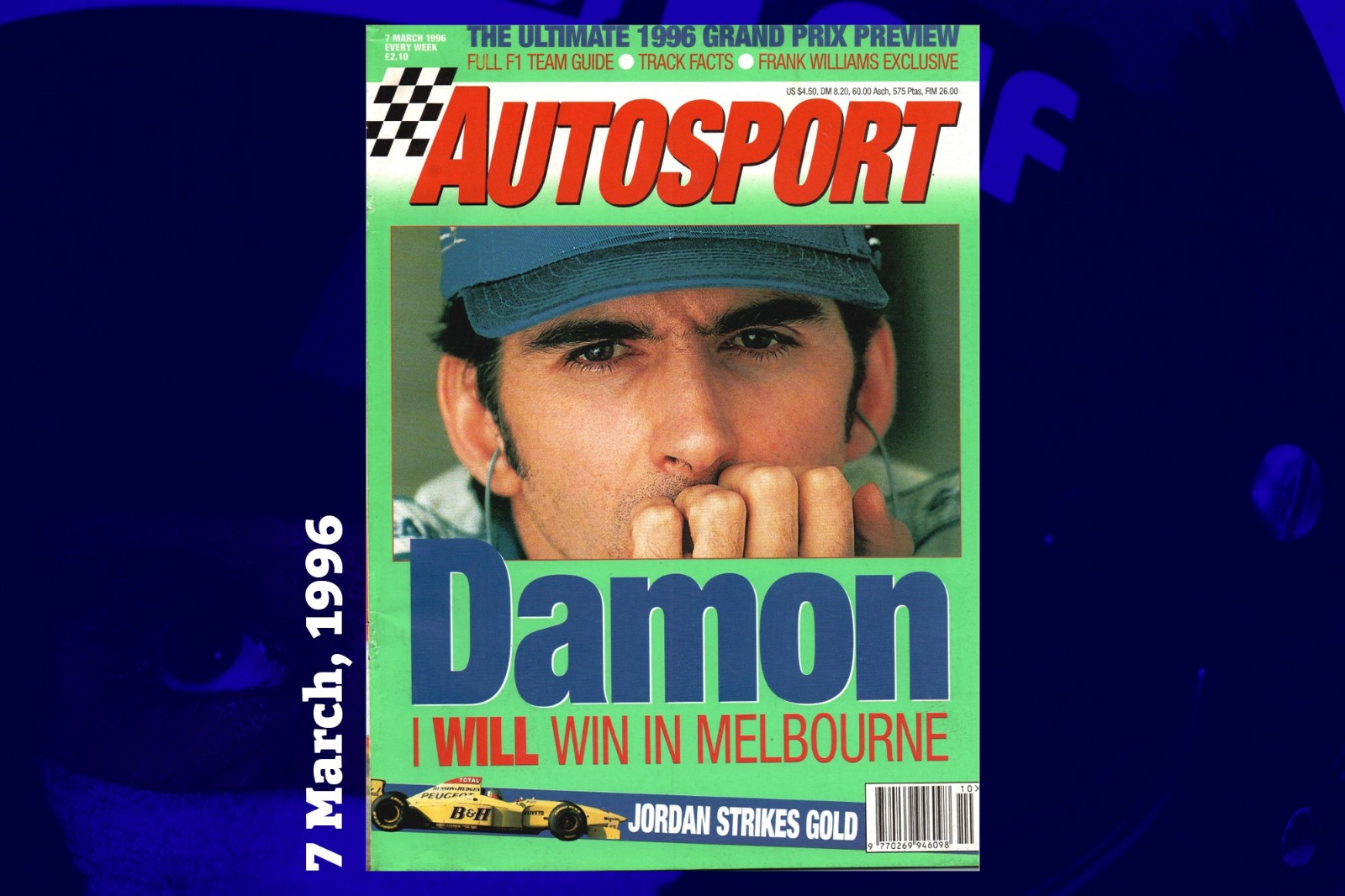
Again, it was the '90s - mint green was apparently a popular hue...
Hill had come tantalisingly close to title glory in 1994, in which he carried Williams' fortunes following Senna's death, but his clash with Michael Schumacher at Adelaide (or rather, Schumacher's clash with Hill) left a bitter aftertaste to an already distasteful year. And, while Hill started 1995 well, his championship challenge had run aground when Benetton and Schumacher continued to build in strength. With the German out of the picture for 1996 following his move to Ferrari, Hill had a clear run at the title...
...or so he thought. Imagine his surprise, then, when new recruit Jacques Villeneuve, the reigning Indy Car World Series champion, rocked up in Melbourne and plonked the FW18 on pole ahead of his more experienced team-mate.
Williams was only fallible in three circumstances across 1996: driver error, team error, and wet weather. Inclement conditions took Williams out of the running for wins at Monaco and Barcelona, the combined driver-team errors cost Hill and Villeneuve in Belgium, and both drivers had tangles with the tyre walls placed at each kerb at Monza (which, in retrospect, was a silly place to put them).
With no other real competition, Williams had run rampant - but what made the FW18 so special? There was no silver bullet, Hill says, but the slightly more mundane reality of having a car that was simply refined and well-engineered.
"Well, the previous one wasn't that bad!" Hill explains. "This was a refinement on whatever Adrian [Newey] did: I think it was probably packaged better. The aerodynamics hadn't changed that much, and there wasn't much to them [back then]. But it was a beautifully balanced car to drive.
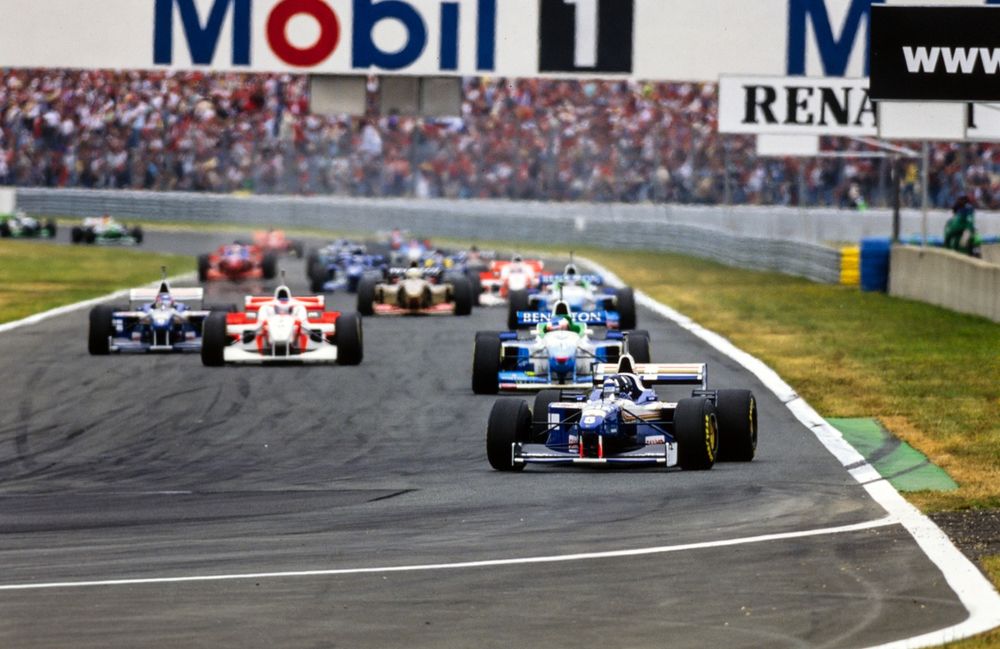
Damon Hill, Williams leads at the start
Photo by: Getty Images
"It was a refined version of the FW17, and it was a big change from the '94 car to the FW17. But this was an evolution of the 17, I think. I needed a car that I could fine-tune myself, because I drive different styles; I like a car, it depends what circuit you go to, where you can adapt it for the circuit you're going to, then you've got a car for all tracks.
"It must have generated better, more efficient downforce than the other cars out there; we were always a little bit ahead on power and a bit ahead on downforce as well."
Indeed, Hill did win in Melbourne; the consequences of Villeneuve's oil leak very much visible on Hill's car and crash helmet as the FW18's white trim was doused in a dirty-brown spray.
What were Hill's recollections of his team-mate?
"Everyone was interested to see where he was headed, coming in from the States," Hill recalls of Villeneuve - now a fellow ambassador for Williams.
"I think the general feeling is that drivers who come from the States find F1 a little bit more difficult to do, but then he was cultured in Europe, he had a European upbringing, really, and I think he got F1 in a way that American drivers, domestic F1 American drivers typically didn't. I think they were underprepared, a lot of the American drivers, apart from Mario Andretti, for coming across the pond. But Jacques seemed to get where he was."
1996: Villeneuve vs Hill: World title showdown
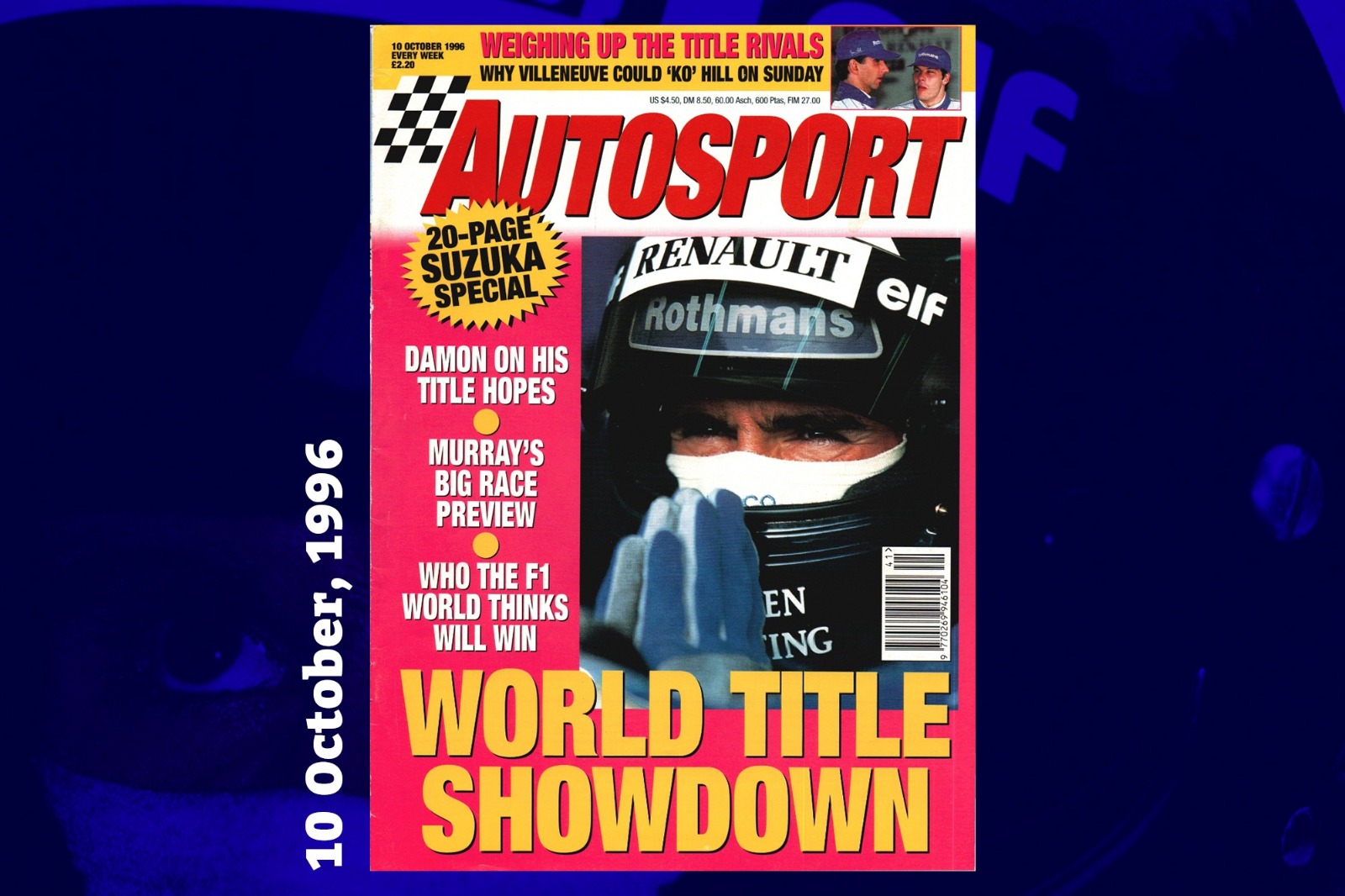
While the two Williams drivers battled for the title, it was an intra-team battle very much in the mould of Lando Norris versus Oscar Piastri, where the drivers generally behaved themselves despite external baying for conflict. The two pushed each other along, and the closest the team-mate relationship got to breaking down was when Villeneuve once helped himself to a piece of chicken on Hill's plate...
While Villeneuve clicked with the 'format' of F1 better than most drivers crossing the Atlantic, Hill explained that the Canadian had still found room to be something of a maverick with regards to set-up options.
"He had kind of slightly extreme ideas about engineering and set-up, where it was interesting watching the engineers trying to [work it out]. Jock Clear [Villeneuve's race engineer] was very important; Patrick would say "he wants what?!" and Jock would say "well, a happy driver is a good driver, so just give it to him".
"And he'd ask for the most ridiculous roll-bars. We tried to explain to him you can't make an infinitely stiff rear bar, it doesn't exist, and he'd go, 'no, but I want it', so he'd have this bloody rear bar. He was very experimental, he wanted to always try this, try that, so he was learning a lot very quickly. But he was no slouch, and very high on his success from the States, he was full of confidence.
"But I had the edge in experience with the team, and maybe a little bit more wisdom - I was now about 35, he was 25.

Photo by: Rainer Schlegelmilch / Getty Images
In a recent episode of F1's Beyond the Grid podcast, Villeneuve's recollections were that he'd been happy to learn from Hill across 1996, hence the relative serenity of their intra-team battle - and his assertion was that losing the title in 1996 was fair recompense for taking the '97 crown. Perhaps there's a touch of revisionism about Villeneuve's point of view, who knows; when the quotes were put to Hill, he enjoyed a wry smile.
"If he learned from me, he didn't exactly employ any of it - if anything, I would say he was determined not to do whatever I did!" he laughs. "He was very perverse in that way, kind of obstinate, he wanted to be different. We've had drivers who are determined to be different in Formula 1, he was definitely one of them, he wanted to do it his own way, and he's maintained that posture ever since. He is completely unique, and even if it doesn't give him an advantage, he'll do something different.
"I wasn't going to help, he was clearly out to beat me, so we understood each other quite well. The thing that always, I found interesting was, I thought having both of us had dads who were racing drivers, he would have asked a few questions, but he would never mention his dad, never mentioned that we were 'sons of' - that never came up in conversation.
"He was a very stand-alone, Jacques; he was an interesting guy. I mean, the overalls, he wanted them as baggy as possible with no belt, and the marketing department were going, 'can you please make them look a bit smarter?' while he was slouching around with his boots undone.
"I remember looking at Patrick, because I remembered Patrick telling me off after I hadn't shaved. He let rip, because he's obviously from admiralty stock, he looked at me and he went, "you look like a bloody tramp!" while we'd been testing for about 10 days in Estoril.
"So I remember thinking, I wonder what he's going to say about Jacques...but he never said a thing. So Jacques could do whatever he liked, and I had to be smart."
1996: Champion!
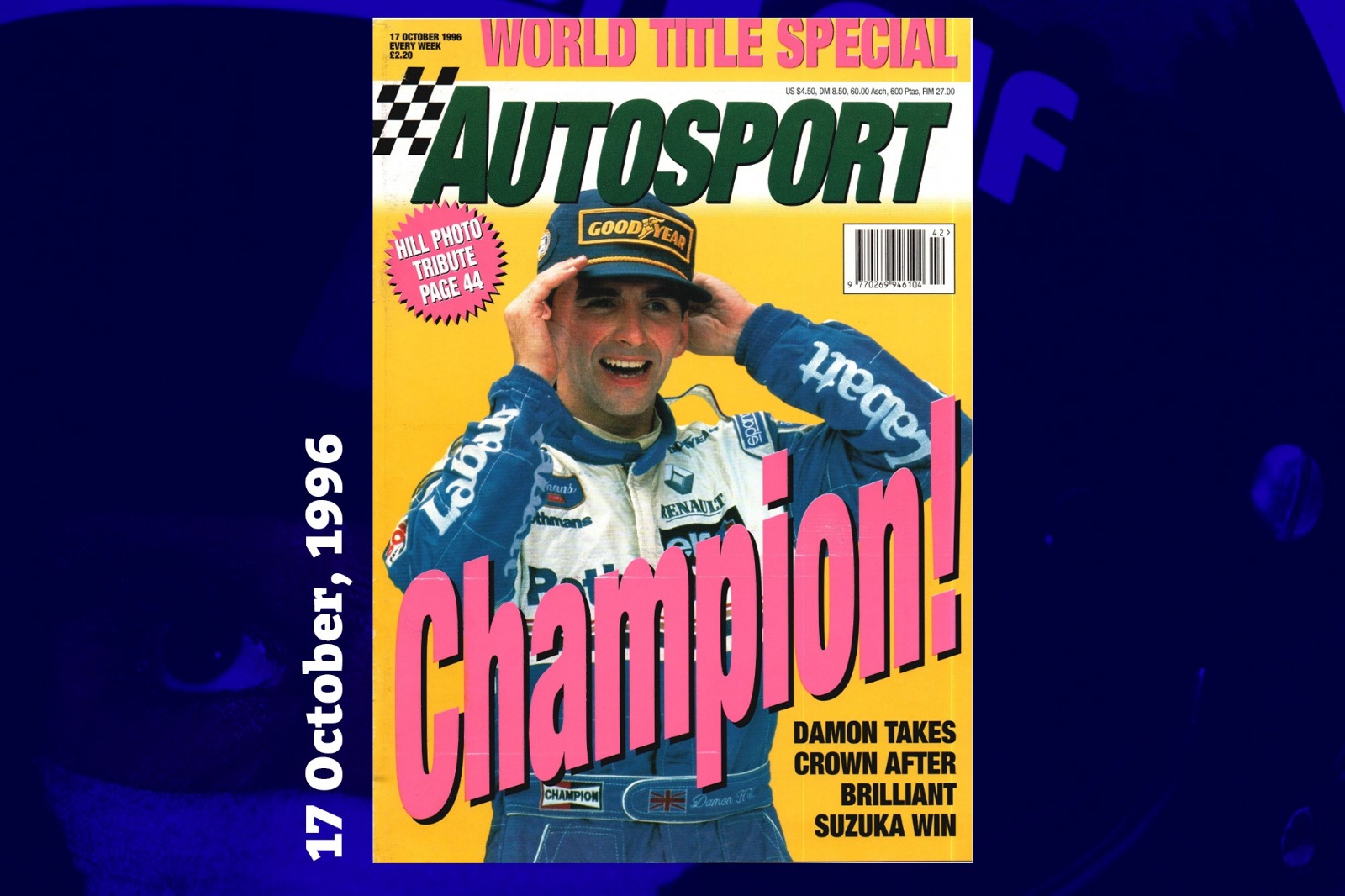
"Pink, who chose the pink?" Hill asks, having mentioned having been given a box of 'his' title-edition magazine. "Someone was saying that it sells more if it's got the writing in pink, is that right?" If true, perhaps we ought to revert to bubblegum hues...
The aftermath of the 'Benson affair' put a bit of a dampener on Hill's eventual title win; Williams decreed that it was not going to keep the #1 sticker on the car in '96, and Arrows duly waved a lucrative contract under the new champion's nose as Frentzen indeed left Sauber for Sir Frank's team.
It was a bitter pill to swallow, but the show must go on; indeed, Hill still had a title to win. After Villeneuve brilliantly won at Estoril, the title race notionally came down to the final round; Hill was nine points clear of the Canadian, and just needed to finish in the points at the Suzuka finale to seal the championship. As it was, Villeneuve crashed out after a wheel bearing failure, crowning Hill on the spot.
Of course, the UK viewers will immediately perk up at the thought of Murray Walker's soundtrack to Hill's homecoming in Pavlovian fashion, his typically excitable style of commentary eventually giving way to the 'lump' in his throat. Did Walker's commentary accurately encapsulate Hill's own feelings on crossing the line?
"No, because I was already told that I'd won the championship because Jacques went out in the middle of the race!" Hill remembers. "It was relief, I think, before you get to the elation and the allowing yourself to believe it's actually happened. You go through the... It's a long weekend, and you've had loads of stress.
"There was a three-week gap between Estoril and here, jet lag, the constant press questions and all the rest of it, and lack of sleep. And eventually, just across the night, you just want to go to bed. Let's be honest, you're just absolutely knackered."


Lights, Camara, action: How Haas picked F1's latest rookie for 2027

Horner's inside story of how Red Bull built its own F1 engine

Why Mercedes' latest 2026 F1 update is no downgrade

Singapore Grand Prix Driver Ratings 2026

What we learned from the 2026 F1 Singapore GP sprint race and qualifying

The political minefield set out by F1’s recent cost-cap grievances

What caused Mercedes' pace deficit at Sepang despite upgraded W17?

Three kings: F1's generational stars shone at Sepang

McLaren retains Fornaroli as F1 reserve and hands him WEC programme for 2027

How Andrew Jordan realised his teenage rallycross dream

Inside the competition building F1’s future engineering talent

WEC Barcelona: Toyota scores dominant 1-2 to clinch manufacturers’ title
Subscribe and access Autosport.com with your ad-blocker.
From Formula 1 to MotoGP we report straight from the paddock because we love our sport, just like you. In order to keep delivering our expert journalism, our website uses advertising. Still, we want to give you the opportunity to enjoy an ad-free and tracker-free website and to continue using your adblocker.


Top Comments