


Are F1's technical changes for Miami enough to ease 2026 concerns?
After several meetings, the FIA unveiled tweaks to F1's 2026 formula to address the biggest issues. How will this affect the Miami Grand Prix - and are those changes bold enough?

Whatever your views on Formula 1's 2026 regulations, it's time to be pragmatic: they'll likely stick around until the end of 2030, and it's up to F1's governance structure to make the best of them. In the meetings across the ad-hoc April break, F1, the FIA, the teams, and the drivers have attempted to perform an autopsy the opening three races and put any suggestions for change on the table.
Originally, F1's powers-that-be had wanted to put its focus on reviving the qualifying spectacle. Although the current cars are capable of great speeds and manage to be within a couple of seconds of last year's high-downforce ground-huggers, the spectacle of cars passively cruising into braking zones rather than gnawing at the kerbs had been viewed as an aberration. F1 was satisfied with the racing aesthetic, even if a vocal section of the fanbase was not.
Oliver Bearman's Suzuka crash forced a review of that perspective. The Haas driver's high-speed waltz into the barriers, in his attempt to evade Franco Colapinto on the run to Spoon, demonstrated the danger of being caught on the hop by the difference in closing speeds, and prompted F1 to add this to the docket.
The three objectives from the meetings were thus: retract some of the damage done to qualifying, address the difference in closing speeds and attempt to mitigate them, and introduce some safeguards in the event of wet races. After Monday's meeting between teams, the FIA has now ratified some of the changes for May's Miami encounter - albeit with a few additional features to test for potential inclusion in future rounds.

For qualifying, the recharge limit has been set at a maximum of 7MJ per lap, with provision to reduce this further depending on the circuit. Cutting the maximum recharge limit should reduce the amount of super clipping into corners; while it doesn’t account for the regular derate as drivers run out of energy on straights, the eyesore of lift-and-coast or otherwise slow progress on the approach to corners should be less conspicuous. It is unavoidable that the batteries will have to be charged through the lap, given that they can store up to 4MJ, so this is a compromise solution.
When the cars do enter the super clipping phase, it should be a less drawn-out process. The maximum energy recovery has been set at 350kW, up from the previous 250kW limit, and this will slow the cars down more as the cars charge off the internal combustion engine. In theory, the 100kW increase will shrink the super clipping distance, and an optimistic view of this would be that this blends more seamlessly with the conventional braking zone to minimise the visual impact further.
This also extends into the races, as part of F1’s drive to reduce the more conspicuous differences in closing speeds. Furthermore, the ‘boost’ button (essentially the 350kW power-on-demand function) cannot be used until the MGU-K is deploying more than 150kW to limit any sudden bursts of acceleration.
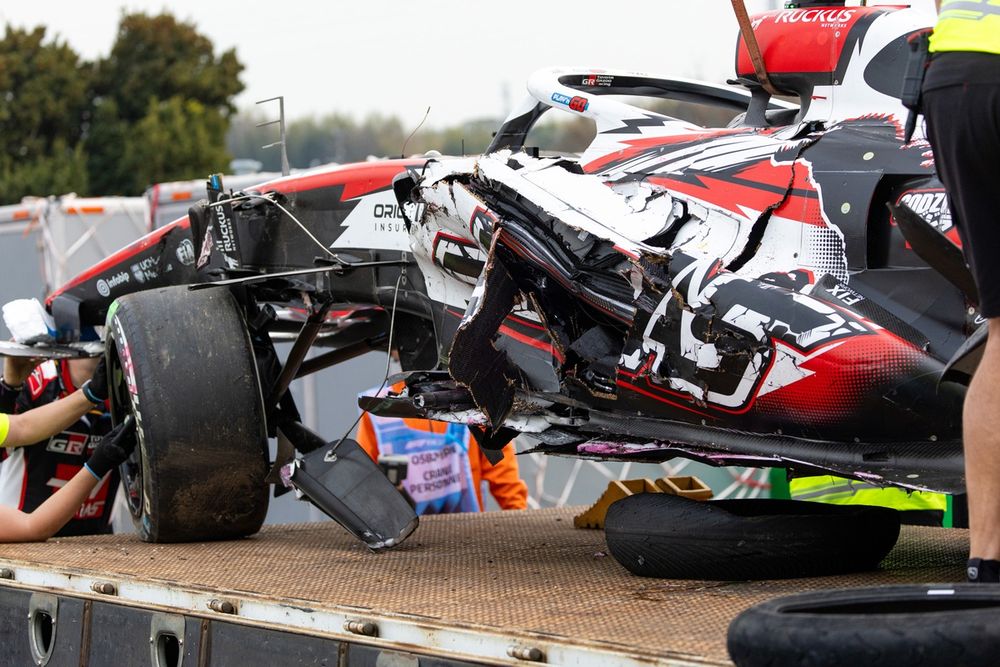
Bearman, deploying energy, was caught out by a slower Colapinto in Japan
Photo by: Kym Illman / Getty Images
Perhaps the most impactful change, however, is that the maximum deployment will now be variable. In straight-mode zones, the activation of the active aero package will ensure that cars can reach their 350kW platform; in cornering mode, the cars will now be capped at 250kW. This should ensure two things: one, that drivers are more likely to be equal in deployable energy through downforce-critical zones on-track and two, that deployment can be spread a bit more evenly through the lap.
While there are areas where teams choose not to deploy, as demonstrated by the Esses at Suzuka, the rules around this are somewhat complex. Elsewhere, there are rules governing power limited periods around the circuit, and the engineers build maps around this to pick their deployment levels. This is, to a degree, similar to the previous regulations, but magnified as the electrical systems command more airtime owing to their increased output.
F1 wanted to keep the notional 50:50 split in internal combustion engine power and electrical power, and the headline numbers are thus retained (although let’s be honest, it’s not really 50:50) with more sporadic use of the full 350kW from the MGU-K.
Then there's the changes to wet races. The blanket temperatures will be increased for intermediate tyres, with further plans to limit the energy deployment in wet races to reduce the chance of drivers losing control through the high levels of torque produced by the electrical systems. This is expected to be to around 200-250kW, and without the chance to activate the boost or overtake modes on the wheel. Furthermore, the rear lights will be revised to improve visibility for chasing drivers.
F1 will also test a new system in Miami to alleviate concerns about slow and stranded cars at the starts of races. This includes what the FIA has termed as a “low power start detection” system, which kicks in when it determines a driver has got away slowly after the release of the clutch.
With this, the MGU-K will be deployed as a safety measure to ensure the driver can at least get up to a minimum level of acceleration, ensuring that drivers behind do not have to make any sudden manoeuvres in response. The level of energy deployment will be low to ensure no performance advantage is gleaned from this, and the drivers behind will be kept informed of any low-power starters ahead with rear light signals.
It's important to note that this won’t be implemented in the race; F1 will put the system through its paces in practice and then assess the data produced.
Are these changes enough?

Will F1's Miami changes reinstate a sense of urgency into qualifying?
Photo by: Andy Hone/ LAT Images via Getty Images
There is an inescapable element of ‘suck it and see’ with the changes rolled out for Miami, as F1 is effectively responding to new scenarios on the fly. That’s understandable; given that there’s no provision to conduct test races (and teams likely wouldn’t vote for that eventuality anyway), the opening rounds of 2026 were always going to stress-test the new regulations.
In truth, it’s hard to know if they’ll be enough. Reducing the recharge limit by a minimum of one megajoule per lap in qualifying will help a bit, but the bulk of the difference should be made up by the change in super clipping rules. The idea of moving to a 350kW recharge mode was sounded out in pre-season testing, particularly by McLaren team principal Andrea Stella who felt that it would severely reduce the blight of lifting and coasting into corners. Evidently, F1’s stakeholders now agree.
The changes to the races to alleviate the concerns about closing speeds appear to touch both the top and bottom ends of the deployment spectrum. Limiting the boost until a driver is already deploying 150kW of power ensures that this is less likely to be applied in problematic areas on track, especially when allied to the placement of 250kW zones around the track. It should mean that the application of the boost button will be ring-fenced into the larger acceleration zones, where the rest of the field will be deploying anyway.
For now, it might be the best that we get, and we’ll revisit the impact of the changes after the next handful of races. As long as F1 remains wed to the idea of 50:50 power outputs, then there will be restrictions on the changes that can be made. Reducing the MGU-K output to 250kW universally would, in this writer’s opinion, be the most sensible option to smooth out the energy management and minimise the chance of overspeed. But that’s probably not going to happen, even if you gave the 350kW back as a potential push-to-pass mode in limited circumstances.
There's also the knock-on effects as well to consider. Reframing the parameters of how the powertrain is used also changes the duty cycle for parts, which might carry them out of the operating circumstances they were designed for. The increase in the super clipping rate shouldn't offer too much of an effect, but it does extend the spells spent at 'reverse' maximum power against the crankshaft to charge up.
Plus, the reduction in recharge limit over qualifying might solve the lift-and-coast and super clip problem, but it does mean that the drivers ultimately have less battery energy to play with.
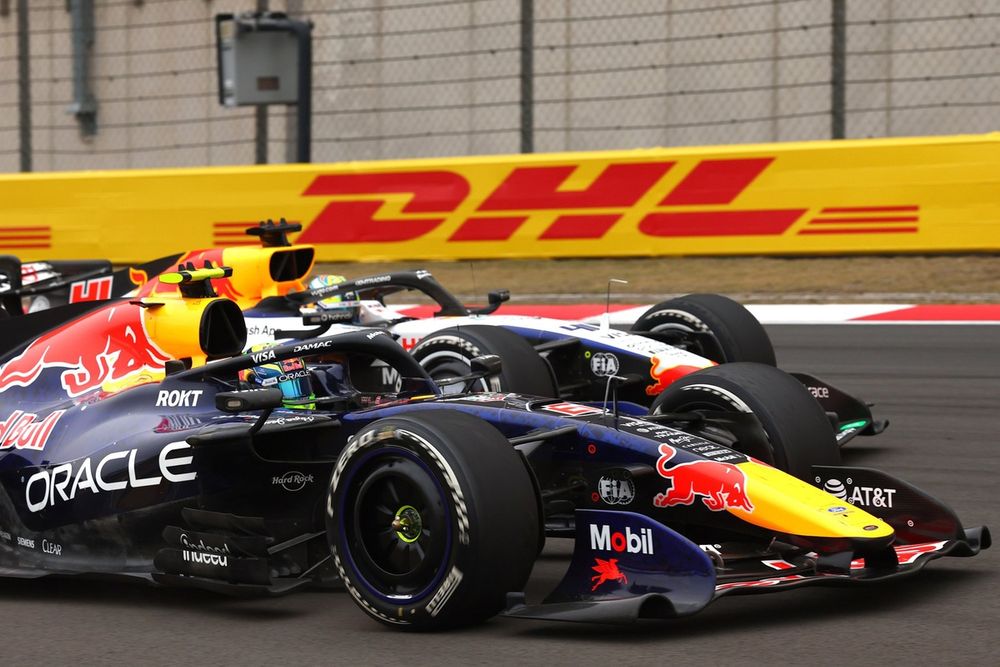
Power caps should smooth out some of the energy-limited moments in races
Photo by: Andy Hone/ LAT Images via Getty Images
"In terms of driving more naturally, I'm not sure that the reduction in the recharge overall limit massively affects that," reckoned Haas' head of car engineering Hoagy Nidd.
"But what it obviously does do is reducing the amount you recover reduces the amount that you deploy. And what it means is that you can recover a greater proportion of what you need to do while under braking conditions or under part throttle conditions on corner exit, normal grip limited areas of the circuit.
"That means that if you achieve your energy target under, how do I say, more normal driving conditions, you don't need to start altering your behaviour in order to make the final megajoule of energy there.
"So you don't need to start having lift and coast, you don't need to start using super clipping, you don't need to have the drivers holding part throttle on exit corners to avoid deploying in one place and putting it somewhere else. But it's something that, in a way, it's kind of introducing more of a problem to fix another problem.
"We're already in quite an energy-starved formula, aren't we? And further reducing that, it perhaps means that you have more clipping and less time when the cars are running as fast as they possibly could."

Photo by: Sam Bagnall / Sutton Images via Getty Images


Hungarian Grand Prix Driver Ratings 2026

How Norris shrugged off his first-lap error to deliver on McLaren's Hungarian GP pace

How much time has Aston Martin gained with its F1 Hungarian GP update?

What we learned from Friday practice at the 2026 F1 Hungarian GP

Aston Martin's heavily updated AMR26 breaks cover in Hungary pitlane

Russell: Data shows software calibration behind recent F1 struggles, not driving style

Hamilton takes "full responsibility" for disappointing Belgian GP

LIVE: F1 Hungarian GP updates - Norris wins from Verstappen, Piastri retires with gearbox failure

How Sutton scorched rivals to extend BTCC lead at Thruxton

Norris: I was better than Piastri in every sense in battle for Hungarian GP victory

Ogier to reunite with WRC champion co-driver for Rally Finland

Hungarian Grand Prix Driver Ratings 2026
Subscribe and access Autosport.com with your ad-blocker.
From Formula 1 to MotoGP we report straight from the paddock because we love our sport, just like you. In order to keep delivering our expert journalism, our website uses advertising. Still, we want to give you the opportunity to enjoy an ad-free and tracker-free website and to continue using your adblocker.


Top Comments