


The two F1 rules problems Perez’s recent mishaps expose
OPINION: Sergio Perez has been involved in controversial crashes in the last two Formula 1 races, with the Suzuka event also including a regulation loophole his Red Bull squad used to avoid a penalty being stretched to the next round. These serve to make the case for two elements of F1’s rulebook being urgently re-examined

How Formula 1 is yearning for a 2021 scenario right now. That championship famously went down to the wire. This year will effectively have six grand prix dead rubbers – assuming Max Verstappen seals his third crown in the Qatar sprint race as he is near certain to do.
Two years ago, F1 television audience numbers were booming globally – famously boosted by Netflix’s Drive to Survive and all the new viewers that had come across what was already a successful F1 promotion vehicle during the COVID-19 lockdowns. In 2023, the championship’s spin is about new social media interactions and how fans engage in content differently during a dull season.
But, if you can, imagine the unlikely scenario of the titanic 2021 tussle – or any championship in any motorsport division for that matter – being decided by an officiating call.
In this case, say, a driver desperately recovering up a race order in the season’s quickest car but at one stage biffing into a slower rival, then easily overcoming the sanction applied for causing the incident. Would that be justice? Would it be moral? Even without the potential for controversial world title-sealing sagas, the answer to both is surely: no.
Now, there is utterly no room for morals in F1’s sporting realm.
Red Bull demonstrated this perfectly with its shrewd/cynical (delete based on your partisan position) call to re-enter Sergio Perez in the Japanese GP so he could serve the five-second penalty he’d accrued for whacking into Haas driver Kevin Magnussen.
This exposed a longstanding loophole in F1’s sporting rules.
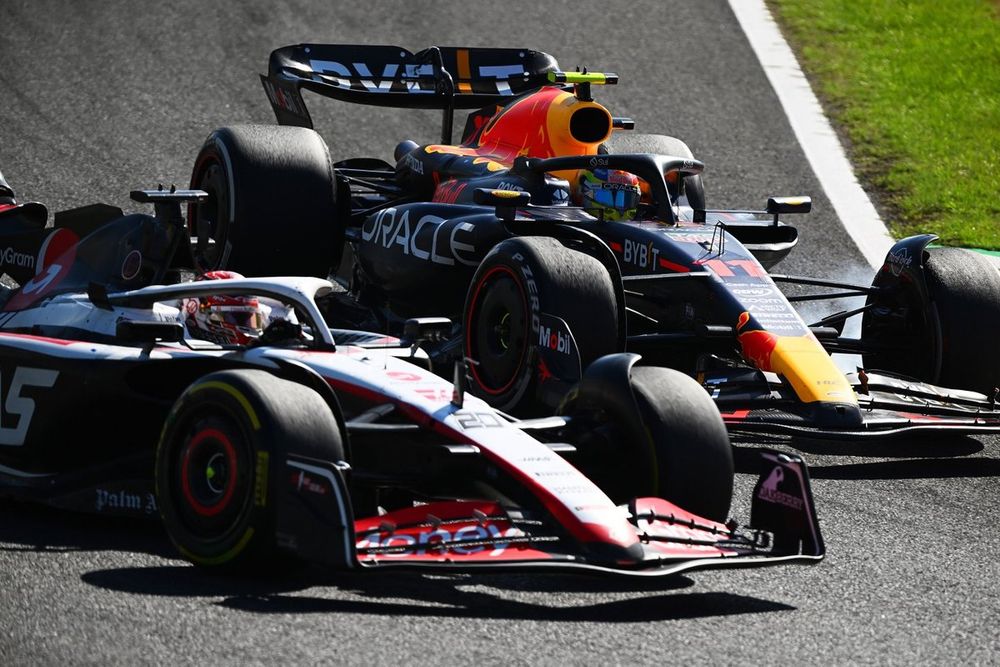
Red Bull re-entered Perez in the Japanese GP so he could serve the five-second penalty he’d accrued
Photo by: Red Bull Content Pool
Article 54.3 states, if a driver “is unable to serve the penalty due to retirement from the sprint session or the race, the stewards may impose a grid place penalty on the driver at his next race”.
Red Bull feared, having stopped Perez shortly after his Magnussen shunt and before the stewards’ investigation into it was concluded, that he would then carry his penalty over to Qatar as prescribed above.
Fair enough, really – so long as the car Red Bull had previously decided was too damaged to continue was in a safe enough condition to re-enter the track and no other driver was impacted by Perez slinking around.
Interestingly, Williams driver Logan Sargeant was retired one lap after serving his 5s penalty for hitting Valtteri Bottas at the same Suzuka spot seven laps earlier. In this case, Williams only decided to stop its rookie after assessing in that long stop that his floor damage was too severe to continue.
The safety argument alone of sending out a quickly repaired car is surely overwhelming
Now it has been so brutally exposed the FIA should at least consider closing the loophole to prevent this occurring again. The safety argument alone of sending out a quickly repaired car is surely overwhelming.
So too should the allowance to race at full speed between safety car lines in the pitlane during race neutralisations be stopped. Perez overtaking Fernando Alonso on the way into the pits for his first front wing change was clumsy, but ultimately needless.
More concerning was Williams informing Sargeant to push to the second safety car line at the pit exit after serving his first penalty for the team incorrectly building up its spare chassis, with Bottas bearing down during the early safety car. There were marshals cleaning up debris just past that spot.

Sargeant was retired one lap after serving his 5s penalty for hitting Bottas at the same spot seven laps earlier
Photo by: Mark Sutton / Motorsport Images
But there’s a more pressing concurrent point regarding F1’s rules at play here, which involves all of the names covered so far. This is how sanctions are currently being dished out by the stewards for poor driving actions. Perez and Sargeant earned the same 5s penalty for their Suzuka hairpin infractions. But they simply were not equal incidents.
While he was very unlucky that Sargeant messed up so badly on his inside, Bottas left himself exposed by attacking around the outside of a corner. A clash can happen in such circumstances in racing and it was right of the stewards to call Sargeant “predominantly” to blame and hand him the penalty they did.
Magnussen played no part in Perez turning him around – such was the distance the Red Bull driver attacked from, with a car he felt was “struggling quite a lot on the braking with the front end” following his Turn 1 approach clash with Lewis Hamilton that broke his first front wing. That feeling should have increased Perez’s caution, not the reverse. But it was, frankly, bizarre to read the stewards’ reasoning for his penalty as assessing that he was only “predominantly” in the wrong.
The Magnussen clash came one race on from the Singapore stewards deciding Perez’s late lunge and crash with Alex Albon was “predominantly” the Red Bull driver’s fault, when ‘wholly’ was more appropriate.
There, Perez raced up the road in the closing stages, passed AlphaTauri’s Liam Lawson and rendered the sanction toothless. Albon and Williams were rightly exasperated given Albon had needed to reverse away from a wall, lost four places and valuable points in the team’s constructors’ battle with Haas.
A race further back, Monza, had the two Mercedes cars also overcoming 5s penalties by pulling clear of rivals. In George Russell’s case of leaving the track and gaining an advantage, however, that sanction felt appropriate.

Stewards decided Perez’s late lunge and crash with Albon in Singapore was “predominantly” the Red Bull driver’s fault
Photo by: Mark Sutton / Motorsport Images
But this all serves to highlight how, of the four most pertinent penalty options available to the stewards under Article 54.3 (a 5s time addition, 10s time addition, drive-through or 10s stop-and-go), the harsher ones are just not being applied to the more egregious incidents of late.
The drivers are getting vocal about this – it’s the consistency they’re always calling for being applied in the wrong way, surely.
“It's not really teaching the drivers anything, because the penalties aren't strict enough – that's two races in a row”, Albon said of Perez after watching him hit Magnussen.
“I look at Austin last year, when I made a mistake with Carlos [Sainz] and I got a 5s for it that was really drive-through worthy”, said Russell – recalling his tangle with Ferrari driver Sainz at the 2022 United States GP’s first corner.
Perez and Sargeant earned the same 5s penalty for their Suzuka hairpin infractions. But they simply were not equal incidents
The counterpoint in this discussion is that the outcome of incidents shouldn’t be taken into account for sanctions. That the cause alone should be judged within that slew of penalty options available for the stewards.
Again, this chomps at any justice desire in F1’s sporting morality vacuum, but nevertheless right now it seems that all driving actions are somehow being penalised as if they are equal.
Alonso jumping over the Singapore pit entry kerbs twice feels appropriate for a small time addition. Yet that is seemingly being lumped in with similar decisions over serious driving gaffes and crashes. And, back in Melbourne, Sainz was forced to cop a points-costing penalty for his driving in an incident that was partially wiped away by a red flag. Its confusion heaped on chaos, at times.

The Turn 1 clashes between Perez and Hamilton, and Ocon, Bottas and Albon were considered ‘first lap incidents’
Photo by: Steve Etherington / Motorsport Images
Yet common sense can clearly prevail. At Suzuka, the Turn 1 clashes between Perez and Hamilton, and Esteban Ocon, Bottas and Albon just behind were rightly considered for ‘first lap incidents’ leniency.
Charles Leclerc’s thrilling late pass around Russell’s stern Turn 2 defence seemed to slip beyond track limits. Thankfully, this was dismissed because, really at that point and in those race circumstances, what advantage was gained given Russell’s part in the manoeuvre?
Yes, this is indeed inconsistency in considering how F1 rules and penalties are applied. But there’s room for common sense calls ignoring things the regulations aren’t intended to stop, sitting alongside wanting glaring discrepancies eliminated.
Plus, we know the FIA and its stewards can be open to admitting they get things wrong – such as the decision not to penalise Verstappen for his Singapore qualifying impeding, as the teams were told in Japan this was indeed incorrect and not precedent-setting.
That these discussions can take place have long been a part of motorsport’s deeply woven history.
Some people will argue that wanting the full range of penalties for driving infractions to be used is over-regulation. But not only are they already in the rules, adapting is part of how evolution occurs.
And when misadventures such as these and the confusion they create come at a time when F1 audience numbers are apparently dwindling, stopping baffling rules debacles is, surely, overwhelmingly helpful.

Perez has been involved in controversial crashes in the last two F1 races
Photo by: Red Bull Content Pool


Why Britain’s role in Formula 1 endured a troubled start

Why Bottas believes his F1 reserve driver role is the fastest route back to a race seat

Why Norris is now ready for his final exam

The key advantage for Bottas vs Perez in the 2026 F1 return race

Why Ferrari's management is under pressure after its bad start to F1 2025, not Hamilton or Leclerc

Why Red Bull can’t solve its second F1 car problem with a simple paint job

Hirakawa replaces Doohan at Alpine for Japanese GP FP1 outing

How Alonso and Bortoleto can be F1 rivals in a unique driver management deal

The not-so-obvious chance Leclerc missed to usurp Verstappen

Cheshire cats de la Roche and Musgrave grin after Silverstone Historic F3 thrillers

Dramatic Mini fight goes to the wire as Ovenden wins title by a point at Brands Hatch

How Ingram made his mark on the 2026 BTCC campaign – before going out with a bang
Subscribe and access Autosport.com with your ad-blocker.
From Formula 1 to MotoGP we report straight from the paddock because we love our sport, just like you. In order to keep delivering our expert journalism, our website uses advertising. Still, we want to give you the opportunity to enjoy an ad-free and tracker-free website and to continue using your adblocker.


Top Comments