


The tough balancing act facing Schumacher’s Netflix film producers
Michael Schumacher is the latest sporting superstar to get the ‘Netflix treatment’, with a special documentary film airing on the US streaming giant’s platform this month. DAMIEN SMITH has the inside track on how the filmmakers gained access to tell the human story behind one of Formula 1’s most publicity-shy champions - while the man himself, for obvious reasons, is in absentia…
“How nice he is.” That was how Vanessa Nöcker, co-producer and co-director of the new documentary on Michael Schumacher, answered our question on what surprised her the most about her subject during filming. If that reads like damning with faint praise, think again about the figure we are talking about. For 20 years Schumacher was both parts an arrogant pantomime villain to the English-speaking world and a Zeus-like God who could do no wrong in his own country. But to those who worked with him at Benetton, then Ferrari and on his Formula 1 return with Mercedes, Schumacher was indeed simply ‘nice’.
He was lovely, in fact; those who worked with him and for him generally adored him. For a man who spent so long in the unrelenting glare of the media spotlight, and in fairness didn’t always do himself any favours during the most controversial episodes that grazed his reputation through his long and ultra-successful career, being considered ‘nice’ and so incredibly grounded should be considered a remarkable achievement.
PLUS: How Schumacher’s trust made F1 engineering fun
Schumacher is available now on Netflix and is the latest in a recent line of big F1 feature-length documentary releases, following in the wake of studies on Max Mosley, Sir Frank Williams, Bruce McLaren, Ferrari in the 1950s and most notably Ayrton Senna, the one that really kicked off what is fast becoming its own movie genre. The Williams documentary (still available on the BBC’s iPlayer) is the most striking, intimate and at times shocking so far because Sir Frank isn’t exactly portrayed in a manner that always garners sympathy, thanks to the startling honesty of his own family.
Likewise, Schumacher promises a nuanced sketch of Michael that doesn’t skim away from the hard subjects – the notorious moments of his career such as Adelaide 1994 and Jerez 1997, then most notably the devastating skiing accident in December 2013 that so profoundly changed his life – while also offering insight, from those who know and love him the most, into the simple man behind the sporting colossus.
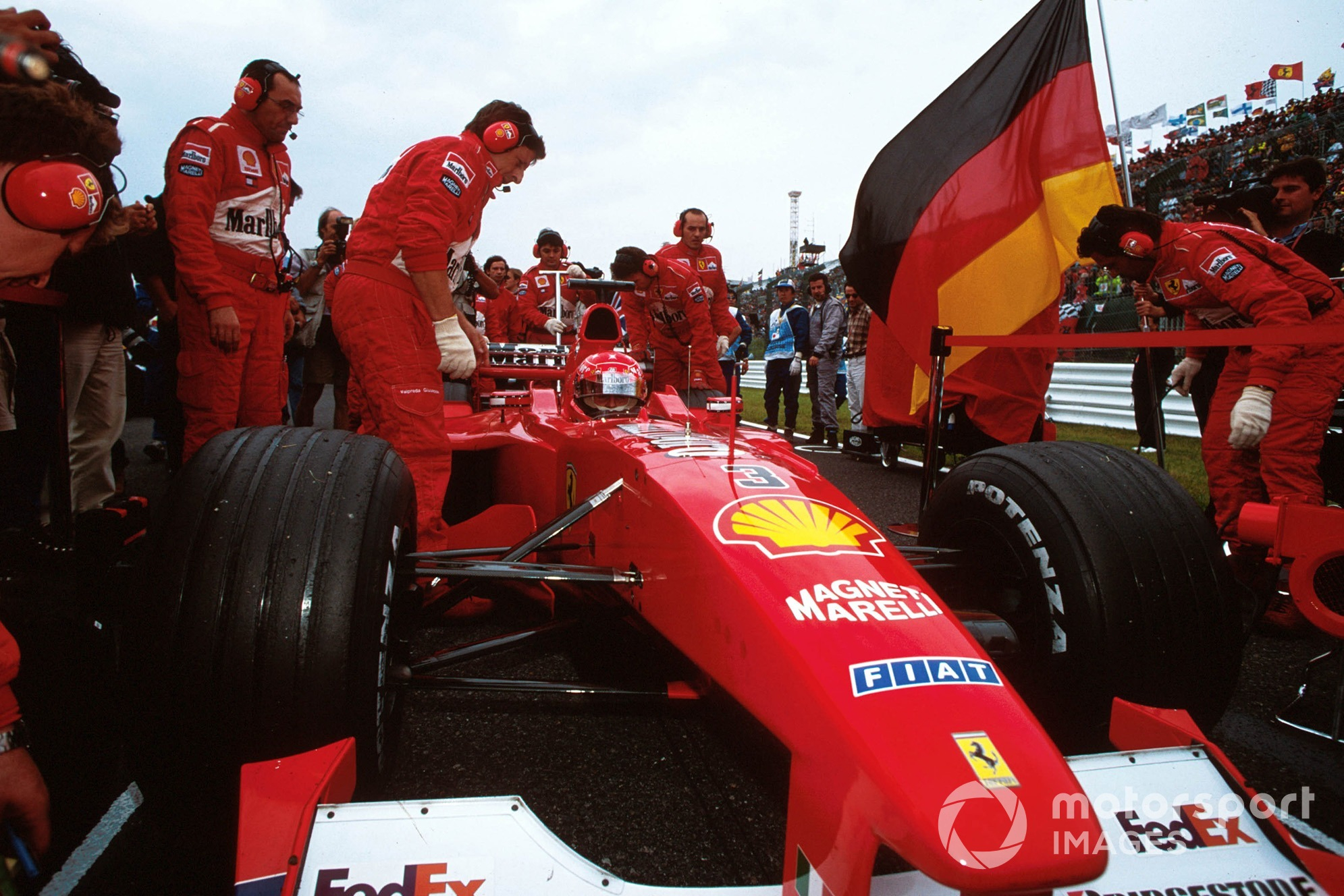
Schumacher on the grid before the 2000 Japanese GP, where he would go on to secure victory and the F1 world drivers' title
Photo by: Motorsport Images
While Michael himself can only speak to us through archive footage, the film features interviews with his fiercely private and protective wife Corinna, her children Gina and Haas F1 ace Mick, Michael’s brother and ex-rival Ralf, plus big-hitters including Jean Todt, Bernie Ecclestone, Sebastian Vettel, Mika Häkkinen, Damon Hill, Flavio Briatore, David Coulthard, Luca di Montezemolo, Piero Ferrari, Michael’s manager Sabine Kehm and more. Quite a cast.
PLUS: The remarkable story of Schumacher’s F1 debut
But it’s the interviews with Schumacher’s family, including his father, that really makes this release a landmark. Officially endorsed projects aren’t always the best if they only show a sanitised, squeaky-clean view of a controversial subject, but this is Schumacher – a monumental figure in our world whose story deserves a closer look beyond the history we all know so well. As he can’t speak for himself, to hear it from those closest to him who are still suffering the pain of what his life has now become is little short of a privilege.
"Our main goal was to tell his career story through his character, it wasn’t to make headlines about his accident. But we very openly said from the beginning the film had to address the accident too" Vanessa Nöcker
GP Racing spoke to Vanessa Nöcker in the run-up to the movie’s release and before we’d had a chance to see it. She had been inundated with requests to speak about the film she co-produced with Benjamin Seikel, and co-directed with Michael Wech and Hanns-Bruno Kammertöns, an experienced journalist who knew, befriended and interviewed Michael during his driving career. All of them had worked together before, on a documentary about a far more gregarious character, German tennis great Boris Becker.
“We had the idea to make a film for Michael’s 50th birthday, which was January 2019 – a long time ago!” explains Nöcker of the film’s origins. “Hanns-Bruno knows Sabine Kehm and Michael Schumacher also. He did some interviews with him during his career. So he called Sabine and from that point on we started talking. But these talks weren’t only about the film and the concept we had. They were trying to find out more about our attitude, to find out who we are and why we wanted to do this. There were a lot of meetings.”
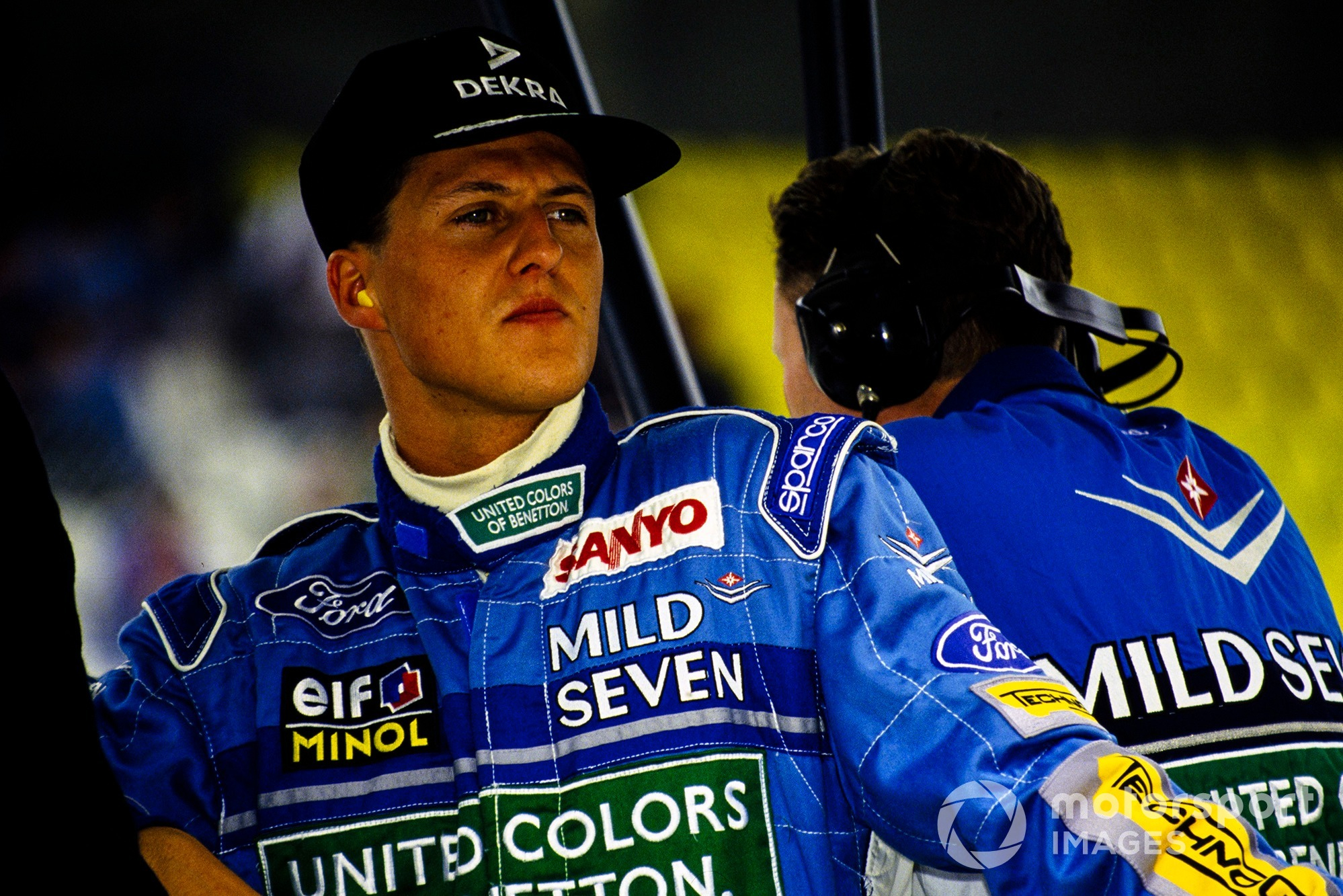
Schumacher at the 1994 San Marino GP, which he would win on a dark weekend for F1 after the deaths of Ayrton Senna and Roland Ratzenberger
Photo by: Motorsport Images
Kehm was all too used to pitches from journalists, filmmakers and producers wanting to get close to Michael – all through his driving career, not just since the accident. But now Corinna and the Schumacher family recognised the timing for such a project felt right, not so much because of a birthday or an anniversary, more because a man of Schumacher’s global stature deserved such a film. In the press release, Kehm says: “It is his family’s gift to their beloved husband and father.”
The filmmakers’ strong credentials and Kammertöns’ personal contact helped, but it’s likely their approach was the clincher in being given the green light. “The documentary was a big challenge and needed a lot of time and sensitivity, considering the pressure that was put on the production from the outside,” says Seikel. “Thanks to a great team and a really great collaboration with the family, we didn’t let ourselves get rattled. We’re excited about its global release on Netflix. The film was always intended to be an international documentary and we’re confident it will be embraced as such.”
Nöcker emphasises the producer/director team was always interested in telling a human story beyond a straight sports doc – and notably, the focus wouldn’t be on the accident and its awful consequences. “Michael seems to be very open, has this open face – but the human part of his story hasn’t been told really,” she says. “Germans and people around the world love him for his smile and his open heart when he gets up on the podium. That’s what I’ve seen all my life because I have a father and two brothers, and we watched him winning and losing, winning and losing.
“So here our main goal was to tell his career story through his character, it wasn’t to make headlines about his accident. But we very openly said from the beginning the film had to address the accident too. Somehow. Because we can’t ignore it. Everyone would get very mad if we did. So we had to find a way to tell that and it was a process – a long process. Which is why we are getting this out now. It doesn’t have anything to do with his birthday anymore.”

Schumacher would cement his legendary status in F1 with five consecutive world titles with Ferrari between 2000 and 2004
Photo by: Motorsport Images
The timing of the release, just after the 30th anniversary of Schumacher’s F1 debut for Jordan at Spa, is a happy coincidence. “The film was ready in October last year,” says Nöcker. “It was planned and produced for cinema and we were a little sad we couldn’t show it in cinemas, but it is still not possible. Now we are really happy to go with Netflix because many people will see it all over the world. Fans as well as families. So in the end Netflix is the best scenario that could happen to us and I only wish that many people will watch the film wearing earphones because of the awesome sound.”
As the stream of A-lister movie stars making films and TV for Netflix attests, the service does represent a zeitgeist choice for such a release. The Drive to Survive effect on F1 is the prime example of mass audience power – 209 million paid memberships in more than 190 countries – so Schumacher was never likely to be a niche production for a specialist audience. But that shouldn’t devalue its worth to GP Racing readers.
“Imagine that somebody made a 112-minute portrait about someone you love. What would that do to you?" Vanessa Nöcker
The story arc centres on Schumacher’s “personal fight”, as Nöcker describes it: the rise from his humble roots in rural Kerpen, the two championships in 1994-95, the moments of controversy, his switch to Ferrari, how he kept falling short of that vital first championship in red, until the moment of release in 2000 when the run of domination began that took his tally to 91 grand prix victories and seven world titles. That’s the sports film bit. Central to the narrative is how grounded Schumacher remained amid the whirlwind that was his racing life – and how those who worked with him and knew the man behind the media caricature were dedicated to the cause because of the way he was with them.
PLUS: How Schumacher's first year marked him out as F1's king in-waiting
“Ross Brawn says in the film Michael knew everyone, the names of the team members’ wives, he played soccer with them,” says Nöcker. “He was one of them. He also was a mechanic in his heart, building karts with his dad and his brother. He knew how to use a screwdriver and he was trying to develop the car further and further. That is what his team loved. As Eddie Irvine said, he made the car better, that’s what he could do. He was apparently able to perform small miracles. That’s really cool.”
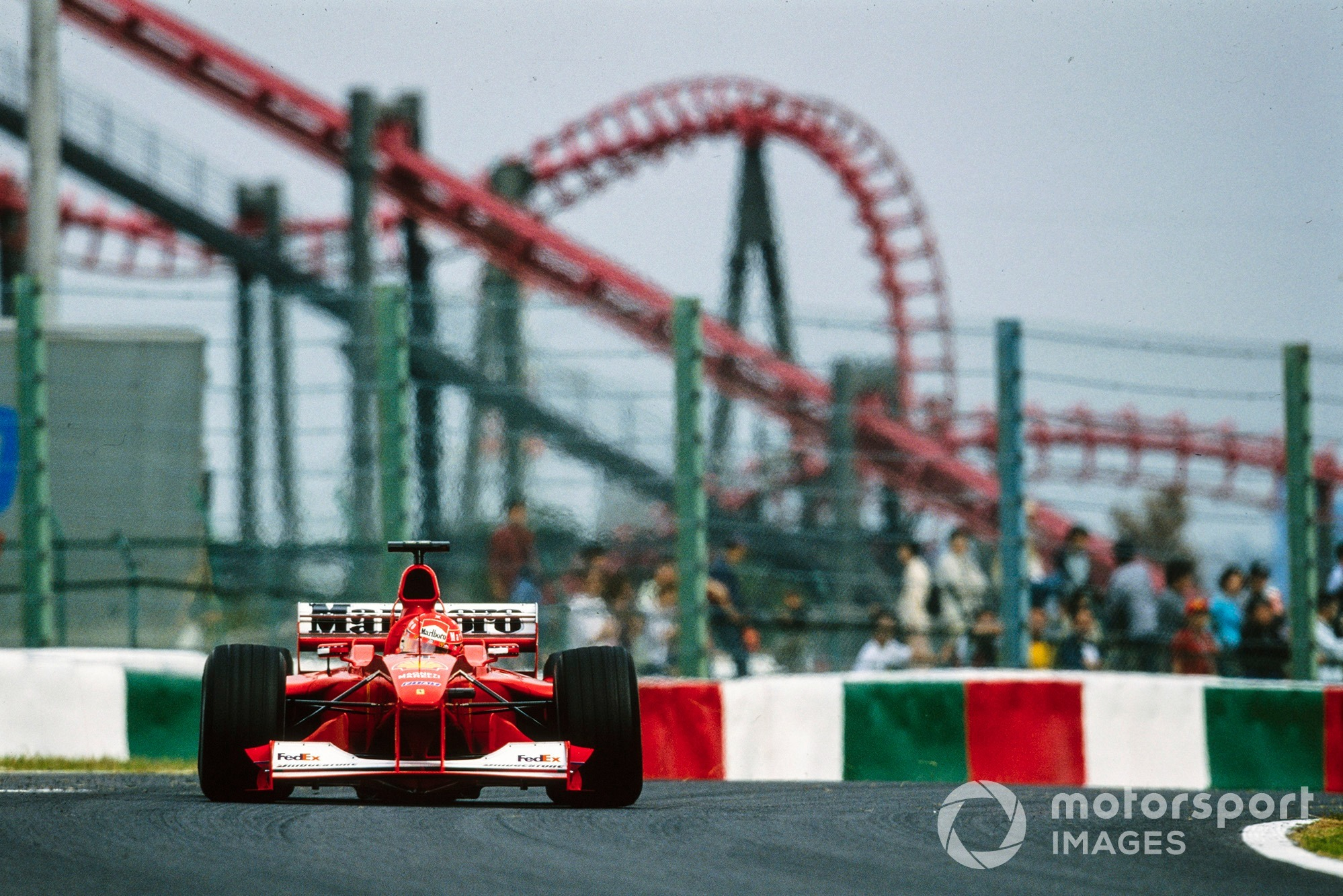
Schumacher on his way to victory at the 2000 Japanese GP to seal the F1 world title
Photo by: Motorsport Images
But there’s another star of the story who, if anything, shares equal billing. “Corinna is a fighting lioness, a protector – and very warm,” says Nöcker. “I was impressed by her. She is very straight, she knew what she wanted. She is really a fighter. We all really respected her because she didn’t make any boundaries for us that would have made it impossible to make the film. She was very open. She said, ‘I don’t want a legend story, I want the real story so tell it the way you like – and I hope I like it in the end’. That was her attitude.
“She knew we wouldn’t want to hurt her and she had the security that if she said something she didn’t mean or broke down in tears we would cut that out. But we had all the freedom in every other way. And in some way the film also turned out to be a bit of a love story too.”
For all of Corinna Schumacher’s trust, this was never going to be an easy project to bring to fruition in such desperately sad circumstances. So how did the family respond when they saw it for the first time? “They were moved,” says Nöcker. “Imagine that somebody made a 112-minute portrait about someone you love. What would that do to you? Corinna was happy. She didn’t have any problems, even with the parts that do not show Michael’s best side. Even those things, she said, ‘that’s real, that’s the way he is’.
“We tried our best and I think you can really see him,” Nöcker concludes. “For me, that’s what makes the film so special.”

Schumacher celebrates his first F1 world championship for Ferrari at the 2000 Japanese GP
Photo by: Motorsport Images

How Ratzenberger beat the odds to realise his cruelly short-lived F1 dream

F1 uncovered: A weekend behind the scenes with a chief mechanic

When McLaren was pipped by Red Bull in a modern F1 classic

The big opportunity Sainz’s Williams switch affords to F1’s latest centurion

Inside the science of F1 fuel

How F1’s plan for rotating races could look in practice

The early decisions that set Sauber’s rookie for success

How F1 media coverage has evolved in line with its subject

Haas confident of getting 2027 F1 budget closer to cap with new partner talks

Top 10 Can-Am drivers

F1 reveals 2027 calendar as Monaco joins expanded sprint schedule

Ferrari not yet switching focus to 2027 F1 car
Subscribe and access Autosport.com with your ad-blocker.
From Formula 1 to MotoGP we report straight from the paddock because we love our sport, just like you. In order to keep delivering our expert journalism, our website uses advertising. Still, we want to give you the opportunity to enjoy an ad-free and tracker-free website and to continue using your adblocker.


Top Comments