


The remarkable story of Schumacher’s F1 debut
GP Racing columnist MARK GALLAGHER was working as Jordan’s press officer when Michael Schumacher made his F1 debut at Spa in 1991. Here, for the first time, Mark gives his first-hand account from behind the scenes at the birth of a grand prix legend
Michael Schumacher is sitting on the steps of the Team 7Up Jordan race transporter in Spa-Francorchamps telling me about his brother.
“He’s sixteen,” he says. “Very quick, racing in karts, his name is Ralf.”
It’s Thursday afternoon, August 22, 1991. In my role as press officer, I’m trying to pull together Michael’s biography in order to give the Formula 1 media information about Jordan’s new signing.
We discuss his Formula 3 successes: winning the German F3 title and Macau Grand Prix in 1990 while driving for WTS Racing, the team run by his manager Willi Weber. He tells me about racing in Formula Nippon and his experiences in the World Sportscar Championship with Sauber-Mercedes.
Then I ask him about his experience of racing at Spa, a mere 70 miles away from his hometown of Kerpen in Germany.
“I’ve never raced here,” he says, matter of factly, before adding, “But I did take a bicycle around the track earlier.”
As I take this onboard, I realise our new driver is itching to move on.
“Are we finished?” he says. I let him go. The past twelve days had been a blur. I have a protest march to deal with. Things are not normal.
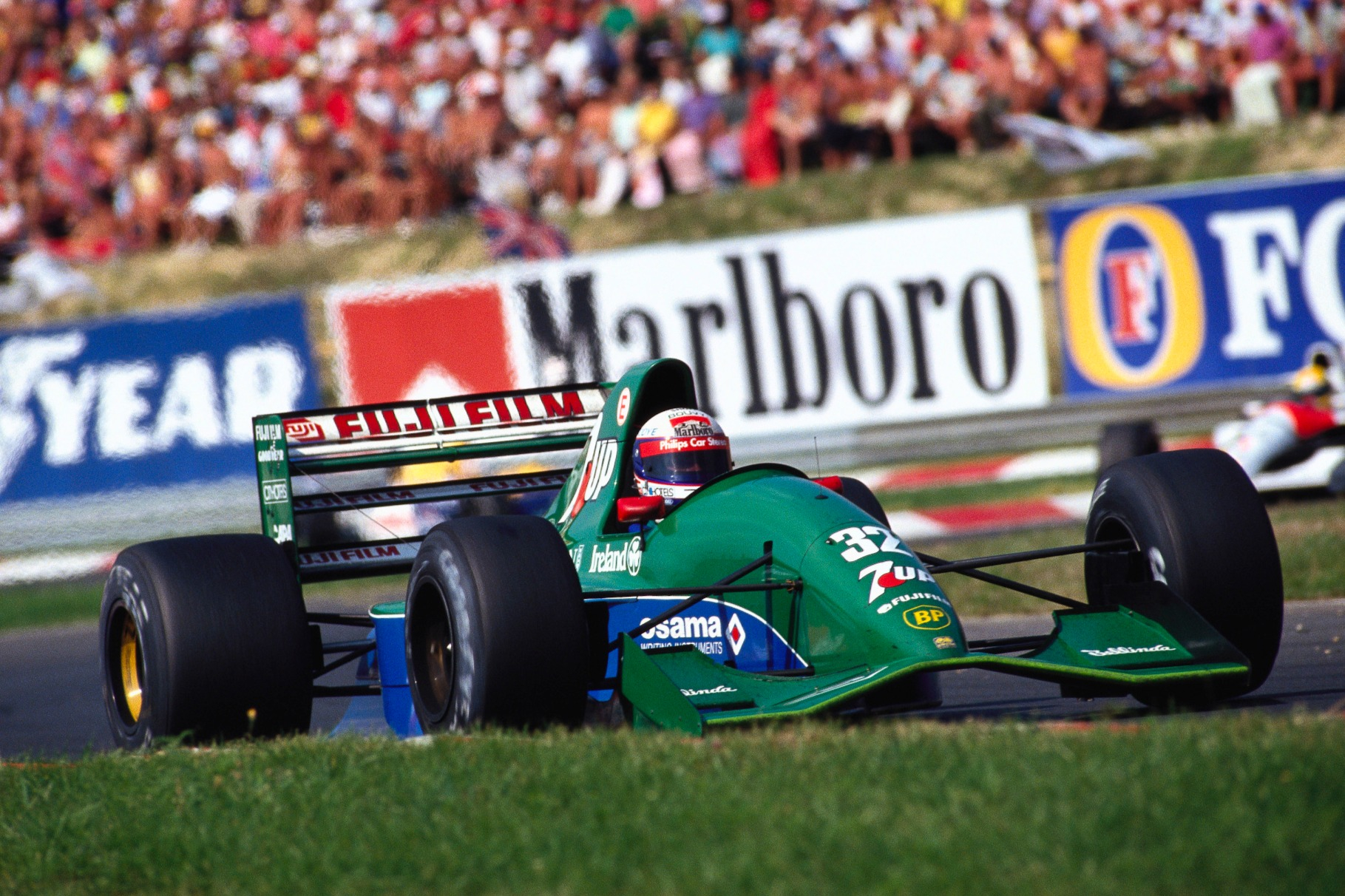
Gachot set fastest lap in Hungary, but by the next race he was spending time at Her Majesty's pleasure
Photo by: Motorsport Images
At the Hungarian Grand Prix our drivers, Andrea de Cesaris and Bertrand Gachot, had finished seventh and ninth. Indeed, Bertrand had set a new lap record, a late stop for a fresh set of Goodyears giving him the pleasure of running the final laps on low fuel and new rubber.
The team had scored points – top six finishes back then – in the five grands prix prior to Hungary, including a fourth and fifth in Canada.
There had been plenty of drama, but nothing compared with what happened when we got back from Budapest. Prior to a planned test at Monza, Bertrand had to attend a court appointment in London for what we all thought was a straightforward traffic offence.
I was in the Jordan ‘factory’, the former F3 and F3000 workshop, when the phone rang. Fred Rodgers, solicitor and partner in Eddie Jordan Management, called to say that our Hungarian lap record holder had just been convicted of causing actual bodily harm to London taxi driver Eric Court. More than that, Bertrand would not be going to Monza. He had been jailed for 18 months.
"Because the car had proven to be so competitive, all kinds of names were being mentioned, and Keke Rosberg was one. That actually became quite serious, and Eddie was thinking it would give a lot of credibility to the team" Trevor Foster
For Bertrand, tackling Monza was replaced by the challenge of adapting to life behind bars in Brixton Prison and, later, HMP Northeye in Bexhill-on-Sea. Buoyed by thousands of letters of support, a media campaign and protests orchestrated by fellow Belgian racing driver Pascal Witmeur, Bertrand busied himself with gardening work. The long-time Marlboro sponsored driver was paid on the inside in cigarettes, which he traded for a Mars bar, slicing it into seven pieces, one for each day of the week.
Back at Silverstone there was utter shock followed by the realisation that major sponsors Pepsi Cola (owners of 7Up) and FujiFilm would have to be informed, a press statement issued. I recall speaking to Elizabeth Wright at 7Up, trying to determine which was the better word to describe our driver; ‘incarcerated’, ‘imprisoned’ or simply ‘jailed’.
There was also the matter of finding a replacement driver for the Belgian Grand Prix, Bertrand’s home race. While Stefan Johansson was Eddie’s preferred choice, he required paying… Another option was Keke Rosberg. The 1982 world champion had retired from Formula 1 in 1986 but was still racing for Peugeot in World Sportscars. Trevor Foster, Jordan’s team manager and race engineer to Bertrand, remembers the debate.
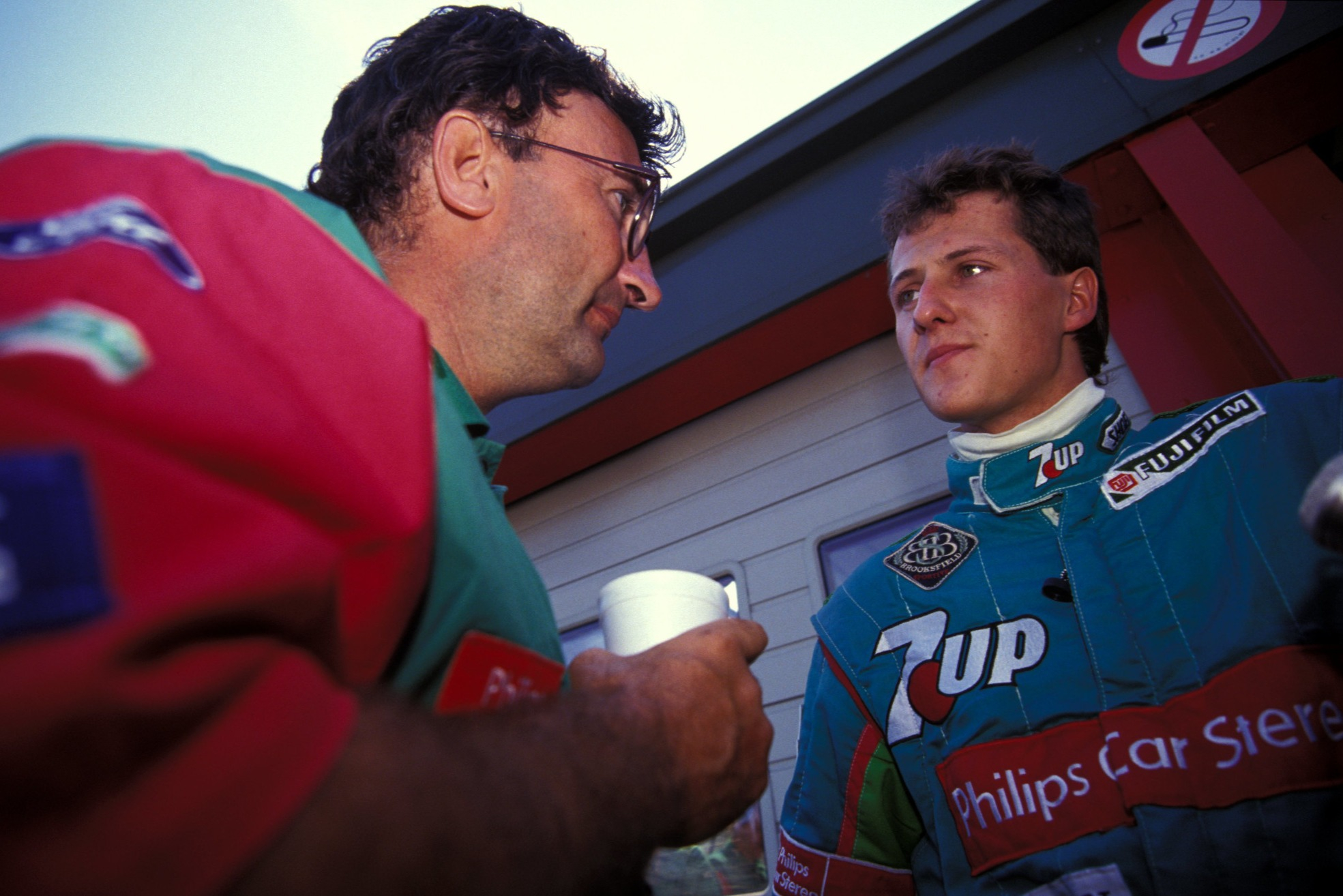
Schumacher's path into Eddie Jordan's team was smoothed by a hefty cheque from Mercedes motorsport boss Jochen Neerpasch
Photo by: Motorsport Images
“Because the car had proven to be so competitive, all kinds of names were being mentioned, and Keke Rosberg was one. That actually became quite serious, and Eddie was thinking it would give a lot of credibility to the team, being an ex-world champion, coming back to F1 to drive for Jordan. Eddie thought he could probably generate some income from that.”
While Eddie and the team’s commercial manager Ian Phillips pursued every angle, Trevor recalls how both he and chief designer Gary Anderson were asked for their opinions.
“We said we thought that the fact Keke was even prepared to consider it was a fair acknowledgement of the team’s standing, but we had always done our best when we had young, talented drivers who we could mould in the Jordan way.”
As the Rosberg conversation drifted, the deal to sign Michael moved swiftly, particularly once Mercedes’ sportscar boss Jochen Neerpasch supported his young driver to the tune of US$150,000.
Michael soon found himself in Jordan’s humble headquarters at Silverstone on the Monday following his Nurburgring 430kms sportscar race, preparing for a seat fitting in the Jordan-Ford 191.
This was the car which Alain Prost had said was the most impressive to follow through a quick corner. Its design was the result of Gary Anderson’s technical artistry, supported by Andrew Green and Mark Smith, and verified in the University of Southampton windtunnel. That all three would go on to become F1 team technical directors speaks volumes.
For Michael, the Jordan 191 represented the tool with which he could carve a memorable entry into Formula 1.
PLUS: The half-truths and deal-making behind Schumacher’s first F1 racer
The morning after his seat fitting, Tuesday August 20, 1991, he joined the team at Silverstone South Circuit for a shakedown test. The weather was dry, and the team gathered on the concrete runway slabs which acted as a temporary pit.
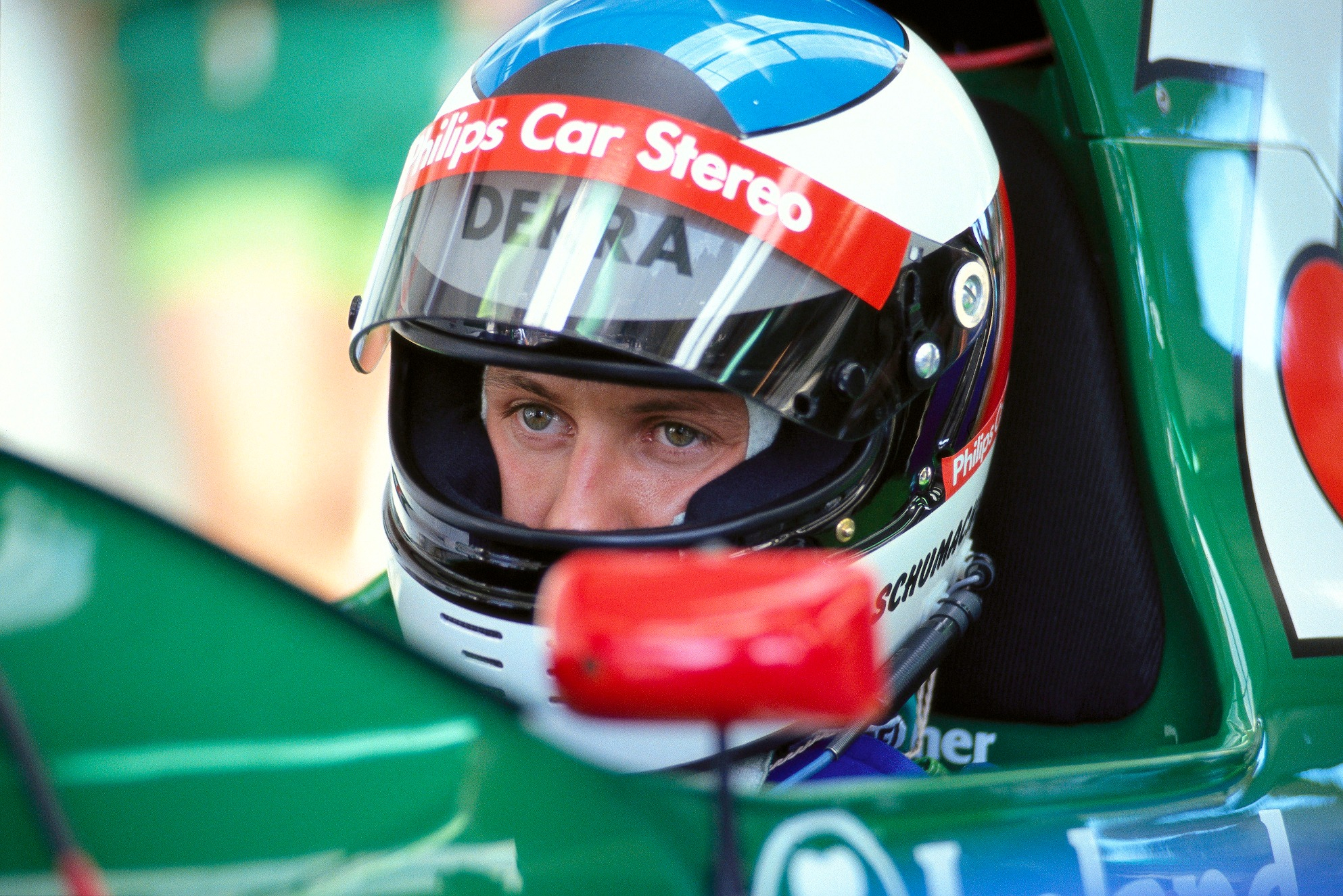
Schumacher immediately impressed team boss Trevor Foster on his first test at Silverstone
Photo by: Motorsport Images
Following an installation lap, Michael was invited to complete a three-lap run but had other ideas. Arriving at the chicane directly in front of the team at the end of his first lap, he missed the first apex, caught a big slide, kept his foot in and booted the car back out towards Chapel corner and down Hangar Straight.
Lap after lap he came by, Trevor concerned in case his rookie driver should make a mistake with the H-pattern manual gearshift and over-rev the Ford HB V8 Series IV engine. At £30,000 per rebuild, and with Cosworth owed money, this was something Jordan could ill afford.
He need not have worried. Michael kept circulating, learning and exploring. In the end the team sent a mechanic onto the track to wave him down.
“It was one of those rare occasions when you watch somebody in a car which is the next grade up, for five or six laps, and you know they are on top of it,” recalls Trevor. “The car is not 20 metres in front of them. At that point we had worked with many young drivers over the years, and with the very best of them you get that tingling feeling the first time they test.
"He was there to do a job, he had no thoughts of ‘well if I get on the back of the grid I’ll be happy.’ I remember in the first session, within a handful of laps he was right there, on the pace, top 10" Trevor Foster
“We had seen it before when Johnny Herbert moved up from F3 and tested a Formula 3000 car. When the good guys make the jump, within five laps they are right there. Then you have the guys who are still staring at you vacantly after a day’s testing and you think, ‘maybe not!’ They may get there, but it’s going to take a lot of work.”
Insight: Driving the F1 icon that launched Schumacher's career
Shakedown completed, the team headed to Spa, but it was not until the Thursday that the contractual terms under which Michael would race were finally agreed.
As Michael’s first F1 race engineer, Trevor recalls how the team tackled its lack of information about the circuit, including attempts to give Michael some useful guidance.
“We hadn’t been to Spa before as an F1 team. We had no data, and anyway the data system was not as advanced as it is now – throttle, brake, steering angle, just the basics. However, in those days there were certain times when you could take a road car around the circuit, so I spoke to Andrea – who was often quick at Spa – and said, ‘Look, we’ve got this young guy called Michael, could you show him around the track?’ and he said, ‘Sure, no problem at all.’”
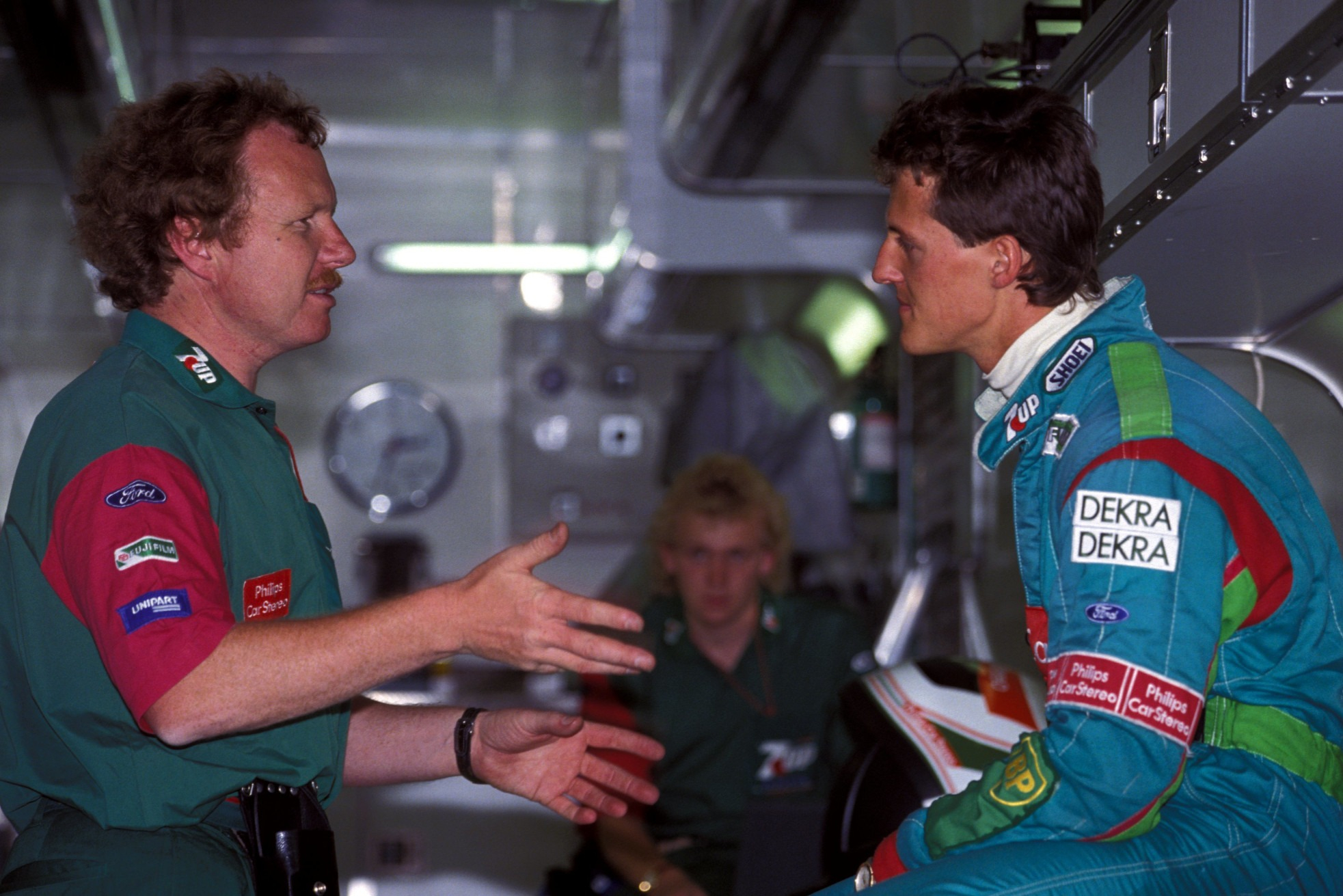
Schumacher had never previously driven at Spa, so Foster (left) asked De Cesaris for his input
Photo by: Motorsport Images
“The problem was that Andrea was constantly hassling Eddie about a contract for the following year, so he was forever in meetings and never available. When I explained to Michael that Andrea was still locked in meetings, he just said, ‘Don’t worry, I’ve got a bike in the boot of my Mercedes, so I’ll just do a lap on the bike.’”
Later in the day, with Andrea still unavailable to undertake some coaching, Michael opted for a second lap under pedal power. Trevor recalls the degree of focus he brought to the task.
“He was there to do a job, he had no thoughts of ‘well if I get on the back of the grid I’ll be happy.’ I remember in the first session, within a handful of laps he was right there, on the pace, top 10. I called him in and said, ‘Michael, are you OK? Please remember this is practice day for your first grand prix, you have time. Tell me you are not over the limit?’ and he said, ‘No, no, I’m not over on the limit, just on the limit’.
“You could not be more impressed with his calmness, his control. We sat in the briefing after the first morning. Andrea was the lead, working with Gary who was being assisted by Andy Green. He [Andrea] was talking about the quick double left-hander at Pouhon and complaining that sixth gear was too high, fifth too short. He was having to change gear in the middle, plus at Blanchimont there was a bump which was causing him to lift and destabilise the car.
“Gary turned to Michael and asked if he was experiencing similar things, and he said, ‘I did for the first four or five laps but then I realised it is better to go through Pouhon in sixth gear and just trail brake, and also coming back through Blanchimont I just keep it flat, I don’t lift, I just left foot brake and keep the exhaust flowing.’
“No one had explained the aerodynamics to him, but he had worked it out for himself. Keep it flat and if you are carrying too much speed you just had to rest your foot on the brake. You could see Andrea’s face when Michael explained what he was doing…”
Andrea, somewhat rattled by his quick new team-mate, switched from his race chassis, 006, to the spare car – 004 – during practice. When Michael’s car, 005, then developed a water leak, necessitating the removal of the engine in order to access the water pump, Trevor asked Gary if he could put their new man into Andrea’s race car in order to give him more track time. He was quick in that too.
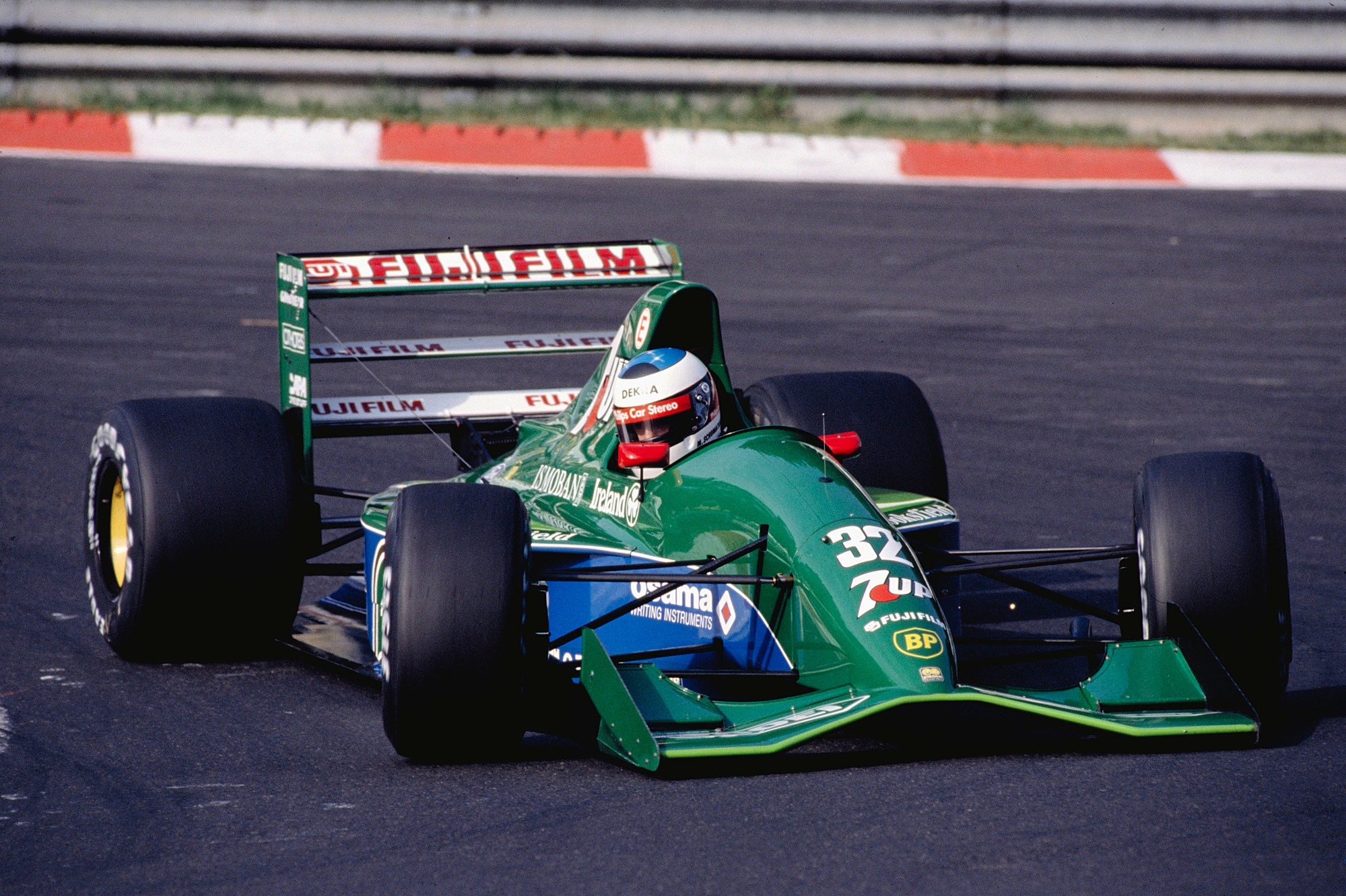
Schumacher shocked the establishment by qualifying seventh on his debut
Photo by: Motorsport Images
Come Friday qualifying, Michael lapped 0.896s faster than Andrea, while in Saturday’s final session the gap was reduced slightly to 0.774s. This placed the newcomer seventh on the grid, while Andrea – competing in his 160th grand prix – would start 11th.
The team was euphoric. The media story surrounding Jordan shifted emphasis, from the sadly imprisoned Bertrand to the singularly impressive Michael. As it happened, P7 on the grid was something of a disappointment.
“What a lot of people don’t remember is that on his last qualifying run Michael was even quicker,” says Trevor, “which would have put him fifth on the grid, but [Jean] Alesi spun at the Bus Stop chicane and ruined the lap. If Michael had been able to carry his speed, he would have been P5.”
"By the time he got onto the grid the clutch had already done a lot of work. Then he did another [practice start]. Once the race started, he was then straight into La Source, which is a tight first-gear hairpin, and to get the car to turn faster on the inside he dipped the clutch again" Trevor Foster
To put that into context, only the McLarens of Ayrton Senna and Gerhard Berger, Nigel Mansell’s Williams and Alain Prost’s Ferrari were quicker.
As though to emphasise the point, Michael speared between Nelson Piquet’s Benetton and Alesi’s Ferrari to hold fifth into La Source hairpin after the start. But the young German’s debut ended ingloriously, the clutch in pieces, his car coasting to a halt on the run up to Les Combes.
Myths have since developed about why that happened. The reality is mundane, though it provides further insight into the mind of a driver who came to define an era.
“At that time the standard clutch for F1 was a three-plate carbon clutch,” recalls Trevor. “Cosworth had some concerns and would not let its teams run more than a two-plate clutch because of the weight of the mass on the end of the flywheel. It was OK, but you had to take care of it, particularly on the first couple of laps on full tanks.”
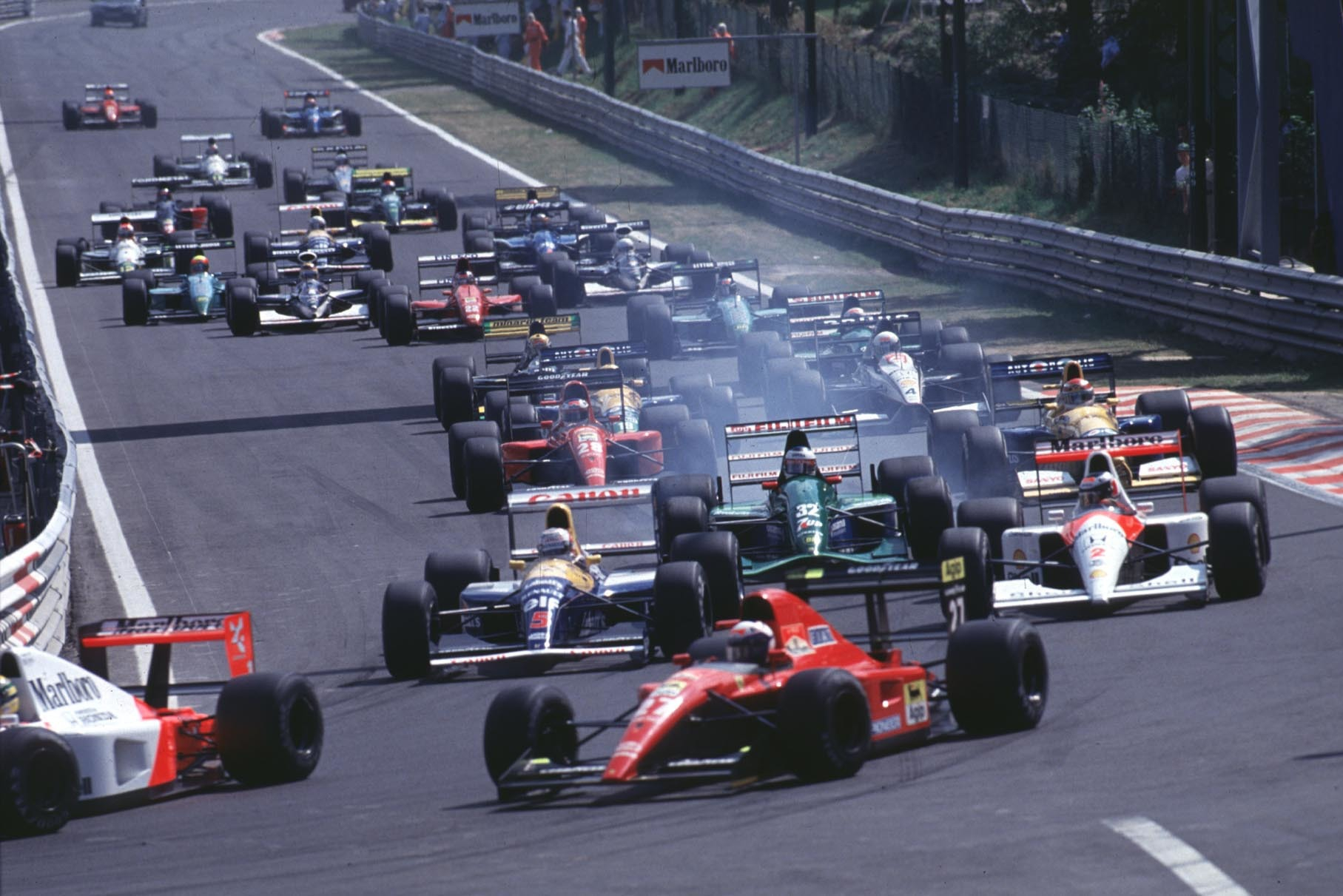
Practice starts burned out the clutch and meant an early bath when Schumacher tried to duck underneath Berger exiting La Source
Photo by: Motorsport Images
“We fitted a new clutch for the race, and in those days you could do dummy starts. So Michael, whose thought process was to make the best possible start and be fifth or fourth by the first corner, did a practice start off the dummy grid, then another one out the back of the circuit, and then more coming down to the Bus Stop.
“By the time he got onto the grid the clutch had already done a lot of work. Then he did another one. Once the race started, he was then straight into La Source, which is a tight first-gear hairpin, and to get the car to turn faster on the inside he dipped the clutch again.”
Video replays show Michael powering the car out of La Source, the 191 snapping into oversteer. The clutch protested, then blew itself apart. Michael was frustrated, but both he and the team had seen enough of each other to know that, as first dates go, there was plenty of excitement to look forward to.
Michael watched from the garage as Andrea climbed through the field, rising to second, closing on leader Senna until the engine failed – out of oil – three laps from home. Fate could so easily have decreed that Spa 1991 was remembered, not for Michael’s debut, but a maiden win for Andrea de Cesaris and Jordan GP.
Instead, Andrea would never stand on the top step while Jordan would wait seven years for its first win. That also came at Spa, a 1-2 secured by Michael’s mid-90s rival-in-chief Damon Hill and the younger brother he had spoken of to me about on the steps of Jordan’s transporter.
A fortnight after his F1 debut Michael was gone, off to Benetton, wrested from Eddie Jordan’s grasp by intrigue and powerplay from a cast headed by Bernie Ecclestone, Flavio Briatore and Tom Walkinshaw. Everything finally clicked into place with half a million dollars deposited into Roberto Moreno’s account, lubricating his exit from a binding Benetton contract.
It was that sequence of events which gave rise to Ron Dennis greeting Eddie Jordan with the words, ‘Welcome to the Piranha Club’.
Thus concluded the remarkable opening chapter of the Michael Schumacher F1 story, one which would end with his retirement from grand prix racing 21 years later. In doing so, he passed the Mercedes baton to the man who would equal his tally of seven world championships. Looking back now, it’s a story that continues to run and run.
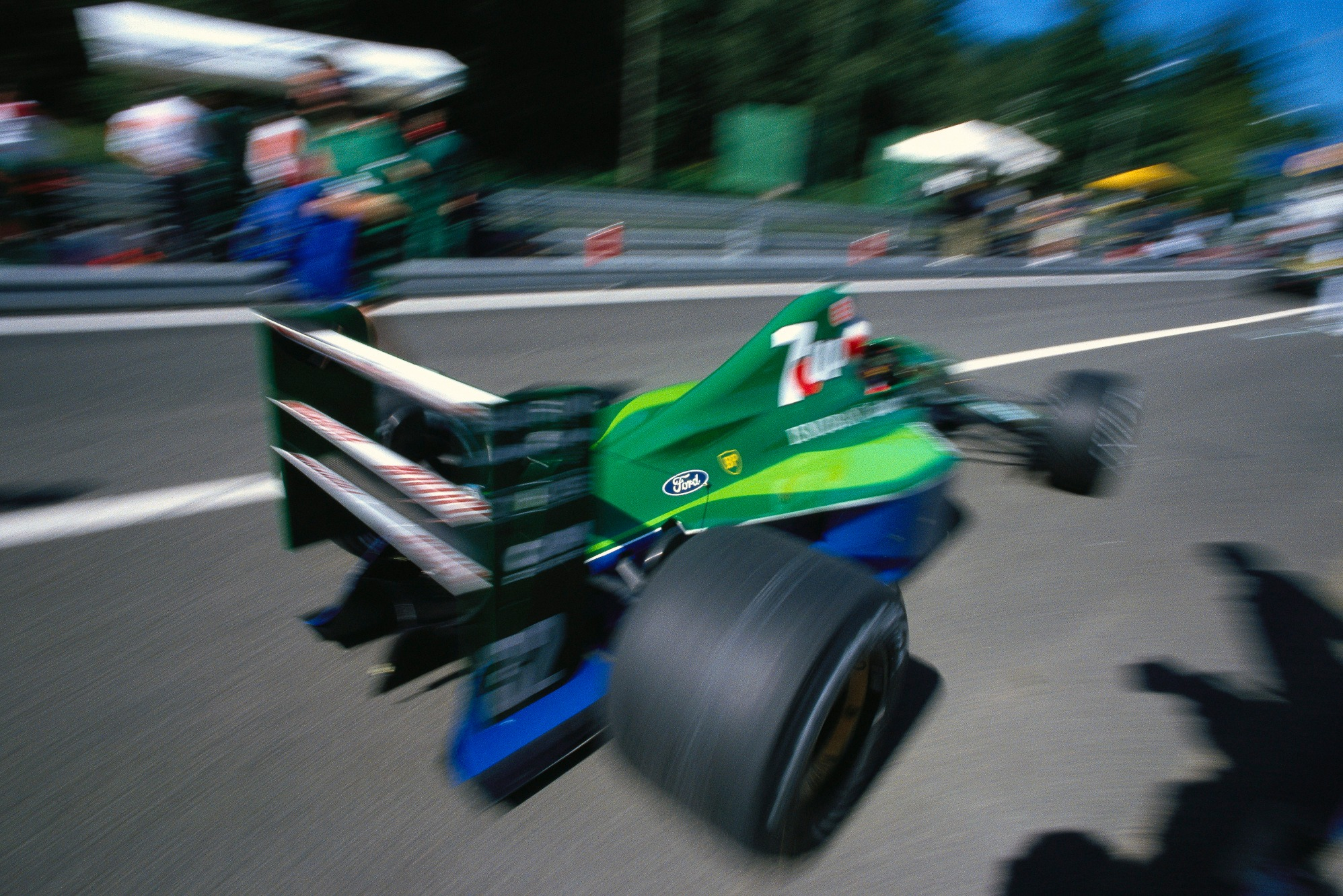
Schumacher's time with Jordan would prove short-lived, as he was poached by Benetton to begin a long and successful F1 career
Photo by: Motorsport Images

How Ratzenberger beat the odds to realise his cruelly short-lived F1 dream

F1 uncovered: A weekend behind the scenes with a chief mechanic

When McLaren was pipped by Red Bull in a modern F1 classic

The big opportunity Sainz’s Williams switch affords to F1’s latest centurion

Inside the science of F1 fuel

How F1’s plan for rotating races could look in practice

The early decisions that set Sauber’s rookie for success

How F1 media coverage has evolved in line with its subject

Ferrari not yet switching focus to 2027 F1 car

The verdict on the WRC Rally Chile tyre solution

Top five roles on Motorsport Jobs this week

Quartararo explains why Yamaha relationship has strained ahead of Honda move
Subscribe and access Autosport.com with your ad-blocker.
From Formula 1 to MotoGP we report straight from the paddock because we love our sport, just like you. In order to keep delivering our expert journalism, our website uses advertising. Still, we want to give you the opportunity to enjoy an ad-free and tracker-free website and to continue using your adblocker.


Top Comments