


How Schumacher's first year marked him out as F1's king in-waiting
After his sparkling F1 debut with Jordan at Spa, Michael Schumacher quickly leapt to Benetton for the 1991 Italian Grand Prix. This move paved the way for the German to win his first grand prix one year later and laid the foundations for his ascent to become a title contender by 1994

Michael Schumacher first put himself on the Formula 1 map with his stunning qualifying performance on his debut with Jordan at the 1991 Belgian GP. But it was the rapid progress he made following his switch to Benetton that really signalled he was a potential world champion. Exactly 12 months after his first appearance, the 23-year-old German scored his maiden victory in a rain-affected race at Spa.
His first year at the top level remains one of the most spectacular logged by any driver in the modern era. Of course, Jacques Villeneuve in 1996 and Lewis Hamilton in 2007 both won races and challenged for the title in their rookie seasons, but they had the equipment with which to do so. Schumacher was usually battling with McLaren drivers Ayrton Senna and Gerhard Berger for the scraps left by the dominant Williams duo of Nigel Mansell and Riccardo Patrese, so the headline results were not as spectacular. But the talent was there for all to see.
In 1991, Schumacher was driving for Mercedes in sportscar racing, competing against the Jaguar XJR14 designed by Ross Brawn and fielded by Tom Walkinshaw’s eponymous squad. Brawn and Walkinshaw were also at the heart of the Benetton team, which that year was running Nelson Piquet and Roberto Moreno.
Mercedes wanted to fast-track Schumacher into F1, and a one-off deal was brokered with Eddie Jordan for Spa. The newcomer stunned the paddock by qualifying an eye-catching seventh at a track he didn’t know, only to retire with a driveshaft failure on the first lap.
PLUS: The remarkable story of Schumacher’s F1 debut
The delighted Jordan thought he had an ongoing deal to run Schumacher, but the contract had wiggle room and Benetton boss Walkinshaw soon pounced.
“Of course we knew Michael very well from sportscar racing,” Brawn recalls. “We hadn’t quite anticipated him getting into F1 as quickly as he did. So that Jordan deal got done slightly before we got our act together. But once we saw that he was coming into F1, our wheels were in motion even before we saw him run. And Tom did a great job in sort of prising him out of there.”
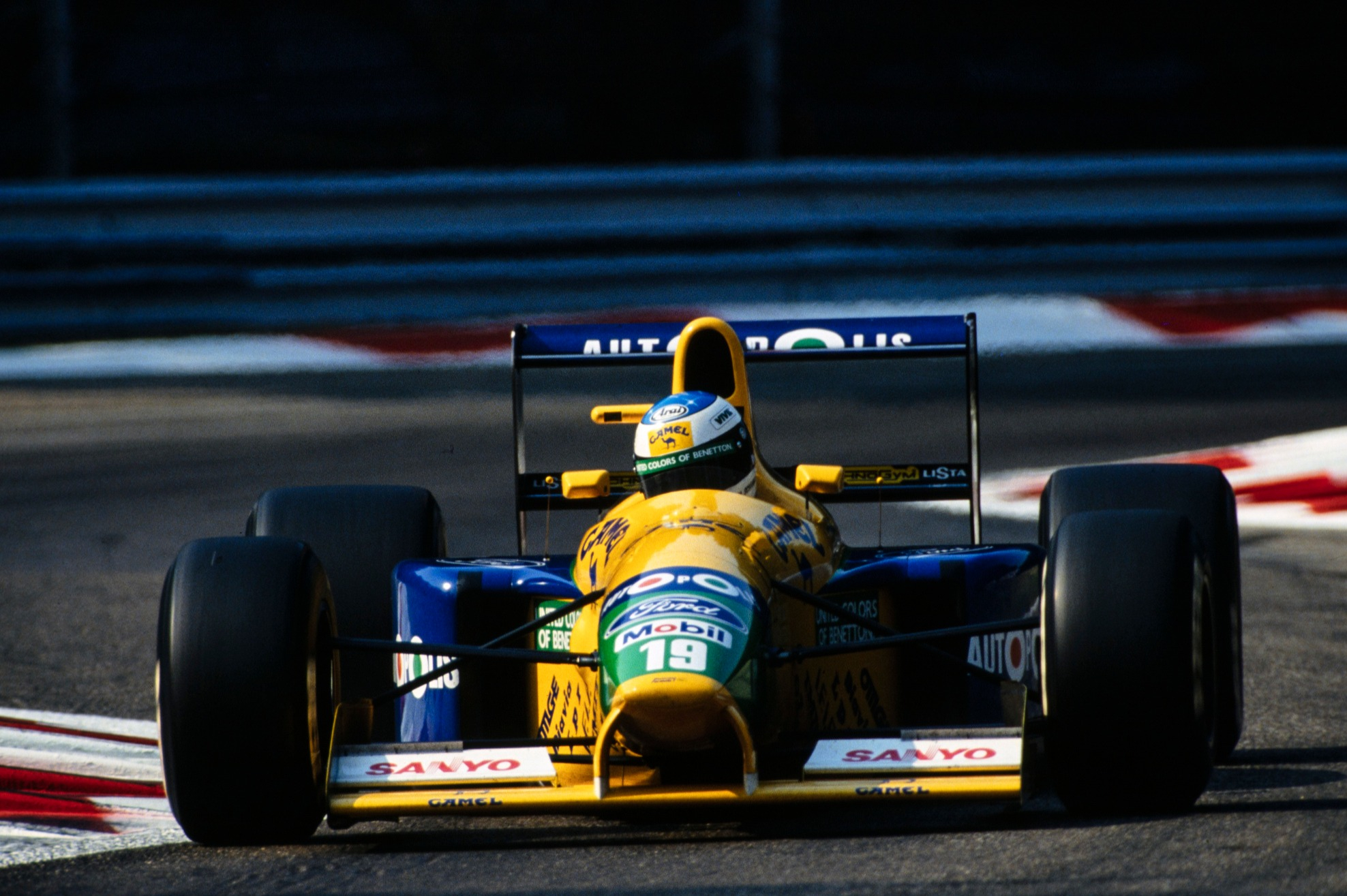
Schumacher quickly made an impression on his Benetton team upon arriving at Monza in 1991
Photo by: Motorsport Images
Indeed, after a legal tussle, Schumacher became a Benetton driver by the next race at Monza, and Moreno had been unceremoniously kicked out.
“You start building a relationship,” says Brawn. “It was the first time we’d worked with him, and he was in this new environment. But he took to it like a duck to water. I think Nelson kicked up a fuss because he could see the problem he had. There was this young kid who was immediately giving him aggravation, whereas his mate Moreno was all nicely under control.”
From the start Schumacher impressed his new team – and the veteran Piquet.
"Nelson was an old hand and was keeping something in his pocket all the time, whereas Michael was young and hungry, and was just stunningly quick straight away" Christian Silk
“He was clearly very fast straight away,” remembers performance engineer Christian Silk. “The two Lesmos were very quick in those days. I was looking at the data between the two cars. And I said to Nelson after the session, ‘Michael is 10km/h faster than you through the second Lesmo,’ and Nelson said, ‘Yeah, but I’ve got a wife and children, and Michael hasn’t…’
“That just about summed it up. Nelson was an old hand and was keeping something in his pocket all the time, whereas Michael was young and hungry, and was just stunningly quick straight away. He had some processing power left over to actually record to his hard drive what the car was doing, so he could come in and say to you, ‘It’s understeering there, it’s oversteering there.’ And I think obviously that was a great strength.”
Schumacher made rapid progress, finishing fifth at Monza and then sixth in both Portugal and Spain. At Suzuka he had a huge qualifying crash, receiving a back injury that would trouble him for years to come.
“Michael had got a bad back,” says Silk. “So we’d be careful with his seat and work with him and come up with a solution that worked for him. Some drivers will go, ‘I’ve got an ache here,’ and use it as an excuse. But it was never an excuse, he never played that card. It was just, ‘I’ve got a bad back, we need to work on the seat, we’ll get it sorted.’ He was a really correct person.”
Schumacher’s initial five-race stint with Benetton at the end of 1991 ended with retirements in Japan and Australia, but the team already knew it had made an inspired call.
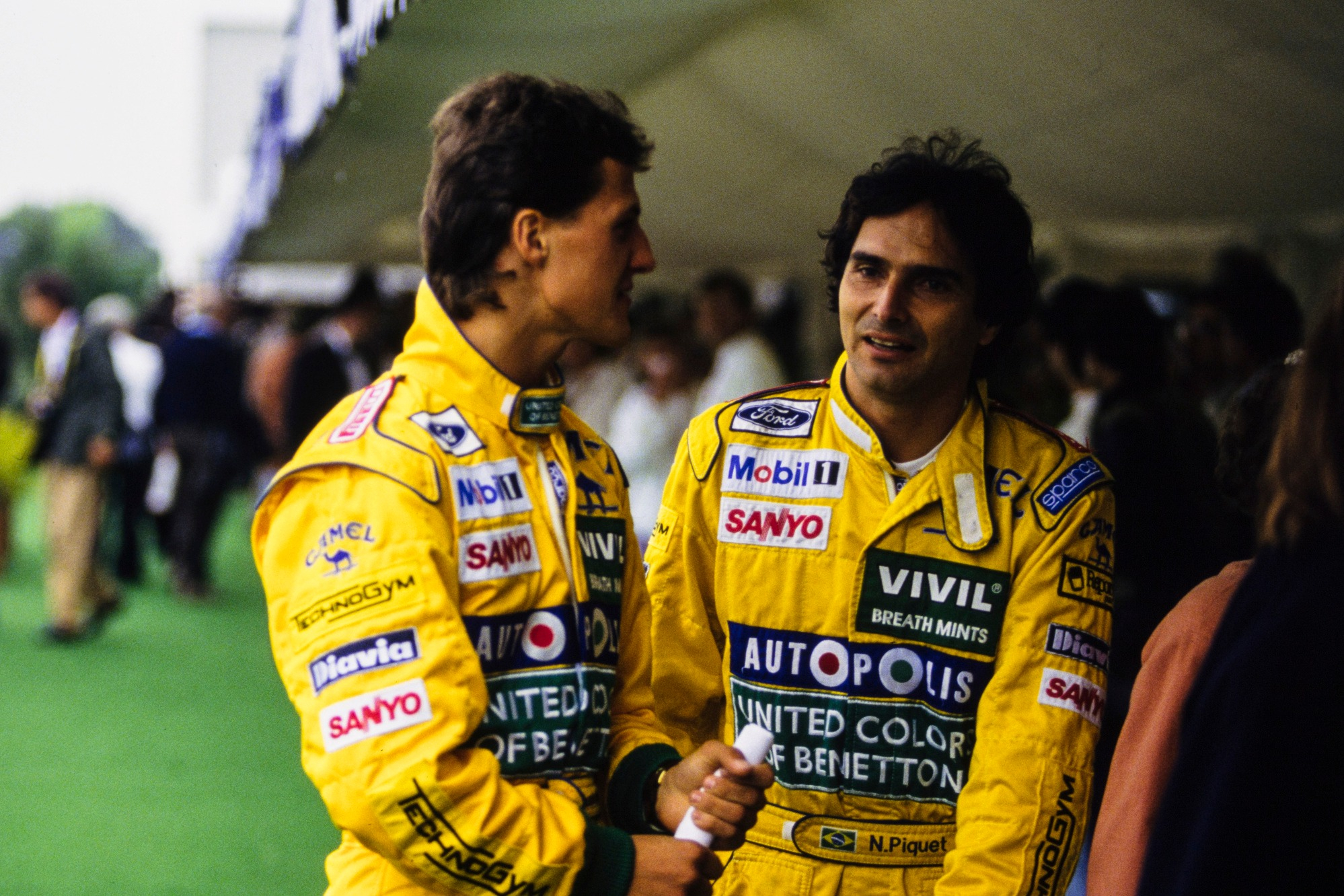
Schumacher's presence in the Benetton team rattled number one Piquet, the ageing treble champion
Photo by: Motorsport Images
“He came very polished,” says Brawn. “He was very fit; fitness was never even a consideration. So Mercedes did a great job of preparing him. We could see he was very special. And you see all the signs, you see how they use the fuel, how they use the engine, how calm they are.
“Certainly with us he never got rattled. He might have got a bit upset out on the track with other drivers, but he generally wasn’t emotional. I think it was clear from day one that he was going to be very special.”
Heading into his first full season with the team in 1992, Schumacher had a new engineer in Pat Symonds, who returned to the camp after a spell away working on the aborted Reynard F1 project.
“It was quite interesting, because Michael had got a lot of hype,” Symonds reflects. “He was quite cocky, and I was confident in my ability. So we had to sort of spar a little bit to sort things out. It stands out in my mind very, very clearly how that came about.
“During the pre-season test in South Africa the car was handling pretty well, and we were quite competitive. But Michael was really uncomfortable in the quick corner, and the car was jumping into oversteer. And he was trying to engineer it, saying, ‘It’s aerodynamic, you’ve got to take off a bit of front wing.’
“But I absolutely knew what was happening: it was just rolling into the bump rubber. And I said, ‘No, we’re gonna fit a stiffer rear rollbar, because you’re not happy with the understeer in the slow corners anyway.’ And he said, ‘No, no, no, that’s wrong.’ I said, ‘Look, this is what we’re going to do.’
PLUS: How Schumacher’s trust made F1 engineering fun
“And he went out and came back and said, ‘The car is now perfect.’ And it was a real turning point. He trusted me. And from that point on, we just had such a good working relationship that just developed and developed during the year until we almost didn’t need to say anything, because we were just thinking along the same lines.
“One thing I really did appreciate was that he had an amazing training by Mercedes. Driving sportscars is a really good training ground anyway; it teaches you the mechanical sympathy, but they did so much more.”

Schumacher and engineer Symonds quickly developed a good rapport
Photo by: Motorsport Images
Schumacher kicked off the 1992 season with a fourth place at Kyalami, and followed up with thirds in Mexico and Brazil, all achieved with the previous year’s car. After the new B192 arrived he earned a superb second in Spain. A crash at Imola was a rare setback, but generally his progress was spectacular.
“I think you could see it, because there were a lot of things that Michael was doing that now we take for granted that were quite new then,” says Symonds. “What really let Senna down in his early days was he was so unfit. He couldn’t perform at a high level through a race, whereas Michael was unbelievable, he knew that fitness was lap time.
“Michael was a very intelligent guy, and I’ve always said that no matter what Michael had chosen as a career, he would have been very successful at it, because the whole way he approached everything was exemplary. He had the attention to detail, he had the incredible recall, he had a very open mind. An example of that was in those days we had that ridiculous Sunday warm-up, an absolute nightmare.
“But what I quite liked about Michael was we’d work and work and work on the car, even through qualifying, a rollbar here, a spring there, whatever it might be. And we’d just try and improve the car. When we got to Sunday morning we’d say, ‘Right, that’s it, that’s the car you’ve got. Now you work on it.’ And he would spend the warm-up just investigating how to go quicker.”
"No matter what Michael had chosen as a career, he would have been very successful at it, because the whole way he approached everything was exemplary. He had the attention to detail, he had the incredible recall, he had a very open mind" Pat Symonds
As 1992 progressed, a healthy rivalry was established with Schumacher’s new team-mate Martin Brundle, who pushed him hard.
“When I look back at my career, one of my regrets is I didn’t realise how bloody good Martin Brundle was,” Symonds admits. “He was a guy who in F3 could race Senna, and in F1 could actually race Michael. You take somewhere like Montreal, Michael finished second there, but Martin had overtaken him before the bolts in the crown wheel failed. People say Michael had the team around him. Yes, he did have the team around him, but he also had a bloody competitive team-mate.”
Schumacher continued to log good points, including another third at his home race in Germany. Then in late August came Spa, and the first anniversary of his debut. The race was impacted by rain, and it came down to a crucial decision to switch back to slicks. Mansell and Williams got it wrong, but Schumacher timed the call perfectly, having observed the state of his own team-mate’s tyres.
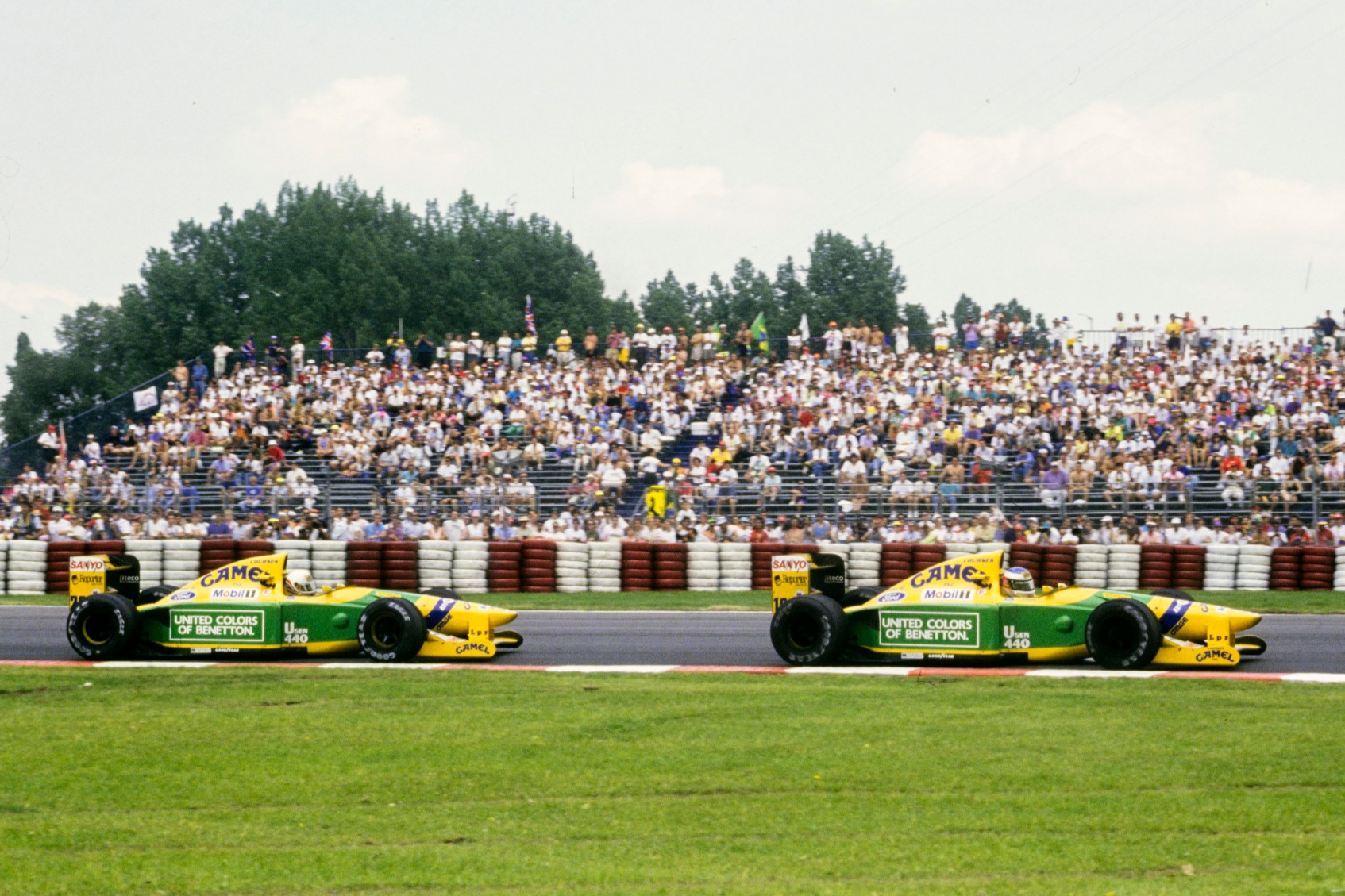
Brundle replaced Piquet for 1992 and pushed Schumacher hard
Photo by: Motorsport Images
“It was a special race, it definitely was,” says Symonds. “But again, what it shows was his intelligence. He made a mistake, and Martin was right behind him and went past.
“Rather than get all flustered about his mistake – ‘I lost place to my team-mate’ – as some would, he was just, ‘OK, I’m behind him, look at his tyres, it’s time to change.’ And that’s what won him the race. On that day, it wasn’t so much his speed or the car speed that won him the race, it was his intelligence.”
PLUS: How Schumacher became the master of F1’s Ardennes wonder
“Michael always had this spare capacity from the very first day,” says Brawn. “Even though he was a rookie he had that spare capacity to be thinking and seeing things and observing things. And that first race win came because of his perception of what was happening with Martin’s tyres in front of him. Had Martin jumped in the pits that day, it could have been his first race win, but there you go. That’s how it works.”
Schumacher would later add further podiums in Italy and Australia, eventually finishing third in the 1992 championship behind Williams duo Mansell and Patrese. Indeed, he was just three points behind the Italian – and also three ahead of Senna.
So did the Benetton team know then that world championship success was just a couple of years away?
“It’s easy to answer those sort of questions arrogantly and say, ‘Yeah, of course I knew,’” says Symonds. “But you never do know, because there are so many things that have to align. And above all, it’s a team sport, you have to be in the right place at the right time.
“So I’m not going to say in ’92 I knew he was going to be a world champion, but the fact is that when someone wins their first race in their first season, you probably do think that – they do something that makes you think, ‘Yeah, he’s going places.’
“It can go wrong from there, but with Michael it actually went the other way. We just got the things together. He was still improving through ’92 and ’93, and in ’94 we gave him the equipment to show what he could do with it.”
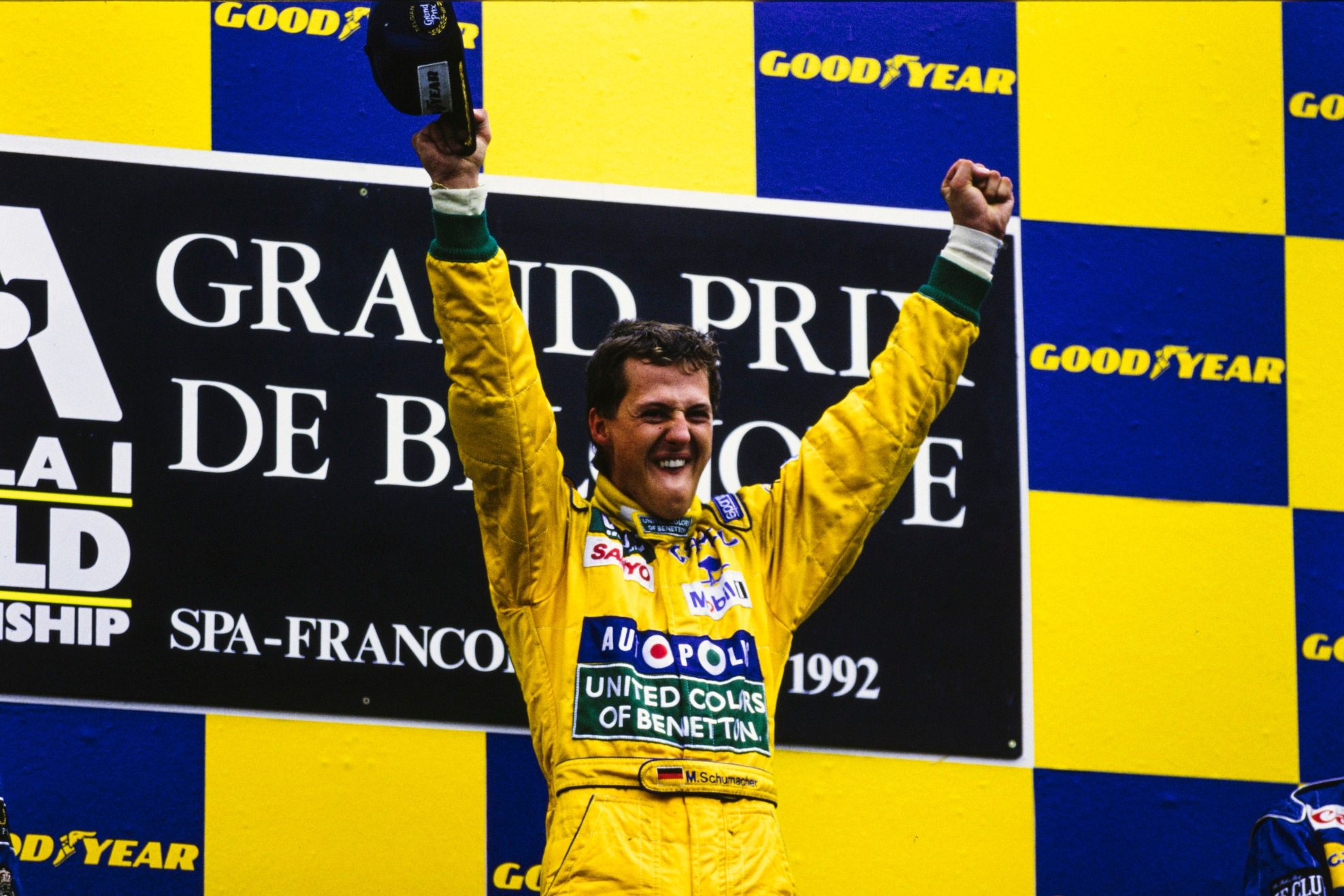
Schumacher's first win at Spa in 1992 lit the fuse under his bubbling career momentum
Photo by: Motorsport Images

Krack: Aston Martin F1 team no longer in “no-man’s land”

Gasly rues costly floor damage from Ocon contact in F1 Japanese GP

Andretti planning F2 and F3 entries to promote US talent to F1 team

Andretti F1 team formally opens new Silverstone facility

RB: Tsunoda “mentally on a different level” in 2024

Russell: Dirty air is causing F1 helmet turbulence problems

Vasseur: No guarantee that Ferrari F1 tyre issues are resolved

How an F1 underachiever became a Japanese political player

How Antonelli levelled up his character to be F1 2026's world champion-elect

FIA set to close F1 cost cap loophole with new rules

Norris promises to make "better decisions" following fresh talks over Singapore GP clash

FIA expects F1 races in Qatar and Abu Dhabi to run as planned
Subscribe and access Autosport.com with your ad-blocker.
From Formula 1 to MotoGP we report straight from the paddock because we love our sport, just like you. In order to keep delivering our expert journalism, our website uses advertising. Still, we want to give you the opportunity to enjoy an ad-free and tracker-free website and to continue using your adblocker.


Top Comments