


The surprising convergence behind F1's increasingly competitive 2026 season
Following early indications Formula 1 2026 would be a Mercedes walkover, a closely contested second half of the season is setting up an intriguing 2027 campaign

Lando Norris, McLaren, Liam Lawson, Racing Bulls, Andrea Kimi Antonelli, Mercedes
Photo by: Alex Bierens de Haan / Getty Images
As George Russell took pole for F1 2026's curtain raiser in Australia by a whopping eight tenths over Mercedes's nearest rivals, you could see the collective heads drop in the paddock.
With this season the first year of all-new regulations, both on the chassis and power unit side, there were genuine fears of a 2014 repeat, with Mercedes out in front and the competition fighting over scraps.
Mercedes certainly did try to make the most of its early advantage, despite its power unit's reliability woes, as it has now sealed both the drivers' and constructors' title with three rounds to spare.
But the second half of the season after the summer break paints a different competitive picture. A picture in which all four top teams have had their chance to shine, owing to the ebb and flow of powerful upgrades being fast-tracked as part of a frantic in-season development race.
Lando Norris dominated either side of the summer break with wins in Hungary and the Netherlands, and what should have been a third win in Madrid. That followed a strong spell for Ferrari with one win apiece for Lewis Hamilton and Charles Leclerc.
Later on, Red Bull made perhaps the most impressive comeback of all by clawing back one second, enabling Max Verstappen to take three wins over the past five races.
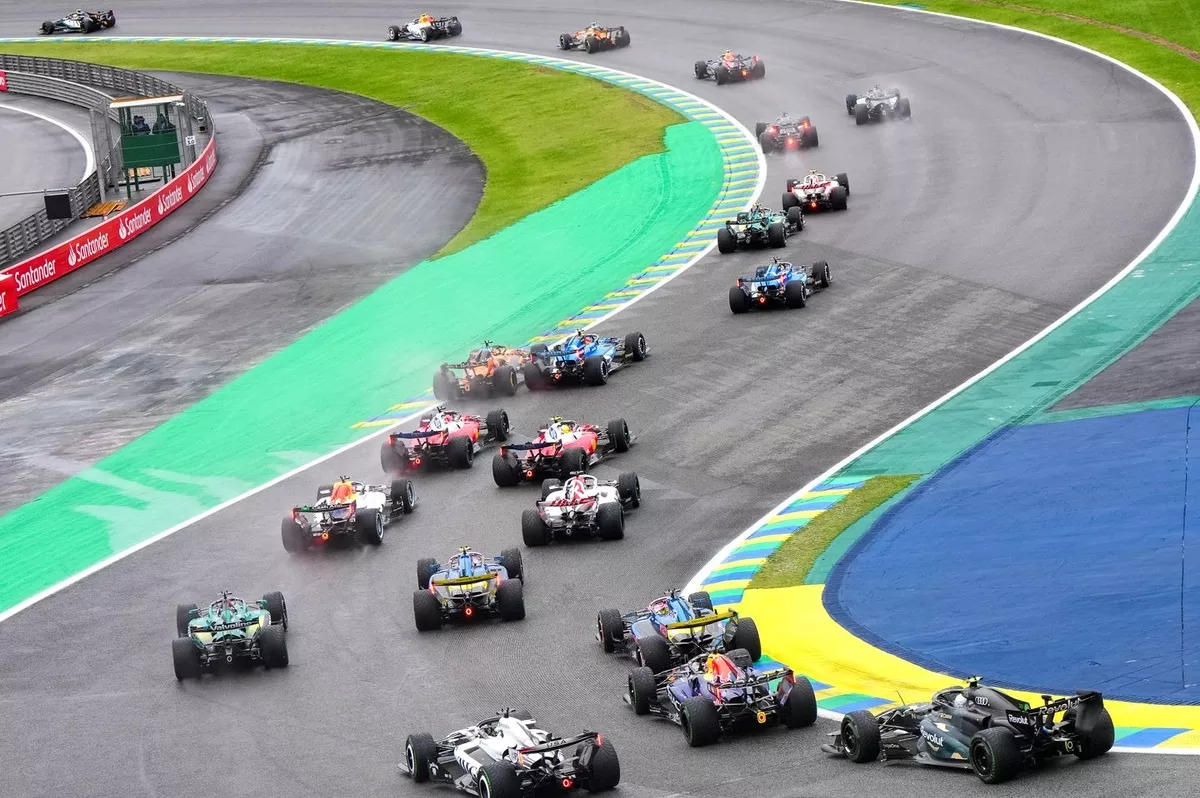
The end result is that Mercedes outscored Red Bull by just a single point since the summer break, while Ferrari could have been closer with better race weekend execution. McLaren has firmly been the fourth-fastest team only for Norris to excel in the wet in Sao Paulo last week.

Andrea Kimi Antonelli, Mercedes
Photo by: Anadolu via Getty Images
Constructors' standings since the summer break
| Position | Team | Points |
|---|---|---|
| 1 | Mercedes | 227 |
| 2 | Red Bull | 226 |
| 3 | Ferrari | 172 |
| 4 | McLaren | 133 |
That convergence is best observed in qualifying, with the top four teams covered by three tenths in Singapore and Mexico. Austin was a difficult race for McLaren, but Kimi Antonelli, Verstappen and Leclerc all qualified within 0.230s at COTA. The absolute highlight was a thrilling qualifying session at the inaugural edition of Madring's Spanish Grand Prix, where the top five qualified within 0.195s across four different teams.
The new regulations have caused the top teams to enjoy a bigger advantage over the midfield than last year, which some feel is down to the cost cap restricting smaller teams from catching up. However, the fight at the front is demonstrably closer than what most observers expected during the first year of a new regulations cycle, especially given the added variable of power units being a bigger differentiator.
Why is that the case? When Autosport asked McLaren chief Andrea Stella that question, the Italian believes that under the budget cap, F1's four top teams have all converged in terms of the quality and quantity of their personnel, and with it the quality of ideas and methodologies at the front end of the field.
"In my view, teams have never operated at these standards," Stella said in Austin. "Four teams, and even the other teams, keep developing at this rate within a cost cap and somehow everyone has found a way to deliver lots of upgrades.
"The second consideration is that car performance is an expression of the expertise and know-how that you can realise from an engineering point of view. When you have a group of people that have established methodologies, knowledge, a certain way of working together, then they deploy this expertise and know-how to attack a certain group of regulations, and they achieve a certain level.
"Ultimately, it's the same people that attack a new regime of regulations, so I'm not surprised that, because it was close in the past, it's close in the present. In the second half of the season things are converging, but this is because it's just the quality of the team that gets reflected into the technical product."

Andrea Stella, McLaren
Photo by: Steven Tee / LAT Images via Getty Images
Ferrari boss Fred Vasseur noted the rate of aerodynamic development is much steeper than in previous years, which explains why car performance can fluctuate so much weekend to weekend. "The first six races of the season were a bit difficult compared to Mercedes, they were perhaps six, seven tenths faster than us, and we came back all over the season. Now we score more points than everybody after Madrid," he said in Sao Paulo.
"We won races in June, McLaren in July, Red Bull in August or September, and we came back. What is true is that the first year of new regulations, the gradient of upgrades is much higher. Each time we are bringing something, we are doing a step. Look at McLaren this weekend [in Brazil], where McLaren deployed a new front wing to good effect].
"It's the story of the season. We had this kind of rotation, but I think this convergence of performance is good for the championship and good for the show."
Red Bull chief Laurent Mekies also pointed out the new regulations appear more restrictive at first, though the number of innovations this year - such as the Ferrari pioneered rotating rear wing - suggest there's still plenty of scope to exploit the fine print.
"The convergence is probably happening earlier than what we all thought," the Frenchman said when quizzed by Autosport about the subject in Brazil. "I'm guessing somehow, it's perhaps an indication of fairly restrictive regulations. That being said, you see cars with visibly different concepts, and you see four top teams fighting.
"What is fair to say is that to be already in the second part of 2026 we're in a situation where you turn up at a race weekend and you don't know which one of the four top teams is going to win the race, I think it's great for the sport. Now we have a top five in qualifying separated by two tenths. It's a strong combination of the development race and absolute perfect execution if you want to win on Sunday."

Lewis Hamilton, Ferrari, Max Verstappen, Red Bull Racing, Andrea Kimi Antonelli, Mercedes
Photo by: Colin McMaster / LAT Images via Getty Images
That means 2026's world champion Mercedes will have its work cut out next year to defend both of its titles. Team boss Toto Wolff was under no illusion that this regulations cycle would be a repeat of the 2014 era.
"The competition has been getting tougher between Ferrari, McLaren, Red Bull and ourselves," Wolff acknowledged. "It's four teams that can win races and will be challenging for a world championship. And I have no doubt that it's going to be very difficult for us next year. So for me, the 2027 season has started now. It is about learning in the three last races."
Echoing Stella's thoughts about the four big teams operating at a similar standard right now, Wolff added: "It looks like maybe the most competitive era that is about to start, because the teams have become so professional in capability, in resource, that these kind of runaway seasons, I don't see them anymore, whether it's four in a row or eight in a row.
"You can see how quickly it goes from being dominant, and within a few races you realise that your upgrade doesn't work, and you fall back and you're just third on the road.
"I wish it was the era of Mercedes running away with another few championships, but I don't think it's the reality. It's a completely new challenge."


Singapore GP sprint qualifying
SQ3
| Cla | Driver | # | Chassis | Engine | Laps | Time | Interval | Tyres | km/h | |||
|---|---|---|---|---|---|---|---|---|---|---|---|---|
| 1 |  M. Verstappen Red Bull Racing |
3 |  |
Red Bull | Red Bull | 15 |
1'31.156 |
S | 194.580 | |||
| 2 |  G. Russell Mercedes |
63 |  |
Mercedes | Mercedes | 21 |
+0.120 1'31.276 |
0.120 | S | 194.324 | ||
| 3 |  C. Leclerc Ferrari |
16 |  |
Ferrari | Ferrari | 19 |
+0.243 1'31.399 |
0.123 | S | 194.063 | ||
| 4 |  O. Piastri McLaren |
81 |  |
McLaren | Mercedes | 19 |
+0.298 1'31.454 |
0.055 | S | 193.946 | ||
| View full results | ||||||||||||
Singapore GP qualifying
Q3
| Cla | Driver | # | Chassis | Engine | Laps | Time | Interval | Tyres | km/h | |||
|---|---|---|---|---|---|---|---|---|---|---|---|---|
| 1 | M. Verstappen Red Bull Racing |
3 |  |
Red Bull | Red Bull | 15 |
1'31.373 |
S | 194.118 | |||
| 2 | C. Leclerc Ferrari |
16 |  |
Ferrari | Ferrari | 25 |
+0.054 1'31.427 |
0.054 | S | 194.003 | ||
| 3 | L. Hamilton Ferrari |
44 |  |
Ferrari | Ferrari | 25 |
+0.123 1'31.496 |
0.069 | S | 193.857 | ||
| 4 |  A. Antonelli Mercedes |
12 |  |
Mercedes | Mercedes | 23 |
+0.189 1'31.562 |
0.066 | S | 193.717 | ||
| 5 | L. Norris McLaren |
1 |  |
McLaren | Mercedes | 24 |
+0.339 1'31.712 |
0.150 | S | 193.401 | ||
| View full results | ||||||||||||
US GP qualifying results
Q3
| Cla | Driver | # | Chassis | Engine | Laps | Time | Interval | Tyres | km/h | |||
|---|---|---|---|---|---|---|---|---|---|---|---|---|
| 1 | A. Antonelli Mercedes |
12 |  |
Mercedes | Mercedes | 18 |
1'34.035 |
S | 211.057 | |||
| 2 | M. Verstappen Red Bull Racing |
3 |  |
Red Bull | Red Bull | 12 |
+0.179 1'34.214 |
0.179 | S | 210.656 | ||
| 3 |  I. Hadjar Red Bull Racing |
6 | |
Red Bull | Red Bull | 12 |
+0.215 1'34.250 |
0.036 | S | 210.576 | ||
| 4 | C. Leclerc Ferrari |
16 |  |
Ferrari | Ferrari | 15 |
+0.232 1'34.267 |
0.017 | S | 210.538 | ||
| 5 | L. Hamilton Ferrari |
44 |  |
Ferrari | Ferrari | 14 |
+0.276 1'34.311 |
0.044 | S | 210.439 | ||
| 6 | G. Russell Mercedes |
63 |  |
Mercedes | Mercedes | 18 |
+0.441 1'34.476 |
0.165 | S | 210.072 | ||
| 7 | O. Piastri McLaren |
81 |  |
McLaren | Mercedes | 20 |
+0.768 1'34.803 |
0.327 | S | 209.347 | ||
| View full results | ||||||||||||
Mexico GP qualifying results
Q3
| Cla | Driver | # | Chassis | Engine | Laps | Time | Interval | Tyres | km/h | |||
|---|---|---|---|---|---|---|---|---|---|---|---|---|
| 1 | L. Hamilton Ferrari |
44 | |
Ferrari | Ferrari | 20 |
1'16.514 |
S | 202.504 | |||
| 2 | G. Russell Mercedes |
63 |  |
Mercedes | Mercedes | 22 |
+0.009 1'16.523 |
0.009 | S | 202.480 | ||
| 3 | C. Leclerc Ferrari |
16 |  |
Ferrari | Ferrari | 24 |
+0.119 1'16.633 |
0.110 | S | 202.189 | ||
| 4 | M. Verstappen Red Bull Racing |
3 | |
Red Bull | Red Bull | 14 |
+0.178 1'16.692 |
0.059 | S | 202.034 | ||
| 5 | A. Antonelli Mercedes |
12 | |
Mercedes | Mercedes | 24 |
+0.193 1'16.707 |
0.015 | S | 201.994 | ||
| 6 | L. Norris McLaren |
1 |  |
McLaren | Mercedes | 21 |
+0.310 1'16.824 |
0.117 | S | 201.686 | ||
| View full results | ||||||||||||
Brazilian GP qualifying results
Q3
| Cla | Driver | # | Chassis | Engine | Laps | Time | Interval | Tyres | km/h | |||
|---|---|---|---|---|---|---|---|---|---|---|---|---|
| 1 | L. Norris McLaren |
1 | |
McLaren | Mercedes | 24 |
1'27.470 |
I | 177.345 | |||
| 2 | G. Russell Mercedes |
63 |  |
Mercedes | Mercedes | 23 |
+0.204 1'27.674 |
0.204 | I | 176.932 | ||
| 3 | A. Antonelli Mercedes |
12 | |
Mercedes | Mercedes | 23 |
+0.625 1'28.095 |
0.421 | I | 176.087 | ||
| 4 | C. Leclerc Ferrari |
16 |  |
Ferrari | Ferrari | 22 |
+0.819 1'28.289 |
0.194 | I | 175.700 | ||
| 5 |  L. Lawson Racing Bulls |
30 |  |
RB | Red Bull | 24 |
+0.851 1'28.321 |
0.032 | I | 175.636 | ||
| 6 |  N. Hulkenberg Audi |
27 |  |
Audi | Audi | 23 |
+1.198 1'28.668 |
0.347 | I | 174.949 | ||
| 7 | I. Hadjar Red Bull Racing |
6 | |
Red Bull | Red Bull | 24 |
+1.293 1'28.763 |
0.095 | I | 174.762 | ||
| View full results | ||||||||||||
Share Or Save This Story


Lawson to stay in F1 as Racing Bulls announces 2027 driver pairing

How Brazil showcased everything that's good about F1 - plus some that isn't

How the Racing Bulls pendulum is swinging back towards Lawson


What the Brazilian GP revealed about F1's ability to cope with rain

F1 2026 calendar update: Imola off the table, no plan B if Iran war escalates

Why Ferrari must act now after its own 'Papaya Rules' moment

The surprising convergence behind F1's increasingly competitive 2026 season

Why aerodynamics will become "even more important" under 2027 MotoGP regulations

The lowdown on this year’s FIA F3 title protagonists

The Antonelli you don't know: Inside the Mercedes garage with F1's new world champion
Subscribe and access Autosport.com with your ad-blocker.
From Formula 1 to MotoGP we report straight from the paddock because we love our sport, just like you. In order to keep delivering our expert journalism, our website uses advertising. Still, we want to give you the opportunity to enjoy an ad-free and tracker-free website and to continue using your adblocker.


Top Comments