


The one aspect of the 2026 US GP that should be a blueprint for F1 2027
Antonelli? Leclerc? F1's real MVP of the US GP weekend turned out to be the hard tyre - largely against expectations. But the usefulness of all three compounds produced some strategic variance, which should be pursued next year

Charles Leclerc might have won 'driver of the day' at the United States Grand Prix, but there was one crucial component in his late-race push for second - and in Kimi Antonelli's victory, and a component that Max Verstappen did not have in his corner across the race.
Perhaps the award ought to take its cues from The Simpsons episode "Deep Space Homer" - the one where Homer becomes an astronaut. In the prelude to his space-bothering antics, he'd been beaten to the Springfield Nuclear Powerplant's employee of the month award by - yes - an inanimate carbon rod.
So, let's award driver of the day again - if you please, round of applause for...the hard tyre! Long live the C2 compound, and all who used it. We'll be serious now.
There were hints that the hard tyre might actually fare pretty well in the race, demonstrated by Lando Norris' stint on the C2 during FP2. If we'd incorporated this into the long runs of our usual practice analysis, Norris' stint average was quicker than those logged by Leclerc and Verstappen on the soft, but we chose to default to the driver who'd used the softest compound for a clearer comparison of car pace. This probably masked the power of the hard compound, and Pirelli's suggestion that the hard would only be used sparingly suggested that the softs and mediums would dominate proceedings on Sunday.
As it happened, the hard tyre was the one to have. Degradation had a bigger effect than perhaps anticipated over the race; although free practice did show some degree of drop-off in performance for the soft, the stints perhaps weren't long enough to truly illustrate the compound cross-over point. As such, this cross-over approached faster than expected, and the hard tyre was simply able to outlast any of the other compounds - as you'd expect from a more durable construction. It was generating good grip over a pretty long period of time.
Antonelli and the McLaren drivers offered a demonstration of that durability. When Antonelli stopped at the end of lap 24, he'd been able to extend his medium-tyre stint without losing too much time, and the use of the hard ensured that he was able to cover off whatever Verstappen could do on the medium in the second half of the race. It didn't help Verstappen's cause that his pace plateaued once he'd caught the one-stopping Norris, but this is further emblematic of the hard tyre's advantage across the course of the grand prix. Norris had stopped on lap 16, while Verstappen's medium tyre was 15 laps fresher, but this offset could not buy the Red Bull driver enough pace to close in at anything more than a couple of tenths per lap.

Antonelli got a tune out of his hard tyres, ensuring Verstappen's attempts to charge towards the lead stalled out
Photo by: Alex Slitz / Getty Images
When Verstappen did get the move done, this was effectively in response to Leclerc's arrival in his mirrors; it was pass or be passed, and the resulting move at Turn 1 was a perfectly managed blend of prolonging his time on the throttle pedal, and an inch-perfect application of the brakes. It didn't do him much good in the long run, and Verstappen was ultimately powerless to resist Leclerc's eventual play for second, but it at least added a touch of shine to the Dutchman's afternoon.
Norris had been able to keep the hard tyres in for 40 laps, while Oscar Piastri had done likewise for a race-high of 41. From the sound of the McLaren radio chatter, a two-stopper was perhaps the initial plan but, as the Australian had been able to counter everything that George Russell had thrown at him, McLaren kept him out.
"The softer compounds today were not really working that well. I think the way that we used our tyres in the order was wrong" Max Verstappen
So, it was durable - but we knew that already. The performance of the hard tyre, then, was perhaps a surprise to everyone - Isack Hadjar questioned it after his sole stop of the afternoon, in between the usual smattering of existential crises and expletives you usually hear from his radio traffic.
This is where the stints from Leclerc and Lewis Hamilton demonstrate the advantage of the hard. In switching to the C2 for their final stint, they'd guaranteed themselves a tyre that they were able to push on until the end of the race, presenting an opportunity to flex the offset over Verstappen while knowing that they wouldn't encounter much of a drop-off.
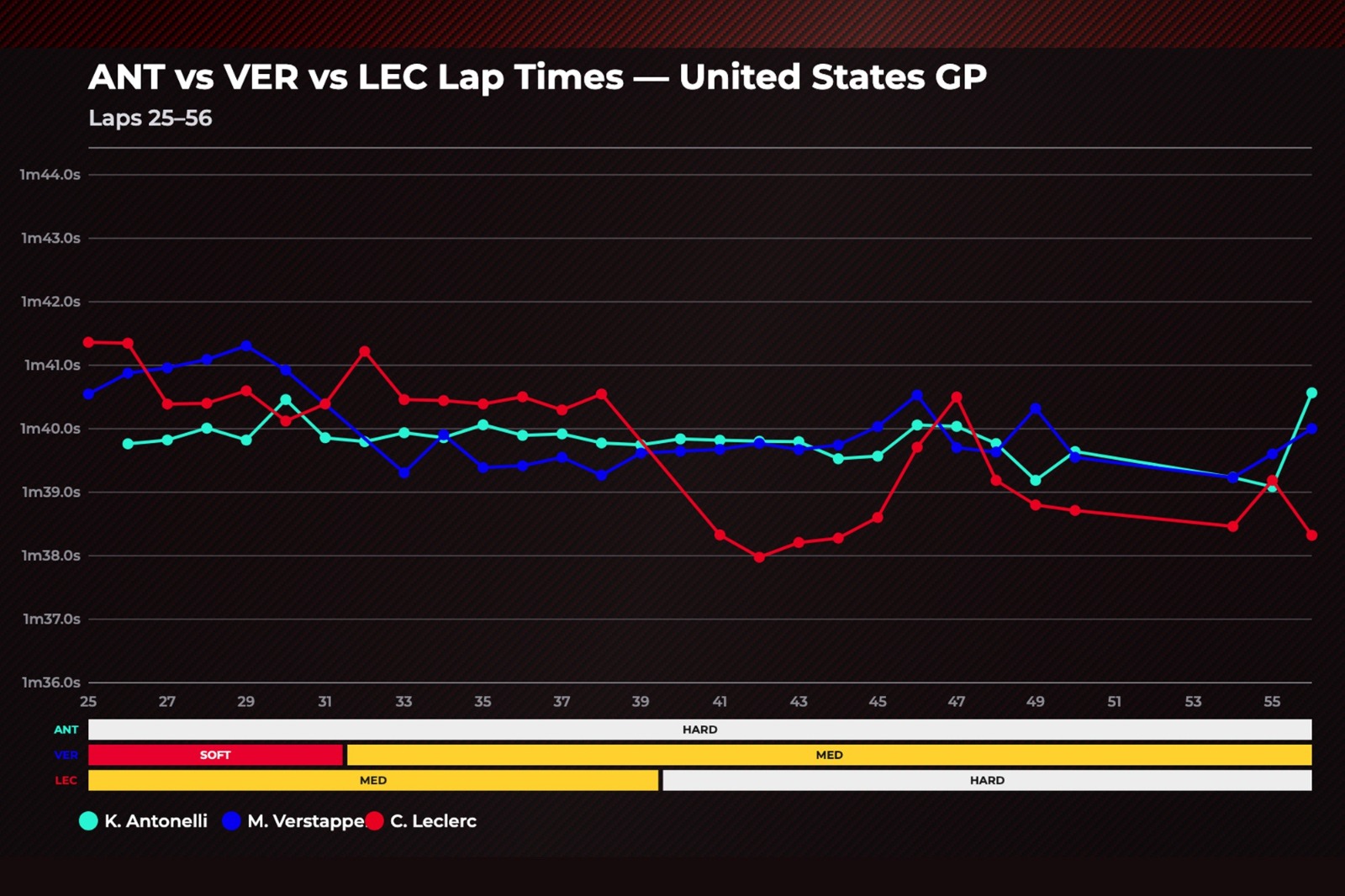
The race stints of Antonelli, Leclerc, and Verstappen from lap 25 - demonstrating the hard tyre's pace
The white-walled tyre, however, was also incredibly receptive to delivering high levels of grip from the get-go; the two Ferraris proceeded to light up the timing screens and Leclerc's 1m37.976s ultimately ended up as the fastest lap of the race. Furthermore, Leclerc was able to sit comfortably in the 1m38s for a prolonged period of time.
Sure, context matters, and it's true that those who ran with the soft tyre towards the end of the race wouldn't usually be challenging for any kind of fastest-lap honours - Bortoleto's 1m38.393s being the quickest lap logged on the C4, a couple of laps after his VSC stop. By comparison, the best lap on the medium tyre - logged by Verstappen - was a mere 1m39.231s.
Hadjar's surprise at taking on the hard tyre alluded to Red Bull's view of the C2, in that the team believed that the softer compounds would be the more effective choices - even with an extra stop. Post-race, Verstappen confirmed as much to explain why Red Bull was not initially bowled over by the hardest compound option.
"In hindsight it's very easy to say, but for whatever reason, the softer compounds today were not really working that well. I think the way that we used our tyres in the order was wrong. Plus, I think at one point it was quite clear that the people on the harder compounds were finding a lot of grip, so I guess we also didn't really react to that," he explained.

Verstappen thought Red Bull got its tyre sums wrong in Austin
Photo by: Alex Bierens de Haan / LAT Images via Getty Images
"Just probably sticking too much to our belief from the last two races, where the softer compounds were the fastest, and clearly here that didn't work. Of course, if we chose different tyres, probably we could have maybe been second, but that's always easy to say afterwards."
Leclerc and Antonelli agreed that the hard was probably the best option, particularly for their purposes as some of the fuel had burned off by the time they'd picked up their sets of the C2. Mercedes didn't have any new softs left for the race, which forced its hand somewhat, while Red Bull had got through qualifying having used just three of its six sets available.
You might be thinking, if you've got this far, that this is all very well - but so far over 2026, most of the races have been one-stoppers with little variation. Why are we talking about this now?
"One of the most exciting races I ever remember was in Bahrain. People doing two stops versus three stops, and then with the brand new soft tyres, we had a very, very aggressive three stops, just like a sprint race" Ayao Komatsu
There is context to this. Arguably, the only aspect that brought life to this year's US Grand Prix was the tyre strategy, and the offsets ensured that nothing was a foregone conclusion until the final stages of the race. Pirelli appears to have accepted that its 2026 compounds have been on the durable side, and the myth of durable tyres equalling more interesting races should have now died a death.
What matters is strategic variance, and the chance to make an offset strategy work; for 2027, the Italian tyre supplier is planning to introduce compounds that exhibit a little more degradation to break the races out of their single-stop inertia. Austin's race has demonstrated why this is a good idea; had the tyres been even more durable, it would have been an incredibly dull affair.
When the news that Pirelli would consider less durable compounds came to light, we asked Haas boss Ayao Komatsu - once a tyre engineer in his early F1 days - to explain why this was going to be beneficial.
"One of the most exciting races I ever remember was in Bahrain [he didn't mention a year] people doing two stops versus three stops, and then with the brand new soft tyres, we had a very, very aggressive three stops, just like a sprint race. Just qualifying laps, qualifying, qualifying, qualifying against the two stoppers, who's doing some tyre management. And then we managed to beat some two stoppers with a three stopper.

All three tyre compounds should be equally as popular next year, if Pirelli can slightly increase degradation
Photo by: Mark Sutton / Formula 1 via Getty Images
"Another exciting race I remember is Canada some time ago, Montreal. Mainly, the baseline strategy was two stops, but one-stop was possible if you did it right. And then we just did a focus on tyre management, making the one-stop work because we didn't qualify too well. And then we managed to beat faster cars with one stop versus two.
"So what Formula 1 and the tyres need to achieve is to have the mixture. Even if it's three stop, it doesn't matter if everybody's doing three stops. Even if it's two stop, if everybody's doing two stop with two compound, that's going to be boring.
"So what's important is having a mixture of one versus two or two versus three, just a mixture of strategy because then what happens is at some point in the race, some have got fresh tyres, some have got tyres that are dying or managing, then overtaking happens. Because just about performance differentiator from the car on its own, sometimes it's not enough. So you've got to have that tyre differentiation.
"You saw in Baku, right? Nobody touched the hard. So what's the point of having three compounds? You've got to have three compound that are usable. Those three compounds have to have positives to use in the race. If you only like the medium and soft, that's already 33% of the options gone. So that makes it more predictable, more boring."
And it's fair to say that Austin demonstrated that. There were two-stop races, one-stop races, and every compound (more or less) had a place over the course of the grand prix. This should be the blueprint for races next season, if Pirelli can get the formula right.
Exciting races will, of course, develop on their own - but for circuits destined to provide more tedious races, the strategic shake-up should be able to allow those one-stop affairs to evolve into borderline one-two stop runs - as Austin demonstrated. This can never be guaranteed, of course, but tweaking the durability of each compound will be a step in the right direction.


We're not quite suggesting Pirelli should reinstate its 2012 approach - just a small tweak should do the trick...
Photo by: Sutton Images


A strategic masterclass: How Antonelli put himself on the cusp of F1 title at the US GP

Leclerc and Hamilton's differing theories behind Ferrari's Austin qualifying disappointment

What we learned from Friday practice at the 2026 United States GP

The reasons behind Ferrari's US GP upgrades

Mission control: Inside the FIA and F1's remote operations centre

FIA expects F1 races in Qatar and Abu Dhabi to run as planned

Why Piastri has struggled to show his best with this year's McLaren MCL40

Lights, Camara, action: How Haas picked F1's latest rookie for 2027
The one aspect of the 2026 US GP that should be a blueprint for F1 2027

Red Bull explains why Verstappen and Hadjar's 'silly' problems won't all be fixed in 2026

Why being "very adaptive" gave Norris the edge over Piastri at US GP

Smyth makes Formula Ford Festival history as he wins despite clash with team-mate Murray
Subscribe and access Autosport.com with your ad-blocker.
From Formula 1 to MotoGP we report straight from the paddock because we love our sport, just like you. In order to keep delivering our expert journalism, our website uses advertising. Still, we want to give you the opportunity to enjoy an ad-free and tracker-free website and to continue using your adblocker.


Top Comments