


The principles at stake in the Verstappen/Hamilton Turn 4 clash
OPINION: The FIA's decision not to investigate Max Verstappen for his move to repel Lewis Hamilton's challenge for the lead of the Brazilian Grand Prix, which resulted in both going off the track, has become the latest polarised incident in the dramatic 2021 Formula 1 title battle. Regardless of which side of the fence you sit on, the lack of consistency from those upholding the rules should be seen as a point of concern

One of the fundamental principles of law is that laws are clear, publicised, stable and fair. It is also essential that there is consistency in their application, for the rule of law requires that laws be applied equally, without unjustifiable differentiation. Inconsistency in the way they are applied is one of the easiest ways to promote feelings of unfairness; and if such unfairness becomes accepted as the norm, then the laws effectively cease to have consent.
In sport, it is equally vital that competitors all operate to the same rule book, and understand and accept that the application of regulations are upheld in the most fairest of ways. That is why Formula 1 has got itself in a bit of a pickle over the latest incident between Max Verstappen and Lewis Hamilton, which has left it open to accusations that the rules of racing are hazy, do not exist in writing, are wildly inconsistent and appear to favour some drivers over others.
The negativity around the FIA’s decision not to even investigate Verstappen’s running wide moment on lap 48 of the Brazilian Grand Prix - termed “laughable” by Mercedes boss Toto Wolff - was also further ramped up when it emerged that race control did not even look at a potential ‘smoking gun’ of the Red Bull driver’s forward facing on-board camera. That footage finally emerged on Tuesday, and it has done little to converge the polarised views of the Hamilton and Verstappen camps about whether or not a penalty was justified from the incident.
Looking at the onboard, it is clear that Verstappen did not do anything obviously nefarious – like turning towards Hamilton in a bid to recklessly drive him off the track. Such actions would definitely have been worth a sanction. However, his acute steering angle on the entry to the corner – much less input that he gave on the previous lap – does point towards him squeezing Hamilton out. It is only late in the turn, when Hamilton has been successfully repelled, that Verstappen steers more before washing out over the run off.
However, steering angles do not tell the true story of what a driver is experiencing and intending, so more telemetry – such as throttle and brake traces, plus GPS data – would be needed to get a proper understanding of what really was going on. And, while it is hard without such information to make a properly informed decision about whether or not it is worth a penalty just based on the on-board, what seems far more clear cut is that it was definitely worth an investigation.
That it didn’t is down to both F1 race director Masi and the stewards who, under F1’s Sporting Regulations, have the option to open an investigation if an incident is noted – as happened on Sunday.

Masi elected not to investigate the latest flashpoint between Hamilton and Verstappen, without seeing the full evidence
Photo by: Jerry Andre / Motorsport Images
The biggest problem with the Verstappen decision isn’t just about what happened on Sunday. It is that it flies in the face of other rulings that have been made on similar incidents this year when penalties have been dished out.
One of the key comparisons has been made with the clash between Lando Norris and Sergio Perez at the Austrian Grand Prix this year, when they disputed position at Turn 4 in similar circumstances. On that occasion, the attacking car (Perez) pulled alongside on the entry to the corner and stood ground on the outside of the turn.
Norris, defending his place, ran out towards the kerb on the exit and squeezed Perez (without contact) off the track – something the stewards were absolutely clear was not allowed. The McLaren driver was given a five-second time penalty, which Red Bull boss Christian Horner said he didn't deserve. In their explanation for why Norris was guilty of an offence, the stewards said: “At the entry of turn 4, PER and NOR were side by side. Then on the exit NOR was judged not to give PER enough room and PER was forced off the track.”
Treating each incident differently is a recipe for massive inconsistency. Plus adopting ‘let them race’ principles is all well and good, but then there has to be consistency in when they are applied and when they are not
Masi later explained that, in the case of Norris/Perez, plus later clashes between Perez and Ferrari’s Charles Leclerc, that a car’s width had to be left on the exit of a corner if the attacking car had drawn level.
“In Sergio's one with Lando, he was wholly alongside Lando,” explained Masi. “Therefore there is an onus to leave a car's width to the edge of the track. And then the same in the reverse with Checo and at exit of turn four, and then Checo and Charles again at the exit of turn six.
“Obviously I don't sit in the stewards room to deliberate, but their view was in all three circumstances that a car's width should have been left to the edge of the track because the two cars were alongside each other."
That summary in effect seems to suggest that since Hamilton had drawn alongside Verstappen (and indeed was ahead), then he should have been left room. Masi argues, however, that previous rules should not be compared in current incidents as the circumstances of each and every one are different.

Norris was penalised for ushering Perez wide in Austria
Photo by: Erik Junius
“You judge the incident on its merits, and you have a look at all of it,” he said about the decision not to investigate the Verstappen/Hamilton matter. “And let's not forget, we have the overall ‘let them race’ principles, and looking at it all, with all of the angles that we had available, that philosophy was adopted."
But treating each incident differently is a recipe for massive inconsistency. Plus adopting ‘let them race’ principles is all well and good, but then there has to be consistency in when they are applied and when they are not.
For if drivers cannot base their behaviour on incidents that have happened before, or know if they can or can’t push the boundaries with ‘let them race’ freedom, then that uncertainty means there is no consent to rules – as effectively everyone understands them in their own way.
Speaking to Wolff on Sunday night in Brazil about whether or not he felt F1 teams and drivers know what the rules are amid such current inconsistencies, he said: “Whatever is in the director’s notes, we’re going to accept.
“I’m also OK if the director’s notes are being shredded and we just race hard like we did today, fine. But if the director’s notes say that you cannot push anybody off the track in Mexico, and then obviously that’s valid here too, and then you’re actually being driven off the track, it’s just not very consistent.”
Wolff’s reference to Mexico was in a special note that Masi sent to teams on race morning in Mexico City, making it clear that forcing another driver off track after the start was not acceptable. Citing rules in Appendix L of the International Sporting Code, Masi highlighted: “Manoeuvres liable to hinder other drivers, such as deliberate crowding of a car beyond the edge of the track or any other abnormal change of direction, are strictly prohibited. Any driver who appears guilty of any of the above offences will be reported to the Stewards.”
Whilst Masi reinforced them for the start in Mexico, as elements of the International Sporting Code they are applicable at all times and at all events. It is a rule that has relevance for the Verstappen/Hamilton incident.

The race director's notes in Mexico emphasised that drivers shouldn't be forced wide at the start
Photo by: Glenn Dunbar / Motorsport Images
What is becoming more and more obvious this year is that F1 is lacking a proper code of conduct document for drivers about exactly what is expected of them in battle – and what they are and aren’t allowed to do. It doesn’t need to be a complicated 300-word dossier. Instead a simple summary on when the attacking or defending car has the right to a corner, and what is legitimate through the turn in terms of leaving room, would be enough.
The closest we have come is the FIA guidance that Wolff received from Charlie Whiting several years ago, which was forwarded to Masi in the wake of the British Grand Prix crash between Hamilton and Verstappen. There, the concept was that if you had drawn fully alongside your rival on the outside, then you had the right to the corner and the other driver had to leave you room. On the inside, with the significant overlap that Verstappen had as he outbraked Hamilton to retake position at Turn 4, the document stated that the corner was his providing he makes it through cleanly.
But this document is not official FIA policy, for that only comes from previous stewards’ verdicts in terms of setting a precedent.
This week’s decision by Mercedes to push for a right of review over the Verstappen/Hamilton incident may give us some short terms answers about the events of last weekend. But there are still wider issues about the principles of law that underpin grand prix racing
In the case of the Copse incident at Silverstone, the reason Hamilton was judged predominantly to blame was that was he washing out away from the inside when the collision happened. As the stewards’ said: “Car 44 was on a line that did not reach the apex of the corner, with room available to the inside. When Car 33 turned into the corner, Car 44 did not avoid contact and the left front of Car 44 contacted the right rear of Car 33.”
After the collision at Monza between Verstappen and Hamilton, the stewards made clear that the Red Bull driver was at fault because at no point in the incident did he get any further forward than just behind the front wheel of Car 44. That meant he had no ‘“right to racing room” as Hamilton turned in for the second part of the chicane.
Speaking after the race in Interlagos, Hamilton said: “I think all of us drivers, we are on the edge. When we have the inside line, every single driver, past or present, will try to hold on to his position.
“Of course when you’re wheel-to-wheel going into a corner, and the car is still alongside you wheel-to-wheel on the outside, then you have to concede and give extra space when the car is ahead of you. There is a known rule that the driver who is ahead, it’s his corner, and eventually a driver has to concede.”
This week’s decision by Mercedes to push for a right of review over the Verstappen/Hamilton incident may give us some short terms answers about the events of last weekend. But there are still wider issues about the principles of law that underpin grand prix racing. If consistency is lost completely, and F1’s rules aren’t clear, publicised, stable and fair, then it risks becoming the Wild West.
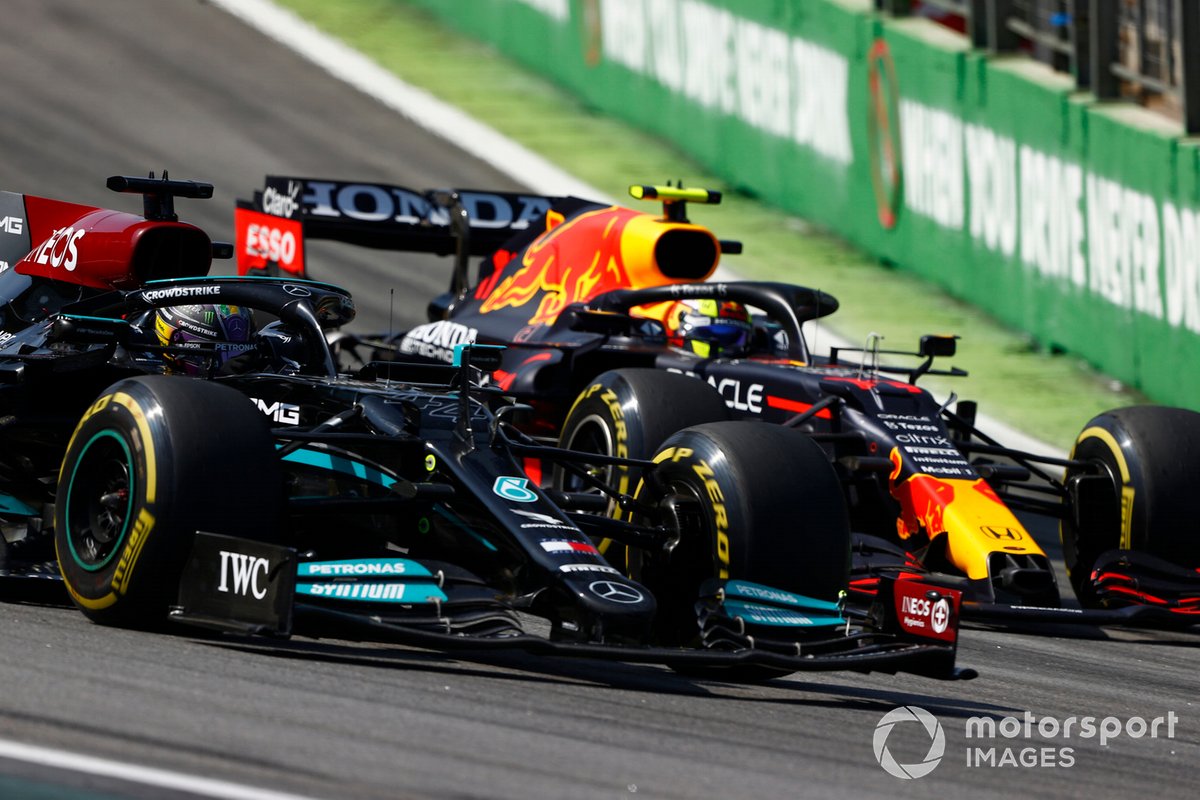
Hamilton had earlier passed Perez cleanly around the outside into Turn 1
Photo by: Andy Hone / Motorsport Images


Brundle awarded OBE in King’s New Year’s honours

The new rules dilemma that will define the 2025 F1 season

Verstappen issues Red Bull title warning in push for RB21 progress

Mercedes opens up on the factors that hurt Hamilton with the W15

How McLaren faced up to the misinformation, noise and distractions of being an F1 title challenger

Why Bottas is not letting the “worst-case scenario” end his F1 career

Jon Noble: An unfair perception or a genuine concern? Lifting the lid on Red Bull’s Tsunoda scepticism

Binotto on Audi's F1 reality check after finding team "frozen" with no plans

Rwanda turns to F1 as it moves forward from a chequered past

Mekies extends contract as Red Bull's F1 team boss

What to expect from WEC's Barcelona debut

Acosta proposes new idea for monitoring tyre pressure in MotoGP
Subscribe and access Autosport.com with your ad-blocker.
From Formula 1 to MotoGP we report straight from the paddock because we love our sport, just like you. In order to keep delivering our expert journalism, our website uses advertising. Still, we want to give you the opportunity to enjoy an ad-free and tracker-free website and to continue using your adblocker.


Top Comments