


The F1 compromises Mercedes battled to make ‘monster diva’ W12 a winner
After a shaky start, the W12 delivered Mercedes an eighth consecutive constructors’ championship in 2021. Speaking exclusively to GP Racing’s STUART CODLING, tech bosses Mike Elliott and Hywel Thomas explain the reasons for the team’s toughest-ever title defence…
Team boss Toto Wolff famously described Mercedes’ fast-but-fractious 2017 W08 car as “a diva”. Recalling that sobriquet during the 2021 world championship run-in, Lewis Hamilton went a step further when discussing the challenges of taming the W12: “This one,” he said, “is a monster of a diva.”
For all that Hamilton dominated the 2020 season, repeating the feat, even with a carry-over car, was never going to be easy. A budget cap, new limits on in-season development, a resurgent Red Bull, a new technical ruleset on the horizon, along with new aero regulations announced relatively late in the day – all these factors would conspire to render 2021 a most perilous tightrope act.
It was a period of change behind the scenes, too, as Mercedes technical director James Allison ‘moved upstairs’, handing the reins to former head of aero Mike Elliott, while Hywel Thomas embarked on his first full season at the head of Mercedes AMG High Performance Powertrains, after taking over from Andy Cowell in 2020. Daimler welcomed new investment from Ineos into the team and stepped down its shareholding to a one-third stake. To the outside world at least, the 2021 season would provide a test of the serial championship-winning team’s strength in depth, even if those at the coal face in Brackley and Brixworth viewed it as business as usual.
PLUS: How getting sacked gave Mercedes F1’s tech wizard lasting benefits
The 2021 campaign would prove to be more challenging than Mercedes expected. In the early phase of the pandemic, when the introduction of the all-new technical formula was kicked down the road to 2022, F1’s stakeholders also agreed to a partial freeze on development between the 2020 and 2021 seasons, to be governed by a system of tokens. Teams were given a deadline of 22 July 2020 to inform the FIA of how they planned to spend their tokens. Believing most gains could be found at the front end, Mercedes committed to spending its tokens on the nose of the W12 – only to have to scrap those plans later.
“When a chunk of the car is carried over, you are limited in what you can do,” says Elliot. “Our feeling was that for our car – and that doesn’t mean it was the same for anybody else – there might be opportunity in the nose. And actually there was opportunity. It’s just that by the time we got to a final solution, the improvement wasn’t big enough to justify the cost of the effort. And as a consequence of that, we decided not to do it.”
Mercedes had switched off development of its 2020 car early with a view to focusing on the 2022 package, but 2021 returned to the agenda as the FIA looked to peg back downforce levels to protect Pirelli’s tyres. The timing of the changes added complications: an initial package of cuts to the floor and other aero devices was announced in May 2020 but then superseded by another in October, later in the W12’s development.

Mike Elliott took over as technical director from James Allison and was presented with regulatory obstacles from the start
Photo by: Mercedes AMG
While the changes might have seemed relatively minor – a tapering of the floor in front of the rear wheels and removal of slots and strakes in this area, combined with stricter size limits on strakes in the diffuser and the inner face of the rear brake assembly – they added up to a substantial change in car behaviour. And it appeared to be the case that Mercedes and the similar Aston Martin ‘low rake’ designs were disproportionately affected by the new regulations.
PLUS: The 0.759% shift that created F1 2021's thriller
“For us, it was a massive hit,” says Elliott. “And the initial development slope recovering that was very steep. The biggest hit was in the mid ride heights [at the rear] where we run the car. Very quickly we were recovering performance there. It wasn’t until we got further into development, we started finding it was easier to make gains at the higher ride heights. And that was starting to raise some alarms, in the months coming up to Christmas [2020], that maybe this set of rules would be worse for us than for cars running higher rear ride heights.
“If you take for instance the trim to the ‘cake tin’ deflectors [on the rear brakes], where the bottom of the cake tin deflector interacts with the top of the floor – if your floor is physically much higher, that trim is completely different in the way it works.”
"If you’ve optimised a car to a certain position, and you change something, you can’t just put that something back. You genuinely have to change everything around it to rebalance and get back to a new optimum" Mike Elliott
While this discovery would push Mercedes towards running the W12 with a higher rear ride height, converting fully to the ‘high rake’ philosophy pioneered by Red Bull was impossible, even if it were desirable. The rake angle is fundamental to the aero concept of the car and would require nose-to-tail change, mechanically as well as aerodynamically.
So even if Mercedes felt inclined to take the massive competitive risk involved in adopting high rake – a philosophy many rivals took years to understand and optimise – it couldn’t under the newly agreed budget cap and development restrictions. Besides far-reaching aero changes, high rake would also demand a new gearbox design and rear suspension, items falling within the realm of the token system. Notionally Mercedes had long since committed to spending its tokens on the nose…
Given the imminent need to focus significant resource on the 2022 project, Merc’s technical team naturally prioritised understanding the impact of the 2021 changes and finding ways to restore aerodynamic performance. Seemingly minor cuts to the strakes within the diffuser had greatly reduced the loads it could generate.
The diagonal trim to the floor ahead of the rear tyres also had a significant impact on the airflow coming into the diffuser area from the side of the car; this effect was compounded by the cuts to the deflectors at the lower edges of the rear brake housing. All the aerodynamic surfaces in this area are designed to work harmoniously to maximise airflow to the diffuser, while balancing pressure across the diffuser’s edge and reducing turbulence caused by the floor edges and the tyres.

Cuts to the floor area made Mercedes W12 unpredictable to handle in testing
Photo by: Mercedes AMG
“The level of aerodynamics now on an F1 car, it’s not the case that you change one bit and you find performance,” says Elliott. “What we’re trying to do is to manage the flow features, and how the various surfaces all interact to control those flow features. So if you’ve optimised a car to a certain position, and you change something, you can’t just put that something back. You genuinely have to change everything around it to rebalance and get back to a new optimum.
“With a big regulation change, you see the change in flow structure, and then what you’re trying to do is to get that underlying flow structure back, or ask if there’s a new flow structure which will be better. As an aerodynamicist, you’re thinking from that flow structure point of view, and then you develop the parts to try and get you there.
“You build understanding by experimenting in CFD and the windtunnel: for engineers, F1 is an understanding race. If you understand what’s going on better than your competitors, you end up with a better engineering solution. So there’s always a time gap from the point regulations change to the point where you understand how big the effect will be.”
During this process the aerodynamicists also had to evaluate the potential impact of a new air intake system proposed by Mercedes’ powertrain division in Brixworth. The new design featured a larger plenum, the reservoir which equalises the pressure of air ingested through the airbox. Theoretical advantages of higher plenum volumes include greater power and the ability to run engines with leaner fuel mixtures, improving efficiency – but trade-offs include greater bulk and the potential for diminished throttle response.
“If you looked at the original plenums, the proof-of-concept work we did before committing to this, and saw the size of those plenums – everyone at Brackley was saying, ‘Well, that’s definitely going nowhere near the car!’” says Hywel Thomas. “It took a number of iterations to get the physical shapes and the specifications we needed into a package where we could even consider having a sensible conversation with the guys from Brackley.
“It’s all about what makes the fastest car: it’s us coming forward and saying, ‘Look, we’ve got something which is this size, we realise it doesn’t fit inside the existing engine cover, but this is the sort of performance we can get. What’s your position on that?’ They’ll estimate how much performance that might cost, so we’ll go away and do more work to put a more concrete number [on the potential gains]. And then as that starts to get more real, Brackley might do a windtunnel run to establish what exactly is the downside.
“All these things get looked at in the round, and you ask if this is going to make a quicker car or whether it’s just an ego trip from the engine guys. The decision is driven by data rather than emotion. If the data comes back and says the aero loss is twice the size of the gain from the engine, then it’s a bad idea.”

Mercedes AMG High Performance Powertrains boss Thomas led work on new air intake system
Photo by: GP Racing
When the W12 hit the track in pre-season testing a further consequence of the aerodynamic changes manifested itself: the car’s peak performance was much harder to access. It wasn’t a question of pure downforce, more an issue of the W12’s responses during the different phases of a corner – characteristics now so different from previous Mercedes of the hybrid era that it rendered much of the team’s bank of set-up knowledge irrelevant. It would also take time to reproduce accurately in the simulator, reducing the value of this critical element of the team’s toolbox.
During the course of a test punctuated by spins and slides for both Mercedes drivers, the picture was complicated further by the performance of the new power unit. Both Hamilton and Valtteri Bottas – along with several drivers in Mercedes’ customer teams – raised queries about the new engine’s driveability. While it wasn’t a ground-up conceptual redesign, its new intake system required far-reaching changes to accommodate.
“There were some sizeable changes from 2020,” explains Thomas. “In terms of quantity, there were more changes for reliability. If I go back to the previous season [2020], that was a huge change on performance. And we needed to tidy ourselves up a little bit – there were a few shabby things that we’d left over through chasing performance, and we needed to readjust ever so slightly to make sure we had the reliability.
“The biggest change we did was the introduction of the new plenums and changing the design in that engine breathing area. The number of parts that touched and required adjustment to make that fit, and make it work, was large" Hwyel Thomas
“The previous season was actually quite short because of the pandemic – 17 races, whereas this season it was 22. So although it was the same sort of challenge in terms of number of engines [three for the season], because there were so many more races it was actually quite a step. And there were quite a few things that needed tidying up for that.
“On the performance side, the biggest change we did was the introduction of the new plenums and changing the design in that engine breathing area. The number of parts that touched and required adjustment to make that fit, and make it work, was large.
“We learned a significant amount quickly. Part of the thing with those new plenums was it did mean a big rework on some of our calibrations. There was a little bit of talk [at the test] that we weren’t as good as we had been previously. But what having eight drivers’ feedback was very good at was pinpointing which areas were a real issue to them, to make sure we could attack those first and get the solutions quickly.”
Despite the prevailing impression that Mercedes was in trouble, Hamilton won the season opener in Bahrain – albeit slightly against the run of form versus Red Bull, and assisted by Max Verstappen transgressing track limits at a critical moment.
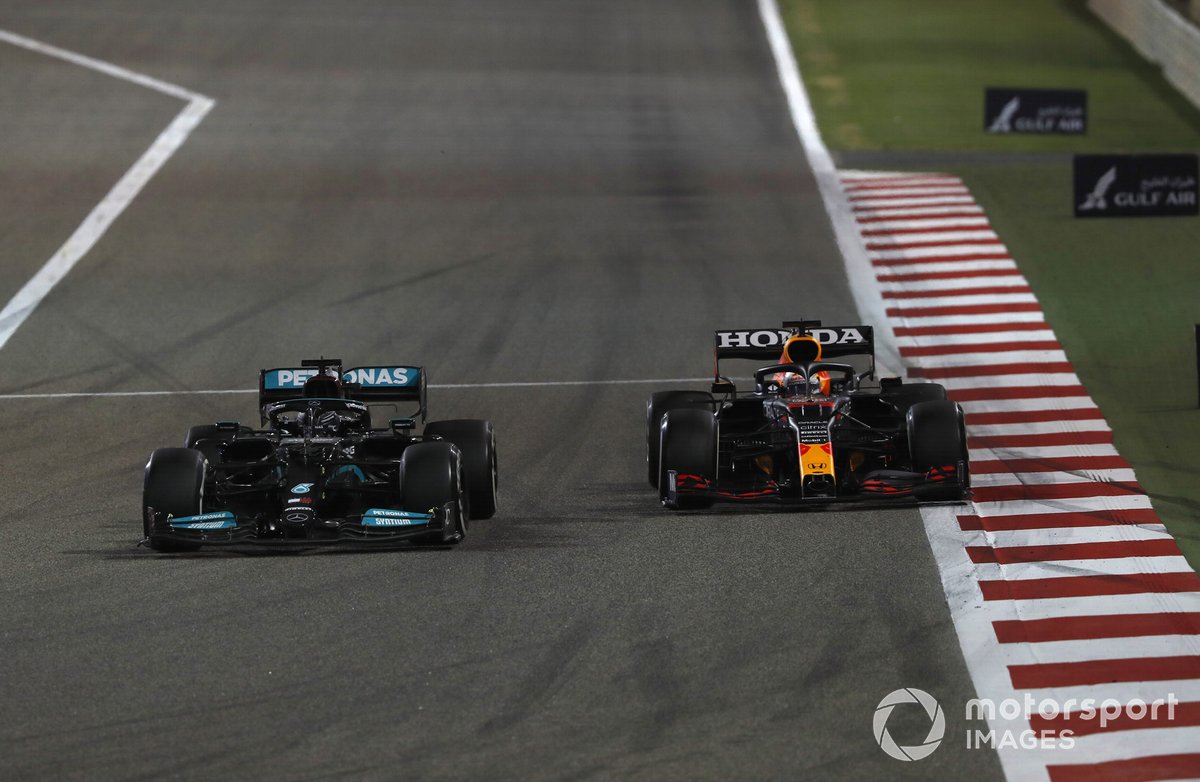
Hamilton beat Verstappen to win the season-opener and took three of the first four races against the run of play
Photo by: Charles Coates / Motorsport Images
Mercedes fitted an upgraded floor to the W12, featuring a new diffuser design, in time for the second round at Imola. But the sweet spot of the car remained frustratingly difficult to access despite intensive work on the simulator; Bottas said he “lost count” of how many setup items he evaluated in the sim ahead of the Emilia-Romagna Grand Prix, where he struggled and crashed out while Hamilton secured pole but was then fortunate to salvage second after a scrappy race.
While Red Bull’s RB16B appeared to be the quicker car, or at least the easier of the two to optimise, Mercedes and Hamilton contrived to extract both performance and results from the W12, with the exception of the races at Monaco and Baku – although the cost of Hamilton’s blunder in the latter was offset by Verstappen’s retirement.
But Red Bull was bringing new components to every race, while Mercedes wasn’t. After a run of three Verstappen wins in France and the twin Austrian races, it seemed as if the championship was slipping away.
Max was particularly dominant at the Red Bull Ring, after which a dispirited Hamilton called upon Mercedes to “find some performance” and said the car “needs an upgrade of some sort” to get him back in the fight. But by then – early July – Mercedes had already signed off the W12’s final upgrade package and shelved onward development in favour of the 2022 car. F1’s new aero development restrictions, where leading teams are permitted less wind tunnel time and fewer CFD resources than those further back, were a key influence on the decision.
“In years gone by we might have been doing 400 runs a week,” says Elliott. “It dropped to 81, then 65, and we’re now on 30-odd a week. You’ve got to make very clear and calculated decisions about what effort you put into which car.
“If you look at the potential development gradient of the new rules, which is huge, versus those in a set which is reaching its end, you have to put your effort into the new car. Gains start to become harder to find. You’re faced with a choice between doing a week in the tunnel on next year’s car, which might be worth a tenth of a second, or doing work on the current car which might be worth a couple of hundredths.
“Lewis is an intelligent driver – when you show him the data and explain why you’re making the decisions you make, he buys in.”
Mercedes engineers continued to work on setting up and understanding the W12, as well as fine-tuning the driveability of the power unit. The final update package, fitted at Silverstone in mid-July, comprised a detailed evolution of the bargeboards and their straked deflectors, along with a new profile at the leading edge of the floor, and new front and rear cake tins. It delivered bigger gains than expected.

Silverstone updates yielded gains that helped Hamilton to win - albeit in controversial fashion after Verstappen clash
Photo by: Steve Etherington / Motorsport Images
Mercedes has always been strong at Silverstone in the hybrid era so Hamilton’s victory there was unsurprising, if controversial owing to his clash with Verstappen. Subsequent rounds confirmed the impression that Mercedes had found something. Its new-found strength in a straight line set Red Bull reaching for explanations, levelling claims of illegality at the power unit (suggesting the new plenum featured a super-cooling device), the rear suspension and the rear wing. FIA investigations found no charges to answer.
“That was an interesting moment to start talking about that [super-cooling],” says Thomas. “I’m not sure what they were thinking, to be honest.”
“In terms of the rear suspension, it didn’t change, we didn’t spend any tokens on it, it’s clearly the same as it’s been in previous years,” says Elliott. “If you look at the Red Bull it is set up soft, at a higher rear ride height, and they use their travel up through the phases, the different speeds of the corners.
“We run a lower ride height with a stiffer car and, therefore, we’ve got more suspension travel to play with between our cornering phase and our straight line. All that happens is the suspension stiffness varies with load – that’s completely within the regulations and it’s something all the teams do to a greater or lesser extent.”
A tricky car isn’t necessarily a slow one, and the W12, while not as finely poised as its predecessor, certainly wasn’t slow. Was it decisively faster than the RB16B? Probably not, and its treasure chest was far harder to locate and unlock
Hamilton cites the Sao Paulo GP as one of the few events of the year where the W12 was unequivocally in its sweet spot. It was also where he began a three-race winning streak which enabled him to stay in contention for the drivers’ title until the final round – despite being put to the back of the grid for the sprint race at Interlagos when his rear wing failed scrutineering, and taking a five-place grid penalty for the main event for fitting a new power unit.
Worries about the powertrain defined the championship run-in for Mercedes, requiring it to add new elements to the pool strategically. Hamilton took his fourth new engine of the year in Turkey, a full month before the Interlagos round, while Bottas was already on his fifth as the final flurry of flyaways beckoned, taking his sixth at October’s US GP.
“We did have some reliability problems and they came out of the sun,” says Thomas. “We got a little bit caught out, which was very uncomfortable. But once we realised we had a problem, it’s all about the decisions you make.”
A tricky car isn’t necessarily a slow one, and the W12, while not as finely poised as its predecessor, certainly wasn’t slow. Was it decisively faster than the RB16B? Probably not, and its treasure chest was far harder to locate and unlock. But the team – and its star driver – got there, even if it required a major update package and a fundamental rethink on set-up.
As Hamilton himself said: “You don’t dwell on the fact that it’s not great. You try to find what’s good and try and figure out how you can make the parts that aren’t so good better.”

Hamilton's superb form at the end of the year brought him to the cusp of an eighth drivers' title in Mercedes W12
Photo by: Glenn Dunbar / Motorsport Images

How Ratzenberger beat the odds to realise his cruelly short-lived F1 dream

F1 uncovered: A weekend behind the scenes with a chief mechanic

When McLaren was pipped by Red Bull in a modern F1 classic

The big opportunity Sainz’s Williams switch affords to F1’s latest centurion

Inside the science of F1 fuel

How F1’s plan for rotating races could look in practice

The early decisions that set Sauber’s rookie for success

How F1 media coverage has evolved in line with its subject

WRC Chile: Pajari to take deeper look to understand lack of speed in Chile

WRC Chile: Solberg saves best until last to pull away from Evans

How Norris unfurled a surprising - and "unrepeatable" - Spanish GP pole lap

F1 drivers criticise Madrid circuit, Verstappen laughs: "I'll sort it out"
Subscribe and access Autosport.com with your ad-blocker.
From Formula 1 to MotoGP we report straight from the paddock because we love our sport, just like you. In order to keep delivering our expert journalism, our website uses advertising. Still, we want to give you the opportunity to enjoy an ad-free and tracker-free website and to continue using your adblocker.


Top Comments