


The biggest losers from F1’s Belgian GP non-race
OPINION: Formula 1's controversial decision to call a result after the Belgian GP that never got going due to persistently poor weather was good news for George Russell, as he scored a shock maiden podium. But the Williams driver aside, there were plenty who lost out as a result of Spa's washout - not least F1 itself

While a number of drivers and fans have been upset about the way three laps behind the safety car was enough for the Belgian Grand Prix to be declared, unhappiness about what happened wasn’t universal.
Max Verstappen and Red Bull came away with a victory that helps close up the F1 championship battle by a few points, and the most joyous man of all was George Russell, who took his maiden podium finish.
There may have been not a single metre of actual racing on Sunday but, as Russell was clear in his TV interviews afterwards about the way he earned his second place: “It doesn’t matter.”
F1’s Ross Brawn later pointed out in his regular post-race column, there was something fitting about Russell and Williams being rewarded for what had been a superb qualifying lap to grab second place on the grid for the Belgian Grand Prix.
PLUS: The calls that led to the memorable moment of Spa's infamous weekend
But the smiles from certain quarters of the paddock did not make up for complaint, unease and frustration elsewhere – as there were a host of big losers from a day when F1 did not do itself any favours.

Fans under umbrellas during a red flag period
Photo by: Steven Tee / Motorsport Images
Fans
After a 2020 campaign that took place mostly without spectators, the return of fans this year has been welcomed by everyone in the paddock – especially the drivers. So it was unfortunate timing that, after a year with empty grandstands at Spa, a packed crowd endured both terrible weather conditions and a lack of action.
Sure, there was nothing that F1 could have done to change the weather, but fans could certainly have been served better by the FIA and organisers. F1’s failure to be prepared for a washout on Sunday meant the race didn’t run on a day that F3 and Porsche Supercup did get their events in.
Plus, the lack of communication and stretching the proceedings out in an attempt to find an improved weather window, meant fans were left standing in the rain for hours before finally not seeing any racing laps. Then, to add insult to injury, it is unlikely they will get full refunds.

Marshals on the wet track
Photo by: Mark Sutton / Motorsport Images
Spa organisers
Having pulled off one of the full Covid lockdown grands prix in 2020, Spa organisers welcomed back fans for what it hoped would be a thriller of a Belgian GP. Wet weather is nothing new at the track, and is out of the hands of anyone. It was clear that the failure to be able to race the cars was not the fault of the circuit’s.
The track itself was not suffering from drainage issues, and had that weather been there for qualifying – when cars are spaced out – then it probably could have gone ahead. Visibility was the key issue. Very low winds and the nature of Spa being between trees and quite sheltered, meant that the spray being thrown up was the limiting factor here.
But amid calls from many, including Lewis Hamilton, for fans to be refunded, the farce of a race is a major headache for the race promoters because it is them who will take the financial hit.
PLUS: What F1 must do for Belgian GP fans after Spa farce
The way F1’s race hosting rights fees work is that Spa’s payment to Liberty Media will be unaffected by what happened on Sunday – and ticket sales are its only revenue stream. So any potential refunds that are made – unless F1 makes concession over its 2021 fee – will have to come out of Spa’s bottom line.

Mechanics on the grid with Lando Norris, McLaren MCL35M
Photo by: Andy Hone / Motorsport Images
F1 personnel
In a year when F1 personnel are being pushed to the limit by a brutal 22-race schedule – which includes several triple headers – the events of Spa will not have been especially welcome.
With teams already concerned about energy levels and the mental health of personnel, the stresses and strains of Sunday – as team personnel battled the elements and worked in atrocious conditions for it not to count for anything much in the end - will not have helped matters.
The crews at McLaren and Red Bull, who pulled off amazing jobs to repair the cars of Lando Norris after his qualifying crash and Sergio Perez after his formation lap blunder, especially went above and beyond for no reward in the end.

The Safety Car Max Verstappen, Red Bull Racing RB16B
Photo by: Charles Coates / Motorsport Images
The FIA
While the weather conditions were especially difficult on Sunday, the optics of the way the situation was managed did not appear particularly good for the FIA.
For although it and F1 race director Michael Masi took the right decision in not letting the cars race – as a big accident if it had done so would have been terrible to justify – the way the events panned out were not great.
A lack of clear and concise information about what was happening, allied to confusion and uncertainty about what was going on from the first delay and formation laps, to the eventual result being declared, did not give the impression that things were playing out in a controlled way.
Insight: 10 things we learned from F1's 2021 Belgian Grand Prix
And even when the FIA stewards went the extra mile to try to give it scope to get the race in at some point – by invoking force majeure to stop the three-hour clock – it was never explained properly and gave the impression that things were being made up as they went along.
Of course, as Sebastian Vettel was right to point out, it is always better for the FIA to do too much on the safety front than not enough, but there are clear lessons that can be learned in better handling events if they play out like Spa again.

Sergio Perez, Red Bull Racing RB16B, crashes out on his way to the grid
Photo by: Charles Coates / Motorsport Images
F1’s rule book
The biggest cause of the farcical nature of the Belgian Grand Prix was F1’s rule book, which helped trigger a series of baffling decisions and ultimately laid out the path that ended up with a one-lap 'race' counting for the world championship.
F1’s sporting regulations are a constant work in progress, and many times over the years circumstances are often thrown up that were either never covered by rules or have exposed weak wording in certain clauses.
Perez’s formation lap crash and then delay in starting the race were something that had never been considered before – so Red Bull was right to challenge the FIA that it was allowed to get the Mexican back in the race.
And, while F1’s three-hour race time limit, and half points being awarded after three laps of running, were put in the rules to deal with unforeseen circumstances, they proved unfit for purpose when it came to delivering a satisfactory outcome at Spa.
It was little wonder that F1 CEO Stefano Domenicali is set for imminent talks with teams and the FIA to get things changed.
Alfa Romeo

Antonio Giovinazzi, Alfa Romeo Racing C41
Photo by: Charles Coates / Motorsport Images
Russell’s podium and Williams’ second consecutive double points finish in Belgium meant it was a bad day for Alfa Romeo, its main rival in the constructors’ championship.
The Swiss-based squad had been gunning for eighth place in the standings this year, and seemed pretty comfortable there a few races ago despite having halted development of its car right at the start of the season.
But things have changed dramatically in the space of just two races. In Hungary, Nicholas Latifi being in the right place at the right time at Turn 1 helped him and Williams to a chunk of 10 points at the Hungaroring – and they doubled that tally in Belgium.
And where Alfa Romeo may have felt before Spa that a seven point deficit to Williams was something that could have been closed down over the second half of the season, the now 17 point-gap looks to be game over for its hopes.
The drop in the constructors’ championship position will deliver a financial blow, as teams’ commercial rights income in based on the final standings.
Lewis Hamilton and Mercedes

George Russell, Williams, 2nd position, Max Verstappen, Red Bull Racing, 1st position, and Lewis Hamilton, Mercedes, 3rd position, on the podium
Photo by: Glenn Dunbar / Motorsport Images
While Hamilton had gone into the Belgian Grand Prix just hoping to make it to the finish on a weekend where his Mercedes had not performed particularly well in the wet, there was no denying the way things panned out were not great for the title battle.
With so little to choose between Verstappen/Hamilton and Red Bull/Mercedes in the championship fight, the fact that points were handed out on Sunday was not ideal for the world champions. The half-points call, with Verstappen taking 12.5 points for his win and Hamilton 7.5 for third, meant there was a five-point swing in both championships.
Judging by how tight things have been this year, those five points could prove decisive at the end of the season. And if Hamilton ends up losing the crown by less than that amount, he will have no doubt that the difference was made in Belgium.

Max Verstappen, Red Bull Racing RB16B
Photo by: Erik Junius
F1
Ultimately the biggest loser of all is F1 itself, which has faced a barrage of criticism in the media and on social media for the way the event turned into a "farce", as Hamilton described it.
F1 has made great strides in recent years: opening up on social media, trying to engage more with fans, pushing into new markets and moving to ensure that things are as exciting as they can be on track. It also came through the Covid pandemic in pretty robust shape: having sorted out much-needed cost-saving measures to keep all teams afloat.
But, through a bad set of circumstances and elements out of its control (you can’t change the rule book in an afternoon), F1 has not come out of the Belgian Grand Prix as well as it may like. And that five-point title swing could be a huge cloud that hangs over the entire 2021 campaign if it proves to have made the different in whether the title goes to Verstappen or Hamilton this year.
It’s why it is important F1’s chiefs and FIA push through with necessary rule changes, and do all they can to ensure that the sport does not endure a repeat shambles in the future.
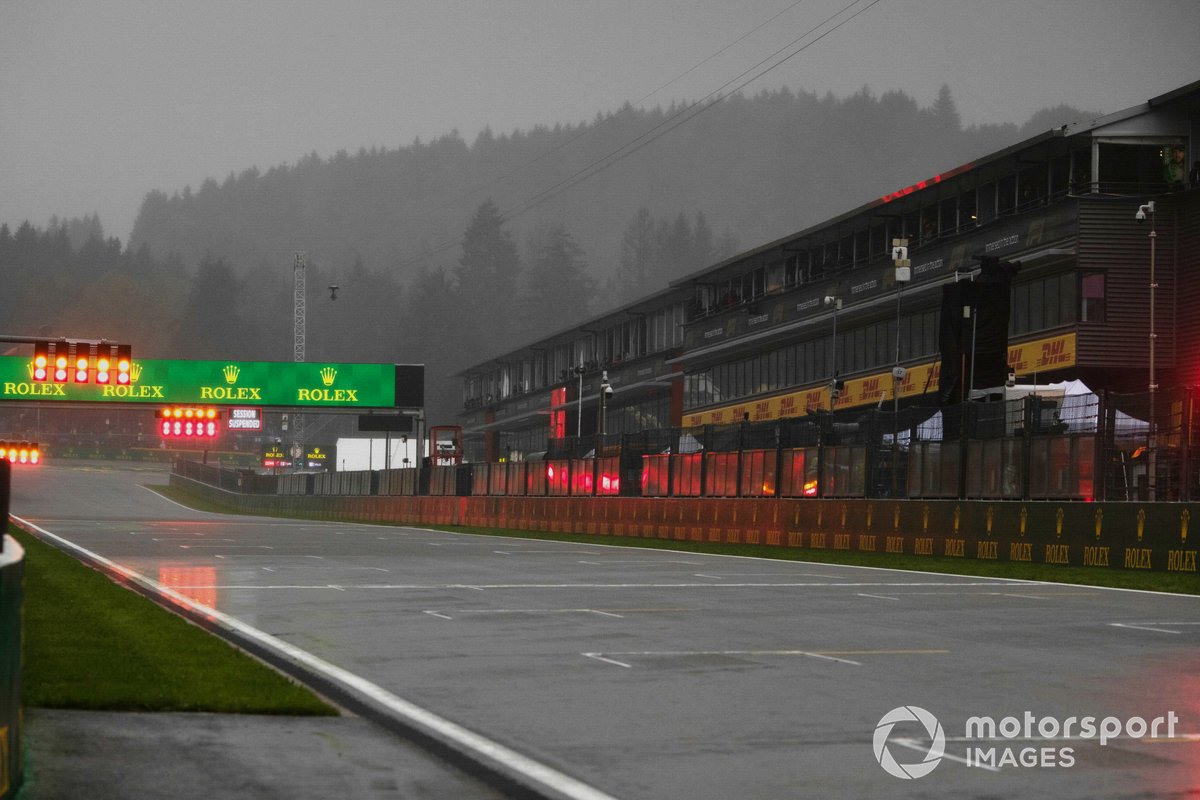
Red flag lights around the soaked circuit
Photo by: Alastair Staley / Motorsport Images


Brundle awarded OBE in King’s New Year’s honours

The new rules dilemma that will define the 2025 F1 season

Verstappen issues Red Bull title warning in push for RB21 progress

Mercedes opens up on the factors that hurt Hamilton with the W15

How McLaren faced up to the misinformation, noise and distractions of being an F1 title challenger

Why Bottas is not letting the “worst-case scenario” end his F1 career

Jon Noble: An unfair perception or a genuine concern? Lifting the lid on Red Bull’s Tsunoda scepticism

Binotto on Audi's F1 reality check after finding team "frozen" with no plans

Why Cadillac F1 boss provoked fresh intrigue by dodging driver question

Marquez: “In the first half of 2026, all I wanted to do on Sundays was lie on the sofa”

Vinales: “If I stay at home, I don’t get paid”

The unexpected issue Honda faced with upgraded F1 power unit
Subscribe and access Autosport.com with your ad-blocker.
From Formula 1 to MotoGP we report straight from the paddock because we love our sport, just like you. In order to keep delivering our expert journalism, our website uses advertising. Still, we want to give you the opportunity to enjoy an ad-free and tracker-free website and to continue using your adblocker.


Top Comments