


What F1 must do for Belgian GP fans after Spa farce
OPINION: The 2021 Belgian Grand Prix broke statistical records as Formula 1's shortest ever 'race'. But while F1 deserves credit for its safety-first approach, it has been heavily criticised for going ahead with declaring a result and leaving fans short-changed. To restore credibility, it must learn from what happened and take decisive action

The 29th of August 2021 was a bad day for Formula 1.
On the day the Belgian Grand Prix officially took place, the championship faced appalling conditions at a Spa track still tinged by recent tragedy. There were seemingly endless delays and dithering, underpinned by poor communication. Teams and officials at times appeared not to have a full grasp on the rules. The day ended with questions over whether the applications of the final decisions were even correct.
And, perhaps most perniciously, there were suspicions that what eventually transpired had more to do with money than what was right – admittedly in an awful situation for those making the big calls.
What transpired
Overnight rain at Spa continued into Sunday morning, with the FIA Formula 3 race and Porsche Supercup taking place in wet conditions. The precipitation continued as the grand prix start time approached. The cars left for the grid half an hour before the scheduled off as usual, running the extreme wet tyres.
The treacherous conditions were highlighted by Red Bull’s Sergio Perez crashing at Les Combes after climbing onto the sequence’s second apex kerb, breaking his front-left suspension and steering rack, and seemingly ending his chances of starting the race.
Inevitably, the start was pushed back – first by 10 minutes, eventually three more times to 1525 local time. When the formation lap did commence, it did so behind the safety car. On the second such exploratory tour, with visibility for everyone except Max Verstappen unacceptable – “I may as well have been closing my eyes down the straight”, said Williams’s George Russell, who was following the Red Bull in second place – the red flags flew.

The Safety Car Max Verstappen, Red Bull Racing RB16B, and George Russell, Williams FW43B
Photo by: Mark Sutton / Motorsport Images
There followed a near three-hour suspension. In that time, Red Bull successfully argued if it could fix Perez’s returned car, he should be allowed to start the race – “it’s not Le Mans,” quipped team sporting director Jonathan Wheatley to race director Michael Masi, who was fielding a host of calls from the teams.
Four promised weather updates turned out to be nothing but more promised weather updates. Lando Norris dozed in the McLaren garage and AlphaTauri’s Yuki Tsunoda had some soup. Medical car driver Alan van der Merwe was regularly dispatched to assess the track conditions as the rain refused to abate.
Eventually, the call was made to “resume” the race at 1817 local time – the wording rightfully mocked but also correctly used given the regulations. Those rules had even been superseded by the stewards, who paused the three-hour time clock that had commenced at the scheduled 1500 start time (a rule introduced initially as a four-hour race completion window in the aftermath of the similarly rain-affected 2011 Canadian GP), by applying force majeure status.
"For it to be a legal race, it has to be – I think – a minimum of two laps. They knew that and they sent us out for two laps behind the safety car and that activates a bunch of things. I don’t know all the politics and the background but my most concern is that the fans should probably get their money back" Lewis Hamilton
But on the second lap back in what Verstappen called “worse” conditions than during the initial attempts to get racing, proceedings were halted again. After 18 more minutes passed, the event was called off. But by completing those two ‘race’ laps, a result could be called – per Article 6.5 of F1’s Sporting Regulations.
Verstappen was the winner, Russell and Lewis Hamilton completing the podium in qualifying order – the result of Perez’s pre-race misadventure the only alteration to the final grid, as he dropped from seventh to 20th after Red Bull’s latest rapid fix.
That meant half-points could be awarded too, which meant Verstappen’s 12.5 trimmed Hamilton’s championship lead to three. Russell picked up his first F1 career podium and got to stand on it too as all the usual post-race proceedings played out as normal.

George Russell, Williams, 2nd position, with his trophy and Champagne on the podium
Photo by: Glenn Dunbar / Motorsport Images
The reactions
“Of course it’s a win but it’s not how you want to win,” reflected Verstappen.
“From a points point of view and from a championship point of view it is great to get those five points [over Hamilton],” surmised Red Bull boss Christian Horner.
Russell said: “We don’t often get rewarded for great qualifyings but we absolutely did today.”
Understandable reactions from competitors that can only tackle the circumstances set before them, Verstappen and Russell in the position to capitalise because they starred in qualifying. But for the rest, and we can assume for the 75,000 fans that had endured a farcical day, there was a general feeling of frustration.
Hamilton summed up what plenty were thinking – once again the world champion making a vocal point many others would not dare.
“There is a rule that says for it to be a legal race, it has to be – I think – a minimum of two laps,” he told the post-‘race’ press conference. “They knew that and they sent us out for two laps behind the safety car and that activates a bunch of things.
“I don’t know all the politics and the background but my most concern is that the fans should probably get their money back. I don’t know if by doing the two laps it means they don’t and that’s… I just don’t think that’s what we want. We have better values than that as a sport.”
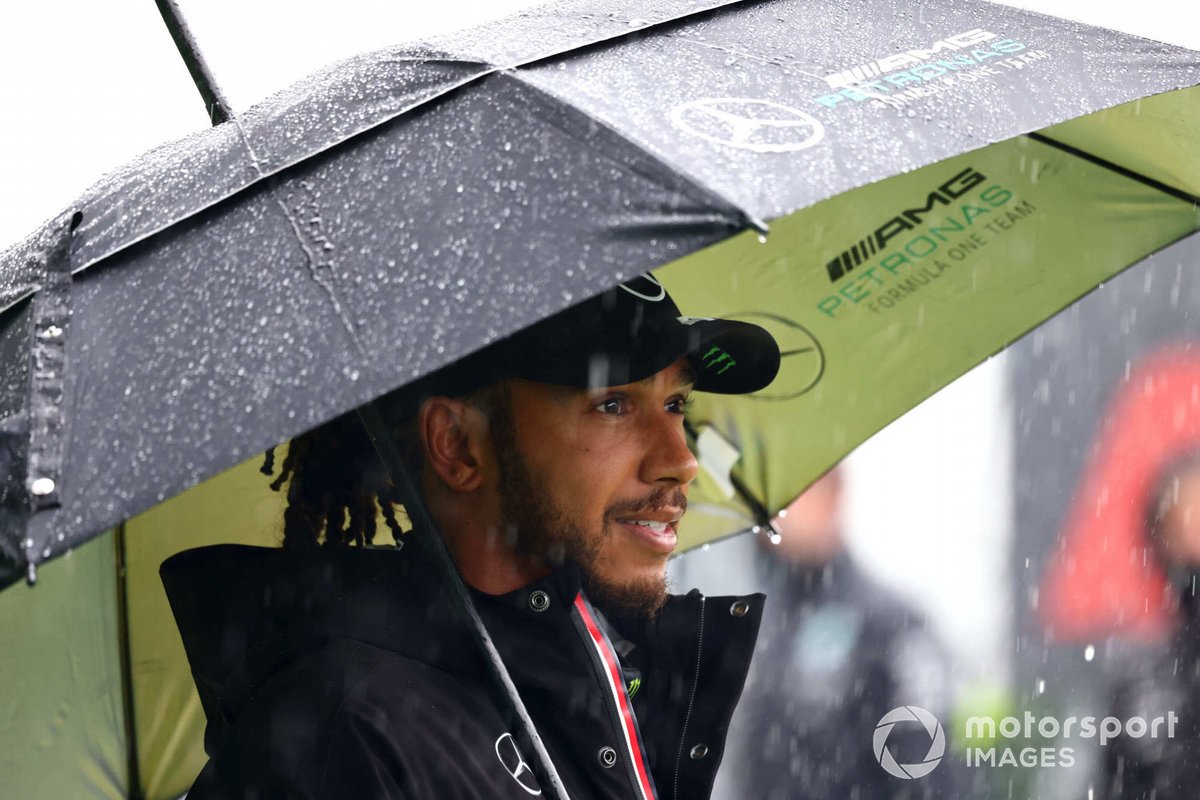
Lewis Hamilton, Mercedes
Photo by: Steve Etherington / Motorsport Images
The reasoning behind the decisions
There were several critical calls that Masi had to explain once the podium ceremony had finished. And to his credit he visited TV crews and conducted his usual post-event press briefing. Halfway through this, F1 CEO Stefano Domenicali arrived to speak to reporters too.
On the race resumption decision – when the cars left the pitlane for the final time that was officially the race start, the earlier running considered formation lap running that would have reduced the total lap count had proceedings been able to go ahead in anywhere near normal circumstances – Masi said: “We were all aiming for a [weather] window that we thought was there.
F1 should work with Spa to ensure that the spectators that were "robbed", per Hamilton, ultimately by the weather, can somehow be paid back if that's what they want. It will be tough given the commercial pressures created by the pandemic and it’s a more nuanced situation than it may seem, but it's the right thing to do
“The teams even saw it. There was sort of a weather band there where we thought we could get some racing in. But then the weather deteriorated so rapidly that unfortunately, we couldn't.”
On suggestions the race be postponed until Monday, Masi explained: “The list [of reasons why not] would be pages long between organisers, everyone here. There is no ability to postpone to the following day.”
Domenicali, who said F1 “absolutely” would have received its race hosting fee from Spa even if no laps had been completed at all, also rebuffed suggestions the two-lap ‘resumption’ period had been designed to fulfil commercial considerations.
He said: “It’s totally not true, because when we’re talking about racing, there is responsibility, that is a clear process, and those things are not connected at all.”

Red flag lights around the soaked circuit
Photo by: Alastair Staley / Motorsport Images
The conclusions
F1 and the FIA deserve a huge amount of credit and praise for so much of what transpired last Sunday.
The championship’s history features wince-worthy moments where responsibility for safety calls was left down to individuals – such as a Niki Lauda at the 1976 Japanese GP or at Alain Prost at the 1989 Australian race. Thankfully, motorsport has moved on since such times, and the decision not to press ahead with racing in difficult conditions at a track where the engaging and gifted Anthoine Hubert lost his life just two years ago was entirely correct.
The various stakeholders tried to get in a race in very tough circumstances – even stopping the countdown clock for the first time under force majeure, as the stewards have the power to under the FIA’s International Sporting Code.
It must be accepted that F1's explanation of why the race was called as it was is the truth – taking it at its word is the right thing. But if that is indeed the case, then it should work with Spa to ensure that the spectators that were "robbed", per Hamilton, ultimately by the weather, can somehow be paid back if that's what they want. Domenicali has already said the event’s “organiser, together with us” will consider “the maximum attention to the fans”.
It will be tough given the commercial pressures created by the pandemic and it’s a more nuanced situation than it may seem given three practice sessions and qualifying took place over the rest of the event.
But it's the right thing to do and would go some way to making up for the elements of last Sunday that need to be criticised. A race being called after two laps behind the safety car is both not a real race nor a good look for F1.
One fan in attendance told Autosport that from their perspective in a grandstand between La Source and Eau Rouge – and we mustn’t forget there were plenty of fans with no roofed protection from the elements – supporters from a range of nations could understand how things were shaping up to end, even with the at times incomprehensible messages flashing up on the world feed being broadcast on track TV screens that at times reportedly stopped working thanks to the rain. There was apparently plenty of booing and the podium ceremony was not exactly well received.

Fans under umbrellas during a red flag period
Photo by: Steven Tee / Motorsport Images
F1 often finds itself tied by lots of the rules and deals it has made to reach this point in its development. For instance, having races start hours later than they traditionally would to ease global TV coverage, even if that risks adding to things going wrong on the ground.
Now F1 needs to be flexible to pay back its fans as much as possible.
Another round at Spa in 2021 would be great given the ever-shifting calendar. It’s what happened in 1985 when the new Spa surface broke up and the event was abandoned before being restaged two months later. With a ‘TBC’ slot on the current schedule and the strong possibility of more races being lost to the infernal pandemic, this seems pleasantly logical.
Start times must surely become flexible. And NASCAR and IndyCar can postpone races by a day to get racing in if bad weather strikes – so that must be something ‘the pinnacle of motorsport’ can at least assess
Russell and Hamilton were in favour when Autosport broached that possibility in the post-race press conference, and Masi says it is “logistically a possibility”. But Verstappen also sagely noted “we already do too many races”, plus, as Bernie Ecclestone put it in the 6 June 1985 issue of Autosport magazine, “let’s see who’ll put the money up…”
If that's not possible, F1 as a whole needs to put its money where its mouth is to win back any fans it lost with the 2021 Belgian GP farce. But there are further factors it should consider too.
Start times must surely become flexible. And NASCAR and IndyCar can postpone races by a day to get racing in if bad weather strikes – so that must be something ‘the pinnacle of motorsport’ can at least assess.
Plus, with freak weather events becoming even more common thanks to the climate crisis, might the machinery involved even need to be adapted to ensure events can safely go ahead when the elements close in again? After all, this might not be the last true sporting contest lost to such unfortunate circumstances.

The Safety Car Max Verstappen, Red Bull Racing RB16B, and George Russell, Williams FW43B, out of the pits
Photo by: Mark Sutton / Motorsport Images


Why Britain’s role in Formula 1 endured a troubled start

Why Bottas believes his F1 reserve driver role is the fastest route back to a race seat

Why Norris is now ready for his final exam

The key advantage for Bottas vs Perez in the 2026 F1 return race

Why Ferrari's management is under pressure after its bad start to F1 2025, not Hamilton or Leclerc

Why Red Bull can’t solve its second F1 car problem with a simple paint job

Hirakawa replaces Doohan at Alpine for Japanese GP FP1 outing

How Alonso and Bortoleto can be F1 rivals in a unique driver management deal

WEC Barcelona: Genesis secures maiden series pole from Toyota
What drives Bortoleto as his junior rivals hit new heights in F1

How the M8B became the most dominant car in McLaren’s history

What Verstappen knew about Red Bull’s big upgrade when he signed his new F1 deal
Subscribe and access Autosport.com with your ad-blocker.
From Formula 1 to MotoGP we report straight from the paddock because we love our sport, just like you. In order to keep delivering our expert journalism, our website uses advertising. Still, we want to give you the opportunity to enjoy an ad-free and tracker-free website and to continue using your adblocker.


Top Comments