


The ‘backwards step’ that is the right move for Formula 1
OPINION: With its days apparently numbered, the MGU-H looks set to be dropped from Formula 1’s future engine rules in order to entice new manufacturers in. While it may appear a change of direction, the benefits for teams and fans could make the decision a worthwhile call

While Formula 1’s engine manufacturers – and potentially future ones – still have to hammer out some ongoing sticking points about new era rules from 2025/2026, there is an increasing likelihood that one of the championship’s more complicated technologies is about to be consigned to the bin.
F1’s MGU-H – officially ‘Motor Generator Unit - Heat’ – has proven to be one of the most devilishly complicated components of the modern turbo hybrid engines. Introduced from 2014 as a core area where F1 could lead the way in developing hybrid technologies that would be a step in front of the automotive world, hopes were high that it would confirm grand prix racing’s place as a technology testbed for future road car applications.
The theory sounded great. By converting heat energy from exhaust gases and converting it back into electric power, it would help improve the efficiency of the hybrid engines as F1 entered an era where sustainability started to matter.
While there has been some technology transfer (with Mercedes in particular using the concept in AMG models to improve engine response time and minimise turbo lag), for F1 itself the MGU-H has not proven to be one of its great success stories.
From the competitors’ viewpoint, the technology was incredibly complicated, expensive to develop, and very, very tricky to get right. With the MGU-H needed to be coupled to the turbocharger, and work in harmony with an electrical generator, the rotation speed could sometimes be in excess of 125,000rpm.
For a new manufacturer coming in cold to F1, and with energy management through the MGU-H so critical to overall performance, the expense and time taken to catch up on the technology was a massive turn off.
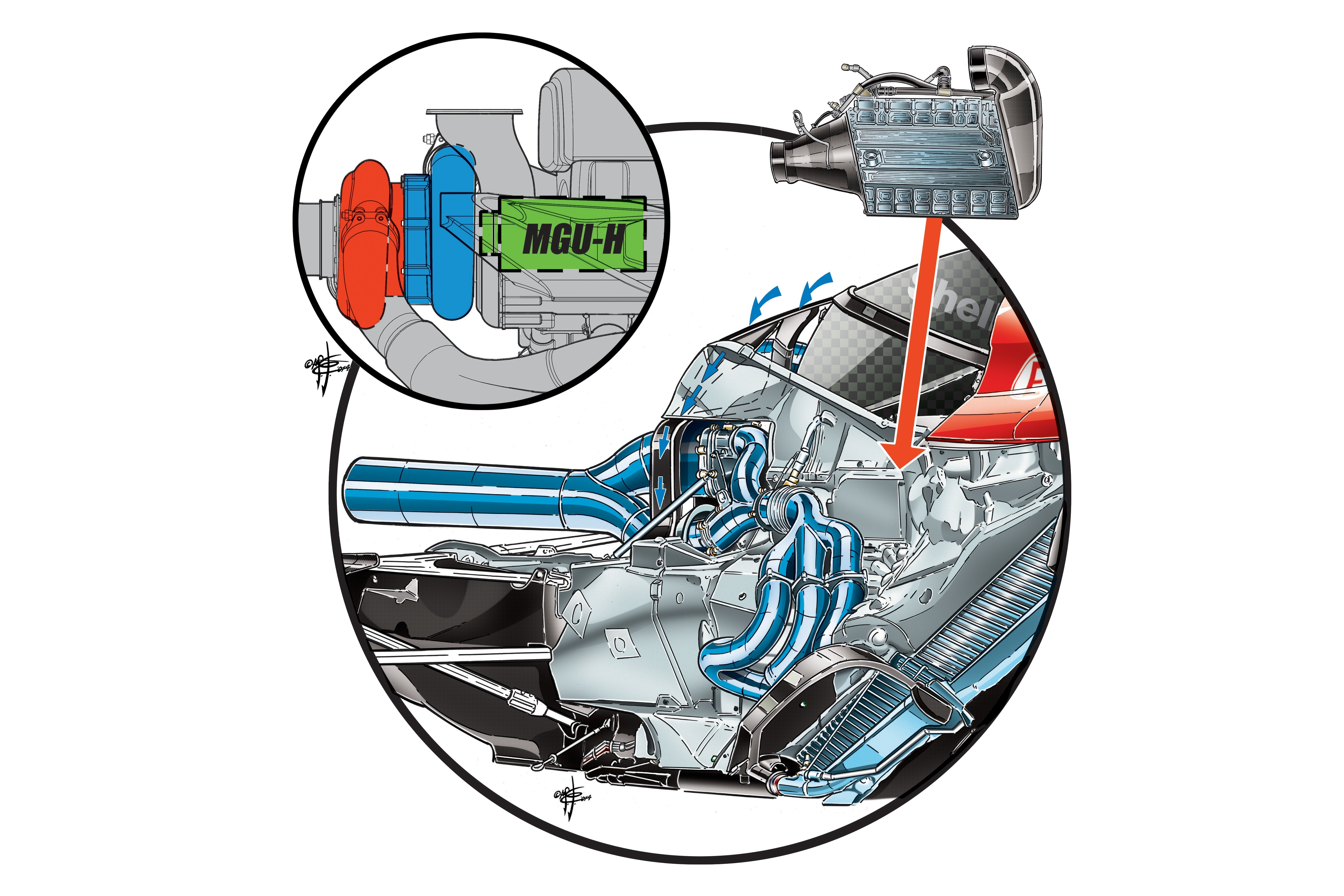
Ferrari 059/3 power unit layout, Turbo layout inset (red, turbine - blue, compressor with MGU-H inside
Photo by: Giorgio Piola
Honda’s character building entry from 2015 – where initially, as it got to know F1’s turbo hybrid regulations, it was burning through an MGU-H every other race weekend with no results to show for it – was not an encouraging sign for making other car makers feel that F1 was the place they needed to be.
The chances of getting the technology right in a short space of time were very slim; and the risk of getting it wrong and spending an awful lot of money to be made to look a chump were very high.
"MGU-H is one of the most difficult units which we use in the Formula 1 PU, because of the high revs, and the component combined with turbocharger and generator" Toyoharu Tanabe
Last week, reflecting on the progress Honda had made with its F1 project since those troubled early days with McLaren, technical director Toyoharu Tanabe acknowledged the headaches that the MGU-H in particular had given the Japanese manufacturer.
“From our experience, MGU-H is one of the most difficult units which we use in the Formula 1 PU, because of the high revs, and the component combined with turbocharger and generator,” he said. “The hardware is important, and the efficiency of the energy recovery is important, so it is not a simple bit.
“Honda took a long time to achieve that certain level. On the other hand, it’s the same thing for the other PU manufacturers, especially newcomers. It’s a very difficult technology to achieve the level of current PU manufacturers’ MGU-H.”
So as F1 looks to try to attract fresh manufacturer interest, especially from the Volkswagen Group, the sacrificial lamb looks set to be the MGU-H.
From VW’s perspective, it is clear that trying to come into F1 and master technology that rival manufacturers will have had a decade’s more knowledge on is not particularly attractive. And, while previous pushes to drop the MGU-H from F1 have failed with current manufacturers reluctant to give up on technology they have invested millions developing, there is a shift in mood this time around.
Even Mercedes, which said in 2018 that losing the MGU-H from F1 would be a ‘backwards step’, is ready to let it go as a compromise for getting VW in.

Fernando Alonso retires from the 2015 Malaysian GP with a power unit problem - one of many niggling issues that plagued Honda as it got to grips with MGU-H technology
Photo by: Motorsport Images
But the benefits of losing the MGU-H go beyond the interests of current competitors and manufacturers, for there can be gains for fans too.
The ‘backwards step’ that Mercedes warned about was related to the way that the lost energy gained from the MGU-H would need to be recovered from somewhere else. The MGU-H has helped ensure that F1’s current 1.4-litre turbo engines regularly put out more power than any other engine in F1 history (bar the occasional turbo one-lap wonders from the mid-1980s).
While some extra boost can come from beefing up the MGU-K, there will likely need to be some refining of fuel limits, fuel flow and rev limit to increase the power contribution from the internal combustion engine.
It means F1’s original concept of focusing on fuel economy to minimise emissions goes out of the window but, amid a switch to fully sustainable fuels, the goalposts are shifting.
PLUS: F1's options to define its next powertrain step
Changes to the fuel limits, and the loss of the MGU-H, will sort the power aspect out and will also deliver an extra key benefit that could make the 2025/2026 power units very attractive for fans. Noisy engines.
One of the impacts that the MGU-H and turbo set-up had was that by efficiently recovering energy from the exhaust, it was reducing the sound of the cars. Combine that factor too with lower revs and fuel flow limits and you were left with turbo hybrids that failed to inspire a lot of fans.

Valtteri Bottas, Mercedes W12
Photo by: Jerry Andre / Motorsport Images
Sure, a future turbo engine without the MGU-H may not have a chance of matching the screaming sounds that the old V8 and V10 engines produced, but with more fuel flow and higher revs, there should be a step change from what we have now.
Throw all the factors - like louder engines, simpler technology, cheaper development costs, and more interest from manufacturers - and it seems a no brainer that the MGU-H’s time is up.
One step backwards? For sure. But there is an opportunity for F1 to two or three steps forwards, and that is much more important for the long haul.

Daniel Ricciardo, McLaren MCL35M, Max Verstappen, Red Bull Racing RB16B, Lando Norris, McLaren MCL35M, Lewis Hamilton, Mercedes W12, Charles Leclerc, Ferrari SF21, and the rest of the field at the start
Photo by: Steve Etherington / Motorsport Images


Brundle awarded OBE in King’s New Year’s honours

The new rules dilemma that will define the 2025 F1 season

Verstappen issues Red Bull title warning in push for RB21 progress

Mercedes opens up on the factors that hurt Hamilton with the W15

How McLaren faced up to the misinformation, noise and distractions of being an F1 title challenger

Why Bottas is not letting the “worst-case scenario” end his F1 career

Jon Noble: An unfair perception or a genuine concern? Lifting the lid on Red Bull’s Tsunoda scepticism

Binotto on Audi's F1 reality check after finding team "frozen" with no plans

WEC Barcelona: Genesis secures maiden series pole from Toyota

What drives Bortoleto as his junior rivals hit new heights in F1

How the M8B became the most dominant car in McLaren’s history

What Verstappen knew about Red Bull’s big upgrade when he signed his new F1 deal
Subscribe and access Autosport.com with your ad-blocker.
From Formula 1 to MotoGP we report straight from the paddock because we love our sport, just like you. In order to keep delivering our expert journalism, our website uses advertising. Still, we want to give you the opportunity to enjoy an ad-free and tracker-free website and to continue using your adblocker.


Top Comments