


Where you can find the best battles of F1 2026
Despite the rule changes, the midfield is still tight and tough to call – here’s how things are shaping up behind the top three

What constitutes ‘exciting racing’? It’s a term that means different things to different people; some believe that it pertains to the form factor and the noise of the cars, while others (usually working in the championship itself) think that it can be reduced to overtaking statistics.
Most probably sit on the side of wheel-to-wheel action, with two or more drivers duelling over position and skirting the boundaries of conventional legislature and etiquette without ever going over. That’s racing utopia, surely.
Most yearn for the notion of exciting racing to happen at the front of the field on a regular basis, because that’s where the world feed tends to concentrate its broadcasting output. It often misses out on the fun among the midfielders, which is the true connoisseur’s choice for imbibing F1-themed excitement. Who cares about race wins when the battle for eighth is so fierce?!
Light-heartedness aside, the fight among the midfielders has arguably presented F1’s toughest battleground over the past few seasons, helped by the impact of the cost cap. The regular mid-grid teams haven’t quite had the wherewithal to tip into the top four teams (unlike McLaren in seasons past), but their various and often opposing strengths and weaknesses have created an ebb-and-flow state that ensures the order is rarely the same as the previous weekend. Surely, this scratches the ‘exciting racing’ itch, on the basis that these teams are consistently close.
As it stands, the top three squads – Mercedes, Ferrari and McLaren – have bought themselves some breathing room over the rest of the pack, arguably leaving Red Bull behind to be pecked at by the circling vultures. The Milton Keynes operation has now, on the evidence of the opening three rounds, dropped into the mid-pack on merit - but in Miami an upgrade package gave it a rebound to push back towards the top.
Let’s assess our esteemed midfield, then, and gauge their plus points and greatest drawbacks so far as the 2026 battle looks primed to rumble on…
Red Bull
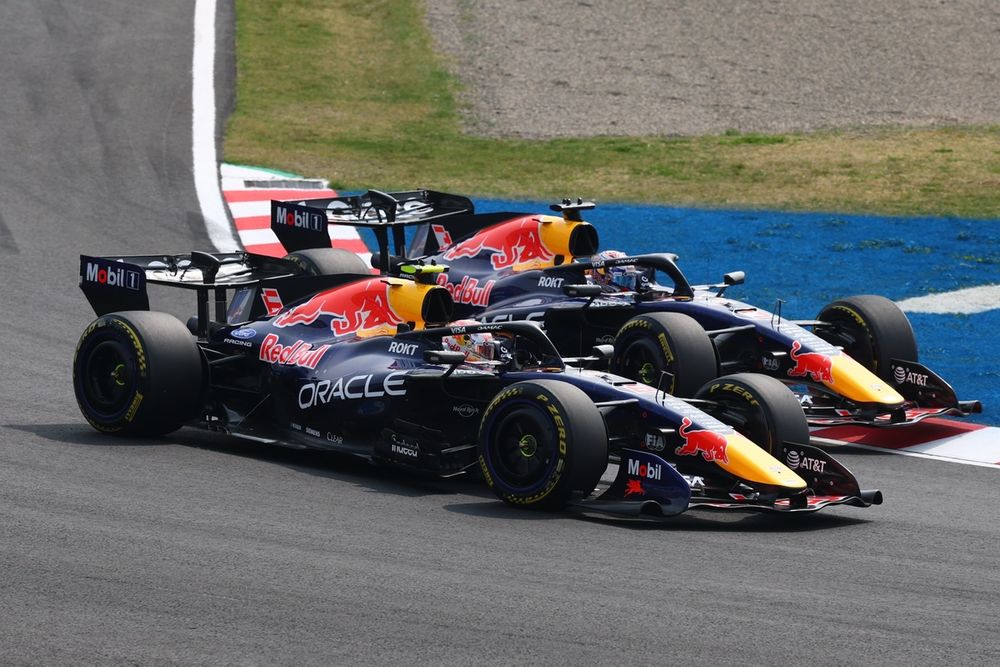
The power unit’s strength has surprised, while the Red Bull chassis has not been up to scratch
Photo by: Clive Mason / Getty Images
Strengths Straightline speed, MGU-K efficiency
Weaknesses Chassis, aerodynamic grip
Ahead of 2026, it looked as though Red Bull’s RB22 would be a contender for podium finishes, but perhaps hindered by a powertrain that was lacking a smidgen of overall performance when compared to those produced by the more experienced manufacturers. Instead, it has entered the year in reverse; the powertrain has received plaudits from its drivers and key figures elsewhere on the grid, while the car has been something of a letdown.
“We have a good power unit; the engine is good,” was Isack Hadjar’s curt assessment of the package at his disposal. “The chassis side is terrible. We’re just slow in the corners for once.”
The team appears to have produced an MGU-K that allows it to be aggressive with its harvesting and deployment, underpinned by an internal combustion engine that isn’t a world away from Mercedes in terms of output. Suggestions are that Red Bull-Ford is on the borderline with the new ADUO engine catch-up mechanic, which requires it to be at least 2% shy of the leading motor in power to receive an upgrade token. Team principal Laurent Mekies believes that the manufacturer will fall on just the ‘right’ side of the cut-off – and get the token.
Both Verstappen and Hadjar have struggled to assert their authority over the likes of Alpine and Haas, and even their own sister team
Max Verstappen also agrees that the car itself has been the main drawback. While capable of good straightline speed, owing to its low-drag platform and its deployment efficiency, the Red Bull is simply missing a bundle of downforce. Although this was less of an issue in Australia, the characteristics in China and Japan demonstrated that the car struggles to maintain grip in longer-radius corners.
Fix that, and Red Bull should be able to pull free of the midfield pack. But, for the time being, both Verstappen and Hadjar have struggled to assert their authority over the likes of Alpine and Haas, and even their own sister team.
Stripping out weight – the RB22 is almost 20kg too heavy – will be a relatively easy way to recapture some performance, but the developments cannot stop there. Since Miami progress on both fronts was apparent and has helped the team shift in front of the midfield.
Haas

Bearman starred in the first two rounds, while strategy has hamstrung Ocon
Photo by: Ricky/Anadolu
Strengths Driveable car, Bearman’s form
Weaknesses Inability to unlock consistent qualifying pace, Ocon’s strategy luck
Throughout pre-season testing, the Haas VF-26 had presented as a well-balanced car that its drivers could do quite a lot with, and this has continued into the season proper. Ayao Komatsu’s squad continues to make magic happen with the smallest team on the grid, and a well-behaved car with Ferrari’s low-inertia turbo has given Ollie Bearman and Esteban Ocon the platform to be reasonable getaway drivers off the line.
In the opening two races, Bearman was exquisite; seventh- and fifth-place finishes had him sitting in the top five after two races, although this was undone by his Japan shunt when he was caught out by a low-power Franco Colapinto. The crash was just the tip of the iceberg of a difficult weekend at Suzuka, during which he’d come unstuck in Q1 owing to an issue with deployment on the straights.
This rather demonstrates Haas’s biggest issue, in that it hasn’t been able to dig out consistently strong qualifying results with both cars. It’s helpfully much stronger in race trim, and both drivers can hold their own when sitting within the points-paying positions.
Not that Ocon has had much opportunity to sit within the top 10, with strategy calls seldom going his way. China demonstrated both of the above points; when Ocon stayed out under the safety car, he shuffled into the top three but lost positions on the opening restart laps as the faster cars made their way through.
He had been able to settle in eighth despite running with older tyres, but ultimately had to stop again – which later precipitated contact with Colapinto. Ocon also lost a place to Liam Lawson at Suzuka, having stopped before the safety car on this occasion.
If Haas can get both cars firing in qualifying and put itself into Q3 regularly, then it has the pace to stay within that pack. As ever, it’ll need to make the most of its smaller pool of resources to develop through the season to keep its midfield rivals in check, which was one of its more admirable traits last season.
Alpine

Gasly is thriving in 2026, holding off Verstappen at the Japanese Grand Prix
Photo by: Lars Baron / LAT Images via Getty Images
Strengths Mercedes powertrain, low/medium-speed traction
Weaknesses Weak front-end, high-speed corners
After two years of trials, tribulations, turbulence and turmoil, Alpine finally looks to have settled down. Key players Flavio Briatore and executive technical director David Sanchez spent that time making tough and sometimes unpopular decisions, in killing off Renault’s powertrain division and sacrificing 2025 development for 2026 respectively, but this is so far paying off.
Now with Mercedes power, the A526 has received critical acclaim from Pierre Gasly, who labelled it the best car he’s ever had in F1. Steve Nielsen’s introduction as team manager has also helped to calm things down, such is his experience operating within team management and in F1’s governance structure.
Gasly has thrived so far this season. While the team arguably got its sums wrong in Australia, the underrated Frenchman still held off old sparring partner Ocon for the final point Down Under to open Alpine’s account for the year. He couldn’t quite manage the same against Bearman at Shanghai and lost the battle for fifth but, at Suzuka, Gasly kept Verstappen contained to ensure Alpine could claim the bragging rights against Red Bull.
Colapinto also needs to start matching Gasly more regularly; while the Argentinian impressed in China, he is much less consistent than his more experienced team-mate
Thanks to the Mercedes powertrain, the Alpine has tapped into a vein of strong top-end performance. Furthermore, its traction out of low-speed corners has been of considerable use in defending position, and arguably exploited one of Red Bull’s major weaknesses when Gasly and Verstappen duelled for seventh in Japan.
Where the A526 is lacking lies in higher-speed conditions, since the front end tends to fade slightly in higher-load conditions. The team has been able to mitigate this with set-up choices, but ultimately the car is lacking a smidgen of front-end downforce versus its immediate rivals. Colapinto also needs to start matching Gasly more regularly; while the Argentinian impressed in China, he is much less consistent than his more experienced team-mate.
Gasly’s qualifying performances have been strong and he has been a regular in Q3 thus far, while Colapinto has often struggled to stitch together his final Q2 laps under pressure. Despite the nature of 2026’s unique brand of racing, this has been the difference between scoring points and becoming mired in the lower midfield.
Racing Bulls

Lindblad has already demonstrated that he is a natural at this level
Photo by: Guido De Bortoli / LAT Images via Getty Images
Strengths Power unit, handling traits
Weaknesses Overall downforce
Like Red Bull, Racing Bulls’ start to 2026 has been boosted by the Red Bull-Ford powertrain’s potency, ensuring that the Italian squad has been able to duel with its ‘parent’ team on occasion through the year. Liam Lawson looks back to his best after a bruising 2025, in which he lost his Red Bull drive after just two races, and has so far made the most of the opportunities that have come his way.
His slow start in Australia gets a pass, given that the current cars are on a knife-edge off the line, and Lawson was excellent in both China and Japan. That the Kiwi lost places by pitting a lap too early at Shanghai yet still finished seventh demonstrated the gutsiness that brought him into Red Bull in the first place, and his defensive effort at Suzuka was also worthy of merit.
In the other car, Arvid Lindblad looks to be a future star. Thrown into the deep end at just 18 years of age, the Briton has quickly immersed himself in the world of F1 without ever looking overawed. After qualifying ninth in Australia, Lindblad looked like a man in a hurry and quickly caught up to the frontrunners on the opening lap. Finishing eighth was a commendable effort after soaking up late-race pressure from Gabriel Bortoleto, while breaking into Q3 in Japan ahead of Lawson was another demonstration of his prodigious speed.
Despite the regulatory changes, Racing Bulls has consistently been able to produce benign-handling cars, a platform that allowed Hadjar to shine last year. It’s hard to pinpoint the overall strengths and weaknesses on the Faenza team’s side; the VCARB 03 is a jack of all trades, but a master of none.
“Things are changing every weekend,” Lindblad suggests. “So to really pinpoint where we’ve been globally fast or globally slow is not easy because they have changed. I think you’re right, the midfield is very tight. And I think that it’s very easy to be at the top of it and then at the bottom of it.
“I don’t think there’s really one strength or one weakness. I think the engine has been generally strong, but there is still margin to be improved on that side.”
Audi

Audi deserves credit for its efforts so far, although starts have been a weakness
Photo by: Galloway/LAT
Strengths High-speed corners, strong chassis
Weaknesses Missing power, losing positions at starts
Audi kept expectations low for 2026 as it embarked on its first ever tilt at F1, but there have been impressive flashes of pace throughout the opening races. Evidently, the chassis is very strong and, although the German marque’s first attempt at an F1-grade power unit has shown encouraging promise, it’s still a bit short of power.
Gabriel Bortoleto explained this, albeit in wary fashion – he did not want to criticise the hard work over the past few years at Audi’s Neuburg facilities: “We see that our car in the corners is not bad – we just need to improve a little bit our speed but again I’m proud with what we achieved.
“First time doing an engine. Two cars only running this engine in the whole grid and we are already with an engine that is competitive. It’s not quite good enough, so we’ll keep working on improving it.”
“We see that our car in the corners is not bad – we just need to improve a little bit our speed but again I’m proud with what we achieved” Gabriel Bortoleto
It’s a neat summary of the Swiss-German team’s efforts so far, although we mustn’t forget the difficulties faced with its starts; Nico Hulkenberg and Bortoleto have had to contend with losing positions off the line, which has tended to undo the solid qualifying results that the car has been capable of producing.
Indeed, Bortoleto has found the top 10 accessible in his matte-silver R26, but Audi’s potency at starts being diametrically opposed to that of Ferrari has made his and Hulkenberg’s endeavour to score points more difficult.
“It’s certainly not our strength,” CEO Mattia Binotto said of the team’s starts in Japan, where both drivers lost a hatful of positions. “At the moment, the reason it has not been addressed so far is because it’s not an obvious thing to be fixed. But on the other side, we know it’s a top priority for us.”
The R26 chassis itself looks promising, particularly in terms of grip in high-speed corners. With help from ADUO and a fix to the languid releases off the line, however, Audi could start to shine.
Williams

Shed weight from the car and gain downforce and the Williams driver duo will be able to deliver
Photo by: Lintao Zhang / LAT Images via Getty Images
Strengths Mercedes powertrain, strong driver line-up
Weaknesses Weight, downforce
For all of Williams’s best and vociferous intentions over the past few seasons to put its full focus on 2026, it would be fair to say that this has – so far – not worked out as planned.
Perhaps the Grove squad had been a touch too ambitious with its targets; it skipped the Barcelona shakedown, ran pretty reliably in Bahrain, but was evidently missing a good chunk of performance across the test and opening races.
The biggest issue has been weight, with Williams reportedly 20kg over the 768kg minimum, which could be worth well over half a second in performance terms. Carlos Sainz believes that Williams is about half a second shy of the main midfield pack and, since the team’s aim is to have recovered that ahead of the European leg of the calendar, which kicks off in June, putting the FW48 on the automotive equivalent of Ozempic should bring Williams back into play.
This is also assuming that the team is able to keep pace with aerodynamic updates, with the car missing a bit of downforce too. As a combination, this is hurting the Williams duo in race trim; the car isn’t able to tap into the tyres correctly, and nor is it able to make use of the Mercedes powertrain at its disposal.
Occasional wheel-jacking and a lack of grip on the inside-front wheel when cornering is also costing time, although Alex Albon reckons that this has been a consistent trait of the Williams cars over the past few years.
Albon and Sainz can be counted on to perform and score points when the car is up to it; with a bit of work, Williams should be able to get there.
This article is one of many in the monthly Autosport magazine. For more premium content, take a look at the June 2026 issue and subscribe today.

While the world feed focuses on the front, it’s in the midfield where a lot of the fun is happening
Photo by: Charly Triballeau / AFP via Getty Images


F1 doesn't need to change its VSC rules despite Norris' Spain loss

Spanish Grand Prix Driver Ratings 2026

How Norris unfurled a surprising - and "unrepeatable" - Spanish GP pole lap

Audi’s long road back to the top of grand prix racing

What we learned from Friday practice at the 2026 F1 Spanish GP

Leclerc accepts blame for Italian GP clash with Hamilton: "I went too far"

Should Ferrari have pitted Hamilton under the VSC at the Italian GP?

Italian Grand Prix Driver Ratings 2026

Top five roles on Motorsport Jobs this week

Quartararo explains why Yamaha relationship has strained ahead of Honda move

Rain stops play at Santa Pod European Drag Racing Finals

Russell and Hamilton concede F1 2026 title chances as Antonelli dominates
Subscribe and access Autosport.com with your ad-blocker.
From Formula 1 to MotoGP we report straight from the paddock because we love our sport, just like you. In order to keep delivering our expert journalism, our website uses advertising. Still, we want to give you the opportunity to enjoy an ad-free and tracker-free website and to continue using your adblocker.


Top Comments