


The F1 extravaganza at Silverstone's very special celebration
The home of the British Grand Prix hosts its annual Festival this weekend, 22-24 August. Part of the historic extravaganza will be a unique collection of F1 machines

Thirty-four people have won the world championship for drivers since the inaugural contest in 1950. More than 10 months ago, Mark Constanduros and the team at the Silverstone Festival set out to bring together a special group of cars to celebrate all of those title winners – and the fruits of their labours will be seen by thousands of enthusiasts this weekend.
The initial aim was to get a car driven by each of the champions during their successful seasons. That target has largely been met but the realities of trying to bring together so many cars from around the world, in a year when many big events have been wanting to celebrate ‘F1 75’, has meant a few compromises have been needed.
Nevertheless, at the time of writing, cars driven by 33 of the champions will be at Silverstone. Kimi Raikkonen will be represented, but even now the car has not yet been confirmed – will it be a McLaren or Ferrari?!
Here, then, is a guide to the machines scheduled to appear in the World Champions Collection.
Giuseppe Farina
Title: 1950
Alfa Romeo 158

Photo by: JEP
Pre-Second World War grand prix ace Farina narrowly beat Alfa Romeo team-mate Juan Manuel Fangio to the inaugural crown as the Italian marque dominated. Peter Greenfield’s 158, which he races regularly, was built from many original parts and wears the nose markings used to identify Farina’s car in some of his drives.
Alberto Ascari
Titles: 1952-53
Lancia D50

Photo by: Klemantaski Collection / Getty Images
Ascari’s two titles came during the championship’s two-litre F2 era, the Italian winning 11 of the 15 points-paying GPs in Aurelio Lampredi’s Ferrari 500. Ascari then switched to Lancia, but Vittorio Jano’s sublime D50 was not ready until late in 1954. Ascari would probably have been the only serious challenger to Mercedes duo Juan Manuel Fangio and Stirling Moss in 1955 had he not been killed in a sportscar crash just days after taking his infamous dip in the Monaco harbour with his D50.
Juan Manuel Fangio
Titles: 1951, 1954-57
Maserati 250F

Photo by: Debraine / Klemantaski Collection / Getty Images
Fangio won the F1 title five times with four different constructors. He twice used (and won with) a Maserati 250F in 1954 before dominating with Mercedes, then took his final crown with the straight-six Italian car in 1957. It is believed chassis 2532 was driven by Fangio towards the end of his illustrious career, which yielded 24 world championship GP wins from just 51 starts (a record strike rate of 47%).
Mike Hawthorn
Title: 1958
Ferrari 246 Dino

Photo by: Cahier / Getty Images
Hawthorn beat chief rival Stirling Moss by one point to become the first of 10 (so far) British world champions in 1958. The Ferrari 246 Dino was therefore the last front-engined car to win the drivers’ title, helped by Hawthorn’s push for Ferrari to adopt disc brakes. Though not a Hawthorn car, Richard Wilson’s Ferrari nevertheless represents the end of an F1 era, as well as the Briton’s success.
Phil Hill
Title: 1961
Ferrari 156

Photo by: Klemantaski Collection / Getty Images
Enzo Ferrari famously scrapped all the 156 ‘Sharknose’ V6 machines that dominated the 1961 season, only being defeated by virtuosity from Stirling Moss on two occasions. Built by Jim Stokes, the Silverstone car is one of the finest replicas around and commemorates Hill’s 1961 title success, the first world title for an American.
Graham Hill
Titles: 1962, 1968
BRM P578

Photo by: Phipps / Sutton Images / Getty Images
Hill won two F1 titles, with BRM in 1962 and Lotus in 1968. It’s his BRM success that will take centre stage at the Festival. The V8-engined P57 battled Jim Clark’s Lotus 25 throughout 1962, with Hill coming out on top when the Scot hit trouble in the South African finale. Chassis 5781 ‘Old Faithful’ is the car used by Hill for much of his successful campaign, including winning the Dutch, German and Italian GPs. This car has also covered more miles in contemporary GP racing than almost any other, having been used in privateer hands through 1963-65.
PLUS: Graham Hill’s 10 greatest races
Jim Clark
Titles: 1963, 1965
Lotus 25

Photo by: JEP
Another legendary chassis, Lotus 25 R4 is the car in which Clark dominated the 1963 F1 season, taking a then-record seven wins, seven poles and six fastest laps from the 10 championship rounds. The 25 was one of Colin Chapman’s game-changers, successfully bringing the monocoque chassis, complete with reduced frontal area, into F1. R4, which was also driven by Peter Arundell, Chris Amon and Richard Attwood, continues to score successes today in the hands of Andy Middlehurst.
PLUS: The best drives of a lost F1 great
John Surtees
Title: 1964
Surtees TS7 / MV Agusta

Photo by: Schlegelmilch / Getty Images
Surtees is famous as the only person to win world championships on both two and four wheels, so it seems appropriate that the MV Agusta he used to win the 1960 500cc motorcycle crown (with five wins from seven rounds) will be the interloper at Silverstone. Having helped lift Ferrari out of the mire following his switch to cars, Surtees took the 1964 crown in a dramatic Mexico City finale against Clark and Hill in a Ferrari 158. He then went on to start his own team, driving the TS7 in 1970 and winning the non-championship Oulton Park Gold Cup.
PLUS: John Surtees’s 10 greatest F1 drives ranked
Jack Brabham
Titles: 1959-60, 1966
Brabham BT20

Photo by: Phipps / Sutton Images/ Getty Images
Brabham was already a double world champion with Cooper when he became the first and only driver to take the title in a car bearing his own name in 1966. Jack spent most of the season in his BT19, which now resides in Australia, but drove the BT20 in three world championship GPs, including taking second place at the 1966 Mexican GP.
PLUS: Jack Brabham’s greatest drives
Denny Hulme
Title: 1967
Brabham BT24

Photo by: Schlegelmilch / Getty Images
The BT24 was Brabham designer Ron Tauranac’s car for the 1967 F1 season. The Cosworth DFV-engined Lotus 49 was the pacesetter, but the Brabham was more reliable and the consistent Hulme took two wins on his way to narrowly beating team-mate Jack Brabham as the team again secured constructors’ laurels.
Jochen Rindt
Title: 1970
Lotus 72
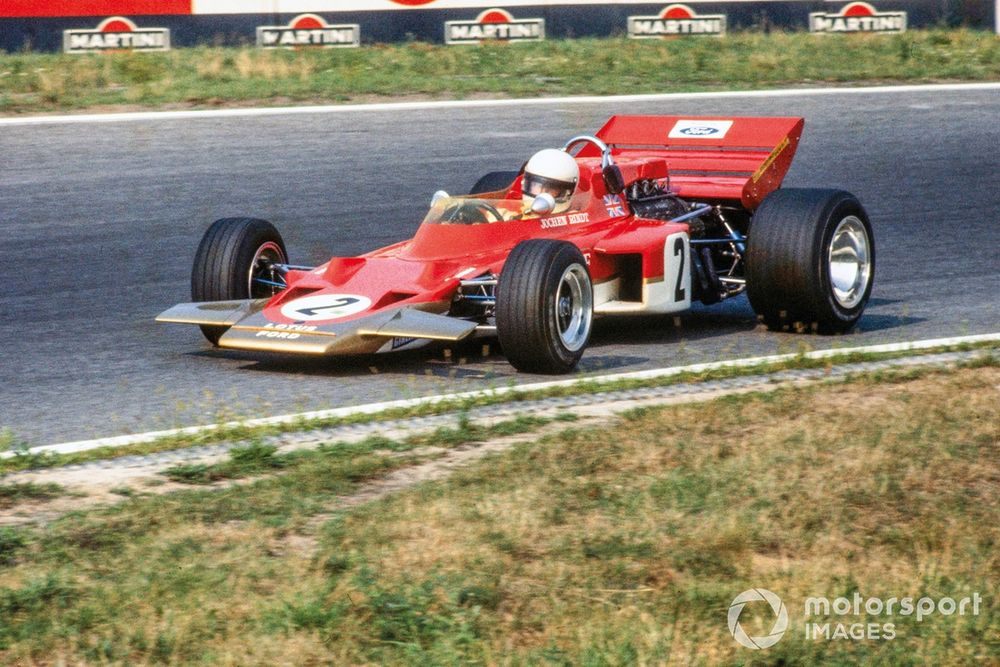
Photo by: Phipps / Sutton Images / Getty Images
Rindt is the only posthumous world champion, having scored enough points prior to his death during practice in the 1970 Italian GP not to be caught over the remaining four races. The Austrian drove both the Lotus 49C and 72 during the campaign while early bugs were ironed out of the wedge-shaped car that would go on to win a total of three constructors’ championships and two drivers’ crowns.
Emerson Fittipaldi
Titles: 1972, 1974
Lotus 72D

Photo by: Schlegelmilch / Getty Images
Fittipaldi became the first Brazilian world champion in 1972. He scored four GP wins in chassis 72/5, which Classic Team Lotus restored four decades after Fittipaldi’s nasty crash at the 1973 Dutch GP. His first world championship race victory, in just his fourth start, came in this car at Watkins Glen in 1970, and he added the 1972 Austrian and Italian GPs and 1973 Spanish GP in 72/5. His final Lotus tally was nine victories before he headed to McLaren in 1974 to add another title in the M23.
Jackie Stewart
Titles: 1969, 1971, 1973
Tyrrell 006

Photo by: Phipps / Sutton Images / Getty Images
Stewart’s 1973 campaign, in which he took his third crown against arguably faster Lotus and McLaren opposition, remains one of F1’s finest. And all five of his wins that season came in the Derek Gardner-designed 006, which is now part of Sir Jackie’s collection. One of those successes came from 16th on the grid at Kyalami, while the final one – at the Nurburgring – was Stewart’s 27th world championship GP win, a record that would stand until Alain Prost surpassed it in September 1987.
PLUS: The 10 greatest races from Britain’s best F1 driver
Niki Lauda
Titles: 1975, 1977, 1984
BRM P160

Photo by: Schlegelmilch / Getty Images
Lauda is a Ferrari and McLaren legend, having taken two titles with the Italian team before retiring, then coming back to pip McLaren team-mate Alain Prost to the 1984 crown by half a point. He first grabbed the attention of F1 figures driving for BRM in 1973, his holding down of third place at Monaco ahead of Jacky Ickx’s Ferrari reportedly attracting the eye of Enzo Ferrari, who signed him for 1974.
James Hunt
Title: 1976
McLaren M26

Photo by: Phipps / Sutton Images / Getty Images
No, your eyes are not deceiving you. This is a McLaren M26 and not the M23 that Hunt took to his world title in a 1976 season that was so dramatic it was (eventually) picked up by Hollywood for the film Rush. But Hunt did drive the M26 for most of his title defence in 1977 and chassis 2 is an appropriate car to have at the Festival. It was in this McLaren that Hunt scored a popular home victory in the 1977 British GP at Silverstone – and he would use it to win the US GP before switching to another chassis to take his third success of a topsy-turvy season in Japan.
Mario Andretti
Title: 1978
Lotus 79

Photo by: Phipps / Sutton Images / Getty Images
Another of Colin Chapman’s innovations, ground effect arrived with the Lotus 78 in 1977 but it was with the Lotus 79 the following year that the team really made it stick. Chassis 79/3 was the car used by Andretti for much of his 1978 title-winning season, scoring wins in it in Spain, France and Germany. Although used as a T-car in 1979, 79/3 also took pole for the Brands Hatch Race of Champions that year, with Andretti finishing third.
Jody Scheckter
Title: 1979
McLaren M19A

Photo by: Phipps / Sutton Images / Getty Images
South African Scheckter took his F1 title with Ferrari in 1979 and also scored wins with Tyrrell and Wolf, but he started his F1 career with McLaren. M19A-1 had already been driven by Hulme, Peter Gethin, Jackie Oliver, Mark Donohue, David Hobbs, Peter Revson and Brian Redman (!) when Scheckter made his world championship debut in the DFV-powered McLaren at the 1972 United States GP. He qualified eighth, quickly rose to third and finished ninth before the busy car had a new life in F5000, fitted with a five-litre Chevrolet V8. Subsequently returned to F1 specification, the McLaren resided in Scheckter’s personal collection until recently and will provide an unusual look in the Festival line-up.
Alan Jones
Title: 1980
Williams FW07B

Photo by: Schlegelmilch / Getty Images
Patrick Head was one of the first designers to truly grasp how ground effect could be optimised in F1 once Lotus had shown the way. The FW07, designed with Neil Oatley and Frank Dernie, arrived in 1979 and was the fastest car in the second half of the season. The updated FW07B was the car Jones used for most of his 1980 campaign, in which he beat Brabham’s Nelson Piquet to the crown with five victories.
Keke Rosberg
Title: 1982
Williams FW08

Photo by: Schlegelmilch / Getty Images
Following Jones’s shock retirement, Rosberg was handed his big chance at Williams. The Finn grabbed it with typically enthusiastic gusto and, despite turbocharged rivals leaving him behind in qualifying, Rosberg’s race charges were a highlight of a roller-coaster 1982 season. He scored only one victory but took the title by five points. The Silverstone car is the first FW08 built and Rosberg drove it in three GPs, including at the Osterreichring, where he finished second to the Lotus of Elio de Angelis by just 0.050 seconds in one of F1’s closest finishes. The car was then rebuilt as the six-wheeled FW08B before that avenue was banned, and has been campaigned in historic racing this century in its original – and more familiar – four-wheeled configuration.
Alain Prost
Titles: 1985-86, 1989, 1993
McLaren MP4/2B

Photo by: Ollie Read
Prost ended his wait for the F1 title in 1985 and drove this car, chassis MP4/2B-3 to victory in the Austrian GP that season. The Frenchman would successfully retain his crown with one of the great F1 campaigns in the MP4/2C before adding more titles in 1989 (MP4/5) and 1993 (Williams FW15C).
Nelson Piquet
Titles: 1981, 1983, 1987
Williams FW11B

Photo by: Schlegelmilch / Getty Images
Piquet was the first world champion signed by Williams (as opposed to drivers who became champions at the team), having taken the 1981 and 1983 titles with Brabham. He famously found new team-mate Nigel Mansell rather tougher opposition than expected and the battling duo allowed Prost to pip them to the 1986 crown. But the Head/Dernie-designed and Honda-powered FW11B set the pace again in 1987. Despite Mansell winning six times and Piquet suffering from the after-effects of a big crash at Imola in May, the Brazilian’s consistent campaign and three victories netted him his third world crown.
Ayrton Senna
Titles: 1988, 1990-91
McLaren MP4/4

Photo by: Muel/ TempSport / Corbis / Getty Images
After three years being close but not close enough with Lotus, Senna joined Prost at McLaren in 1988 to form an F1 superteam. The Honda turbo-powered MP4/4 was by far the season’s best package, winning 15 of the 16 races, Senna taking his first title with eight victories to Prost’s seven. MP4/4-1 was driven by both legends, winning the San Marino GP in Senna’s hands. Perhaps more importantly for most fans of the Brazilian, though, is that it was also the car in which Senna experienced his highest high and lowest low of 1988. It was in this MP4/4 that Senna took his famous Monaco pole position, 1.427s quicker than Prost, but also the one he crashed out of the lead on race day.
PLUS: Ayrton Senna’s 10 greatest Formula 1 races
Nigel Mansell
Title: 1992
Williams FW14B

Photo by: Sutton Images / Getty Images
One of the most popular F1 designs of all time, the Williams-Renault FW14B was the car in which Mansell finally took the title he deserved in 1992. The gizmo-laden Williams, with traction control and active suspension, was the first of Adrian Newey’s championship-winning cars and Mansell took nine victories in 1992. One of his 1992 cars will be at Silverstone and it could be chassis 8, in which Mansell took five straight poles and wins at the start of the season.
PLUS: Nigel Mansell’s greatest F1 and Indycar drives
Michael Schumacher
Titles: 1994-95, 2000-04
Benetton B191

Photo by: Colombo / Studio Colombo / Getty Images
Before Schumacher became a seven-time world champion, taking two titles with Benetton and five with Ferrari, the German had been the subject of a battle between Jordan and Benetton. Following his impressive debut for Jordan at the 1991 Belgian GP, Schumacher was prised away to Benetton by Flavio Briatore and drove chassis B191-02 in the Japanese and Australian GPs at the end of the season. He failed to finish either race, but the 3.5-litre Cosworth Ford HBA5 V8-powered car had already been a winner: this was also the Benetton in which Piquet scored his 23rd and final F1 victory following Mansell’s last-lap retirement in Montreal.
Damon Hill
Title: 1996
Williams FW18

Photo by: Schlegelmilch / Getty Images
Hill became the first son of a world champion to take the F1 title himself in this car. Newey’s FW18 was the first F1 machine in which Hill felt comfortable, and he reeled off eight wins and nine poles from 16 rounds to beat rookie team-mate Jacques Villeneuve to the crown. Villeneuve added four wins and three poles, making this underrated Renault V10-engined car one of the most successful Williams racers ever.
PLUS: Damon Hill’s 10 greatest Formula 1 races
Jacques Villeneuve
Title: 1997
Williams FW19

Photo by: Schlegelmilch / Getty Images
Villeneuve qualified on pole for the 1997 season opener, 1.8s clear of team-mate Heinz-Harald Frentzen and a staggering 2.1s faster than the best non-Williams. The Canadian’s campaign got harder from there as Ferrari’s Michael Schumacher challenged, but Villeneuve still became Canada’s first world champion after surviving that dramatic final-race clash with Schumacher at Jerez. The FW19 is the last Williams to have won a title, having scored eight wins and the constructors’ crown to go with Villeneuve’s drivers’ success.
Mika Hakkinen
Titles: 1998-99
McLaren MP4-14

Photo by: Schlegelmilch / Getty Images
Hakkinen had to wait until his 96th F1 start – the 1997 European GP remembered for the Villeneuve-Schumacher clash – to win, but was the man to beat the following year. McLaren nailed the switch to the narrow-track, grooved-tyres regulations and Hakkinen scorched to eight wins and the title despite concerted attacks from team-mate David Coulthard and Schumacher. The 600kg/800bhp 1999 car was trickier to drive – as shown by Hakkinen throwing away possible wins at Imola and Monza – but still fast, and Hakkinen pipped Ferrari’s Eddie Irvine by two points to retain his crown. Chassis MP4-14A-1 was taken to two victories by Hakkinen in 1999: the Hungarian GP and the Japanese GP finale in which he clinched the title.
Fernando Alonso
Titles: 2005-06
Renault R25
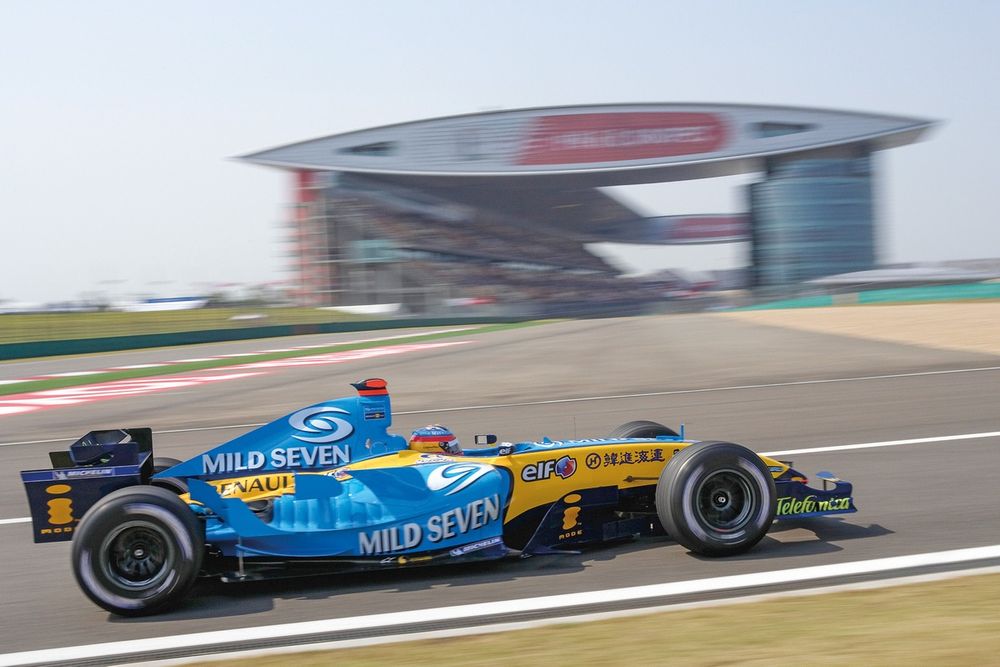
Photo by: Schlegelmilch / Getty Images
Alonso became the youngest F1 world champion at the time – and Spain’s first – when he ended Schumacher’s run of titles in 2005. In the last year of V10s filling the grid, the rule change banning tyre stops hurt Ferrari and Bridgestone, and Renault battled McLaren at the front of the field. Alonso took the R25 to seven wins to beat McLaren’s Kimi Raikkonen to the title, while Renault defeated the Woking squad by just nine points in the constructors’ table.
PLUS: Fernando Alonso’s 10 greatest F1 races
Lewis Hamilton
Titles: 2008, 2014-15, 2017-20
McLaren MP4-23

Photo by: Schlegelmilch / Getty Images
McLaren and Mercedes both wanted to bring ex-Hamilton machines to Silverstone, and who can blame them? The most-successful driver in F1 history, with 105 wins, took his first title in dramatic circumstances on the final lap of the 2008 Brazilian GP finale. His fifth place ensured he beat Ferrari’s Felipe Massa by one point. Hamilton took five victories and used several cars during the 18-race campaign, including chassis 5, which will be at the Festival.
Lewis Hamilton
Mercedes W11

Photo by: Thompson / Getty Images
Arguably the fastest F1 car of all time, the W11 represents the peak of Mercedes performance before aero rule changes started to clip its wings. In the COVID-hit 2020 season, Hamilton won 11 of the 15 races he started in the car that featured the Dual-Axis Steering system, which helped with tyre warm-up. He also set a still-unbeaten F1 pole speed record, averaging 164.3mph at Monza.
Jenson Button
Title: 2009
Brawn BGP 001
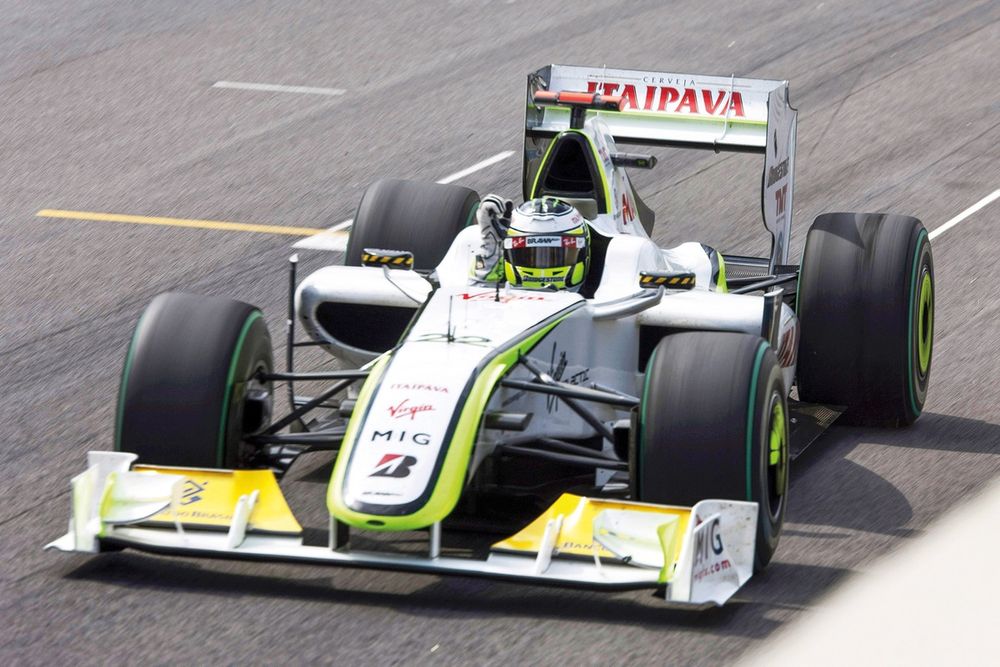
Photo by: Heath / Getty Images
One of F1’s great phoenix-style stories arrived in 2009 as Brawn GP emerged from the defunct Honda team following a management buyout led by Ross Brawn – and shocked the field by winning both titles, helped by the controversial double diffuser. Only three BGP 001s were built and chassis 2, which will be at Silverstone, is the one to have; it was used by Button throughout the campaign. That means it’s the Brawn that Button took to six wins in the first seven races of 2009 and used to charge from 14th to fifth in the penultimate round at Interlagos to seal the crown.
Sebastian Vettel
Titles: 2010-13
Red Bull RB8

Photo by: Schlegelmilch / Getty Images
Adrian Newey-designed Red Bulls and Vettel scored four consecutive title doubles from 2010 to 2013. The 2012 season was the closest of the period, with eight winners from six different teams, but Vettel came out on top. Having scored five wins with the RB8, Vettel’s charge from the back to sixth after an early clash at the Interlagos finale was enough to pip Ferrari driver Alonso by just three points.

Nico Rosberg
Title: 2016
Mercedes W07

Photo by: Schlegelmilch / Getty Images
Rosberg spent much of his career playing second fiddle to Hamilton and was runner-up to his team-mate in 2014 and 2015 as Mercedes thrashed the opposition in the early years of the turbo-hybrid formula. But the son of Keke Rosberg kept battling and a combination of fine performances, misfortune for Hamilton and poor starts from the Briton meant the German went to the Abu Dhabi finale with a 12-point margin. Despite Hamilton trying to back the second W07 into the pack and having to battle Max Verstappen, Rosberg held his nerve to take second and his only F1 title by five points. He promptly retired.
Max Verstappen
Titles: 2021-24
Red Bull RB18

Photo by: Hone / LAT Images / Getty Images
Red Bull and Verstappen set the pace in the early seasons of F1’s second ground-effect era. After a strong start from Ferrari in 2022, Red Bull came on strong and a lighter and better RB18 swept all before it, Verstappen taking his second title with 15 wins. Like Alpine, McLaren, Mercedes and Williams, Red Bull is supporting the event and will bring along one of Verstappen’s RB18s, as well as the Vettel RB8.
This article is one of many in the monthly Autosport magazine. For more premium content, take a look at the September 2025 issue and subscribe today.


How the M8B became the most dominant car in McLaren’s history

Employing team orders can simply be a matter of common sense

The greatest F1 campaigns with no wins

Top 10 F1 results changed by backmarkers – the passes

Top 10 F1 results changed by backmarkers – the clashes

Stars, cars and highlights from the 2026 Goodwood Revival

The Egal has landed – again

Autosport magazine: Antonelli and a Can-Am celebration

How levelling the playing field isn’t antithetical to the principles of F1

The maths behind when Mercedes could become F1 world champions in 2026

WEC Barcelona: Genesis secures maiden series pole from Toyota

What drives Bortoleto as his junior rivals hit new heights in F1
Subscribe and access Autosport.com with your ad-blocker.
From Formula 1 to MotoGP we report straight from the paddock because we love our sport, just like you. In order to keep delivering our expert journalism, our website uses advertising. Still, we want to give you the opportunity to enjoy an ad-free and tracker-free website and to continue using your adblocker.


Top Comments